Wonders never cease: South Korea’s population rose in 2023 after a few years of decline. The reason is immigration. The number of Koreans continued to decline and the average age to rise.
"”There has been a great deal of discussion regarding the proportion of elderly people, and measures have been targeted there. At the same time, the situation of younger people has received less attention in the discussion and in political priorities. This is worrying from a long-term perspective, because if one does not get into work at a young age, it is difficult later on as well”
The rise in the average age of voters is evident here too. What does it do to the economy and economic growth in general when those at the age of moving out and starting a family are not becoming employed?
A “babies now or things will go south” story from Yle. It lists four different options for securing the pension system:
Raising the retirement age
70-year-olds would probably have a hard time finding employment, and the jobs they would still be suited for are quite limited.
More immigrants
Those who move to the country now will burden the pension system in the future. We would either need the native population to reproduce significantly more, or the flow of migration would have to continue steadily until the end of time. All other Western countries are competing for the same immigrants.
Increasing pension contributions
This is equivalent to weakening the purchasing power of employees. Already, a quarter of the annual salary goes toward pension contributions; one month’s worth comes from the employee’s share, and two are paid by the employer.
More babies
The most difficult option of all to implement through political decisions.
Cutting pensions was also brought up at the end of the article, but for some reason, it didn’t make it into the voting options. Are current retirees too large a voter bloc? Will they soon cut YLE’s funding if one were to suggest such a thing?
You are clearly aligned with Bismarck It was on his initiative that just a moment ago (1889) a law was passed where the general retirement age became exactly 70. A perfectly valid observation; after all, nothing has changed in people’s health, the physical strain of work, and such things since then.
It is a fairly common misconception that Bismarck’s law introduced a retirement age of 65:
If maintaining the pension system required a 1.3% increase in pension contributions, would the same result be achieved by a 1.3% cut to current pensions?
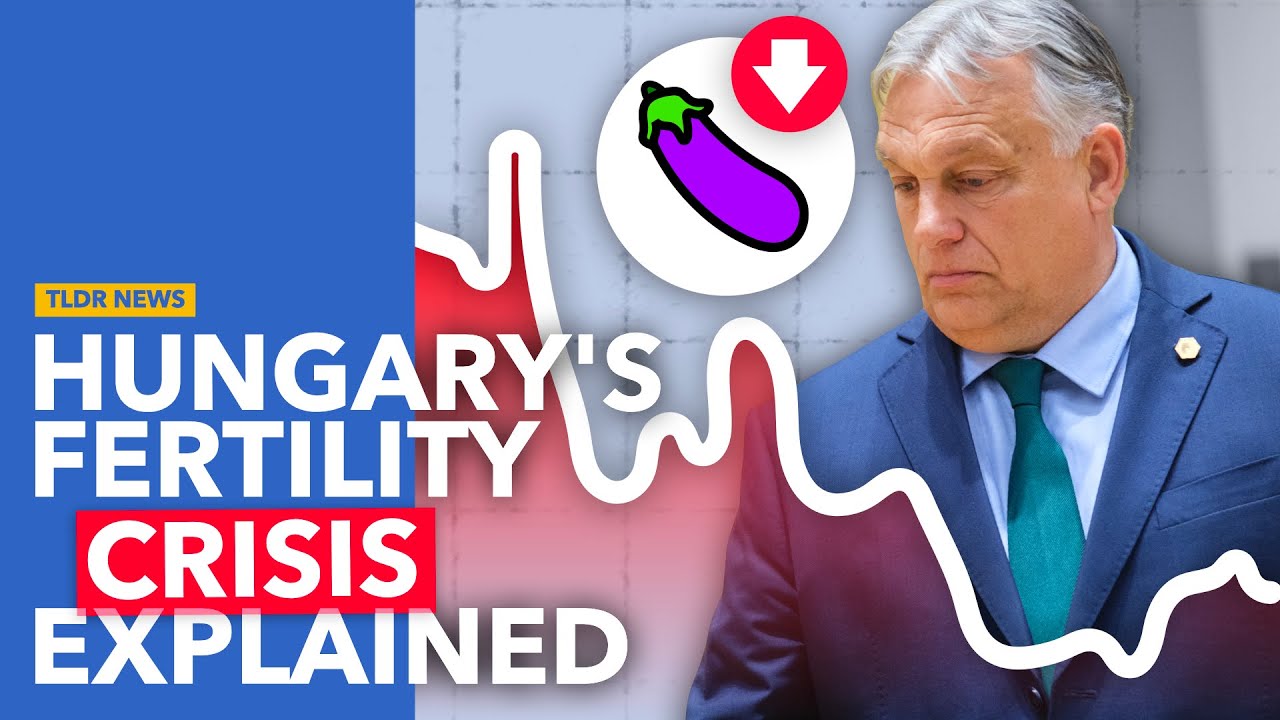
A video on how Hungary supports families with children and encourages childbearing with an amount equivalent to 5% of the country’s GDP, aiming to increase the fertility rate of Hungarian women to 2.1 by 2030.
There is financial support, tax cuts, and housing assistance for families with children.
It has had some effect; by 2022, the fertility rate rose above the EU average, but it is still far from the target, and in 2023 and 2024, it has started to decline again. One reason mentioned is that low-income earners do not benefit enough from the subsidies.
Due to these subsidies, other public services are withering away and the country is rapidly going into debt.
So, even if immigration causes costs in the short term, perhaps it is a better and faster way to get workers into the country than starting to encourage people to reproduce with financial incentives?
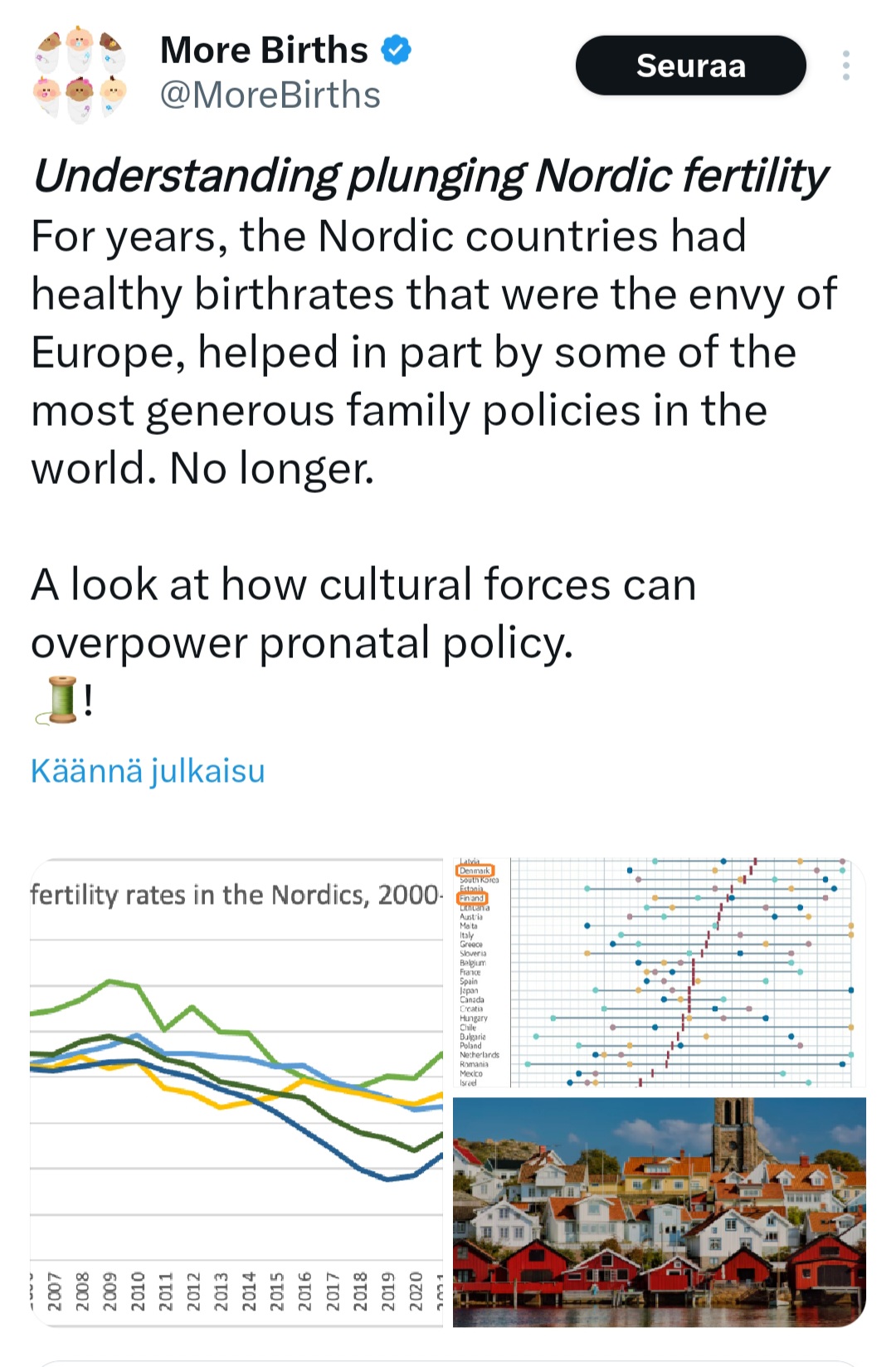
The low birth rate in the Nordic countries and its causes are the topic of this thread.
To give a bit of a spoiler, Finland is the worst of the worst. We should move from a single culture back to a family-centered (or family-friendly) one.
News about today’s European purchasing managers’ indices. Highlighting this for this thread because “It is certainly easy to list many challenges: Chinese growth and competition, higher energy prices, the green transition, transformation in the car sector, population ageing and a backlog in public infrastructure investment” population ageing is mentioned.
Russia is taking concrete measures, behavior encouraging childlessness is being criminalized: Кабмин поддержал законопроект о штрафах за пропаганду чайлдфри (tass.ru) (the link leads to TASS’s Russian-language site, translates into plain language with Google Translate, but a warning about cybersecurity is in order)
Here are a couple of interesting Twitter/X threads regarding population growth and decline. In short, Mongolia and Georgia have managed to reverse their declining fertility rates, and with relatively small financial investments. In both countries, the focus was on raising the cultural status of mothers in various ways. In Georgia, the Orthodox archbishop took every third child as his personal godchild, and in Mongolia, the president awards medals in a ceremony to mothers of large families (mothers of their 4th and 6th child). Perhaps in Finland, the mothers of the largest families could be invited to the Independence Day Reception (Linnan juhlat)?
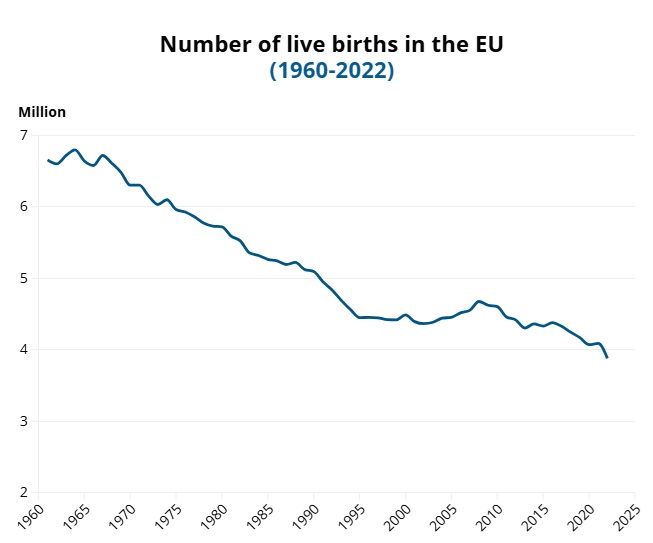
This is partly driven by the declining number of children across the EU. After all, it’s hard to find “better” consumers than families with children. People are willing to cut back on children’s well-being and quality of life last of all.
“Kela is suspending the tendering process for products for the 2026 maternity package. According to Kela’s press release, the reason behind this is the decline in birth rates: demand for maternity packages is lower than expected, meaning that fewer children are being born than anticipated.”
And there you can find the European equivalent. In the European pyramid, the cohorts entering working age each year are shrinking faster than in the US pyramid.
CNBC article on how China is trying to reverse its declining birth rate with tax breaks for parents, but the piece doubts their effectiveness as youth unemployment is at such a high level. Tax cuts don’t help much if income levels are so low that parents can barely take care of themselves. The article also compares birth rates, urbanization, etc., between China and the US.
Journalist Louise Perry predicts that the decline in birth rates will cause quite dramatic changes to society:
The elderly will be cared for privately, mostly within the extended family, and mostly by women. Healthcare for the old will be mostly palliative, and the only safety net for the poor and lonely will be provided by charities. Lifespans will shorten.
In other words
Elderly care will move to the private sector, mainly within the family, and mainly to the responsibility of women. Healthcare for the elderly will be mainly palliative care, and the only safety net for the poor and lonely will rely on charity. Lifespans will shorten.
The article is written from a British perspective, but the same arguments certainly apply to the whole of Europe.
Etla’s forecast for the development of Finland’s population and age structure seems more realistic than Statistics Finland’s “straight-line analysis”.
“Overall, Finland’s age structure will clearly age within one generation, i.e., by 2056, according to Etla’s forecast. At that time, the average age of the entire population will be 48.7 years according to the point forecast, which is 5.2 years higher for men and 4.4 years higher for women than at the beginning of 2025.”
It cannot be compared. At that time, population pyramids were pyramid-shaped; nowadays, they are downward-tapering pentagons. The Black Death decimated people from all strata, while the declining birth rate narrows the “pyramid” from its lower parts.
Democracy and the approaching average age of 55 for voters will ensure that the working-age population continues to be exploited through constitutional taxation for the benefit of the elderly population. That, combined with continuous education cuts, is certainly not conducive to creating economic growth; rather, it withers it and perpetuates a cycle of destruction.
Sitra’s views on the development trend of Finland’s population and economy: “According to a recent publication by Sitra, the Finnish Innovation Fund, Finland’s economic problems can be postponed by immigration, but it does not eliminate them. Sitra forecasts that the population will decrease in the long term, and at the same time, the population will age. The picture of future demographic development is, according to the forecast, ‘grim’.”
The same situation in the EU as in Finland, the population is growing due to immigration: “The population has grown for four consecutive years. Immigration is seen as the reason behind the population growth. Since 2012, the EU’s natural population change has been negative, meaning more people die than are born.”
 It was on his initiative that just a moment ago (1889) a law was passed where the general retirement age became exactly 70. A perfectly valid observation; after all, nothing has changed in people’s health, the physical strain of work, and such things since then.