With urbanization, many have their social support networks tens or hundreds of kilometers away, meaning grandparents, for example, cannot help with childcare. Additionally, living in the city is very expensive, so people cannot afford multiple children and large apartments. The entire world is urbanizing.
4 Likes
Even though the world is global, it is still not homogeneous. Wouldn’t it be worthwhile to study and take advantage of the differences between countries? For example, in Japan or South Korea, the practical effects of population aging will surely be visible before the same happens in Finland. And even though the trend is the same globally, in some countries it has happened even more sharply or even earlier.
Off the top of my head, I would imagine that toy and baby product manufacturers won’t be among the winners of the future. Furthermore, also outside of Finland, housing markets in small towns are likely to be quite bleak. I could imagine that demand for various home furnishings will also decline, as the older population has likely already acquired their sofas, beds, and televisions; while they occasionally need to be replaced, the cycle is likely slower than for working people in their 30s.
What then could be on the rise? Probably pharmaceuticals and healthcare at least, as well as the care sector. What else will the elderly of the future be doing? Watching TV at home, or hanging out in cafes? I don’t know. You would think that such things could be tracked and predicted using credit card data.
4 Likes
It probably depends on what they can afford. Since the income/standard of living of the elderly population is tied to the income level of the working population. Pensions and taxes are paid from those. If you have your own investments, they won’t be of much comfort if companies suffer from a labor shortage and customer numbers keep dwindling. The same, of course, applies to the investments of pension companies.
In my post, I meant that the economy will start growing from its low level, without taking a stance on where the workers will come from. However, there are good natural resources and fertile land there.
The problem is that the market likely already knows how to price those differences.
Well, I’ve seen an article where it was considered a problem that wealth is concentrated among retirees and pension companies and isn’t circulating. Now, following the aforementioned logic, the fact that the population is starting to shrink implies deaths, at which point the wealth transfers to someone else’s control. The Kondratiev cycle doesn’t explicitly say “spendthrift generation,” but the cycle is such that growth is first built by sowing in the spring, then growth happens in the summer, and the harvest is reaped in the autumn. That spring and summer are essentially two generations of building, followed by a third that blows through the money. As for the investment side, we just saw Munger’s passing as an example. Someone gets his wealth, and how will it be managed? When large amounts of money fall into “suitable hands,” they can go surprisingly fast, and the velocity of money changes strangely for a moment.
In Finland, the rise in life expectancy was a major problem for the pension system until COVID hit and life expectancy collapsed. Now, there has been silence on the matter.
I’ll just state here that predictions go quite wrong, and even if the population decreases, the amount of money doesn’t necessarily. The same money just accumulates for fewer people. What happens to it then is too early to predict at this stage. I personally suspect, however, that the biggest money will still accumulate in the best-yielding assets, just like before.
Yeah, it’s hard to take a stand on who will have enough money and who the money will end up with. I’m just thinking purely about demand. I would say that regardless of the velocity of money and its distribution, there is no demand for toys if there are no children. Correspondingly, there is inevitably demand for medicines and treatments that help with the ailments of old age. And if the population drops significantly, many homes will be left empty, and I believe these will mainly be located in sparsely populated areas, etc.
I would see that changes in the velocity of money or the concentration or distribution of wealth affect inflation more than which sectors the demand is directed towards. This obviously has a massive impact on what kind of returns can be expected on investments, but I don’t believe it has a very large impact on how those sectors I mentioned perform relative to the rest of the market.
To the next generation of retirees. Life expectancy in Western countries is somewhere around 80 years, meaning their descendants are approximately 50–60 years old when they receive the inheritance. Or then the inheritance ends up with the state if there are no descendants. Most of the inheritance consists of old apartments, which are entering the market all the time in greater numbers than there are young people in need of housing. Often also in a different location from where the need would be.
The assets of pension companies, on the other hand, do not transfer anywhere even if a retiree dies.
1 Like
In these long-term forecasts, it’s important to remember that they are just forecasts. Currently, birth rates have fallen to alarmingly low levels, but will the trend continue for the next 50 years?
People certainly still want children, but the responsibilities and costs that come with them, not so much. What if humanoid robots become cheap and tireless babysitters, or if the state offers a significant tax incentive as the number of children increases? Medicine already allows for starting a family at an age when, only a hundred years ago, people were at most looking at coffins. This development is unlikely to stop.
In my view, policymakers have a key role here in removing barriers to having children at a younger age. Society could be significantly more child-friendly, and in working life, children should not impose any costs on the employer.
16 Likes
I was also quite pessimistic about the subject, but I spotted this same observation somewhere. Technology can bring about surprising shifts in society, as has been observed so far. But while waiting for babysitting technology, a challenging gap may appear in the population pyramid—at least in some countries—as birth rates have time to plummet. If it doesn’t affect stock prices directly, it will at least drive up inflation as the cost of labor skyrockets due to a shrinking workforce.
3 Likes
If we assume that a turnaround occurs in 50 years, then about two age cohorts half the size of previous ones will have been born by then. The fertility rate rounded to approx. 1.0. First, the number of children halves, and then that half halves again. This means that at that time, there will be only a quarter of the number of women of childbearing age compared to now. Those currently of childbearing age would be retirees in 50 years, and thus four times the size of the group of childbearing age.
The equation simply doesn’t allow for women to be able to leave the workforce to have/care for children even to the extent that is currently possible.
If children were pushed from the maternity ward into the care of robots while mothers and fathers run societies and industry, what kind of adults would these children become?
5 Likes
Exactly. South Korea, for example, can no longer avoid a terrible catastrophe.
2 Likes
In their book Empty Planet (which is already about five years old), Bricker and Ibbitson review population statistics and interview experts around the world, concluding that even the low-growth scenario of the UN population forecasts is too optimistic and that, in fact, the population will soon shrink rapidly almost everywhere, except for a few African countries such as Benin. As I recall, they predict at least the following:
-
The downward trend is so powerful and global that it can no longer realistically be reversed.
-
We are now living in the “second American century,” and demographic trends benefit the United States. The opposite development in China will lead to a situation where, in 2100, the US population is 450 million and China’s is 560 million.
-
Migration from Africa (and the Middle East) to Europe will remain significant, but it will fade as the economic gap between the continents shrinks (with Africa rising and Europe simultaneously declining) and the share of the young population in the countries of origin decreases.
-
Western countries will have to choose between “Canadianization” (high immigration, loss of national identity) and fading away. Most will choose the latter.
The authors consider real estate around Lagos to be an attractive investment target, but otherwise, an investment perspective is not present in the book.
Predicting is notoriously difficult, but here at least an attempt has been made to model the future based on data.
15 Likes
CNBC news about the diamond industry’s troubles from this morning. I’ll quote a relevant excerpt for this thread:
"The demand for diamonds has declined as its allure fades in a key consumer market: China.
Declining marriage rates as well as growing popularity for gold and lab-grown gems all drove down Chinese demand for diamonds"
Diamond jewelry is associated with marriage intentions, and when those intentions are absent, the diamond jewelry stays in the jewelry store and people buy themselves a gold chain as thick as a broomstick.
In that part of the world, marriage is a sign of intent to have children.
3 Likes
Sweden’s population is growing by 15%. So, that’s where the money goes. Quote:
“Sweden has been supported by one structural advantage. From 2007 to the end of last year, Sweden’s population grew by 15 percent. Finland’s corresponding figure is six percent. Rule of thumb: population growth typically supports GDP growth.”
5 Likes
Jobs report May 2024: U.S. job gains totaled 272,000 in May (cnbc.com)
Strong labor market data just dropped again. More jobs were created than anticipated.
Correspondingly, here is a chart on the size of the U.S. working-age population:
It’s not growing—even though they’re bringing in young and fit folks from every corner of the globe. In fact, the working-age population has slightly decreased since the fall, by about half a million people.
When the number of job openings increases and the working-age population shrinks, I’d argue it limits national economic growth. How can microchip production be moved from Taiwan or car production from China to America if there’s no one to do the work?
2 Likes
Now just get AI to do those jobs quickly. At least there’s plenty of hype?
I came across a few interesting comments on X.
Berezin points out that JOLTS does not replace filled jobs, and at some point, it will start to show and be felt.
https://x.com/peterberezinbca/status/1799092923327246377?s=46&t=2ioRmPR9E06CY7pIWMMRqA
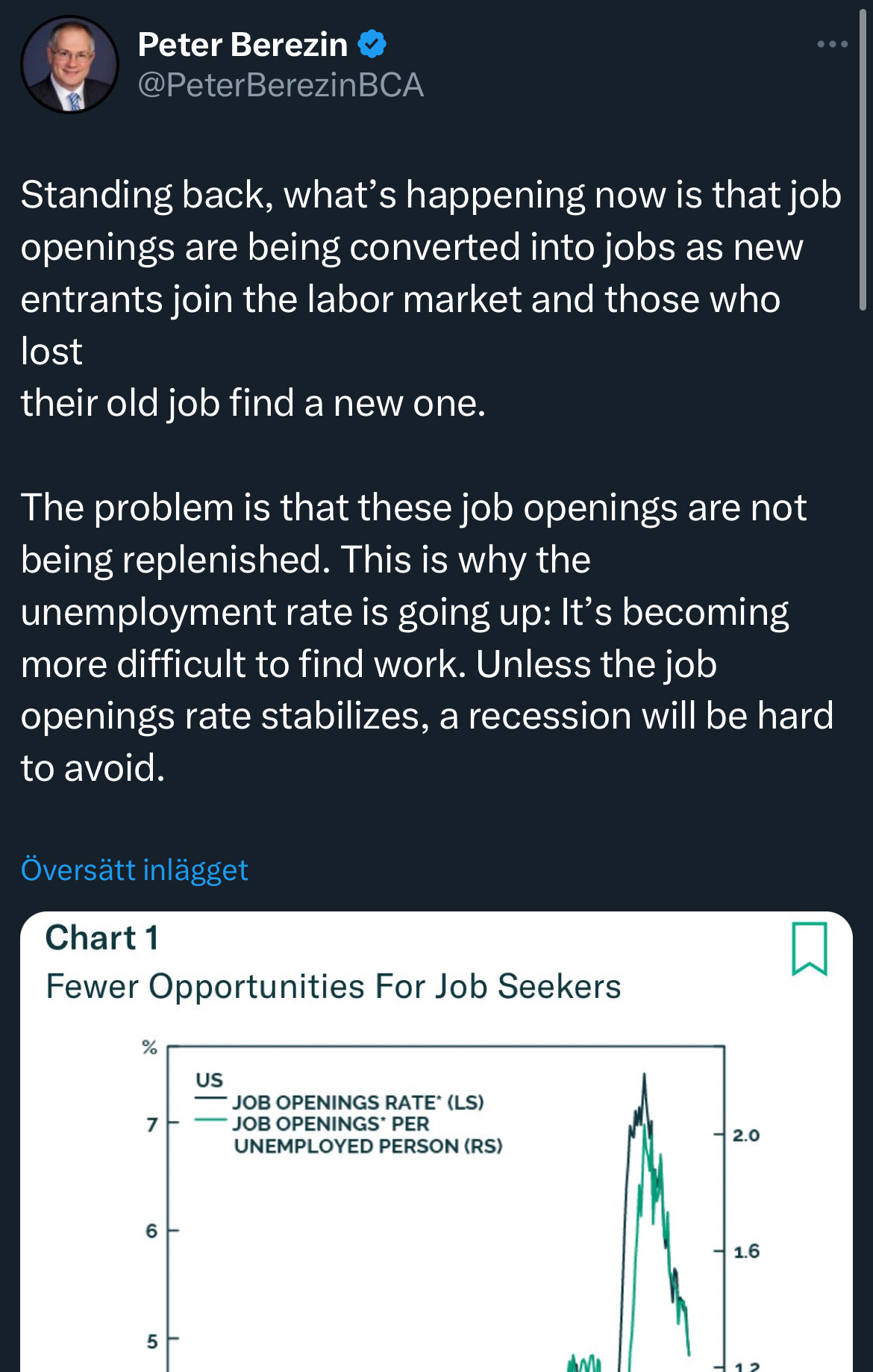
But there is a note under the tweet that the unemployment rate rose because some of those jobs were filled by immigrants. Immigration is decreasing and could collapse during a Trump term. That will be a tough nut for the Fed to crack, as wage inflation is rampant.
In another thread, it was discussed why two different surveys give a different picture of the labor market. BLS reported 270K new jobs, while the household survey showed a loss of 400K jobs.
https://x.com/schuldensuehner/status/1799061760718332006s=46&t=2ioRmPR9E06CY7pIWMMRqA
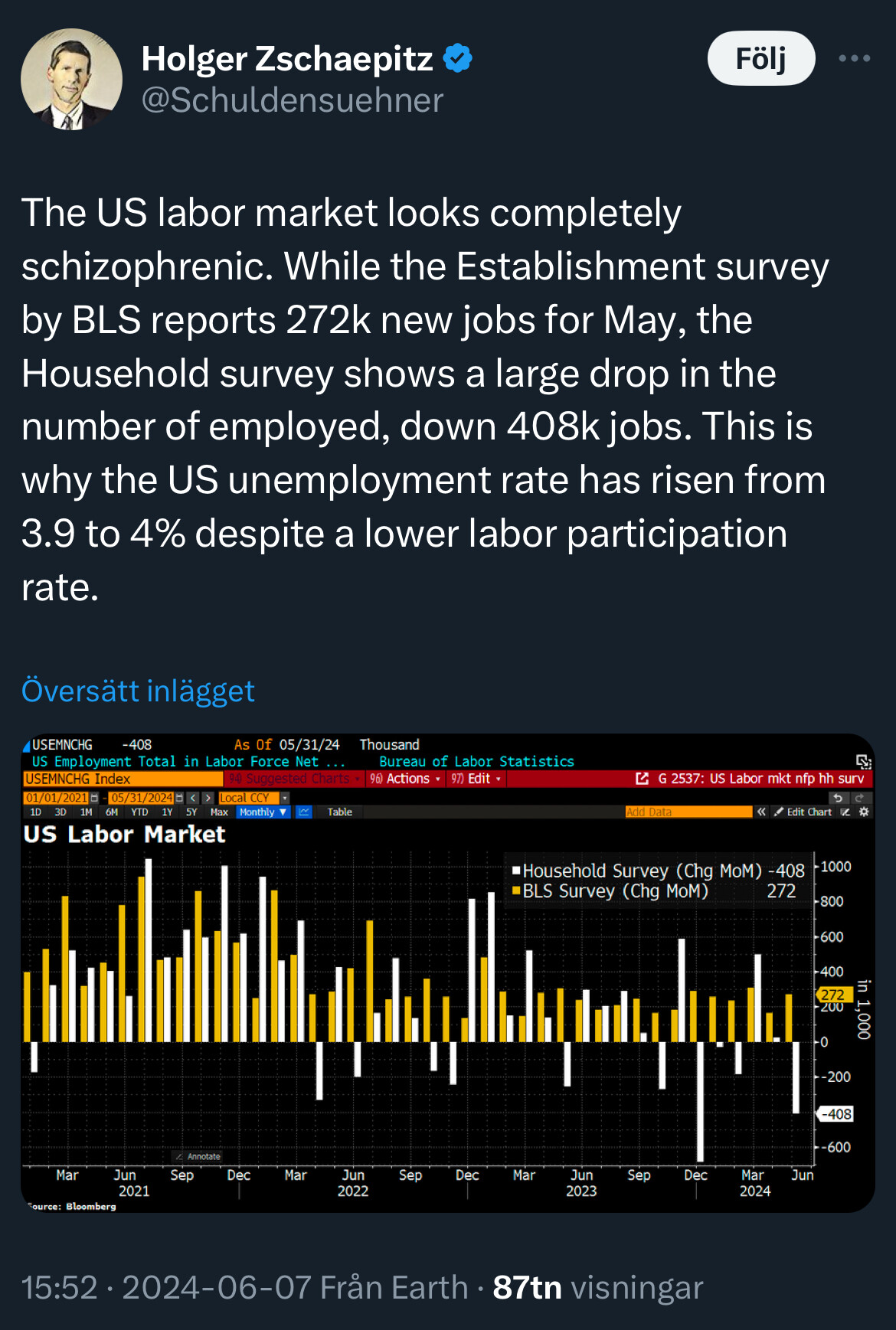
“Illegal immigration,” someone quips below. These have always diverged a bit.
7 Likes
A lot of fluff about a topic that is surely familiar territory for those who have read this thread this far, but here is one point that might not be considered:
“Berg says that the fewer children there are, the less motivation politicians have to invest in the birth rate.”
This could also be expanded: the fewer families with children there are among the electorate, the less it pays to fish for their votes. It’s useless to promise money for support for families with children when promising the same money for elderly services brings in more votes.
15 Likes
According to this, the difference between various birth rate forecasts translates to an annual difference of approximately 0.3 percentage points in GDP growth:

2 Likes