Foreign SaaS Companies

It’s not pleasant to invest in a company that is sliding down the drain day after day like :poop:.
ServiceNow’s valuation has sunk so low that even CEO Bill McDermott sent a message of encouragement to investors. The message is simple: The market doesn’t understand the company’s business. The company is a platform that benefits from AI and harnesses language models to solve customers’ problems.
Servicenow CEO pushes back AI fears

For us Finnish investors, a “truth-telling” CEO is a difficult concept, but let the company’s 14 years of impressive track record speak for itself.

I crunched some numbers from the investor relations pages and Yahoo Finance:
Revenue of $16B for 2026. Annual growth around 20% going forward.
For every dollar sold, 36-37% remains as free cash flow. So, a growth company that prints money with a really juicy margin.
The “P/E” ratio calculated from free cash flow is under 22.

Hopefully, by 2027, we can already laugh at the current SaaS dip and thank the CEO :trophy: :grinning_face_with_smiling_eyes:

11 Likes

Yep.

As you wrote, many SaaS players are falling from really high valuation levels and are still expensive.

This could be, in addition to AI fears, classic rotation within a bull market where chips are moved from previous winners into late-cycle plays like commodities, basic industry, etc.


I was also tossing around another thought over the weekend regarding these large software serial acquirers, like the Constellation family.

If a serial acquirer grows at 15% per year, in five years, half of the businesses will be five years old or younger. So, very new components within this company.

If disruption starts happening through AI, and unless it happens overnight, presumably these serial acquirers owning hundreds or even thousands of vertical niche software firms will simply allocate their cash flow to companies that are not being disrupted.

On the other hand, “one-trick pony” companies might be on thinner ice.

This is exactly what Constellation’s representatives have talked about. If something goes wrong, lessons are learned and capital is allocated elsewhere. For the entire model to break, practically all the companies would have to be disrupted and their cash flows destroyed at the same time.

13 Likes

SalkunRakentaja has written a story about ServiceNow that can be read in just a few minutes. :slight_smile:

The company’s CFO Gina Mastantuono stated to CNBC that the earnings performance proves the business’s strength is unwavering. According to her, ServiceNow is a unique player in the software industry.

The company’s CEO Bill McDermott emphasized in the earnings release that ServiceNow clearly exceeded fourth-quarter expectations and gave exceptionally good guidance for the year 2026. He emphasized the company’s strong position in the AI transformation.

Still, investors were not satisfied.

The reason can likely be found in the fact that the stock’s drop reflects broader uncertainty in the software industry and especially concern about the effects of AI on the traditional business models of software houses.

Subheadings:

  1. Strong position with cloud-based platform, AI at the core of growth
  2. Slowing growth causes concern
  3. Acquisitions raise questions
  4. The AI threat shadows the future
  5. Strong financial position provides support
  6. Customer satisfaction at a high level
  7. Stock has fallen sharply in a year
  8. Markets await clarity
6 Likes

Snowflake and OpenAI have entered into a multi-year $200 million partnership, bringing various OpenAI models to Snowflake Cortex and Snowflake Intelligence across different cloud platforms for approximately 12,600 customers.

The goal is to co-develop and sell AI agents to enterprises. However, security and governance will be handled through Snowflake.

“By bringing OpenAI models to enterprise data, Snowflake enables organizations to build and deploy AI on top of their most valuable asset using the secure, governed platform they already trust,” said Sridhar Ramaswamy, CEO of Snowflake.

https://www.investing.com/news/assorted/snowflake-and-openai-announce-200-million-partnership-agreement-432SI-4478979

3 Likes

The pace of disruption just keeps accelerating. An article from mid-January.

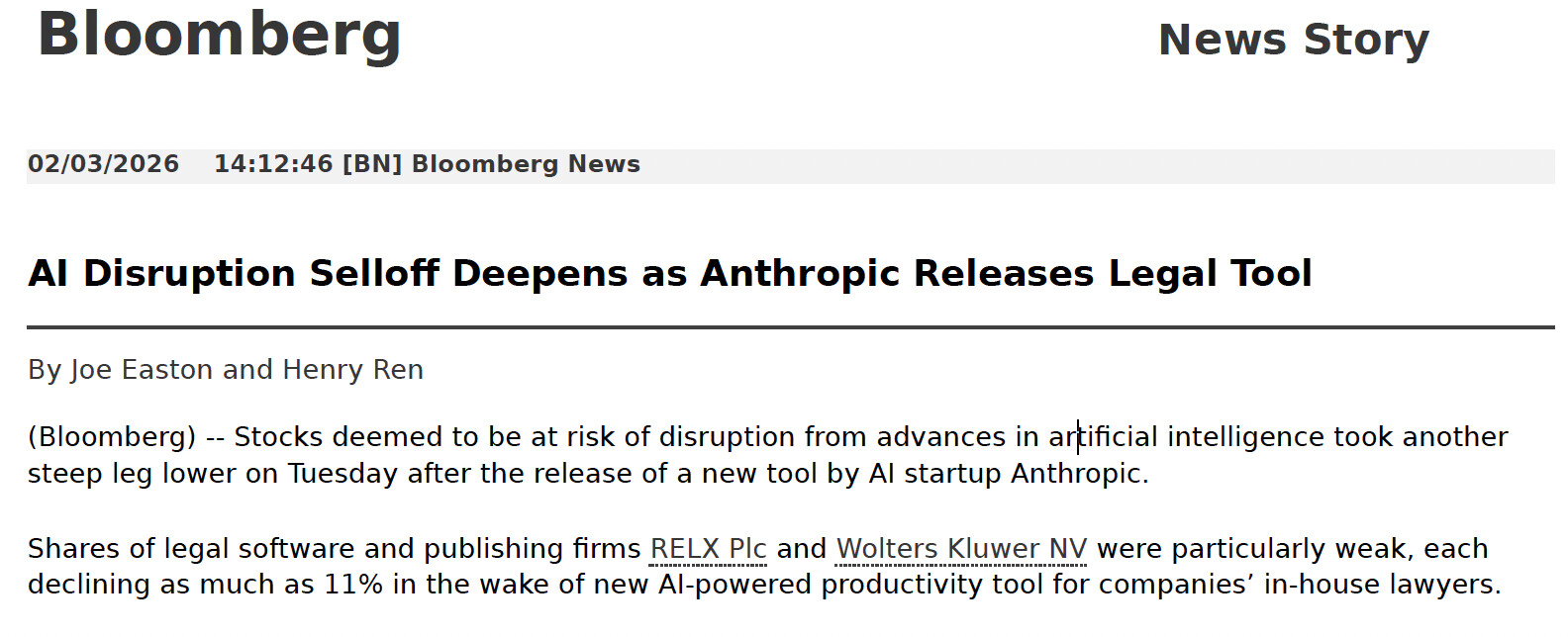
And now Bloomberg had a story about new Anthropic tools that are stepping on the toes of legal tech.

For years, I’ve been wondering if investors’ pricing philosophy for software and technology stocks has been wrong.

Traditionally, this sector has been valued highly because the cream of the sector listed on the exchange is characterized, in general terms, by a) high switching costs b) negligible investment needs c) recurring revenue d) high margins.

But, even if that is the case now, doesn’t technology change rapidly? No matter how profitably you’re raking in the cash, it doesn’t help if you’re “only” doing it for 10 years. In that case, future cash flows are wide but short-lived, and thus, in layman’s terms, the P/E ratio should be low rather than high.

AI disruption has begun to realize this idea more forcefully.

16 Likes

I still think it’s good to keep in mind that these products from Anthropic and others have only just been launched. How quickly will organizations actually adopt them? I suspect psychological legacy will be a bigger obstacle here than some might think.
You do hear from the executive suites of tech giants that users should be using AI more (= they believed in a faster change than what is being seen).

From my perspective, this mostly reminds me of things like Net Zero emissions 2030 targets; in some models, things have been made to work theoretically if everything goes perfectly. In reality, it might not go quite like that.

Edit: Of course, this could just as easily be a Nokia moment; personally, the SaaS sector doesn’t exceed 10% of my portfolio (excl. indices).

9 Likes

Good point, but investors don’t seem to be thinking about that much right now. :smiley:

“I ask clients, ‘what’s your hold-your-nose level?’ and even with all the capitulation, I haven’t heard any conviction on where that is,” Favuzza said. “People are just selling everything and don’t care about the price.”

9 Likes

I guess it depends on the investor :smiley: In my opinion, those Yahoo Finance news stories describe Mr. Market rather than investors.

As a contrarian investor, it feels quite good to gradually reduce my uranium/commodity weight into SaaS companies. The sector itself is new to me as an investor, but relatively familiar from everyday life. And I don’t really see these legacy systems being replaced by any Lovable product yet, at least :slight_smile: We’ll see what the numbers say, but I bet we’ll still see growth for (at least) a year or two. You can then play around with forward P/E or P/FCF figures and wonder at market movements at the same time.

Of course, you’re right that valuations (though they’ve already been corrected now) might never be the same again. But earnings growth of tens of percent for a couple of years makes a P/E 30 firm quite attractive. Their earnings don’t need to grow by 10% into eternity if they double in two years.

The future cannot be predicted, but here’s a quote from the article you linked:

While all software stocks have beaten earnings expectations, that’s mattered little in the face of concerns about long-term prospects

To me, this is nothing but music to my ears. Usually, it’s hard to buy cheap, because who wants to sell cheap?

6 Likes

Tableau CEO Ryan Aytay is leaving Salesforce after nearly two decades. He rose to the head of the data visualization unit in 2023 during the integration phase.

His departure has raised concerns in the market regarding executive turnover at the company. During his career, Aytay has been responsible for strategic partnerships, among other roles, and has served as a close advisor to Marc Benioff.

In his LinkedIn post, Aytay reflected on his 19-year journey at Salesforce, where he held various leadership positions including working in mergers and acquisitions, managing strategic partnerships with companies like Microsoft, Amazon, and Apple, serving as Co-CEO of Quip, Chief Business Officer for CEO Marc Benioff, and ultimately leading Tableau as CEO.

https://www.investing.com/news/stock-market-news/salesforces-tableau-chief-ryan-aytay-departs-after-19-years-93CH-4483354

2 Likes

So, I tossed that comment out with a bit of humor to describe the current sentiment.

I agree that excessive panic is more like music to one’s ears and is at least worth a look for a picker of falling knives. :wink:


A certain thought has also occurred to me regarding serial acquirers in the software industry. This applies to Constellation and its family (Topicus, etc.) and on the other hand, Sweden’s “discount Constellation” Vitec and so on.

If AI disruption starts to manifest concretely as the disruption of many software firms, companies that focus strictly on one thing or one customer base are on thin ice. Their core business is to make the customer’s life easier (or at least convince the company’s management that they are making it easier) through software. If some new AI-agile player does it better and manages to break into the customers’ pockets… it becomes tricky for future cash flows.

Serial acquirers’ businesses do that same thing, but the core business is actually capital allocation to where it produces the best returns. If one area is disrupted, no more capital is allocated there, and it’s directed elsewhere. AI disruption brings a massive number of new companies into the game, which can then be acquired.

If the disruption isn’t too fast, but rather slow, it’s business as usual for serial acquirers.

If a serial acquirer grows at 15% per annum, half of the businesses in-house will be “new” in five years. Relatively fast growth enables rapid renewal.

9 Likes

A good concrete example of AI disruption. “Google Zero” hits hard at businesses whose sales rely on internet traffic. Even though the popularity of the company’s product has grown, revenue has collapsed.

Tailwind CSS, a popular web developer tool, laid off 75% of its engineering team on Monday, with CEO Adam Wathan directly attributing the cuts to artificial intelligence’s devastating impact on the company’s business model. In a candid GitHub comment that quickly went viral in the tech community, Wathan revealed that three of the startup’s four engineers lost their jobs as AI fundamentally disrupted how developers use Tailwind’s services.

Founded in 2017, Tailwind operates on a freemium model with open-source core functionality and a paid “pro” tier that generates revenue. The company’s crisis stems from a paradoxical situation: while AI has made Tailwind more popular overall, it has simultaneously decimated the paid customer base. Traffic to Tailwind’s online documentation—the primary funnel for converting free users to paying customers—has plummeted 40%, while overall revenue has crashed 80%.

Wathan explained that AI’s ability to summarize and extract information without directing users to specific sites has effectively eliminated the traffic conversion pipeline his business relied upon. This phenomenon, sometimes called “Google Zero” in the media industry, represents a fundamental threat to businesses dependent on online traffic and user engagement.

The CEO spent the holidays conducting revenue forecasts and discovered the situation was “significantly worse than I realized.” Without immediate action, Tailwind would be unable to meet payroll within six months. The layoffs, while described as “brutal,” were necessary to provide generous severance packages to departing employees. The remaining team consists of three owners, one engineer, and one part-time employee.

The announcement sparked intense reactions across social media, with some critics blaming Wathan’s business strategy rather than AI. One user noted receiving only five promotional emails from Tailwind in 2025, to which Wathan admitted, “We don’t send enough email.” Others questioned the company’s reliance on selling UI components while free and AI-generated alternatives proliferated. Despite the criticism and his admission of feeling “like a failure,” Wathan maintains optimism about Tailwind’s future, clarifying the company remains “a fine business” with “lots of time and space to try new ideas.”

7 Likes

https://www.redeye.se/research/1147106/redeye-saas-update-saas-and-ai

6 Likes

This part sounded somewhat concerning. It seems we’ve got off easy so far, and small Nordic SaaS firms have declined in line with other small-cap companies. I’m looking forward to the AI panic properly spreading to small Nordic SaaS firms as well :sweat_smile:

Redeye Nordic SaaS index has declined by about 20% the last year, that is only slightly worse than First
North. However, both have underperformed significantly relative to OMXS30. Thus, perhaps the softness among
Nordic SaaS businesses is mainly due to general small-cap pressure rather than the fear of AI seen in the US.

Vitec stands out for its very soft performance compared to the others and the index. Although parts of
the explanation for Vitec’s underperformance and Pexip’s overperformance likely lies in their overall financial
performance, we believe Vitec is among the most well-known Nordic SaaS companies among international
investors. Thus, so far, it might be the case that international/North American investors have mostly put pressure
on Nordic SaaS based on the AI narrative, while the overall decline in our Redeye Nordic SaaS index is driven by
reduced exposure to small caps in general.

7 Likes

The WSJ article is behind a paywall. It generally discusses the recent slump of software firms.

But what caught my eye in the story was a reminder of how private equity has been stuffing portfolios full of software firms for the last 10 years. Naturally, with leverage, too. That’s why the AI disruption bill has ironically also hit large private equity firms, which are potentially sitting on piles of dynamite. Or rather, it’s their clients’ money that’s sitting there. :smiley:

Private-funds firms, which invested heavily in software equity and debt in recent years, also suffered in the selloff. Shares of Ares Management ARES -10.15%decrease; red down pointing triangle, KKR KKR -9.69%decrease; red down pointing triangle and Blue Owl Capital OWL -9.76%decrease; red down pointing triangle dropped more than 9%, while Apollo Global Management APO -4.76%decrease; red down pointing triangle and Blackstone BX -5.24%decrease; red down pointing triangle lost more than 4.5%.

Private-equity managers snapped up software companies over the past decade, often borrowing money from private-debt funds to pay for the buyouts. The flurry of deals left software as a significant slice of their investment portfolios.

Software was supposed to “eat the world,” as tech investor Marc Andreessen once predicted. And, until recently, the industry’s growth made for profitable investments. Now, with the industry under pressure from AI, some of those software holdings have drawn scrutiny.

“I don’t view this as a private credit or liquidity issue,” Jon Gray, Blackstone’s president and chief operating officer, said at WSJ Invest Live on Tuesday. “It’s the change happening in the economy. You could be an incumbent software company that’s the system of record and maybe you face risk from AI disrupters.”

https://www.wsj.com/finance/investing/software-slump-drags-down-private-fund-managers-6f840d0c?mod=hp_lead_pos1

Those PEs have been competing heavily with, among others, Constellation for acquisition targets. Perhaps the pressure will ease in the future…

10 Likes

Nvidia’s Huang dismisses fears AI will replace software tools as stock selloff deepens - https://www.reuters.com/business/nvidias-huang-dismisses-fears-ai-will-replace-software-tools-stock-selloff-2026-02-04/

The Godfather was already needed to calm the markets. There’s certainly a gut feeling that the baby is being thrown out with the bathwater here. If only one knew how to tell them apart. Must there be AI losers if there are AI winners? Surely the economy isn’t a zero-sum game. Verneri’s approach to this sell-off wave through Constellation is indeed nice and simple.

12 Likes

The most interesting cases are those that are AI winners, but which the market currently perceives as “AI losers.” If you find such cases, the return potential and margins of safety can be quite substantial. It is precisely in these types of market reactions that such diamonds can be found.

4 Likes

The same “treat” is being enjoyed by those companies (others besides serial acquirers and PEs) whose acquisition sprees are creating a risk of write-downs. There might be a couple of cases on our local exchange as well.

Whether babies or adults were thrown out with the bathwater, there isn’t much that can be done about it in accounting in the long run. Not everyone can act like real estate funds—putting redemptions on ice, putting their feet up, and spreading their hands while bemoaning the unrealistic price levels of buyers.

3 Likes

A small reality check: in a large public sector organization, a CRM developed in the 90s (sic) was still used until just a few years ago. The friction to move to new solutions is always high – as someone here already pointed out – no matter how good they are. Some large SaaS companies are starting to be priced as if they won’t grow at all in a year or two, but the reality is likely that many of them, despite AI, have years to milk the cow, making current valuations look quite low. Even an “AI loser” could be dirt cheap in such a scenario, not to mention those SaaS companies that are capable of adapting to the AI world. Let’s keep a cool head and carefully evaluate the sustainability of companies in the AI era; although it’s certainly not easy, let’s try.

17 Likes

Thanks for the great discussions above! Truly valuable opinions from both sides.

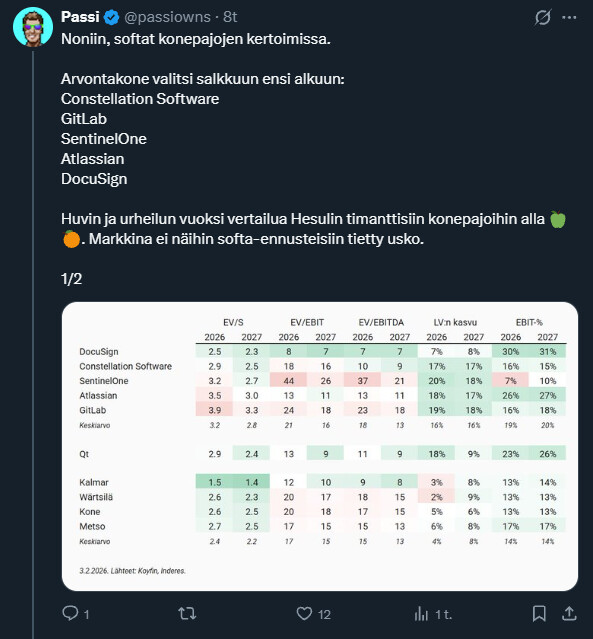
On another note. @Passi tweeted about his SaaS purchases. Since Passi always delivers guaranteed quality, it would be interesting to get even a few lines of the thinking behind these companies. I immediately checked the share prices (properly!) and they looked like quite textbook laggards, with the exception of CSU. I’m asking because I’m also eyeing SaaS companies myself. I try to pick high-quality (or at least formerly so) companies with a good track record over the last few years. It remains to be seen whether all these finds were just winners of the tech rally and are now being reaped by the grim reaper.

https://x.com/passiowns/status/2018923795814162636?s=20

If the embed doesn’t show, there’s a screenshot below.

Tweet as an image

11 Likes

“Quality” seems to be in the eye of the beholder, at least while watching the portfolio’s endless sideways crawling. But here goes:

DocuSign
The world’s eSignature standard, 50-60% market share. Integrated into all important enterprise products. Global regulatory moat (important—AI doesn’t disrupt this). Cheaper competitors have existed for ages; they haven’t eaten the market or margins. A free product from Adobe or Microsoft could be a risk eventually, though. The product costs a few tens a month per user—are billion-dollar firms really going to start saving on this and explaining to a Chinese supplier why they should trust some “AI-native” startup’s product in their contracts? The challenge is slow growth that looks like maturing; perhaps they could expand into complementary products.

GitLab
A developer platform (in nerd-speak, DevSecOps) for software development, a system of record that ensures code quality, security, and compliance are okay throughout its lifecycle. It contains the customer’s code, history, compliance, and a pile of other data. I.e., context. An “AI-native” competitor would have to start gathering this from scratch. Products like Duo already support consumption-based billing and augmenting human users with agent users. The pricing point is the same as Docu above: peanuts for the customer compared to the benefit/developer salaries. In Q3, NRR was still 119%! Microsoft is the only comprehensive competitor; Google and Amazon withdrew. It’s the 3rd largest in the portfolio of Gavin Baker, whom I respect.

Atlassian
A business process platform. Same arguments as GitLab. Data and context. 300,000 customers, 80% of the Fortune 500, 60% of the Forbes AI 50. Has been integrating AI into the product for 10 years already. Customers using AI agents have bought 5% more Jira seats than those who don’t use agents. So, at least for now, it seems AI increases rather than decreases the use of these tools. But will the pricing power remain? And on the other hand, Jira, for example, has never been a particularly loved tool. The most uncertain on my list.

SentinelOne
Cybersecurity. I understand the least about this company and its competitive advantages. But it sounds sexy. Read this in Steven Seagal’s voice: “Calm the chaos with the world’s most advanced AI cybersecurity platform.” Built for the AI world; for example, it scans AI prompts before they are executed. The numbers look good: current and new customers as well as new products are growing, profitability is scaling, and cash flow has turned positive. In Q3, sales +23%, number of $100K+ customers +20%. If a trash bag like WithSecure is bought for over 1 EV/S, then surely this should be worth at least 2. Peer CrowdStrike’s EV/S is 18 even in the middle of this slump.

Constellation Software
There are comments on this above. A serial acquirer/index/basket. I would assume they know how to pick good cases and bet on the future a bit better than me or anyone else on this forum. It’s a field day for software buyers now when nobody will touch these even with rubber gloves. As I understand it, they own many vertical firms (an example of this is our Admicom, which specializes in construction); I believe these will be more valuable/harder to disrupt in the future than horizontal software products.

There it is in brief. As a disclaimer, I have only familiarized myself with these superficially and picked them mainly based on my own software industry background/gut feeling + glancing at valuations. Only small entries so far. The plan is to also add those highest quality/most expensive software firms if we still come down significantly from here. Diversification with a shotgun approach. Focus on business-critical enterprise software; they aren’t replaced just like that because they are just damn complex environments and mistakes can cost companies hundreds of millions.

23 Likes