I’ve been following that myself, but considered it too risky. Speaking of foreign dividend machines, AT&T looks quite interesting with a 7% dividend yield. It was last at these dollar prices in 2011 (excluding the December 2018 dip and this spring). It’s a indebted company, of course, but it’s probably starting to be at buying prices.
They’ll definitely get them if there’s new Hollywood content to show. Soon these will start coming off the production line. Everything from Bond will come eventually. Then Plex will show sports, at least NHL. It’s funny that these are played without an audience but the audience can crowd into movie theaters xD
Plex’s CEO commented in the Q2 review that it’s not expected that big players will widely move to Premium Streaming. Disney’s Mulan, on the other hand, was pushed online and bypassed theaters. 30 USD and you can watch from your couch. I don’t know if that’s appealing. The movie experience is more than just the movie itself.
2 Likes
Oh right, it was only 50 / hall, not 50% / hall Well, you can still make some money with that, and one could almost assume that people in Canada would start to enjoy something like that, as the lockdown has been quite severe for a long time. I read somewhere that Plexi gave up on plans to bring golf halls to Canada, which is a sensible decision at this point, even though in a normal situation it would have been quite a profitable move.
AMC announced it would sell tickets for 15 cents each, I heard it in passing on CNBC, might be a mishearing…
Putting this here as well, Delivery Hero AG bought via Xetra
DHER raised guidance in July, but the share price has not yet been significantly affected.
https://ir.deliveryhero.com/websites/delivery/English/6150/news-detail.html?newsID=2007525
It seems to be replacing Wirecard in DAX30 next week, which will lead to support from fund purchases. While not as significant as in the US, being in the DAX usually helps.
https://www.marketwatch.com/story/delivery-hero-replaces-insolvent-wirecard-on-dax-2020-08-20-14851825
Delivery operations have seen increased demand due to restaurant closures, leading to new records in delivery volumes.
H2 will see expansion of operations in South Korea.
Analyst consensus is Buy / consensus TP 109€ - current share price is between 95-98€
https://www.marketscreener.com/quote/stock/DELIVERY-HERO-SE-36718506/consensus/
Negative points:
- operates at a loss
- the share price has already risen significantly during the year, valuation levels are high
- DAX will redefine requirements for index companies at the turn of the year - negative earnings could lead to delisting at that point
2 Likes
Update to the previous message, DHER is still at a loss and has a new acquisition
Delivery Hero acquires InstaShop - a leading online grocery marketplace in MENA - and publishes H1 2020 report
https://ir.deliveryhero.com/websites/delivery/English/6150/news-detail.html?newsID=2023151
H1 report
Does anyone here follow FLIR Systems Inc (NYSE) or have experience with the company?
I’ve tried digging a bit deeper, and the business seems quite good (thermal camera technologies).
I would somehow imagine that fever detection could fuel the market even further, and in my opinion, the Q2 numbers looked pretty good. I haven’t added it to my portfolio yet and would need a bit more insight.
There’s also the risk that cases will start to increase and restrictions will tighten again.
By the way, has anyone looked into Hasbro (HAS)? It’s a traditional toy and board game company. I did a traditional analysis and checked the toy shelves in different markets to see whose products were there. Hasbro had most of them. The stock has been relatively stable for the past 5 years and is still slightly in a COVID dip. But it will surely recover towards Christmas and with Q1. They pay a dividend of around 3.5%.
The indicators are currently quite neutral. The stock is in the middle of a tightening Bollinger Band, RSI is about 50, and MA50 is about 9% below MA200 and approaching it all the time.
https://finance.yahoo.com/quote/HAS?p=HAS

2 years:
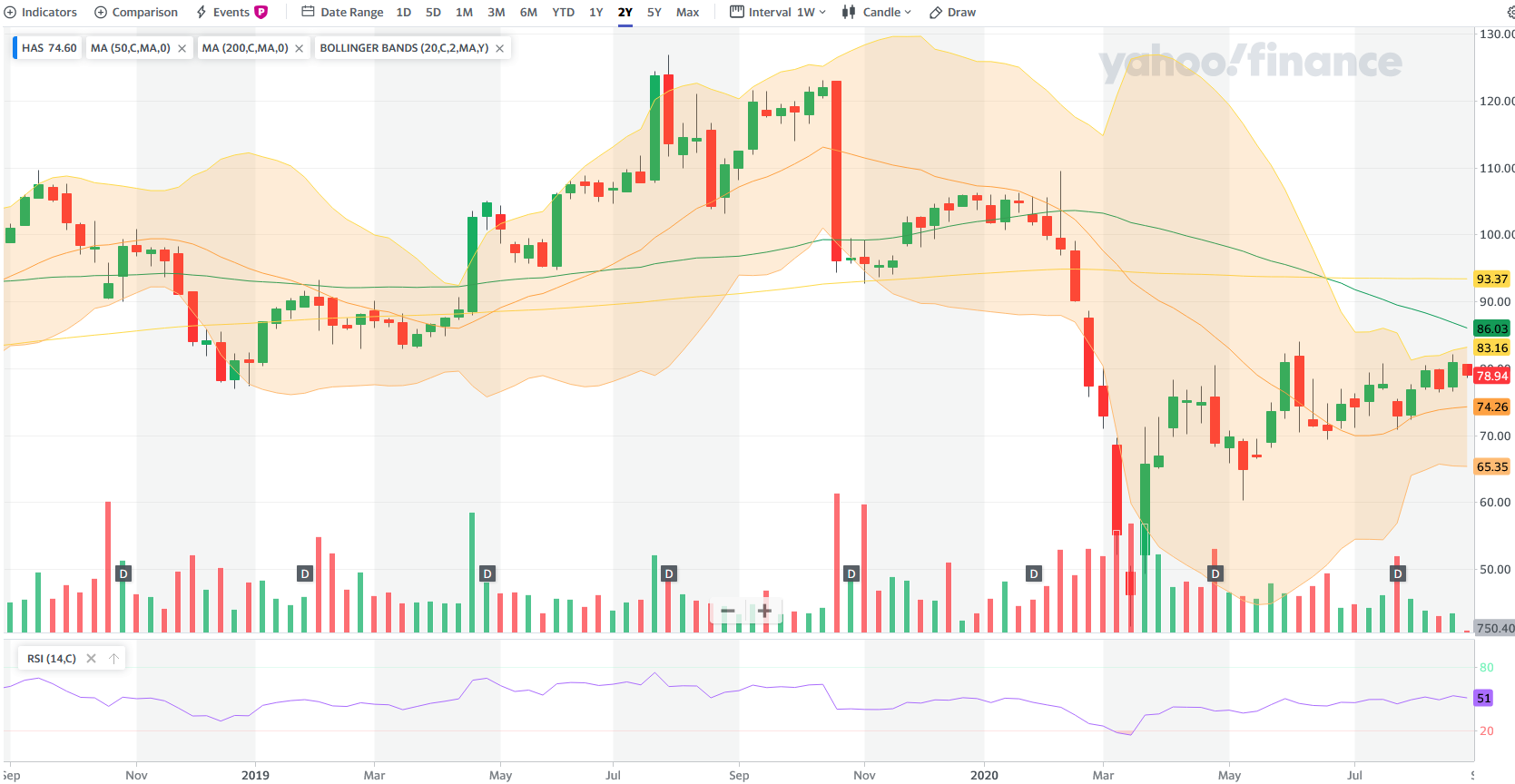
One peculiarity is that the biggest historical gains do not occur at Christmas, but in July. Do they have some unusual H1 reporting practice? For example, are Christmas sales results only reported in July?
2 Likes
Question about Shell shares, which are on my buying list. Shell shares seem to be listed on several different stock exchanges. So which of these shares should I buy…?
These topics have been discussed before; here are links to relevant sections.
2 Likes
I’ve bought Shell’s B shares on the NYSE because there’s no “room” on OST (Osakesäästötili - Share Savings Account) and I have low brokerage fees on the NYSE. The trading volume for B shares seems to be low on many exchanges, so it’s worth buying from the UK. So, no withholding tax is levied on B shares.
Edit: NEA already got there.
The correct answer still depends on the broker and whether it’s a regular investment account (AOT) or a tax-deferred investment account (OST). For an OST, you can’t have a currency account, so dividends are converted at poor exchange rates by some brokers. This is, of course, a lesser evil than withholding tax.
2 Likes
Quite an odd H1 report from Delivery Hero in terms of numbers.
Revenue grew by 87.4%. Gross profit, i.e., revenue minus direct costs of providing the service, did not grow at all! Instead, operating loss grew in line with revenue, by 89.7%. Operating cash flow was also 96.1% more in the red than in the corresponding period last year. Yet, the stock price has doubled over the year. These platform companies are completely beyond me.
The problem with these Wolt-style food delivery companies is that their business model is “extract money from ‘employees’ and restaurants,” and the initial “free delivery” to attract customers was literally done by burning money. The problem is that as soon as they move to more realistic costs (“order a ten-euro meal here and pay five euros for an underpaid guy to rush it to you”), demand disappears like a fart in the Sahara.
I don’t see much future for these companies without a business model change, more along the lines of “a basement kitchen running on cheap rent in an industrial area, churning out food for delivery with low overheads on an assembly line with high volume.” And it’s hard to imagine this type of restaurant operating in a way that is entirely dependent on an external platform and the risk of “we’re altering the deal.” As long as the normal restaurant rent and other costs are baked into food prices, then food + delivery + a cut for the platform company is simply too expensive.
4 Likes
The subscription service’s share comes from the restaurant’s portion. Usually, there’s a rule that the prices in the service must be the same as on-site.
As a service, these are truly unbeatable; our food orders for home or work have increased tenfold.
As a business, not so much. It’s hard to see how this will be resolved in a way that satisfies all parties. The delivery person’s share is already high for the customer but very small for the delivery person. For restaurants, these are pretty good deals, but for the platform company, 10-20% doesn’t seem to be enough for profitable results.
If you compare it to any other delivery business, transporting hot food is probably the most difficult. There are hundreds of starting points and hundreds of thousands of destinations. Because food needs to be delivered quickly and deliveries are random, shipments cannot be combined efficiently.
The problem is being tried to be solved with gray kitchens where the food margin goes entirely to the platform service. These save on rent because customer seating is not needed, and the space doesn’t have to be at street level in plain sight. The same kitchen and staff can handle the menu of several “restaurants,” which further reduces costs. Logistics also become vastly easier when pizzas, pastas, sushi, and burgers come from one place with good transport connections. A grocery store can also be added at the same time. For example, Wolt already has its own grocery store. When you can sell from a “wholesaler” to the end consumer without the expense structures of a store, one would think broad margins could be achieved.
I was looking into the performance of my Norway portfolio over different time frames and was puzzled when the euro-denominated value of the rows seemed disproportionate to the share price performance of the respective stocks, based on a mental calculation from yesterday. The reason became clear after glancing at the exchange rates: the Norwegian krone strengthened by a good percentage today. (And yesterday it weakened twice as much.)
https://twitter.com/FirstSquawk/status/1305455703574761472
Now you can invest in the world of RGB flashing lights!
(Corsair makes/manufactures e.g. power supplies, memory modules, SSDs, fans, cases, AIO cooling solutions, headphones, keyboards, mice… all kinds of PC peripherals. And of course, they all have RGB flashing lights!)
3 Likes
International Consolidated Airlines Group, S.A.
Fully Underwritten Capital Increase to Raise Gross Proceeds of €2,741 million
Key Highlights
• The Capital Increase to raise €2,741 million is designed to:
• enable IAG to strengthen its balance sheet and reduce leverage;
• enhance liquidity and help IAG withstand a more prolonged downturn in air travel based
on IAG’s stressed, downside scenario planning; and
• provide IAG with the operational and strategic flexibility to take advantage of a recovery in
demand for air travel.
If someone is wondering about a small dip in the stock today…
1 Like
Has LED iBond A/S been on anyone’s radar? I’ve been an owner right after the IPO when I read the listing prospectuses, and the stock curve has been quite a rollercoaster. It’s a Danish LED company that focuses on three segments: smart building, disinfection UV lights, and vertical farming.
Smart buildings currently account for most of the revenue, and the company supplies, for example, elevator lights to Thyssen and also has Swedish kitchen manufacturer Nobia as a client.
For the future, I’m more interested in the other two segments, disinfection UV lights and vertical farming, which I see as megatrends in some way.
This morning, it was nice to wake up to a 40% stock increase (65.61% at the time of writing) as the company announced a new deal for its spin-off company LED AVIATION with Vanderlande, where they will supply UV-C LED-based disinfection systems to airports. This is LED AVIATION’s largest single order, and it’s a good way to continue 
2 Likes