Foreign serial acquirers

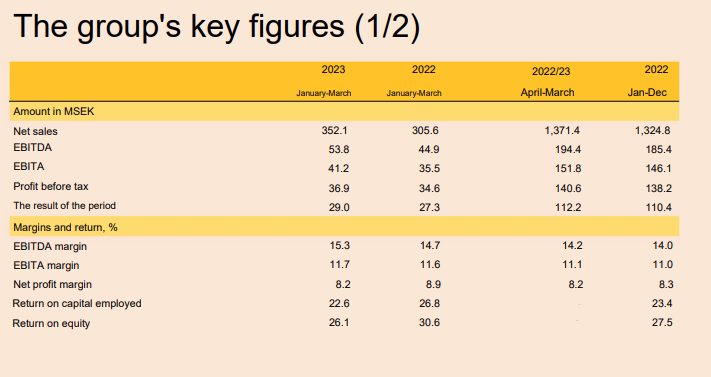
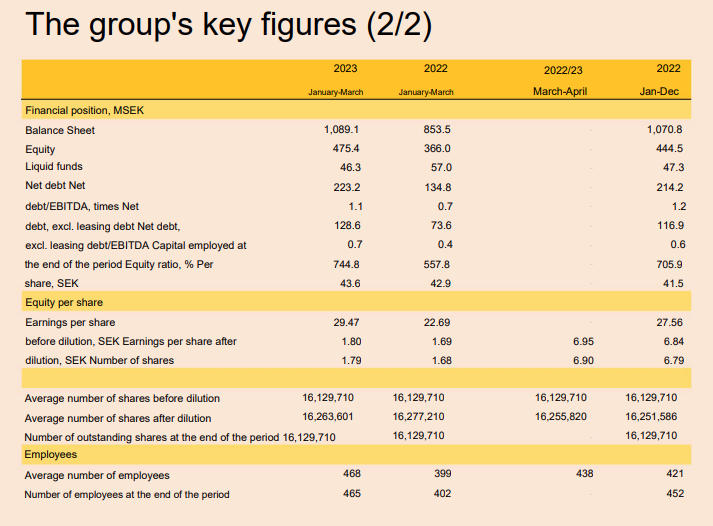
TEQNION AB (TEQ)

The idea originated from this message by @Crazy_Train. I haven’t gotten around to looking into it before, but here is a quick highlight so other enthusiasts can investigate as well :slight_smile: . I’ll try to supplement this post when I have the time!

Some of the information is from Yahoo Finance; I am not responsible for its accuracy. I am not yet a shareholder at the time of this post.

  • Swedish serial acquirer that listed in 2019.
  • Founded in 2006.
  • Aims to acquire stable niche companies with strong cash flow.
  • Supports the development of acquired companies; the organization is highly decentralized.
  • The company covers many industries → Recession-proof?
  • Four acquisitions in 2022.
  • Revenue more than doubled from 2019 → 2022.
  • Mcap approx. 250m EUR, and still plenty of room to grow.
  • TTM PE 30, so one can’t exactly call it cheap…

Company financial targets

  • Net debt/EBITDA <2.5
  • EBITA margin >9%
  • Double EPS every 5 years.


23’Q1 Q&A

9 Likes

Yep, I’ve actually owned this since last autumn. It seems that the involvement of a fund led by Chris Mayer (who wrote 100 Baggers, among others) created some Twitter buzz, and the share price took off quite sharply from that autumn (of course, the market did so in general too). Luckily, the worst of the rally has eased and we’ve even pulled back a bit. Perhaps I’ll end up adding more at some point.

Here is another article about the company: Teqnion - Standing on the Shoulders of Giants - by Bastiaan

The webcasts after the interim reports are indeed uploaded as recordings to their YouTube channel; they often feature good questions, and the majority of the time is reserved for them. If you check the one linked by Ituhippinen and a few previous ones, you’ll be pretty well up to speed on what’s going on.

Additionally, Teqnion’s M&A manager Daniel Sun Zhang has written a book called An Investment Thinking Toolbox, regarding which he was also a guest on Redeye’s podcast: Investing by the Books: #11 Daniel Sun Zhang: An Investment Thinking Toolbox I ordered and read through that book as well, and felt it was a nice addition to the shelf :slight_smile:

Teqnion’s numbers have been wildly flattering, but they face the same dilemma as many other serial acquirers: how to scale growth from here onwards? As I understand it, acquisitions currently rest entirely on the shoulders of Daniel and CEO Johan Steene. I suppose things will keep rocking with the current combo for years, but sooner or later they’ll probably need to get more people to help, unless they start increasing the size of the acquisitions. Furthermore, Sweden, as the promised Eldorado of serial acquirers, is becoming a rather crowded pond for everyone to play the same game. Last year, however, there were already a couple of acquisitions from outside Sweden, so cautious experiments have been made on that front as well.

All in all, I am very confident that Teqnion will continue its solid value creation for a long, long time. There’s a fun, home-spun atmosphere around the company, and for instance, having interim reports, financial statements, and other investor materials only in Swedish likely scares off some investors. When asked about this, Daniel Sun Zhang replied rather sternly that they won’t start wasting money and time on translations. I like it when companies are proudly frugal :+1:

13 Likes

I know, it’s a different matter, but it just came to mind. :grin:

A few things bother me about Teqnion, the most significant being the lack of clarity in the company’s structure. Many of Sweden’s biggest serial acquirer stars have a clear structure in the sense that, despite an independent and decentralized model, the business areas have managers overseeing the business area’s operations AND each business area has a fairly clear focus on a specific industry. As an example for a change, Lagercrantz, whose 70+ subsidiaries are divided into very clear segments:

This is, of course, the kind of bureaucracy that serial acquirers aim to avoid, but it also clarifies the organization and frees up senior management’s hands. In some organizations, this is utilized to such an extent that business area managers are even allowed to leverage their expertise and business knowledge by executing small acquisitions (e.g., Constellation, Embracer). A middle ground is likely a good thing in this situation too, as bureaucracy can still be minimized in so-called floor-level operations.

Teqnion, on the other hand, seems to lack this structure almost entirely: the subsidiaries consist of all sorts of niche product manufacturers without any particular common denominator, and there is only one mention of business areas in Swedish, which I assume is incorrect or outdated (the business areas mentioned are “Industri, Tillväxt och Nischade produkter” [Industry, Growth and Niche products] - this division makes no sense at all). This isn’t necessarily a bad thing—the business generates cash flow, not the industry—but I’m a bit skeptical about how that model can be sustained in the long run without major changes and additional investments in the parent organization. Sooner or later, the supply of long-term, entrepreneurial owners of good and profitable niche companies will simply run out if the scale is to be increased further.

(This same argument can, of course, be used for any bear case against serial acquirers, but it certainly applies most to the smaller players.)

11 Likes

I see your point, but the apparent hodgepodge doesn’t bother me that much. However, Teqnion has articulated quite clearly that they buy understandable, excellent businesses at a sufficiently low price that can manage on their own. For some serial acquirers, synergies are practically a dirty word, while others speak more openly about acquiring similar companies for different business areas and also aiming for some synergies. I don’t think there is a single right way to operate here either. I would believe that, for example, sharing best practices is still most successful when there are similar businesses to bounce ideas off of. Teqnion, on the other hand, being “omnivorous” (limited, of course, by the competencies of its acquisition duo) can pick the best businesses regardless of what industry they operate in.

Yeah, in my opinion, it’s a good way to operate, pushing M&A activity further down the organization. And it probably works best if organized into some sort of sub-clusters. Time will tell how Teqnion solves this, or if the M&A team is expanded around Daniel and Johan.

Yep, they had that classification before, but they themselves came to the conclusion that it doesn’t describe anything and doesn’t correspond to any real division.

I believe that if we reached that point, I would be a fairly satisfied shareholder :smiley:

The nuances of these serial acquirers are indeed fascinating, and by taking them into account, one can get variety in the portfolio, as not all of them are cut from the same cloth.

EDIT. Oh look, this had popped up on the airwaves:

I’ll be listening to it myself during next week.

9 Likes

To this, one could semi-sarcastically remark that doubling every five years is easy. :grin: But in all seriousness, if this method works well over, say, a 10-year timeframe, I’ll take my hat off to them. It just feels like they’re trying to do it the hard way, as the acquired businesses likely generate no material synergies at all AND managing them is unlikely to get any easier as Teqnion’s scale grows. At some point, they’ll have to invest a lot in the parent organization, if only to ensure that key person risks in the business don’t balloon to excessive proportions – some might say they are shocking even now, with M&A activity being the work of just two people.

This is an extremely good point, and as a result, you get great, interesting stories out of these companies. As an example of a great story, the recently released Business Breakdowns podcast episode on Roper Technologies is a must-listen!

7 Likes

Fresh update from Redeye on serial acquirers:
https://www.redeye.se/research/913496/serial-acquirers-update-q1-2023
I intend to read it cover to cover a bit later, but while browsing through, I already found a little gem: from page 37 onwards, they go through the history of Bergman & Beving, as well as the impact of CEO Anders Börjesson, who successfully steered the company, and his mentor Torsten Fardell. Their business teachings and philosophy seem to have left their mark on every company that has since been spun off from the original Bergman & Beving.

As a second highlight for this post, Relais’ recent extensive report featured an excellent table on the value creation of Swedish serial acquirers in recent years:


You can’t help but admire the figures for Addtech, Indutrade, and Lifco, for example, especially considering that the companies are starting to be quite large heavyweights, at least on a Nordic scale :+1:

16 Likes

https://twitter.com/785_mileshunt/status/1636328530584694785

Regarding the Swedish stars, I came across a good tweet where all Nordic companies that grew their EPS every year between 2014-2022 had been identified. Three clear serial acquirers stand out immediately, and as I understand it, there are a few other acquirers in the group as well. This really illustrates how capital allocation skills can take you surprisingly far, even in these duller industrial sectors.

10 Likes

The same report dated May 30th also contains a good table on the valuations of numerous Nordic serial acquirers for this year and next:

6 Likes

A really good Teqnion interview.
Truly long-term thinking from these guys.

5 Likes

British Halma could also be classified as a serial acquirer. The company has 3 business segments:

  • Safety
  • Environmental & Analysis
  • Healthcare

The industries of the owned businesses include, among others, smoke detectors, fire alarm systems, various locking systems, water storage and treatment equipment, and fluid management systems (pumps, sensors, connectors, etc.).

The companies are mainly small and medium-sized enterprises operating in niche markets where there is relatively little competition.

Financial development:

Fiscal Period: March 2018 2019 2020 2021 2022 2023e
Net sales1 1,076 1,211 1,338 1,318 1,525 1,793
EBITDA 252 287 331 339 374 428
Operating profit (EBIT) 224 256 279 288 325 371
Operating Margin 20.8% 21.1% 20.9% 21.9% 21.3% 20.7%
Pre-Tax Profit (EBT) 172 207 224 253 304 315
Net income 154 170 184 203 244 247
Net margin 14.3% 14.0% 13.8% 15.4% 16.0% 13.8%
EPS2 0.41 0.45 0.49 0.54 0.65 0.66
Free Cash Flow1 153 193 223 236 211 239
FCF margin 14.2% 15.9% 16.7% 17.9% 13.8% 13.3%
FCF Conversion 60.7% 67.1% 67.5% 69.7% 56.4% 55.7%
Dividend per Share2 0.15 0.16 0.17 0.18 0.19 0.21
Announcement Date 06/12/2018 06/11/2019 07/14/2020 06/10/2021 06/16/2022 -

Last year, the company’s ROTIC (Return On Total Invested Capital) was 13.8% (14.9%).

  • The dividend has grown annually since at least 2014.

Valuation and forecasts for the coming years:

Fiscal Period: March 2020 2021 2022 2023 2024 2025
Market cap 7,285 9,007 9,507 9,300 - -
EV 7,661 9,263 9,782 9,747 9,567 9,393
P/E 39.5x 44.3x 38.9x 37.5x 33.8x 31.6x
Dividend yield 0.86% 0.74% 0.75% 0.83% 0.89% 0.95%
P/S 5.44x 6.83x 6.23x 5.19x 4.84x 4.57x
EV/S 5.72x 7.03x 6.41x 5.44x 4.98x 4.62x
EV/ EBITDA 23.2x 27.3x 26.2x 22.8x 20.6x 18.8x
EV/FCF 34.3x 39.2x 46.4x 40.9x 32.3x 30.2x
P/B 6.41x 7.71x 6.77x 6.00x 5.57x 4.76x
Shares outstanding (k) 379,252 379,383 378,775 377,732 - -
Share price (GBP) 19.2 23.7 25.1 24.6 24.6 24.6
  • Net debt/EBITDA is a moderate 1.2x

Has anyone else looked into this? This is what I found with a brief investigation.

Based on a quick look, the valuation seems quite expensive.

6 Likes

A speech worth reading, “Delivering shareholder value,” by Halma’s CEO from 1997:

A couple of good highlights:

Do more of the high-return things, and do fewer of the low-return things. Sounds simple :smiley:

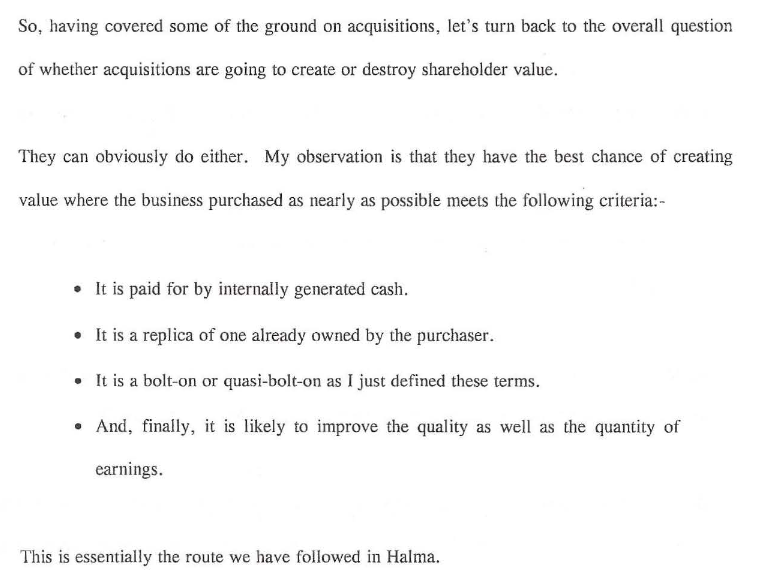
Halma’s principles for successful value creation through acquisitions.

According to Chris Mayer, in 1997 Halma had generated a CAGR of about 22.5% over the previous 20 years. Not a bad performance. Here are his thoughts on the matter: https://www.woodlockhousefamilycapital.com/post/how-they-did-it-a-uk-100-bagger

I have only familiarized myself with the current Halma cursorily, but if nothing else, one can at least learn from its history.

9 Likes

Halma’s valuation is also quite high, as is the case with many successful serial acquirers. What tactics do you use to pick these for your portfolio to avoid overpaying, even if the company is good? Personally, I currently consider Berner and, from Finland, Relais and Boreo to be reasonably priced. Do you know of any other “reasonably priced” serial acquirers at current valuations?

5 Likes

To simplify things, you’re at buying prices when the sustainable earnings yield + dividend yield is close to your own return target. Serial acquirers rarely distribute anywhere near their entire earnings as dividends, so you effectively get the growth from acquisitions mostly as an option (and you won’t suffer too much if the strategy execution suddenly starts to stall). Not a scientific method by any means, but as a concept, it should work.

In Halma’s case, the earnings yield (2.66%) and dividend yield (0.8%) aren’t particularly enticing, so quite a lot of value needs to be created with reinvested profits for the valuation to make sense.

6 Likes

That’s exactly the problem with jumping on board, which is also evident from the table compiled by Inderes: the forward P/E average is 27.9. Bufab bottomed out last autumn at a valuation of approximately P/E 15, and in hindsight, it would have been an excellent buying opportunity (share price ~200 crowns, now approx. 360).

A P/E of 15 is “only” a 6.7% earnings yield, but if you stay waiting for a financial crisis-like correction to buy these stocks at 10x earnings, you might be in for a long wait. Fortunately, a few companies have been a bit more affordable lately.

Of course, as long as the return on equity is at a good level, the portion of earnings not distributed as dividends is reinvested by the company with a good expected return. You can indeed pay a bit more for such a company, but last autumn I didn’t assess the situation correctly, and I missed out on buying Bufab. That’s why I’m reflecting on these things now, so that next time I’ll know to seize the opportunity :slightly_smiling_face:

6 Likes

Teqnion continues to do things its own way. They have completed two acquisitions during June. The momentum certainly seems to hold up with such a small team.

I like Teqnion’s management for a few different reasons:

  1. For every acquisition, they have decided that the target must pay for itself within 5 years. They have stuck to this very strictly, which is crucial in the serial acquirer business to be able to create shareholder value in the long term. In the serial compounder business, one of the biggest factors that can go wrong is the acquired company failing to produce the planned results, leading to stretched payback periods—where a 4x EBIT can easily stretch to 8x based on future years’ multiples. This causes ROCE to drop and debt repayment times to lengthen. I have very strong confidence in Teqnion’s execution, as they also have a very conservative approach to debt.

  2. Management compensation is truly optimal. The top management responsible for acquisitions draws a salary of about 100k in Sweden, with a bonus on top of that based solely on the average earnings growth over the last three years.

  3. Management is frugal in other ways, too. I love this, especially in this industry. They indeed have a small office far from Stockholm city center and appear in all press releases wearing hoodies. This is in contrast to competitors with overly fancy offices in central Stockholm where everyone wears ties. If you imagine being a 70-year-old family entrepreneur who wants to ensure the company’s continued great development and make sure the company culture doesn’t change too much, I would definitely sell to Teqnion.

12 Likes

Hi, it’s great that a dedicated thread has been created for international serial acquirers too! I have been familiarizing myself with serial acquirers for several years now, and the business model is very interesting! There are clearly some guru-level people in this group who have gotten to know the companies really well. So, it would be really interesting to hear which serial acquirers you have in your portfolios, on what grounds, and with what weightings?

I struggle with the same problems as @lazyway, meaning that getting a handle on valuations is proving to be quite difficult. I am willing to pay for good capital allocation, but when the earnings yield starts hovering at only 4 percent, cash conversion is below 80 percent, and on top of that, the company has some debt, I haven’t put on my buying pants yet. I’ve considered buying Boreo a few times, but my nature hasn’t allowed it yet. Boreo is doing the right things and is a clear pioneer in Finland, but I must admit that Boreo’s leveraged balance sheet is a bit scary (when considering the hybrid loan). Companies operating with a serial acquirer business model really can’t be brought down by anything other than excessive debt and illegalities.

4 Likes

So, are you adding these two together?

Second quarter in brief 2023

  • Order intake totaled SEK 284.8 (261.8) million, an increase of 8.8 percent.
  • Net revenue for the second quarter was SEK 245.9 (213.8) million, an increase of 15.0 percent, of which organic growth amounts to 14.9 percent.
  • EBITA was SEK 17.5 (11.6) million, an increase of 51.1 percent. The EBITA margin was 7.1 (5.4) percent.
  • Earnings per share before and after dilution were SEK 0.60 (0.38).
  • Cash flow from operating activities was SEK 3.3 (-18.8) million. Total cash flow for the period was SEK -11.0 (-41.1) million.

No idea what the market expected, but this doesn’t look bad at first glance. Hopefully, profitability can be maintained at a permanently better level, as that would open a completely different portal for the business’s profitable growth.

5 Likes

Christian Berner’s figures looked excellent to my eye.

1 Like

Christian Berner’s figures vs. forecasts.

Strongly reinforces belief in the permanence of the turnaround. :+1:t3:

3 Likes