Some thoughts on the preliminary setup for the next US presidential election, about 2.5 years before the vote. All estimates are my own gut feelings. I have followed US politics keenly since 2000, but I don’t have any formal education in the field nor am I a recognized expert, so my speculations should be taken with a grain of salt. I try to check the facts, but mistakes can always happen, please do correct me if you find any.
Betting Markets
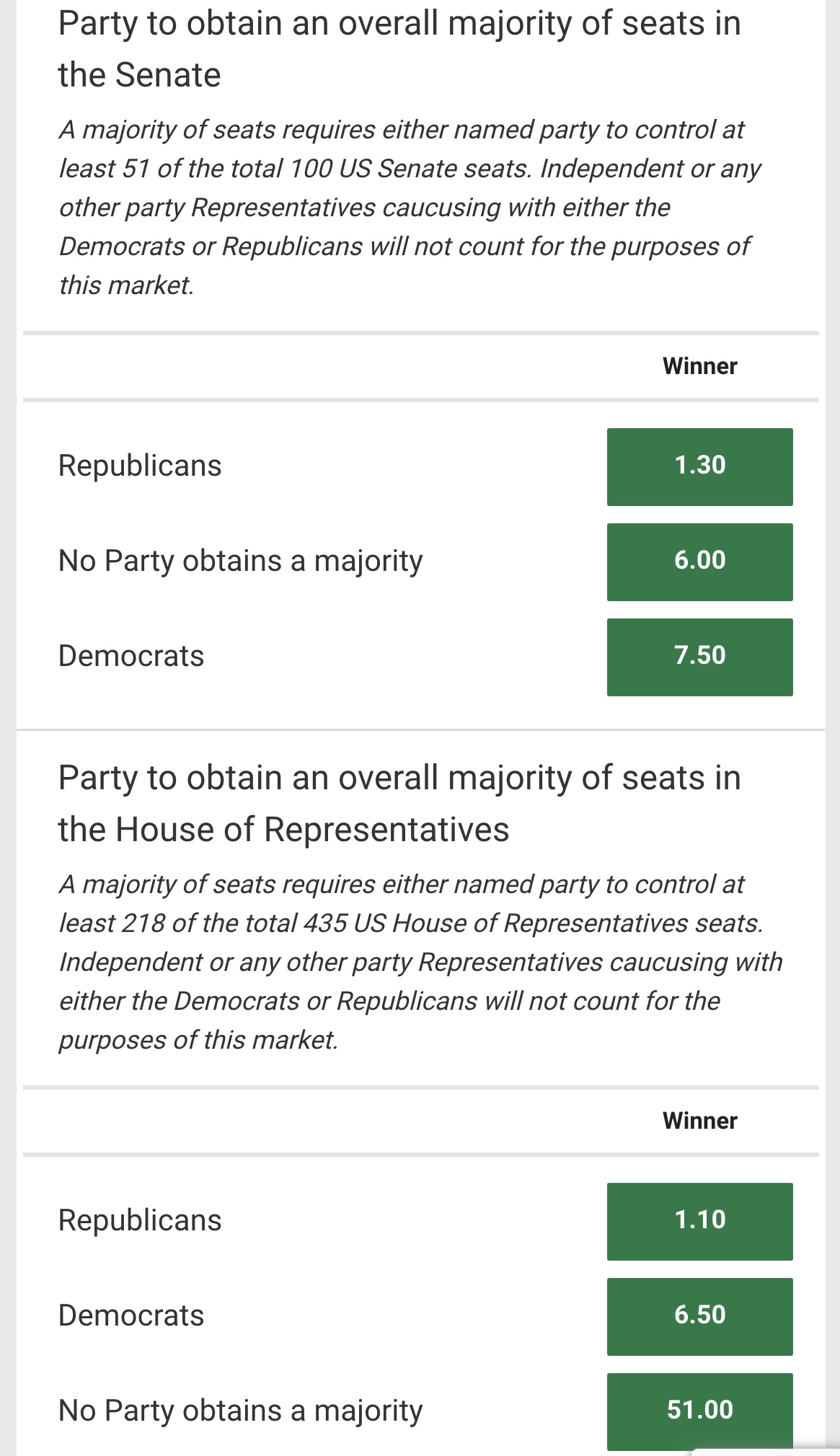
Let’s start with the perspective of the betting market, which often gives a good indication of probabilities in politics. Betfair is a betting exchange where the main market of the previous election (who gets more electoral votes in the election) overwhelmingly rose to become the highest-volume market in the company’s history, with a turnover of two billion. The day before the election, the consensus of Betfair and the betting world in general was that Biden had about a 60% chance of winning. At the same time, the planet’s toughest politics-focused data analysis (https://fivethirtyeight.com/) gave Biden a 90% chance. They included all possible polls state by state, weighted by reliability, and made necessary adjustments based on past election experiences (e.g., Trump supporters answer phone calls less often than the general population), simulating the election tens of thousands of times. There are always many variables in an election; what the weather is like in various parts of the critical states, where there is a flu outbreak, and so on. A sufficient number of simulations blends the noise into an expected value, which on their track record is, in my opinion, the best estimate of the candidates’ chances.
Now, how on earth is it possible that in a billion-dollar market, the odds differed so drastically from high-level data analysis? In my view, it was about the cult created by Trump over the previous five years, almost unique in the US, where tens of millions of core supporters saw him as a messianic figure who simply cannot lose. He is a leader chosen and blessed by God to make America great again. In election betting, such people had an endless amount of money in their pockets to keep Trump grossly overrated as a candidate right up until election eve. After election day, the phenomenon took on even more absurd proportions. Four days after the election, all media outlets, up to and including Fox, declared Biden the winner of the election. In some states, the vote counting was still ongoing, but objectively, Biden was by then at least a 99.9% sure winner. However, Betfair’s main market was still open, and tens of millions in cash poured in daily. At that point, a large mass of Trump supporters desperately wanted to bet on Trump at odds of 12. Day by day, Biden’s victory became more and more certain, but even a month after the election, the market was open and stubborn Trump money was pouring down the drain. The market didn’t even have a backdoor for Trump somehow seizing power, but rather it was about the electors who then officially voted Biden in as president in mid-December.
Based on this, betting odds should be approached with a bit of skepticism; the Trump cult lives on, and one might ask, what kind of people leave their money rotting in a betting market for 2.5 years when during that time they could be getting actual interest from, say, two-year government bonds, not to mention all the possibilities in other asset classes? Perhaps those who don’t think, but just bet on the candidate they fanboy over?
Odds now:

And here is Paf, which shares the same odds with several larger companies (which naturally adjust odds based on how the market is played):

Considering Trump’s chronic overvaluation, the top favorite right now might well be Florida Governor DeSantis. Trump is a close second ahead of Biden. If Sleepy Joe drops out of the race, Vice President Harris and California Governor Newsom are considered fairly neck-and-neck as the top Democratic candidates.
Stable Genius

When Donald Trump announced in June 2015 — exceptionally late by the standards of traditional, viable candidates — that he was running, he immediately shot to the clear lead in the polls for the Republican nomination. In the eyes of Republican supporters, he was the king of the American real estate world and the tough, presidential boss from The Apprentice who thinks for a moment, calls a team together, and makes a shrewd business decision.
Every self-respecting political analyst dismissed him as a joke candidate who would have zero chance at the nomination. The Republican elite and Fox News were openly hostile toward him. When he was pressed in the first primary debate in August '15 on whether he would support the Republican nominee if he wasn’t chosen himself, he refused to say, and was heavily booed by the Republican audience. There was a lot of booing in the fall of '15. Time and time again, Trump said something incomprehensibly outrageous, talking heads declared that this would surely be the death knell for his campaign, but his poll lead never wavered. Even under the shadow of the July '16 convention, there was a lot of tug-of-war within the party, and some party cliques wanted to change candidates a month before the election when the Washington Post published a tape where Trump talked about routinely groping women.Surprisingly, Trump won, and the party finally began to unite behind him. Fox News quickly embraced him. As president, he was at the center of endless turbulence, but the stock market rose, the economy was doing well, and he was fortunate enough to appoint two Supreme Court justices (and even a third right on the eve of the 2020 election). Within the party, all dissenting voices were silenced either voluntarily or at least through heavy harassment, and Trump finally reached his climax on February 4, 2020, when he delivered the annual State of the Union address. He had become synonymous with the Republican Party, and support was nearly unanimous and intensely passionate. All the scandals and the impeachment had been overcome, the economy was in stellar shape, and Trump was undoubtedly the heavy favorite on his way to a second term. Both Congress and the Senate were listening to the State of the Union, and the atmosphere at the time, created by the Republicans, was reminiscent of a revival meeting. It was a very prestigious event, but the Republicans broke out into a standing ovation shouting, ”Four more years!” Then came COVID-19, a problem whose management did not suit Trump’s strengths and which cost him his reelection.
Trump’s actions are driven by a small set of lessons burned into his spinal cord in his youth:
- Speak with a simple, child-like vocabulary and use simple grammar. This is typical of populism and comes naturally to Trump. Although Finland has a high-quality basic education system, there are plenty of people here too who find it difficult to follow the speeches of politicians and A-studio experts. In the USA, the problem is much worse. It is hard to admit to oneself that one’s level of education is not enough to understand a normal politician, and the result is distress and anger. Everyone understands Trump’s speech.
- Be almost limitlessly optimistic and trust your instincts. In the autumn of 2016, Clinton suspended her campaign for days to prepare with her team and sparring partners for the first debate, which in election years is the second most-watched TV program after the Super Bowl. Trump continued campaigning, mocking Clinton’s break, and did not prepare in any way. In some perverse way, I have to admire the fact that someone can walk completely out of the blue into a situation where the pressure is higher than on perhaps any other arena.
- If someone attacks, do not defend yourself passively; strike back with full force. It’s hard to pick single examples of this because Trump does this all the time; it’s like breathing.
- If you are in a long-term conflict, once it is resolved, declare yourself the winner no matter what the outcome. Trump has won all the lawsuits he has lost, all his bankruptcies were successes, he won the Republican primaries he lost, he got more legal votes in the 2016 election than Clinton, and ultimately, frankly, he won the 2020 presidential election. He is a winner; that is the core part of his brand. He always wins, he is the best at everything.
Finally, Trump is distinguished from others by one more hard-to-define X-factor. Why do people play slot machines and get a small rush of pleasure when they notice a message or notification on a social media channel, something unexpected? People are addicted to random rewards. Every time Trump starts talking, people get that dopamine spike because Trump can say anything. Something that immediately ends up in the news. He is completely unpredictable and irresistibly entertaining, which makes him magnetic. In the autumn of '16, a commentator pointed out that Clinton is leading in the polls, but 90% of the media attention is on Trump all the time. Throughout his term, Trump dominated the media airspace in an unprecedented way. He was divisively controversial, but undeniably the world’s most charismatic political superstar, something possible only in America.
After Biden took office, the media storm around Trump has quieted down. He is away from mainstream social media, bored according to leaks at Mar-a-Lago. Democrats are looking for a smoking gun regarding his actions on January 6th, but will hardly be able to physically prevent him from running for the presidency. All insider comments point to him entering the race. According to some sources, he would have liked to announce his candidacy already this summer, but aides are trying to prevent it at least until the midterms.
Florida’s Ideal Son-in-Law

Annoyingly, Donald Trump is not necessarily his place of residence’s most popular politician. Ron DeSantis is the 43-year-old first-term governor of Florida. He graduated as a lawyer from Yale and Harvard, enlisted in the army, served as a Navy lieutenant in Iraq in 2007, and entered Congress in 2012. There he quickly found like-minded individuals in the party’s right-wing Tea Party movement, and in early 2015 he co-founded the “Freedom Caucus,” a club of Republican members of Congress aimed at pulling the party further right. In late 2018, with Trump’s strong support, he ran for Governor of Florida. In his campaign ads, DeSantis was seen teaching his small child, dressed in a MAGA shirt, how to build a wall. In an interview, he was asked if there was any issue on which he disagreed with Trump. There was none. He won against his opponent after a recount by a 0.4% margin. Commentators saw this as fresh evidence of Trump’s growing kingmaker status in important swing states. DeSantis rose to the governorship distinctly as Trump’s protégé, an apprentice.As governor, DeSantis has naturally sought to pursue conservative politics. He favors tax cuts, welfare cuts, and the right to bear arms (he holds the best possible A+ rating from the National Rifle Association). He opposes abortion, the rights of sexual minorities, and COVID-19 restrictions. Specifically, his coronavirus battles with Biden last year catapulted him to become the country’s most prominent young Republican politician. He represents everything that the Republican elite, which has drifted far to the right over the course of the 2000s, could hope for: all the right stances, a stellar background, a presentable, glossy-magazine family, and a strong opposition to the evil federal government’s intentions to interfere in citizens’ affairs and their pursuit of freedom, even amidst a pandemic. He seems like a nearly complete package. Even for swing voters, he has something to latch onto; on environmental issues, his youth shows in the fact that he is not a pitch-black Republican. But does he dare challenge The Donald, and if he does, does he have a chance?
Let’s get this fucking party started
Just last autumn, DeSantis brushed off inquiries about a presidential run as nonsense, emphasizing that he was only focusing on his re-election in Florida. Since then, he has broken fundraising records for the gubernatorial race, which will take place this coming autumn. Money is pouring in so heavily that even though he is aiming for a landslide victory with an expensive campaign, he will hardly use much over half of all the funds raised. The money comes from both high-profile Republican donors and the grassroots level. In principle, funds raised for a state campaign should not be used at the federal level, but there are loopholes and recent precedents for this. DeSantis has not asked Trump for any endorsement for his re-election and no longer answers any questions about the presidency.
In the polls, DeSantis is still very far behind Trump. When Republicans are asked which of the two they would rather see as the party’s nominee, a typical result is Trump 50%, DeSantis 25%, don’t know, or similar 25%. The gap seems huge, but it’s worth remembering that Trump was president until recently, whereas DeSantis is his 43-year-old protégé, a first-term governor. In January 2024, he will be a 45-year-old second-term governor, while Trump will have aged to 77 by then. Even more significantly, Trump and DeSantis have, of course, never been seen on the same debate stage. Their currently completely different-tier profiles would level out the moment this happens for the first time, likely in August next year. DeSantis’s trend is already rising.
The most dangerous thing from Trump’s perspective is that his supporters genuinely like DeSantis. I haven’t seen much of a cross word about DeSantis on Trump-Twitter; instead, the mantra is the Trump-DeSantis 2024-2028 ticket, and DeSantis 2028-2036. Only in this way can the country’s affairs be cemented in order so that the Dems don’t ruin the legacy anytime soon.
As DeSantis has even appeared in presidential polls and started gaining some traction in them, Trump’s attitude towards his former protégé has turned chillier. According to Trump, DeSantis would be nothing without him. An impatient Trump can barely stand the war of attrition anymore and wants to seize the initiative by declaring his candidacy first.
I bet that when Trump announces his candidacy, likely right in Florida, he will frame the setup as if he were the incumbent president of the party seeking a re-election. At that point, the unwritten rule is that a president is not challenged. Trump will immediately demand the entire party fall in line behind him; you are either loyal or a traitor. There is no need for any kind of primary campaign; the candidate will be nailed down right now.
When can an announcement be expected? Perhaps the most likely and, according to Trump’s aides, safest option would be to wait at least past the midterms until December-January. If DeSantis continues to rise in the polls and talk about his candidacy grows, Trump might not be able to wait, rudely declaring his candidacy right in the middle of the midterm campaign, aiming to take over Florida’s airspace and branding both DeSantis’s and the party’s victory as his own doing.
It would, of course, be very dramatic to hear DeSantis’s statement on Trump’s candidacy. If Trump were to announce it in the middle of the midterm campaign, it would be fairly easy for DeSantis to state that he is now fully focused on his re-election. If Donald manages to wait until January, DeSantis will be forced to comment on the matter. The first, anticlimactic option is that he surprisingly comes out in direct support of Trump. They have some kind of deal whose secret addendum includes a guaranteed vice-presidential spot or something nice. This is possible, but I don’t consider it likely. If you want to reach the top in politics, especially in the US, you have to be at least to some extent narcissistic, even a psychopathic killer personality. A political animal that lives off power. An animal that sniffs the momentum vibrating in the air, and if it’s so thick you could cut it with a knife, you have to strike. A second chance might not come. DeSantis is on a major upward trajectory this round. As a hyper-intelligent man, he understands that Trump would likely ruin the movement during a second term, and DeSantis, especially as vice president, would go down with the ship.
So I believe DeSantis will enter the race, but he doesn’t want to announce it as early as Trump. It remains to be seen with what phrasing he will try to keep his candle under a bushel for a few more months, or if the statement will already contain a strong hint. Then if/when he officially enters the race, say next April, the campaign message, based on my guesswork, could be built on looking to the future. Biden has ruined the country in many ways; now it is time to roll up our sleeves and start fixing the damage with fresh, energetic hands and make America the country that the Founding Fathers envisioned once again. Between the lines, the message would be that no one wants to hear the old man’s Tourette-like mantra about stolen elections anymore. DeSantis won’t want to start criticizing Trump directly at the beginning; that would be too dangerous.Trump usually doesn’t have any particular strategy; he reacts to stimuli with his aforementioned toolkit. DeSantis’s candidacy in itself would be a severe blow to his prestige, an attack on his authority. Will the mudslinging start immediately despite the objections of his aides, and if so, how will Trump’s supporters react? Will they obediently turn against DeSantis at the Leader’s command, or will the base of the cult slowly start to crumble? Much like the coronavirus pandemic in February-March 2020, the question of the right approach against the dangerous DeSantis is a very complex problem that one should calmly analyze from various angles, have an open discussion, listen to, and trust the experts (in this case, the least dull pencil in the box of Trump’s political advisors who are still on board). This is hardly going to happen. Will the alpha gorilla leading the pack establish a working group if a young male bites it on the testicles while it’s sleeping?
If DeSantis starts getting the upper hand in early 2024, it will be interesting to see if Trump tries to destroy the entire party to the extent that he can. Are all internal Republican processes corrupted, is there a RINOs’ conspiracy against Trump? Terribly difficult to assess. In any case, an unprecedented circus is likely in store if both run. Right now it’s hard to see anyone else driving a wedge into the race, but of course big surprises have been seen before. In the summer of 2006, hardly anyone could foresee that a local politician from Chicago, Barack Obama running for the Senate for the first time—albeit having risen to national prominence with his speech at the Democratic National Convention two years earlier—would even be in the race, let alone win. In the summer of 2014, no one even thought of Trump as a joke candidate; he had flirted with it so often that he was already the boy who cried wolf. And in the summer of 2018, of course, no one knew that a pandemic would upend the landscape. Precisely for this reason, it came to mind to write such preliminary, likely comically proven wrong musings this early. In the fall of 2024, this will be a faint voice from the distant past, from a time when it wasn’t known at all what surprising twists awaited.
There was supposed to be some rambling about the Democrats’ setup here as well, but let’s leave that for some other time.