However, the news article stated this:
Tokmanni, on the other hand, will focus on selling Xiaomi’s wide range of smart home devices, which include robot vacuums and kitchen products, for example.
However, the news article stated this:
Tokmanni, on the other hand, will focus on selling Xiaomi’s wide range of smart home devices, which include robot vacuums and kitchen products, for example.
This could perhaps have been posted in the Puuilo thread as well. But maybe because of Dollarstore, it fits better here. That is, market development from the perspective of competitors. I have previously written that in Tokmanni’s investment story, the significance of competitors will be even more relevant in the coming years. Tokmanni & DS are in a situation where the greatest growth has been built on the store network. Especially in Finland, that “new store” growth is hardly available anymore (without cannibalization). And in Sweden, expansion is on hold because the direction of the concept is not clear—it’s not worth scaling a dysfunctional concept.
And correspondingly, many competitors are, especially in Finland, just starting their “fastest expansion pace”—meaning right where Tokmanni was in 2015-2024. In some years, they used to open 15 new Tokmannis—this year, I believe, 2-3 openings (in such affluent areas as Ivalo with 3,000 residents and Ähtäri with 5,000 residents)? That is why I think a Tokmanni investor should be extra alert over the next few years regarding what competitors are doing. I would even go as far as to say that competitors are the single most important factor affecting Tokmanni in 2026-2027 (e.g., of greater potential significance than PL development, the cost-cutting program, marketing strategy, etc.). When a direct competitor opens right next door, the growth of the local market size is simply not enough for both.
Indeed. When a new competitor enters a town, the discount retail pie always grows a little bit. But sharing that pie still takes a bigger slice (than the growth of the whole pie compensates for). And as is well known, responding to the competition means, among other things, narrowing margins and heavier marketing expenses…
Rusta
Opening 6 stores in Finland this autumn alone!?! “We continue to expand at a high pace, which demonstrates the strength of our store pipeline and the significant growth opportunities we see across our markets. Our strategy remains unchanged.”
Clas Ohlson
Not growth based heavily on new openings. But I’d say quite convincing execution. Do they even have the best “discount retail” figures in Finland and Sweden? May – July +9% organic growth in Finland and +11% organic growth in Sweden. Somewhat different figures compared to Tokmanni or Dollarstore with the same consumers and the same weather…
Jula
When Rusta this week is gloating that “we are opening 6 stores in Finland this autumn,” what does Jula do the same week!?!?
Jula: “Hold my beer.”
Jula is opening 7 new department stores in Finland during the rest of the year! Jula avaa seitsemän uutta tavarataloa Suomessa kuuden kuukauden aikana - Jula AB/Jula
“It is particularly pleasing to see how Jula continues to grow in Finland. We have a strong offering that Finnish customers appreciate, and we see great opportunities for the future.”
Biltema
And at the same time, Biltema also announces that it does not intend to wait around in the Finnish market. Market shares are being aggressively pursued with 10 new stores, and especially the Biltema Cafe is sought as a competitive advantage that others probably do not have.
https://www.biltema.fi/uutta-ja-hyodyllista/uutiset/10-uutta-tavarataloa-ja-kahvilaa-suomeen/
Puuilo
Nor is the domestic competitor sitting completely silently watching the Swedes’ charge on home turf—instead, it is launching a counter-offensive to compete on away turf. But even in Finland, the expansion pace remains quite brisk. This year, there will probably be 7 new stores?
And above, of course, is only a fraction of the competitors. But when within the span of a week, 3 strong Swedish players announce how investments and expansion are being accelerated even further, a justified question arises in my mind: when Tokmanni takes a hit in Sweden with Dollarstore’s concept change, how will it go for the group’s brick-and-mortar backbone, Tokmanni, as the Swedish charge slowly gathers momentum on home turf?
When a Rusta, Jula, and Biltema open right next to a basic Tokmanni—what will be Tokmanni’s competitive advantage and strategic direction of the concept over the next 24 months, ensuring that despite new competitors, sales do not drop, price competition and margins do not fall, fixed cost percentage does not rise, and marketing expenses do not increase?
Recommendation for fellow Tokmanni investors: Keep your eyes on the competitors for the next twenty-four months at home. And on that comp growth.
Food and clothing. Biltema doesn’t have gingerbread cookies or summer dresses.
Affordable children’s clothing and accessories, and after that, Tokmanni’s rise cannot be stopped. You can get groceries from wherever you want, but with those [offers] the whole family comes in and there is always something for everyone. This used to work for Tokmanni regarding children’s clothing, and back then the share price was twenty euros. It wouldn’t take much more than that. However, Biltema, Motonet, and Puuilo don’t attract the whole family for shopping in the same way.
These need to be high quality. Parents won’t buy poor-quality clothes for their children. If they can build a reputation for high-quality and reasonably priced children’s clothing, that would be good.
People are also ordering from Temu and buying clothes for children from those Chinese shops, so that’s partly to blame. Tokmanni’s clothes have been of the same quality as in any other stores. In my view, Tokmanni did well back when they actually had affordable children’s clothes. Nowadays, the only truly cheap things are cookies and some candy, and those don’t draw customers into the store.
[quote=“Maikki1, post:4093, topic:2105”]
In my view, Tokmanni did well back when they actually had affordable children’s clothing. Now, the only things that are genuinely cheap are biscuits and some candy, and you can’t draw customers into the store with those.
[/quote>
Yes, you can. The Tokmanni segment is still doing quite reasonably well. Dollarstore, on the other hand, is doing terribly.
Now that Inderes’s updated shareholder list has finally provided the shareholder changes for August, it’s interesting to note that the Tuomaalas have continued to increase their holdings:
Henri added 10,000 shares and Markku 5,000 shares. The latter is now the 58th largest shareholder in the company.
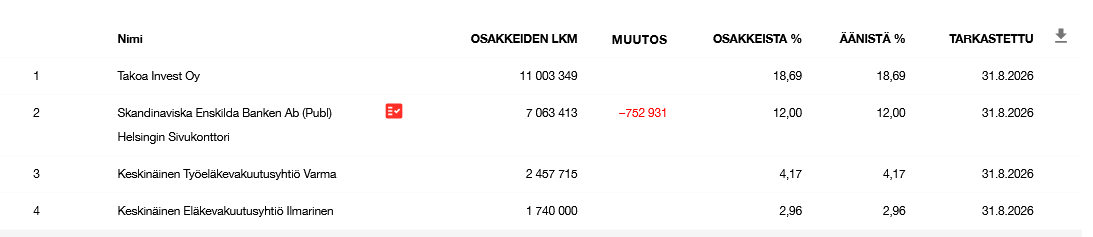
It looks like over 2.5 million Tokmanni shares changed hands yesterday after 6:00 PM. Did any of you on the forum happen to notice that trade?
Looking at Tokmanni’s list of owners, there aren’t many possible sellers for a block that size:
My guess for the seller is Varma, but who was the buyer? After all, it was a stake of over 4% of the company’s shares.
I certainly noticed the event. I was wondering myself if this is the start of short positions being closed, since almost everything was bought in the closing auction from different owners.
This could be a comfortable spot to be on the buying side if sentiment turns even slightly better. Well, everyone has to consider for themselves whether now is a good time. Since the facts nevertheless show that consumer confidence is clearly on the rise and the plugging of trade with China plays right into the hands of Nordic discount retailers.
Well, today the facts were by no means encouraging for the market:
And it would be pretty overly optimistic to think that people wouldn’t know how to sell Temu junk to consumers through intermediate warehouses in other countries.
According to studies, the largest buyer group in Finland on Temu has been rural men. Surprising to me as well. Well, this group is now pondering what to do after the introduction of customs duties: whether to buy from domestic online stores or drive to the nearest Tokmanni or other discount store to fulfill their wishes. In rural municipalities, Tokmanni is likely the closest option. Purchasing behavior doesn’t change overnight, after all. So let’s keep an eye on events for the rest of the year, which is anyway the most important period for Tokmanni.
[quote="Alamaki, post:4100, topic:2105"]\nDo people buy from domestic online stores, or do they drive down to the nearest Tokmanni or other discount store to fulfill their wishes?\n\n[/quote]\n\nRight, are those really the only options? Temu and the like tackle the issue by shipping products from EU warehouses, meaning consumers don’t have to pay customs duties. Sure, the store in question has to pay those duties upon import, but that price increase doesn’t dampen consumers’ eagerness to buy nearly as much as the increase in bureaucracy does.\n\nThen there is the separate question of whether, if someone stops temufication, how much of that junk is actually something they just have to get, even if it means buying it from a discount store.
Oddly enough, however, the number of packages has dropped by nearly 70%. So something has happened after all.
Bought more before the change, it takes a while to get back to a higher level, whatever that might be. But the impact on my own purchases has been smaller than I thought. The price of the product, for example a fishing reel €10 → €11, at Tokmanni the same product €29, I don’t know if Temu compensates somehow.
Of course, your experience is your own. I can hardly assume how customs affects an individual other than the fact that it does. So they will then make decisions in the future on whether to buy from Finland or a Finnish online store. Perhaps they will even wake up to the fact that it’s worth supporting domestic commerce after all. And according to the village bar song, it stays in your neighborhood. At least I would try to keep that village store/bar alive.
Who knows, but short positions just decreased in an instant. Perhaps Finland’s clear improvement in consumer confidence is making people wonder if earnings growth might surprise to the upside and play into Tokmanni’s hands.
At least now heading into autumn, customers and even queues at the cash registers have been visible at Tokmanni. Who knows what’s causing it, but the change has been clear at my nearest Tokmanni. And based on my own observations, teenagers favor Tokmanni alongside Normal. In my own family, Temu was popular with the teens for a couple of years, but since the summer, they haven’t wanted anything from Temu. Probably some TikTok phenomenon or what’s the catch? I’m not complaining about this change, even if it hurts the wallet.
OP published a report today on potential profit warners. OP sees a significant risk for a negative profit warning in three of the companies it covers: Tokmanni, Wetteri, and Raisio.
In OP’s list, eight companies have a moderate risk of a negative warning, and as many as ten companies have the prerequisites for a positive profit warning.