EuroStore would be quite a good name. The Trump administration has managed to ruin the dollar’s reputation; the dollar in a store’s name likely already has a negative impact on sales.
4 Likes
The Tokmanni thread has now gone full circle on this entire Dollarstore pilgrimage, revolving around blame for past actions, the “Tokmannification” of Dollarstore, and semiotic Trump-related imagery of the dollar (?!).
If you look back through the thread, the same phrases keep coming up over and over again.
Now that Tokmanni has started taking action, we will at least be able to see what kind of financial impact the management’s Swedish background and the harmonization of the product range will have.
Naturally, the thread also contains some great content, and thanks to everyone who has contributed! This also becomes clear when browsing through the thread.
Have a great weekend!
12 Likes
I think the negative connotation of the name DollarStore is a perfectly valid point and a factor that affects sales. Especially in Denmark, which has been threatened with the takeover of Greenland. As far as I know, there are 5 DollarStore locations in Denmark.
5 Likes
It is a point, but my message was about the repetition in the thread, as the same discussions have been started from scratch more often than there are Dollarstores in Denmark.
This was not directed at you personally, and apologies if the timing made it sound that way. The words “Tokmanni” and “dollar” surely carry different connotations in Copenhagen, Kemi, and Texas. Although the “Euro-” prefix doesn’t exactly stir up purely neutral or positive vibes everywhere either. On a side note, the difference between Spar and Eurospar is likely down to square footage. That “euro” is taken away from the familiar, reliable local shops.
5 Likes
I consider Tokmanni in Finland to be a kind of B-class Prisma for small towns, with the caveat that Tokmanni obviously cannot offer the grocery department of a hypermarket. Kärkkäinen might actually be an even closer comparison. However, the concept seems to work quite well in small towns. Regarding Sweden, the Tokmanni CEO states the following: “A broader product assortment is a key part of the reform, as it offers customers more choices, increases the average transaction value, and distinguishes Dollarstore even more clearly from its competitors. At the same time, it strengthens Dollarstore’s position as the discount retail chain offering the widest product range in its market segment in Sweden.” Since retailers like Rusta, Normal, and others in Finland seem to be targeting at least medium-sized town centers, unlike Tokmanni, what is the competitive situation like in Sweden regarding a broad product offering? Who is the new, broad-assortment Dollarstore competing with in Sweden? For example, ÖoB appears to be significantly smaller in size, and its stores are apparently concentrated in medium-sized or large centers. Does Dollarstore therefore potentially have room to grow in Sweden’s small towns, or what is the revenue growth forecast based on? Others besides the Inderes analyst are welcome to comment as well.
4 Likes
Twelve in Denmark right now, and more to come.
1 Like
The customer base and, consequently, the contents of the shopping basket vary by location, and even within the same town, as well as between individual shopping trips. In the retail sector, finding comparable peers is a bit difficult, but I think you are right that in many locations, Prisma is the closest competitor when excluding the grocery side, and certainly not the likes of Normal or Clas Ohlson—just consider the number of SKUs, for instance, which is over six times higher at Tokmanni compared to Normal. Everyone’s shopping habits are different; when bread or ham unexpectedly runs out, I might walk to the local convenience store, but once or twice a week we pick up a larger haul by car from Prisma, and on the way to the summer cottage, we might swing by Tokmanni, for example. Furthermore, at least here in my own area, I would compare Puuilo more with the likes of Byggmax, Bauhaus, and K-Rauta than with Tokmanni, at least based on the customer base. It’s not worth lumping everyone into the same category.
4 Likes
As an owner of Tokmanni and Kesko myself, I hope they can do exactly that.
9 Likes
Wondering about the rationale behind the Dollarstore acquisition is indeed a tiresome debate. It’s the same hand-wringing year after year about milk spilled on the table.
On the other hand, speculating about the chain’s assortment, name, development, etc., is not just repetitive bickering; it is the most central part of the Tokmanni investment case. Since Tokmanni’s management itself has been inconsistent along the way regarding what they want to create out of Dollarstore, investor confusion is somewhat understandable.
Although the “Tokmannization” of Dollarstore sounds justified in many ways, and Dollarstore’s old “brick-and-mortar Temu” concept doomed, we are still living in dangerous times as the brand drifts away from its core offering and its customers. Ultimately, Tokmanni is currently making a transformation comparable to Tiimari in its final stages in Finland, when it shifted from a trinket store to a retailer of higher-priced products. Unfortunately, the change drove a large portion of their regular customers elsewhere, and the trinket brand never became a credible player among consumers looking for higher-quality goods. Dollarstore is navigating the same risk zone. However, unlike Tiimari, both the new and old product ranges have been so broad (groceries, etc.) that, fortunately, there is no reason to expect quite as brutal an outcome.
Perhaps an even better example is the story of Anttila during its ownership by Kesko, when, under the new owner’s command, procurement was transferred to the Kesko organization and the chain lost its unique identity. They pursued much the same goals regarding the product range as Tokmanni is now doing in Sweden, even though Anttila’s starting point in terms of quality and its target were much higher than traditional discount retail.
9 Likes
Thanks. This articulated well why I swallowed my losses with Tokmanni and sold my shares. The commercial model of Dollarstore has remained unclear to me. From an investment perspective, it is absolutely essential to understand what Dollarstore is. What is its concept in terms of price point, customer segment, competitor group, etc.? In other words, what does it sell, to whom, and how much does it cost to do this?
If someone else feels the management has been clear on these or other questions, then I suppose I am not listening to them closely enough.
With Tokmanni, the other change, i.e., Spar, is often forgotten. In this case, I don’t see any future unless their purchasing volume grows significantly. As has been stated many times, people can go and look at the pilot store in Ylöjärvi and then swing over to the other side of the road to Citymarket. If the selection, price, or service isn’t better, what would make a consumer become a Spar customer to a significant degree?
2 Likes
This (behind a paywall), the latest interview with Sampo Päällysaho published in Talouselämä magazine, may contain some answers to questions troubling investors: Sampo Päällysaho joutui kovaan paikkaan: Nyt hän kertoo, miten Tokmanni pelastetaan | Talouselämä
I am paraphrasing loosely, as I read the magazine at the library; Päällysaho’s statements are sometimes very verbatim, but I have not added quotation marks.
Currently, the board is indeed working on a strategy, considering, among other things, the number of stores in Sweden and Denmark, accessibility, investments, and overall profitability, and the stores already opened provide a good indication for these considerations. Rautiainen previously spoke about the Capital Markets Day being scheduled for around the turn of the year; in any case, there is no date in Päällysaho’s calendar yet.
For some reason, Päällysaho highlights his Swedish language skills; the lack of this skill among Tokmanni’s management has also been criticized on the forum. He started his career at 16 at the Espoo cooperative Varuboden and was the only Finnish speaker among the staff there, so learning Swedish went quickly and has helped in his career in a Nordic work environment where “Scandinavian” is spoken.
The idea behind Tokmanni expanding its grocery business through its Spar agreement is simply to improve the customer experience; it has already brought stronger customer traffic and a larger shopping basket to the renovated stores. The fact is that a customer might visit a regular Tokmanni once a month, but a grocery store 2–4 times a week. Thus, Tokmanni is targeting these customers and trying to get them to visit the stores more often. Spar, on the other hand, has expertise in different concepts and sub-concepts, meaning not all expertise needs to be centralized at Tokmanni, as support for store openings is obtained from them. The board will also take a stand on Eurospar investments in its strategy work.
Then, Päällysaho’s own opinion on what is fundamentally the problem with Dollarstore: at the time of the acquisition, Tokmanni was already very systematic, with its own product sourcing channels in Asia and Europe. Dollarstore, on the other hand, was the creation of a single entrepreneurial family that used many middlemen in its procurement. Its assortment lacked product categories such as clothing, tools, and groceries. After the acquisition, Dollarstore operated as a fairly independent unit; this phase was likely observed for too long. However, it was known early on that synergy would only be created through close cooperation. So now, the ranks have been tightened and decision-making has been centralized in Finland. The decisions regarding assortment, procurement, and pricing are made here. Local purchases are only supplementary.
Product categories familiar from Finland have been taken to pilot stores in Sweden, and their sales have exceeded expectations. The problems have therefore been identified and now they must be pushed through firmly. They increase the sales and profitability per square meter of every store. Since there are 142 stores in Sweden and product procurement cycles are long, it will take at least a year before this starts to be visible everywhere.
To the question of how discount retail will fare when the economy turns and consumers no longer need to pinch pennies, Päällysaho answers: It is always thought that in a downturn, discount retail does well. However, it is already quite a trend that people want to buy more cheaply. So, the “thrifty gear” would remain on for consumers.
In a high-growth economy, Tokmanni gets to benefit when deferred purchases and investment decisions are realized. It must be ensured that by then, assortments have been replenished and the right products can be found on the shelves.
The importance of seasons is also emphasized; one must succeed in them because the margin on general merchandise is so much better than on groceries. The Swedish crayfish parties are mentioned.
27 Likes
Tokmanni doesn’t seem to publish these figures, but based on their store distribution, I would guess that about a third of their Finnish revenue comes from small towns, half from mid-sized towns, and a fifth from large cities. The concept works because in many locations, Tokmanni is the only general store. Swedish discount retailers, including Rusta for example, seem to be focused on larger centers, so perhaps small “byhålor” (remote backwaters) are the new Dollarstore’s hope in Sweden. Which reminds me:
2 Likes
[quote="Roskapankin_paavi, post:4078, topic:2105"]\nSwedish discount retail, including e.g. Rusta, seems to be focused again on larger centers,\n[/quote]\n\nIisalmi | Rusta.com\n\nFor now, yes, but expansion is happening to smaller localities as well. This week marks the grand opening in Iisalmi (approx. 20,000 residents).
3 Likes
Tokmanni is also likely the only shoe and clothing store within a radius of dozens of kilometers in many smaller towns. I recall seeing figures somewhere stating that, among brick-and-mortar stores, Tokmanni has at least been Finland’s second or third most popular clothing store. And on the same shopping trip, you end up grabbing a screwdriver, garden decorations, and a massage gun. Without the local Tokmanni, you’d have to drive some 40 kilometers away for each of these items, especially now that driving (temuttaminen) has also gotten more expensive.
However, here are two megatrends that Tokmanni can do nothing about, but which will eventually have to be faced:
- Finns (and especially young people) are gradually moving from small towns to growth centers.
- At least some competitors are gradually creeping into smaller and smaller localities.
7 Likes
Temu is hardly the only player capable of shipping those packages to the countryside.
Temu restrictions are certainly welcome, but in my opinion, their impact on Tokmanni shouldn’t be exaggerated. Nor should anyone kid themselves into thinking that new, consumer-friendly delivery models won’t be developed to take their place from one country or another.
1 Like
OP published a report today regarding Tokmanni and Puuilo titled “Kilpailukentän myymäläkapasiteetti jatkaa kasvussa lähivuosina” (Store capacity in the competitive landscape will continue to grow in the coming years). Artificial stupidity summarized the section of the report concerning the store openings of various operators into a concise format:
Store plans of retail chains
- Tokmanni: Opening a new store in Kivistö, Vantaa, in late 2026. Currently updating its strategy, which will clarify future plans.
- Puuilo: Expanding to Sweden and targeting approximately 7–10 new stores per year in 2026–2030. The goal is to exceed a total of 100 stores by the end of the 2030 financial year (at least 7 openings annually in Finland).
- Rusta: Has confirmed 8 new store openings in Finland. At the group level, plans include 65–80 new openings across the Nordic countries and Germany.
- Jula: Opening 7 new stores in Finland during the autumn of 2026 and early 2027. Going forward, targets about 5 new department stores annually.
- Biltema: Plans 9–10 new department stores in Finland in the coming years, three of which will materialize in late 2026.
- Motonet: Focusing more clearly on expansion in Sweden; only one store has been opened in Finland during 2025–2026.
- Kesko & S Group: Kesko plans to open 4 new hypermarkets in the coming years (already opened two Citymarkets in early 2026). Meanwhile, the S Group plans to open 5 new hypermarkets in the coming years.
- Normal: The number of stores has exceeded 100 units. Opening at least two stores in the autumn of 2026 and sees potential for about 40 additional stores in Finland.
- J. Kärkkäinen: Confirmed a store opening in Pirkkala for 2027 and is planning a store in Kempele.
- Clas Ohlson: Opening two new stores in late 2026 (already opened one in early 2026).
18 Likes
The share price recovered quite quickly to the pre-earnings level, and at the same time, short positions have been on a slight increase, now standing at a solid 3.9% of the shares:
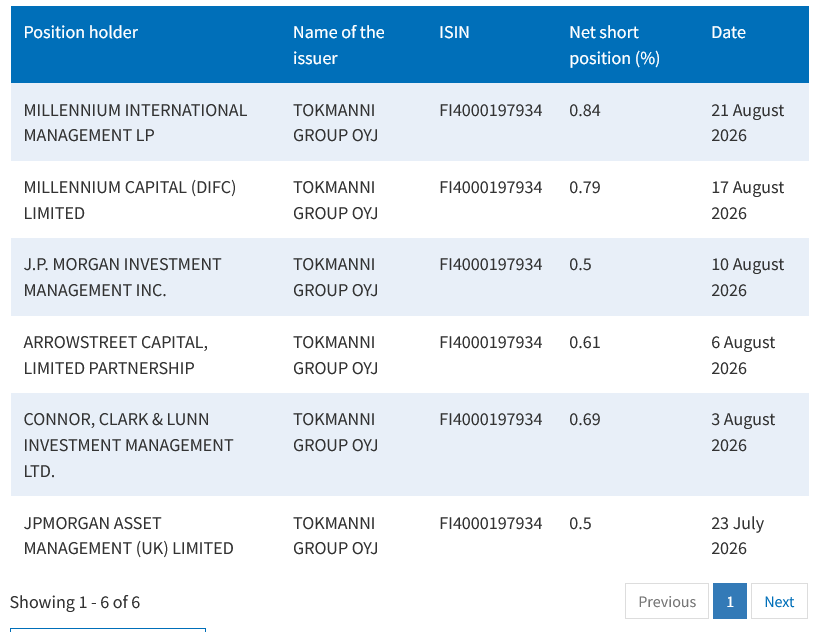
That shorted amount corresponds to over 2.3 million shares, which is a pretty decent chunk relative to Tokmanni’s average daily trading volume (+200 thousand shares). The actual number of shorts is certainly somewhat higher, as this only includes short positions exceeding 0.5%.
It will be interesting to follow how long they intend to sit on their short position and whether they will continue to add to their shorts as the price rises.
6 Likes
I didn’t follow the levels prior to the earnings report very closely myself, but after the earnings report, the shorts increased slightly. Now, according to the new data, however, they have turned downward. That 0.12% reduction in shorts corresponds to about 70 thousand shares, which may have contributed to pushing the price up:
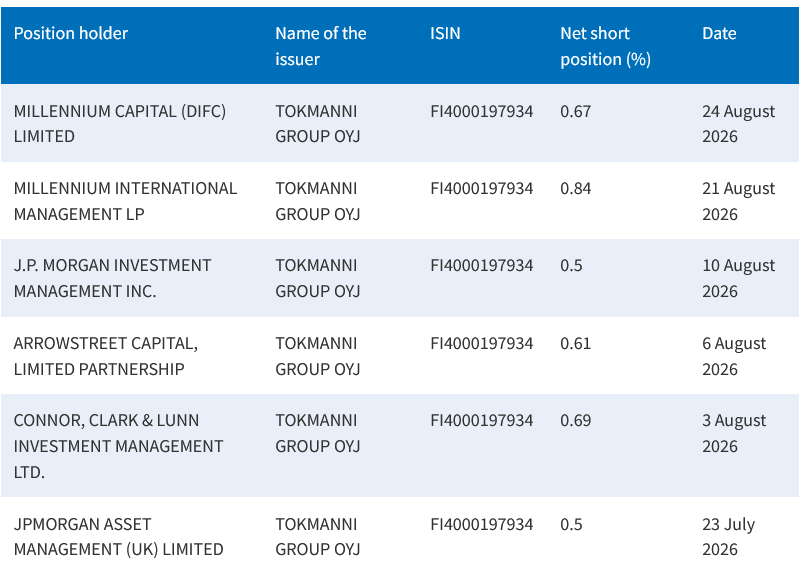
From here: Current net short positions - Notification of short positions - www.finanssivalvonta.fi
you can also find historical data if you want to examine it more closely.
5 Likes
Tokmanni is starting to sell phones. If I understand correctly, this is a new venture for them?
6 Likes
Phones really have dismal hardware margins (often negative), so there’s no reason to be too excited about this unless the dynamics of the home electronics market have completely changed since the 2010s. With phones, value-added services and accessories are where the margin comes from, and I don’t really see subscription/carrier salespeople at Tokmanni.
6 Likes