- It’s quite rare for a retail chain to advertise itself by bragging about being very expensive.
- In these discussions, these chains are often compared & pigeonholed without taking different customer segments into account. Finland is a big country, and Sweden, as far as I understand, is even bigger. I would argue that at the Puuilo in Vaaranperän Eräkulma, people often buy completely different products than they do at the Clas Ohlson in Kamppi, etc.
- In all likelihood, the impact of weather fluctuations on a single quarter’s purchases is relatively small, given that as investors, we mostly focus on mapping out the future a few years, if not a decade, ahead (excluding day traders).
Even though weather explanations are often laughed at, the impact is actually quite significant, given that a substantial portion of sales is tied to the weather, for example in the garden department.
In addition to next week’s weather, last week’s weather can also matter for retail sales. If good weather in early summer leads consumers to buy beer, sausages, or ice cream, they easily continue that purchasing pattern later in the summer, even if the weather has already turned worse by then. So, when comparing two cold Julys, sales regarding the weather impact will be better in the year where the weather in June was more favorable.
The consumer is a peculiar creature in their choices and behaviors.
3 Likes
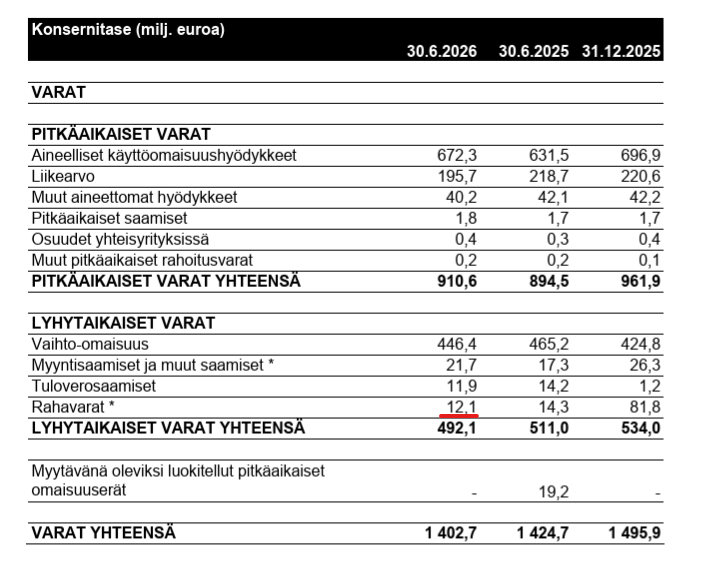
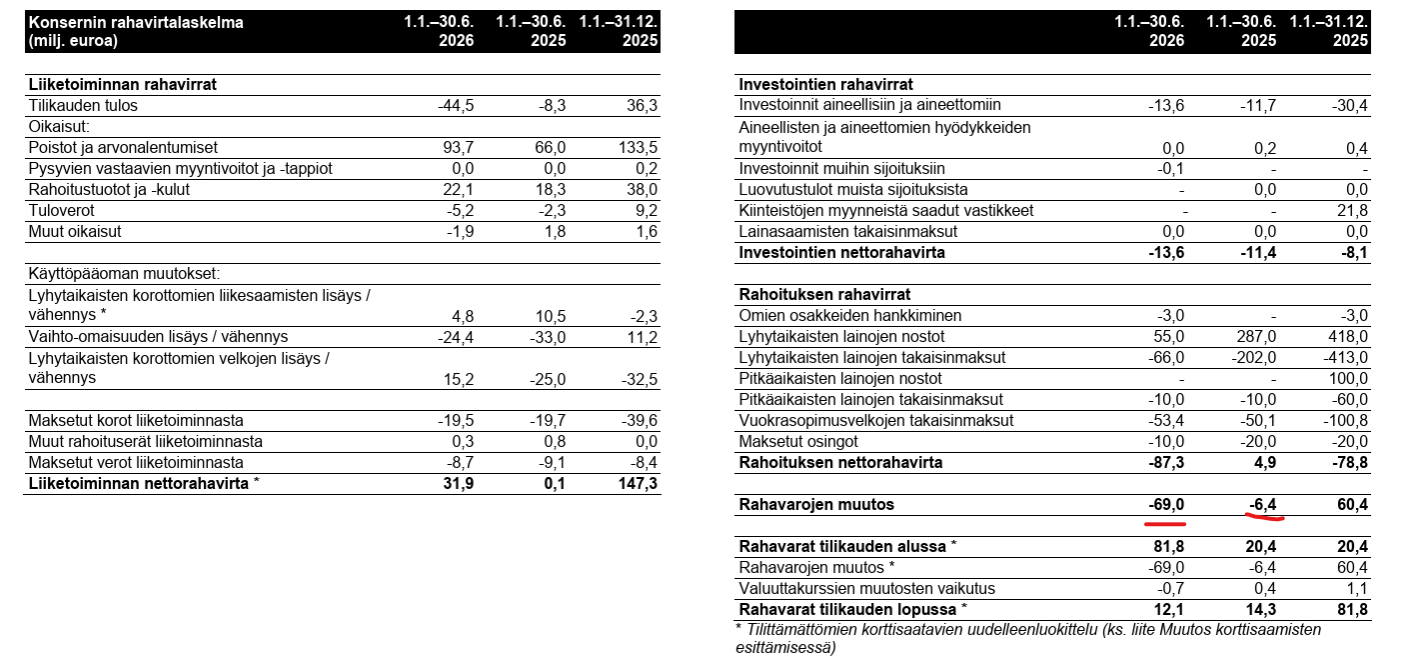
Maybe I’m looking at this from the wrong angle, but isn’t Tokmanni’s cash position actually quite thin?
At the end of H1, cash and cash equivalents were only €12.1 million, whereas at the end of 2025 they were still €81.8 million. On the other hand, the company simultaneously had €233 million in available credit facilities, so it’s hard to speak of an acute liquidity problem.
Still, the financial position raises some questions. Net debt/EBITDA excluding IFRS 16 was still 3.26x, financing costs are significant, and the cash buffer itself is very small relative to the company’s size and debt load.
Do you think the small cash position is just a result of Tokmanni keeping its liquidity buffer primarily in credit lines rather than as cash on the balance sheet, or do you see some kind of financing or liquidity risk here?
1 Like
Or is it because the warehouses are already bulging at this stage with Christmas season products, which have capital tied up in them and are being prepared for the best sales season of the year? In my opinion, it doesn’t make sense to compare the cash reserves to the end of last year, but rather to the corresponding period last year. Although there is a difference of a couple of million euros there too.
5 Likes
From last year’s report: “At the end of June 2025, the Tokmanni Group had a total of EUR 150.0 million (201.3) in drawable credit facilities, which consisted of financial institution loan agreements and a commercial paper program. Cash and cash equivalents stood at EUR 8.9 million at the end of June (13.9).”
So, the situation is better than it was a year ago, when the share price was still around 9 euros.
6 Likes
I would like to add one more thing to the thread: Päällysaho used quite strong language in the webcast: “Today, we do not see that the geopolitical uncertainty would be making any hurdles for us. We have a good position when it concerns product availability, maintaining supply chain, and we are well upfront with the seasonal preparations. From that perspective, we don’t see any clouds in the skies. We rather see a pretty bright skies for our sake.”
Elsewhere, if I recall correctly, it was mentioned that the Iran conflict affected consumer sentiment mainly during Q1 and the beginning of Q2.
8 Likes
I am certainly following the situation with Tokmanni with interest. There has been some very good discussion in this thread regarding the early-year results and the future perspectives for Tokmanni. Thanks to everyone for the comments. My first impression of the new CEO was positive, at least.
Given the branching out and acquisitions of recent years (Miny, Click Shoes), the several acquired brands (Catmandoo, Patricia of Finland, SPAR), and not to mention Dollarstore, I hope that management will dedicate all their time to improving profitability and the situation in Sweden.
When others see gloom, one must be brave. Perhaps the founding family of Puuilo has seen something in this that has led them to appear on the shareholder list. Could it be a good buying opportunity for those who believe that a turnaround can be achieved under the new management? I personally returned as a shareholder after the share price drop following the May earnings release, adding to my position again today. I am looking forward to the release of the new, updated strategy. “We have initiated an evaluation and update of the Group’s strategy and financial targets for the next strategy period.”
The new CEO’s first 100 days is a critical period that will determine future success. For Sampo, that date falls around October 13th, so I am waiting with interest for the Q3 earnings report on November 6th.
I would certainly love to see a strong example from the acting management now. New CEO, CFO, and others—is it time for stock purchases? Or is the price right? As previously mentioned in the thread, the price on the stock exchange is below Tokmanni’s IPO price (€6.70). 
P.S. I would love to see a video from Inderes on the situation at Tokmanni from an analyst’s perspective, and of course, it would be great to get the new CEO on ROAST! 
14 Likes
Over the weekend, I had time to dive into Tokmanni’s data and webcast. My conclusion is pretty much along the same lines as @Arttu_Heikura: I see slightly more risks in my scenarios.
First of all, welcome and congratulations to Sampo Päällysaho. It was interesting to listen to and get to know the new CEO for an hour. A pretty good set and start for Päällysaho. Nothing major was likely launched; rather, we will presumably hear Päällysaho’s guidelines in the next strategy update. Hopefully by the end of the boss’s first 100 days. More on those strategic alignment needs for Tokmanni below… Best of luck and success to Päällysaho in the role!
Praise and kudos for Päällysaho and the management:
- Tokmanni segment’s ability to control costs 22.4% → 21.2%. Rautiainen spoke about this for several quarters, and it is great to see that it didn’t just remain talk, but became verified action. It would be interesting to hear more about this from Arimo: what kind of trade-offs are behind the 5% smaller cost base? A great achievement!
- The potential of Tokmanni Klubi. The hardest work—getting phone numbers, emails, direct marketing permissions, and the app downloaded by core customers—has been pushed through. Hurrah – now it’s time to make money with this data!
- New DS stores are “EBIT neutral”. I didn’t bother to calculate in detail how much the IFRS16 tinkering (presumably) beautifies this, perhaps a little. But in any case, it shows that the new stores are fundamentally performing reasonably well. Great job, Tokmanni. You have clearly found good new locations! And we know that reaching full profit potential will take those 2-3 years, so more good things are coming.
Areas for improvement for Päällysaho and the management:
- H1 comp customer base -5.6%. That is a shocking pace, especially when compared to a market that was growing by as much as 6–8%?!?
- Why is the margin weakening despite the growth in Private Label share and Dollarstore’s joint purchasing? Private label development work also requires investments, but is it worth it if the margin just weakens? Or are we in a situation where even the current weak growth has had to be “bought with discounts”? That is famously only a temporary fix…
- Briefly checked, cash flow development came practically from the change in accounts payable. It’s not wrong, of course, and everything is accepted with joy. But it’s hard to continue that trick for several quarters in a row (unlike genuinely improving competitiveness).
Food for thought for Päällysaho, the management, and shareholders:
- Dollarstore’s competitiveness? The -€36m impairment size is almost half of the entire year’s comparable operating profit guidance of €85–105m. The idea of growth and synergies from the original DS acquisition has been completely eaten up. It wasn’t long ago that Rautiainen was talking about how €22.9m in annual synergy benefits had already been realized from Dollarstore. And despite that, we are in this situation. Now we are in a really unpleasant situation; the size and assortment synergy did not bring what it was supposed to. Now, expensive additional investments (competence, assortment, store updates) are needed for a new rise to be possible. A very high-risk operation, where capital allocation is extremely risky.
- Where are the verified financial figures for the Eurospar/Spar/grocery store strategy and the direction of Spar? We have only heard that the Spar conversion brings “double digit growth” to the Tokmanni side, but I think it is intellectually dishonest and lazy to state that this would be a good figure. E.g., 10% growth by adding a full-sized grocery store is a miserable result. What is the like-for-like (LFL) sales of the SPARs? Effect on gross margin? Size of conversion investments, EBIT, and payback period?
A year of piloting is now behind us, and a year of data has been collected. It is probably the right time to draw conclusions – a longer period of wondering eats away at trust, and a fear creeps into the owner’s shirt: has the worst happened to the management and board, i.e., “falling in love with one’s own ideas”?
A) If Spar works? → 50 new Spars fired up and maximum extraction.
B) If Spar doesn’t work? → Kill the idea and the grocery store hobby ASAP. It only takes attention, energy, and investments away from the most important things.
- What is Tokmanni’s growth recipe if network growth is no longer coming? Comparable growth figures are distressingly below inflation, and in H1, department store trade in Finland grew by 3% as well.
- Strategic ambiguity regarding the direction of the Dollarstore concept continues. We will expand, perhaps, if a good spot comes up. The new Dollarstore concept works and shows only excellent results in tests. BUT it is still maybe not being copied to other stores? Is the future Dollarstore big or small in selection—or maybe both?
@Arttu_Heikura, I hope we have found a good guy to be roasted here: Let’s hope Tokmanni dares to let the boss into the hot seat… Here are a few suggestions for warm-up questions 
- Why were Dollarstore’s concept changes and scaling started before the loyalty program, which tells about changes in customer behavior, had been implemented at DollarStore?
- Päällysaho and Arimo talked in the guidance about the improvement in consumer confidence, which has a positive effect on Tokmanni discount stores. However, when looking at the facts, over the last 10 years, Tokmanni’s best growth quarters have been when consumer confidence has been falling. And conversely, the growth in consumer confidence has been seen as lower growth figures for Tokmanni. As is well known, discount shopping is at its peak during recessions. Why would the next (budding) upturn be different this time, i.e., favoring Tokmanni relatively?
- Dollarstore customers liked the affordable “loss leaders.” However, Tokmanni removed them from Dollarstore’s selection, justifying it with the poor quality of the products. However, customers voted with their feet in Sweden because of this decision. Will the affordable products the customers liked be brought back to Dollarstore? Maybe even to Tokmanni as well?
PS. This forum is probably the highest-quality Tokmanni discussion in the world? If I were an analyst following Tokmanni, I would start my day with this discussion. In my opinion, different and mainly well-founded perspectives help develop one’s own thinking and understanding of the company. Would Sampo Päällysaho dare to be Tokmanni’s first CEO to join the forum (at least during the launch)? That, if anything, would be excellent investor relations. Don’t we already have good examples of this in a few threads on this forum?
32 Likes
Not really  , we get these for the company. Usually, the links don’t work or take you somewhere completely different from what’s being advertised. There’s no way to get into the wholesale side. The password reset link never arrives…
Sure, Puuilo is in the same boat. Tieto (Tietoevry) probably made the app in Finland. I mean, it doesn’t even work passably on the corporate side. The ERP is from before the dawn of time. Capital letters matter. It’s fun to tell them at the checkout that first a capital letter, then a period, then a space, and then another capital and xxxx Oy, otherwise it can’t be found 
This wasn’t related to the stock, but at least the corporate side of both companies is still in its infancy.
6 Likes
Yeah, ever since customer service merged the wholesale and old club accounts under the same email address, the app has been more or less broken since last year or the year before:
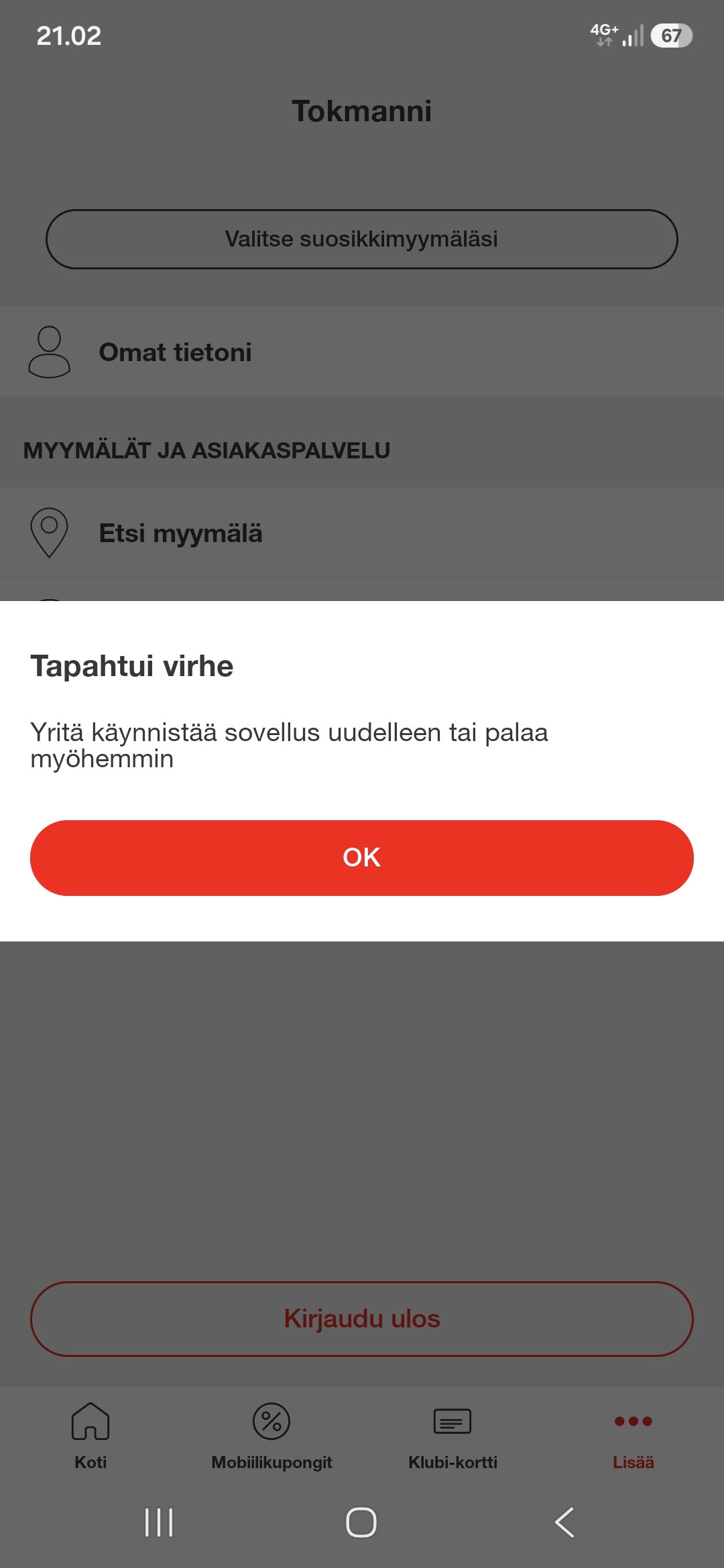
Even installing the Tokmanni app on a new phone doesn’t change anything.
1 Like
Absolutely unbelievable behavior. Surely these kinds of things should be fixed almost immediately. It’s just a matter of the basics again.
2 Likes
Let’s see if we can lure Päällysaho onto ROAST or at least get him for an interview
8 Likes
Apparently, the new CEO will be in an interview with KL today at 9:30 AM.
16 Likes
The CEO and CFO both made round-number purchases of 10,000 shares each: Tokmanni Group Oyj: Johtohenkilöiden liiketoimet - Sampo Päällysaho | Kauppalehti
Arimo was craftier this time, successfully bottom-fishing at €6.47, while Päällysaho had to pay €6.70 for his .
15 Likes
Is anyone reading the forum? The CEO did buy at the listing price, actually. 
12 Likes
Tokmanni’s recognizable red color has been shining on the stock exchange for quite some time, and now the share price has slid back to levels seen at the time of its IPO.  The latest write-down does not point to a quick turnaround for Dollarstore. By request from the forum, we made a video with Arttu about Tokmanni’s situation following Q2:
Topics:
(00:00) Introduction
(00:09) Early year performance
(01:16) Tokmanni segment and the recovery of the Finnish economy
(05:40) Dollarstore
(10:08) SPAR collaboration in Sweden
(12:27) Reaching the guidance
(13:53) Valuation picture
17 Likes