I have shoveled Tokmanni out of my portfolio for once, out of sheer cowardice.
Last year, the profit warning in July came on Friday, July 18th. The year before that, the July profit warning came on Tuesday, July 23rd. One could perhaps think that time is now slowly starting to work in Tokmanni’s favor, and if we don’t see a profit warning this week, we will start to be in safer waters.
If they manage to get through the next interim report without a profit warning, despite the development of the Iran crisis and a soft Q1, it will truly be a major achievement.
Changes to the Tokmanni Group Executive Group: Ulrika Göransson appointed Chief Strategy and Transformation Officer and Martin Sörenhag as Managing Director of the Dollarstore segment.
Ulrika starts on September 1 and Martin on November 1.
Ulrika Göransson is a highly experienced professional in commercial business and change management, with a strong background in retail, consumer brands, marketing, and strategy and business development. She currently works at OKQ8, one of Sweden’s largest fuel and energy companies.
Martin Sörenhag is an experienced retail professional with over 25 years of experience in retail in the Nordic countries. He has a strong background in management, business development, improving operational efficiency, and driving commercial growth in an international operating environment. He currently serves as the Nordic Managing Director of Flying Tiger Copenhagen, responsible for the company’s business in five countries and approximately 160 stores.
As an additional note, I hope they give Sörenhagen broad authority to whip the place into shape so that every single operational move doesn’t have to be submitted to Tokmanni’s Finnish management for approval. Time was wasted here, as they should have replaced Anders Kind with a countryman immediately, but better late than never.
These came out today, and after 6:00 PM tonight, a “summer profit warning.”
Let’s hope these changes get Sweden and Dollarstore moving as expected. It is somehow strange that 99/100 Swedes who come to Finland succeed, while 99/100 Finnish companies that go to Sweden fail.
This would indeed be desirable. For example, I believe Kesko’s internationalization model has proven to be operationally effective: acquired businesses operate under country-specific strategies, and local management is granted a great deal of autonomy. High-level decisions are then made by the Finnish management team (e.g., shutting down K-rauta in Sweden). In Tokmanni’s case, the framework seems to be set by the ongoing integration of product ranges and operating methods. The new management team now has a good opportunity to start with a clean slate regarding Dollarstore and to consider the strengths and weaknesses of the “old” and “new” concepts. For instance, to what extent will the product range be localized, and where will the group seek purchasing synergies in the future?
In principle, these appointments seem positive from the perspective of an internationalizing group and, in part, signal to the market that local expertise is needed to solve Dollarstore’s problems. The appointment of a Chief Strategy Officer was logical, as the previous one was “moved” to the position of Head of Sourcing and Purchasing at the beginning of the year, and no new person was hired to replace them. Sörenhagen’s background at Tiger as the new CEO of Dollarstore would point towards a modestly sized product range, i.e., a return to the old ways for Dollarstore.
According to the press release, Dollarstore’s current CEO, Heimo, is returning to Finland, but it was not specified in what capacity he will continue (if at all). Someone with experience from Verkkokauppa.com was hired to replace Heimo, who previously served as the group’s Supply Chain Director, so it is unlikely he will return to that role.
A completely expected move. Local expertise is definitely needed for the Swedish management. Now we wait with interest to see what happens with the product assortment. As I understand it, before the summer, they were pushing the Tokmanni assortment onto DS quite aggressively, but there might be a change of tune now.
One target price change from yesterday’s Kauppalehti flash news; analysts have a habit of fine-tuning those upwards before the interim report, though the positive news regarding the Finnish economy and the recovery of the retail sector likely play a part as well. In reality, only the turnaround of Dollarstore is essential in this case; naturally, if Tokmanni Finland continues to improve its pace, more will remain on the bottom line, assuming Dollarstore doesn’t perform even more anemically than before. The Q2 result is indeed next week Friday, August 7th.
Danske raises Tokmanni’s target price to 7.70 euros from 6.40 euros, reiterates hold rating.
“However, the turmoil in the management team might create a new point of discontinuity for the development direction of the Dollarstore concept, as the work history of the new appointees would support a more modest assortment, which contradicts the product range change/expansion program currently underway at Dollarstore. For this reason, Päällysaho’s comments on Dollarstore’s direction will be under a magnifying glass on earnings day.”
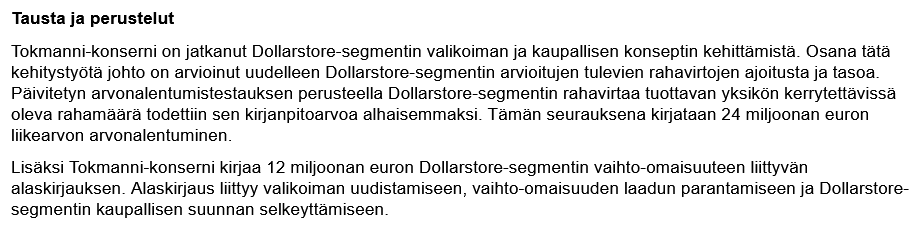
They definitely paid too much, but goodwill is tested periodically, and according to the company, it has now been determined that the goodwill has decreased: