Tokmanni’s Annual General Meeting (AGM) was held this past Tuesday in Mäntsälä at Tokmanni’s administration and logistics center, starting at 10:00 AM. After several years of failed attempts (Covid, train strikes, train delays, forgetting to register, etc.), I finally managed to attend as a car ride was arranged at the last minute. Getting there by public transport is somewhat problematic, as it requires a 40-minute walk to the headquarters after the train journey; even then, you’d arrive at the last minute and miss the pre-meeting coffee. It would be good for the meeting invitation to mention whether coffee is served before or after the meeting, as it is a well-established part of the AGM’s social interaction and important to many shareholders.
After the initial pleasantries, getting down to business: what I’ve written is based on the official speeches by Chairman of the Board Erkki Järvinen and CEO Mika Rautiainen, the Q&A session, and background conversations with Tokmanni’s loyalty program manager and a board member both before and after the meeting. As usual, I grant myself indemnity for any potential memory lapses or misunderstandings.
To recap some basic figures: the Group’s employee count is 6,500, with revenue split between Tokmanni Finland (72%) and Dollarstore Sweden (28%). Sales of daily goods (FMCG) have been growing as a trend, now at 53.5%; it’s worth noting that margins here are lower than in general merchandise. Store counts: Finland 242 (including Click Shoes), Sweden 139, and Denmark 11. In Finland, Tokmanni owns only one store property; in Sweden, they own seven, while all others are leased. There are already 5,900 shared products group-wide. There is a consistent effort to increase the share of private-label products; Kotikulta has been a hit in Sweden. The Spar cooperation is working well, and the share of “food Tokmannis” is being increased so that customers can get everything they need from the same shop. Some food and beverage products will be launched in Sweden in the near future.
Consumer confidence remains low, although it is clearly better in Sweden than in Finland. Foremost in the consumer’s mind is conscious consumption, sensitivity to campaigns, and monitoring offers—price comparison is easy nowadays. Additionally, the competitive landscape has changed: global platform players are increasing their sales, and international retail chains are expanding rapidly. Tokmanni aims to respond to these with familiar methods: cost discipline, improving the price-quality perception, focus on profitability, a low-price program, a joint purchasing organization, and inventory management. The goal is price leadership; it was noteworthy that they took first place in Aftonbladet’s shopping basket comparison in Sweden. The loyalty program plays a significant role; of the three million members, about a third use the Tokmanni app, which is very user-friendly on its home screen compared to those of other chains. Hard work is being done to get those “phone number shouters” at the checkout to use the app instead. There isn’t an equivalent in Sweden yet, but ideas are being pitched to Timo Heino (responsible for Sweden) all the time.
Tokmanni remains the market leader in categories like yard and garden products, and these are being expanded in Sweden and Denmark as well. Rautiainen emphasized that H1 last year went poorly due to the weather; reading between the lines, one could boldly interpret that the same isn’t happening this year, since it was specifically mentioned. In the general merchandise side, toys are also selling well, and in other categories like interior design and clothing, they are near the top of the market. In daily goods, personal hygiene as well as laundry and cleaning are important categories, and the amount of food products is, of course, increasing.
Dollarstore is what particularly interests investors here, and management spoke candidly about it being a turnaround case. The issue is that they’ve tried to increase the share of 50-krona products in sales, which has led to a loss of customers. The problem is that the previously popular 10-krona products were often of poor quality, and in Sweden, one can even be fined for selling poor quality—besides, this doesn’t align with Tokmanni’s image of sustainability. When I asked directly whether the poor quality of these products came as a surprise when the acquisition was made, Rautiainen admitted this was partially the case, as there wasn’t visibility into all products. I also asked somewhat provocatively how they intend to market this to customers—“we used to sell junk for 10 krona and now quality for 50 krona”—this received a very complex answer, and I don’t recall any specific methods being highlighted. However, the aim is also to grow Dollarstore’s store revenue; in Finland, the average store generates six million in revenue, while in Sweden, it’s only three million. The turnaround simply won’t happen overnight, as they were careful to mention.
Two new members were elected to the Board to replace one departing member: Katarina Gabrielson, who is the CEO of Oriola (I don’t know if that’s much of a merit, but it’s good to get a Swedish perspective on the Board), and former Stockmann CEO Jari Latvanen.
The dividend was confirmed at €0.17 in the spring and €0.17 in the autumn according to the Board’s decision. Kim Lindström was present and presented Tokmanni’s rather volatile dividend history. He asked why the autumn dividend couldn’t also be decided at the AGM, noting that things went poorly last year when it was left unpaid entirely. It would certainly increase market confidence, but the Board wants to see the earnings performance first and keep this under their own control.
I was still wondering about the fate of the former head of Sweden, Anders Kind, but as one board member told me: when they aren’t satisfied with the work performance, options are limited. Sourcing cooperation with the Norwegian company Europris continues, even though the companies are now competitors in Sweden (ÖoB).
The management presentations were quite commendable, and the answers to questions were fairly straightforward—points for that. The new CEO, Sampo Päällysaho, who starts on July 1st, was present in the audience as a shareholder and introduced himself briefly. I must also mention separately that the management team and the Board were seated in the auditorium on both sides of the stage sideways, facing the audience—a very commendable practice; the back of the heads of “mountain councillors” (vuorineuvos) at large corporations have become all too familiar .
.
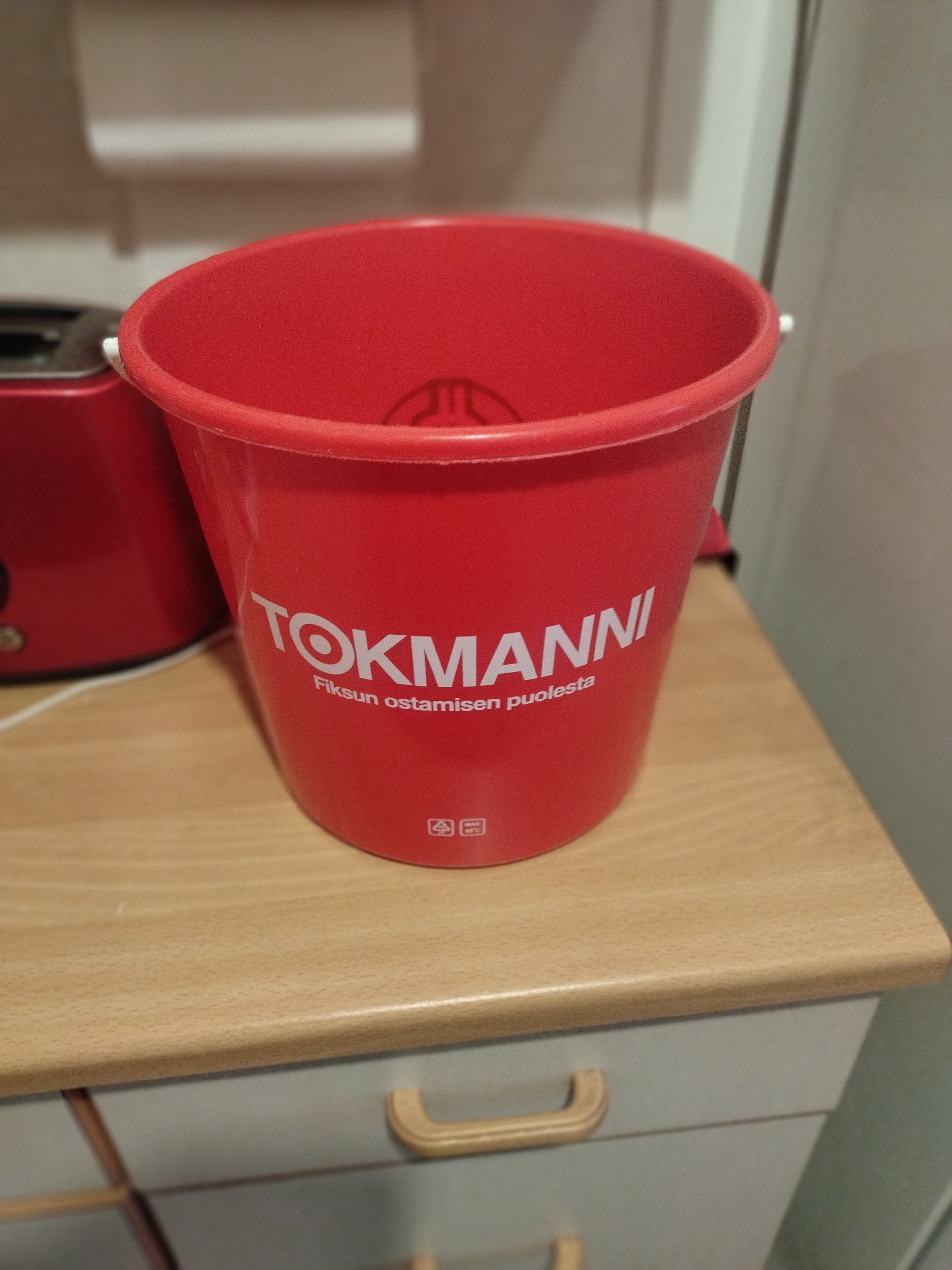
“Physical dividends” offered were butter-eye buns (or something similar) and a couple of types of cookies. Naturally, upon leaving, a red bucket filled with Tokmanni’s product range awaited the meeting representatives.
Adding a picture of the symbol; the bucket has, of course, been emptied. And indeed, bucket queues have also been seen at store openings in Sweden; the Dollarstore logo can be found on the other side of that bucket: