• New DMS design win with a European sports car manufacturer
• Expansion of an existing design win in commercial vehicles
• Tobii surpassed one million vehicles equipped with the company’s interior sensing solutions
• Agreement with a leading global consumer electronics player to integrate Tobii’s eye tracking system into tablets
Comments from the CEO
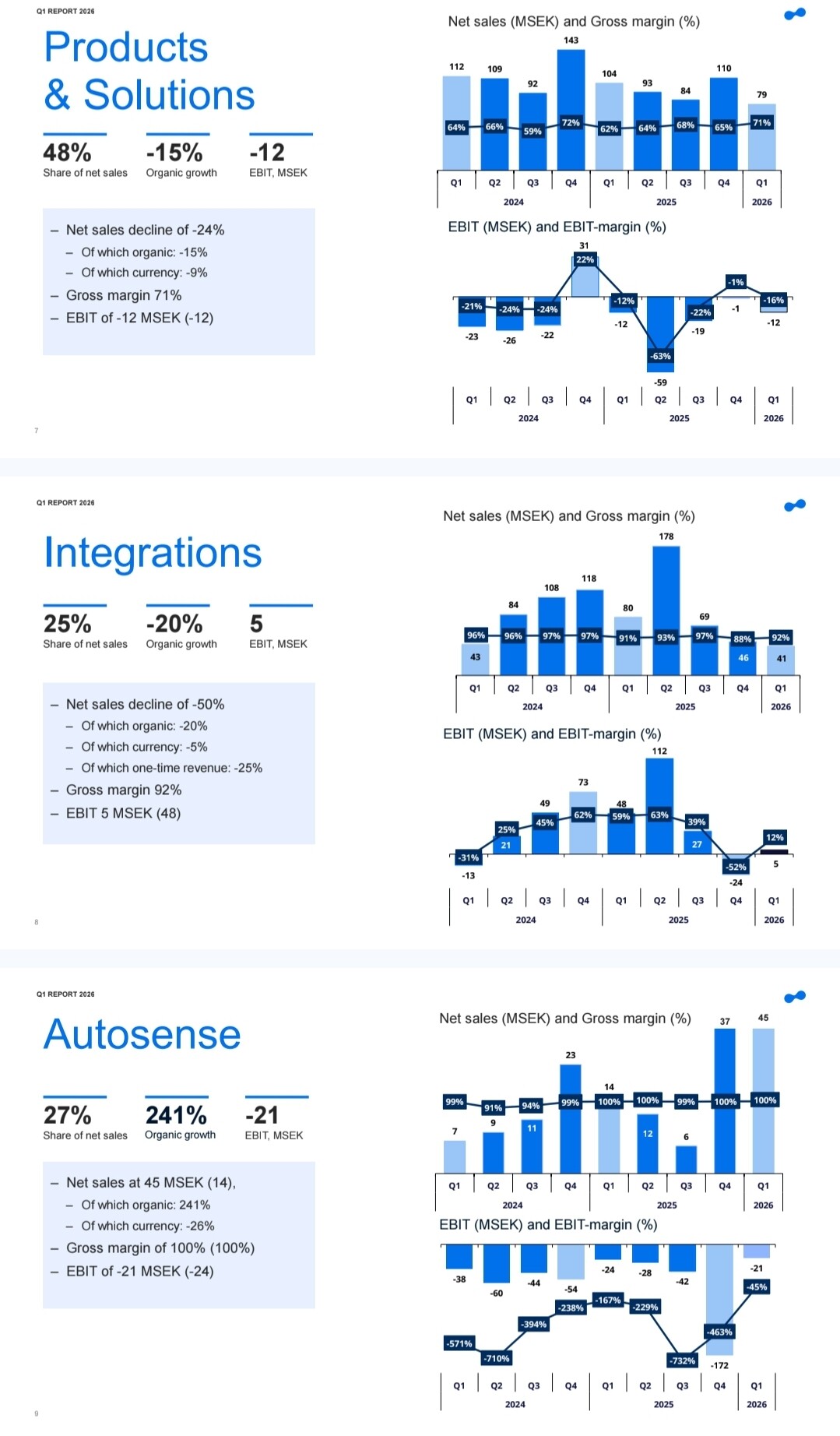
In the first quarter of 2026, we report increased gross margin and improved free cash
flow. Net sales were negatively affected by the challenging currency development and
market situation but still generated organic growth of 5 percent. The commercial
achievements during the period include, among others, a design win for our webcam-
based eye tracking technology with a global supplier of consumer electronics as well as
a design win for DMS for a sports car manufacturer. Our cost reduction target of SEK 100
million by the second quarter of 2026 was exceeded.
An agreement with the company’s bank on a new credit facility was reached after the
end of the quarter.
The strategic review of the Board of Directors and management has led to concrete
discussions with external parties during the quarter.
Tobii Nexus selected as the eye-tracking software for Lenovo tablets.
“We are very excited to see the first consumer device featuring webcam eye tracking enabled by Tobii Nexus. Lenovo has found a very innovative way of utilizing the possibilities provided by our webcam eye tracking to create value-adding new features to how users can interact with their product”, said Gunnar Troili, acting senior vice president, Integrations, at Tobii.
A new achievement for Tobii’s Nexus software. External researchers have confirmed that Nexus is accurate enough for real-world research. This should significantly lower the threshold for researchers to become Tobii customers, as separate hardware is no longer required.
*Tobii launches webcam eye tracking for research
2026-06-04
A new software-based solution and add-on to the Tobii Pro Lab workflow that transforms any webcam into a research-grade eye tracker. The solution facilitates scientific studies by reducing the need for specialized hardware.
Tobii, the global leader in eye tracking and pioneer of attention computing, today announces the launch of Webcam Eye Tracking for Research — a new solution that makes eye tracking studies more accessible and helps researchers reach broader and more diverse participant groups by turning any webcam into a powerful eye tracker.
Expanded participant reach and studies in real-world situations
Thanks to the software-based solution, researchers can use Webcam Eye Tracking for Research to conduct online studies and collect data from participants’ own computers. This enables reaching more participants and reduces the fieldwork associated with data collection. The solution also facilitates the study of screen-based behavior in participants’ natural everyday environments.
“Webcam eye tracking for research expands our product offering to the research community by providing an easy way to conduct remote studies in research areas where our high-performance, hardware-based eye trackers are not essential to achieve sufficient data quality. At the same time, the core principles of eye tracking research are maintained: structured study design, controlled data collection, and systematic analysis,” says Gunnar Troili, Chief Product and Solution Officer at Tobii. “It is more than just a tool — it is an extension of the Tobii Pro Lab ecosystem, developed to help researchers use eye tracking in new contexts with familiar methods and workflows.” Validated by researchers
The solution is based on Tobii Nexus technology and has been validated by researchers at Uppsala University. Their evaluation shows that the performance is suitable for many adult participant research setups using Area of Interest (AOI)-based attention metrics, such as so-called preferential looking tasks.
“We were surprised by how well Tobii Nexus performed right from the start. This technology is an important step forward in eye tracking research,” says Kim Astor, Postdoctoral Researcher at the Department of Psychology, Uppsala University.*