On the contrary, more doctors almost always mean additional costs. Doctors often incur costs by examining and ordering various tests. For example, USA vs. India. Training places have practically increased significantly in recent years, as a large portion of future Finnish doctors study abroad. That’s a good thing, because 6 years of basic education costs easily over 100k per person.
p.s. The solution to the problem would be 1) one large special responsibility area (erva) a la NHS (current situation: over 300 municipalities) and 2) population TFR growth over 2.1 children/woman.
1 Like
This is a bit off-topic, but a few years ago, the number of medical school slots was increased by +25%. Additionally, 15-20% of medical students are studying in foreign faculties, which many people might not know.
In my opinion, it would be good to first assess what effects these changes will have. It will still take 6 years (a few years from now) before results start to show.
I encourage increased competition in the field, although I’m not sure if excessive populism and doubling the number of study places will ultimately have a favorable effect on both the cost and quality of care in Finland.
Compared to other OECD countries, I believe the salary level for doctors is quite moderate, which is also fair considering the free education for students.
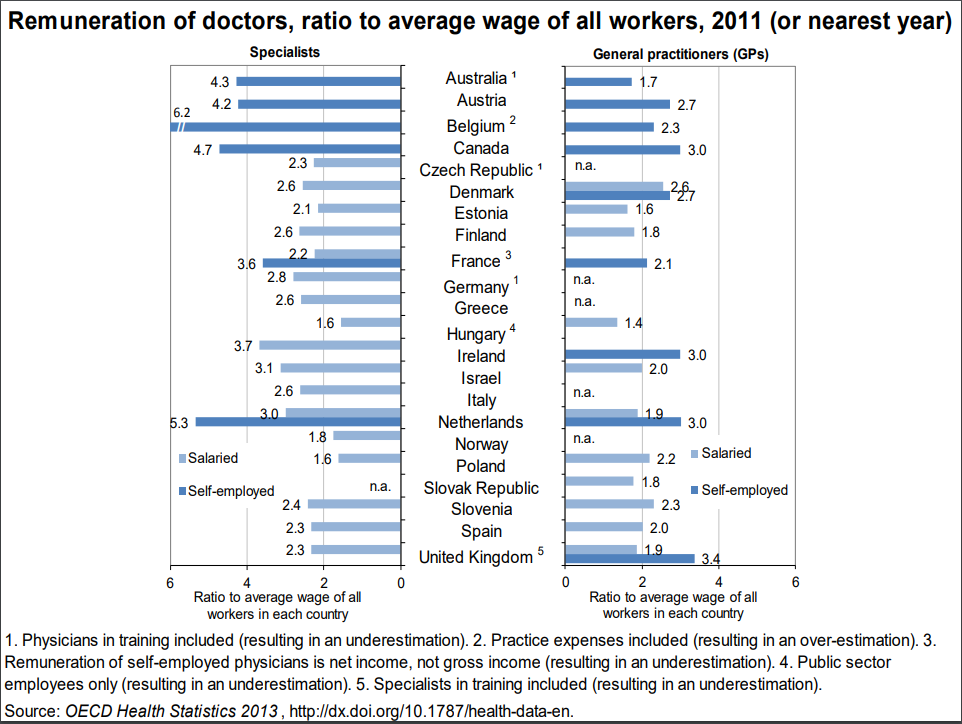
Perhaps the truth lies somewhere between the Finnish Medical Association (Lääkäriliitto) and the loudest opponents of doctors’ salary levels. Perhaps, above all, caution is key; if a politician, for example, were to propose doubling study places before seeing the effects of the previous increase, especially during an election, I wouldn’t take their other likely populist statements very seriously.
The video provides a good overview of the situation from the perspective of a rural municipality: https://www.terveystalo.com/fi/julkiset-palvelut/referenssit/Rantasalmi/
In public procurement, the municipality tenders out outsourced services at a fixed price, and the service provider roughly earns a profit based on how effectively they can deliver services more efficiently than a municipal operator. From the citizen’s perspective, access to services generally speeds up, as it’s easier for large organizations to manage customer demand and service delivery.
2 Likes
And the services are usually produced on municipal premises, which does not require investments from companies
1 Like
Great that we got this under surveillance. I’m eagerly awaiting buying opportunities.
6 Likes
Lukewarm bump.
TT is at somewhat more reasonable prices, the social and health care reform came and went, and now I’m triggering a bump with CEO news.
So, the new CEO Iho was supposed to start and start in the second week of February.
Yrjö was only supposed to quit then.
Now Yrjö left like, well, whatever…
The CFO was appointed as interim for that time.
No particular reason was given for the situation, so it sounds quite suspicious. “Available if needed.”
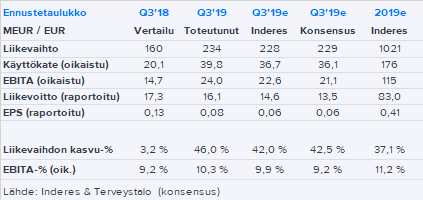
Terveystalo once again delivered excellent results, exceeding both our and the consensus forecasts. Broad-based growth continued, and organic growth in particular was pleasingly excellent (approximately 7% according to our quick calculations).
4 Likes
So now you can make Terveystalo coffee. While waiting for Capman..
3 Likes
Great, thanks for the good analysis, I dared to add it to my portfolio this autumn despite the somewhat high-seeming price!
2 Likes
I myself have been following Terveystalo with interest since its IPO, but I haven’t jumped on board yet. Now, however, I’m seriously considering buying this stock. I still need to study it more carefully before making a purchase decision.
In another thread, @Gerald_of_Rivia, you mentioned being in the industry and considering Terveystalo a somewhat risky investment. May I ask what kind of risks you see associated with Terveystalo’s development? Or what do you think of Terveystalo as a long-term case?
1 Like
Hey,
So I don’t consider Terveystalo to be any riskier an investment than other listed companies. In the message, I stated that it’s a quality company and my own fears are possibly very unrealistic.
Here are some of my own thoughts. A lot depends on how the Finnish economy will develop. With the weakening dependency ratio, the entire healthcare sector will undergo a major upheaval at the latest in 20-30 years. There will be more and more people to care for, expectations for the quality of care will grow, and at the same time, resources will continuously decrease. If we continue on this path, at least public healthcare will inevitably face a crisis. I don’t believe that private providers will be saviors in this situation. The justifications for this are very complex, and I don’t have time/ability to properly elaborate on them here, maybe someday I’ll vomit out my long subjective view on the matter  Additionally, in a potential healthcare crisis, populists will surely be blaming “all sorts of profiteers,” and the political risk is therefore big. Private healthcare is also possibly much more cyclical than one might think, even though one might easily consider it a defensive investment.
But if things continue as they are, it’s probably worth owning, it was a mistake for me to sell it too. I originally bought it with a very quick decision because Mr. Market offered it at a discount, and I didn’t do any deep analysis of the company. You absolutely shouldn’t base what you do with the stock on my subjective views. I personally prefer to hold other stocks.
1 Like
It’s quiet in the Ttalo thread. What do you think about the valuation? I jumped off the ride with shares bought at 8€ at the 11.5€ level when the P/E was over 20 with this year’s multipliers. Now it’s probably over 23, wild multipliers for a company that grows about 5% a year, or maybe the market knows something I don’t. I do consider it a high-quality and defensive company, but I don’t think it’s going to become a Talenom or Revenio after all 
2 Likes
I myself have stayed invested, even though the valuation is admittedly quite high. The market has long been willing to pay a high price for defensive investments, even without growth (case Orion  ). That’s why I’m not afraid that the upward trend would quickly reverse without a turn in the entire market.
Now, large social and healthcare outsourcing deals are again in the news, where in Finland there are practically only two players left in the market: Terveystalo and Mehiläinen. Terveystalo’s reputation is better in my opinion, so one could think TT would be the most preferred partner?
I’ve also been following Terveystalo “with that eye” for a while, but the price is really scary. How about that Päijät-Häme deal? If it materializes, it would probably be a pretty tasty deal for TT as well. Has this already been taken into account in the current valuation multiples? Does @Olli2 have any insights on the matter?
1 Like
Hey
The discussion on social and healthcare services in Päijät-Häme reveals more about the bigger picture, specifically the financial distress of municipalities, which leads to long queues in the public sector and, for example, a lack of funds to invest in digital services. Demand consequently shifts to the private sector, either through outsourcing or through individual customer choices, even without outsourcing. This, combined with an aging population, supports the growth outlook for private healthcare services, which also bolsters their valuation multiples.
The specific planned deal itself should not be reflected in valuation multiples, as the Päijät-Häme outsourcing deal for the joint venture would be approximately EUR 65 million per year. The shares would be 51% for the healthcare giant and 49% for the municipal federation.
Currently, about 50 percent of doctor and nurse services in Päijät-Häme are already outsourced to private providers through smaller contracts. In Lahti, the southern and central local clinics are managed by Mehiläinen, and Terveystalo operates elsewhere in the region.
So, a rough calculation suggests that the total outsourced turnover to private providers would not change significantly. Of course, in this model, the winner would be either Mehiläinen or Terveystalo, and it would enable more efficient management of the care chain, as the entire entity would be under the control of a single operator. Mehiläinen and Pihlajalinna have experience with joint ventures elsewhere, and it is possible that they would have a slight advantage in the tender process compared to Terveystalo.
3 Likes
4 Likes
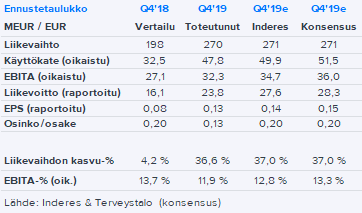
Terveystalo once again advanced strongly but fell slightly short of high market expectations. The dividend also fell short of expectations, but the company maintained the option for an additional dividend of the same amount.
7 Likes
Dividend fell short of expectations? I think it was the opposite.
· The Board proposes to the Annual General Meeting that a dividend of a total of 26 (20) cents per share be distributed in two installments[4)]
4 Likes
True, good correction
4 Likes
It’s been quiet for a while, let’s open a discussion.
- How do you see Terveystalo’s (Terveystalo) situation in this corona chaos?
- Does anyone know what caused the share price to drop by -5.5% today? (I know there’s some minor turbulence in the stock market, but is there a more specific reason?)
Hoivatilat, Pihlajalinna, and Terveystalo have all been in the portfolio. Due to recent acquisition offers, only TT (Terveystalo) remains. I see that TT’s (Terveystalo) position, especially in the private sector, is strong, and competition with Mehiläinen will be tough and interesting. One would think, however, that the Corona (COVID-19) situation could benefit TT (Terveystalo), especially since it is now relatively clear that the public sector will not necessarily be able to handle all treatment. Today, there was news that TT (Terveystalo) will start Corona (COVID-19) testing.
1 Like