If the report’s forecasts materialize, the market would likely remain supply-constrained for some time, as it takes time to ramp up new capacity (which will inevitably be added eventually if the boom is permanent). This would, of course, be an excellent operating environment for Suominen and other producers, and the industry’s normal challenges (e.g., capacity increases and raw material inflation) would hardly be an acute problem.
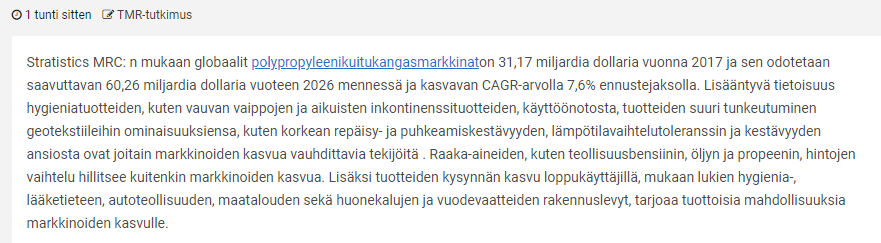
However, the market size presented in the report seems enormous, and I strongly suspect that only a relatively small portion of the market size presented in the report is relevant to Suominen.
Are you basing your assessment only on the presented market size, or are there clear shortcomings in Suominen’s product range that would prevent Suominen from participating in the entire market?
The summary does not explain how the market size was calculated. Markets can be calculated, for example, based on the retail value of finished products, but Suominen, of course, does not manufacture finished products; it supplies rolled goods that need further processing. Therefore, Suominen’s achievable share of, for example, the retail sales value is significantly smaller than the entire pie, as each part of the chain covers its own slice of the total pie. But it’s hard to comment more specifically in light of this information.
In the comprehensive report, I have printed Suominen’s relevant market (before Corona, of course) as an estimated size of 2.1 billion dollars (which would correspond to about a 20% market share for Suominen). I have marked Suominen as the source, so the information is likely from the company’s materials (I would guess CMD materials from 2015-2018, but for some reason, I couldn’t open them now). However, the report has gone through fact-checking within the company, so I believe that the issue would have come up if the relevant market were indeed the mentioned approximately 10x larger. Furthermore, the idea that Suominen, which declared itself the global market leader in wiping products years ago, would have a couple of percent market share of the relevant market, doesn’t really make much sense to me personally.
{“content”:“Thanks for the good and logical answer. Defining market size by the retail price of finished products could very well be the reason why the numbers are so large compared to Suominen’s earlier estimates.”,“target_locale”:“en”}
Could something be inferred from this tonnage estimate? The volume of nonwoven material will rise across the same period. From 1.44 million tons in 2020; to 1.97 million tons in 2025.
According to Suominen, “The consumption of nonwovens manufactured with hydroentanglement technology in Europe was 322.9 kilotons in 2019. In the Americas, the consumption of nonwovens manufactured with hydroentanglement technology was 334.2 kilotons in 2019.”
At that time, a total of 0.7 million tons were manufactured with hydroentanglement technology, which could match the report, considering that it’s only one technology.
Could a significant difference in Euro amounts be explained by retail prices? If so, then it would be understandable that the “raw material” producer’s revenue is only, for example, a tenth or a quarter of the consumer price, which includes the margins of distribution, packaging, branding company, etc.
If these two were combined, would it be possible that the market is relatively relevant and the growth forecast would be quite current for Suominen’s market as well?
Yes, this could be possible in my opinion. The growth of non-woven fabric markets relevant to Suominen was expected to be in the range of 2-5% in developed countries and even higher in developing markets before the corona (it is not clear whether this forecast has materialized historically). Even a 5-6% CAGR until 2025 is not a particularly high forecast, if the 2020 demand surge does not stabilize and the corona leaves long-term effects on demand.
I no longer believe in an actual profit warning for Suominen this year (there have already been a couple), as the wording of the guidance is, as I understand it, at the most positive end of the scale typically used by listed companies. An preliminary announcement of the full-year result in January is not an impossible scenario, especially if the company had significantly exceeded market expectations in Q4. There is, of course, only just over a month until the Q4 report is released, so there isn’t a particularly long time to wait until we get more information about Suominen.
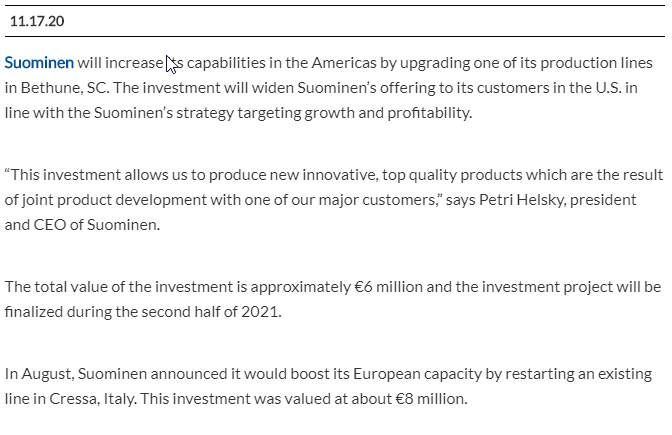
OK. At the same time, I have to ask, since you predict that revenue will decrease next year, what is that based on? The company invested in Italy in August and just announced investments in the US right now.
The biggest significant negative driver in next year’s revenue forecast comes from a stronger EUR/USD exchange rate. I have predicted volumes to fall slightly from the very high level of 2020 (this will be corrected upwards later if demand continues to grow without dips despite the likely calming of the pandemic). Prices/product mix will add a small positive to revenue in my papers next year. I don’t count particularly much on the investments starting in H2’21 for next year, as it usually takes a while to ramp up investments.
How do you see the impact of rising pulp prices on Suominen’s profitability?
This year, Suominen has had a “star alignment” in terms of demand, raw material prices, and thus margins. Now, however, a lot of new capacity is coming into nonwoven production, and at the same time, pulp prices have started to rise for the first time in a long time.
In my estimation, different pulp grades account for about 20% of Suominen’s raw material usage. Therefore, the rise in pulp prices is not good for Suominen, especially considering that half of the contracts are tied to raw material clauses (which supports Suominen when raw material prices fall and penalizes it when they rise). Of course, pulp alone is not a massive driver, but there is upward pressure on other raw material prices as well, due to prices having fallen to quite low absolute levels. In the prevailing demand situation, however, the “open” half of the portfolio likely has better-than-normal opportunities to compensate for rising raw material prices through direct price increases.
In summary, I would say that, in my opinion, the anticipated normalization of this year’s exceptionally favorable raw material price situation is one of the most important reasons why I personally do not expect earnings growth from Suominen in 2021. However, linear earnings growth expectation does not seem to be baked into the stock price, in my view.
Thanks for the quick reply! I guess this year will indeed be an anomaly for Suominen. Even though different pulp grades represent “only” 20%, the impact of rising pulp prices on material costs remains moderate.
Suominen also already has a nice selection of products that meet green criteria. This is probably some kind of competitive advantage in the market. I’m just speculating, as I haven’t studied the competitors enough, but I would assume that Suominen is a pioneer in these biodegradable products?
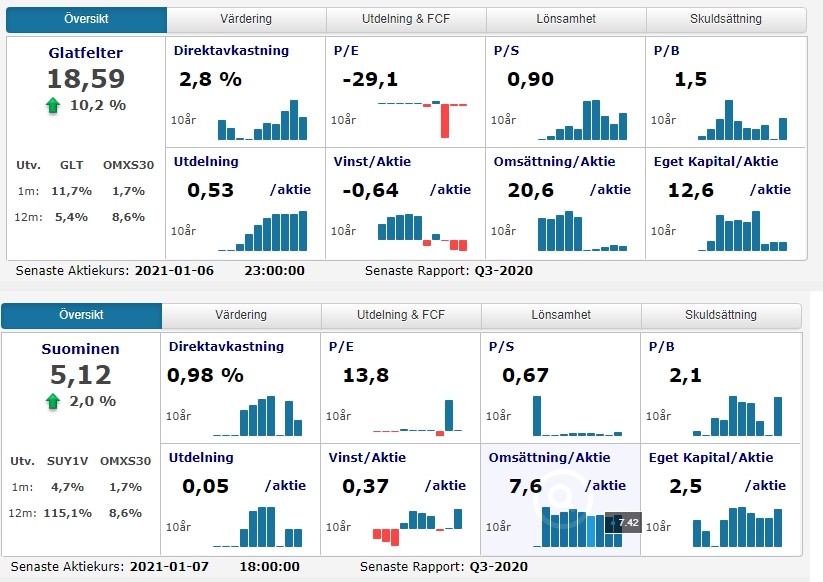
Interesting deal where they’re buying a pretty straightforward peer business (wipes). EV 175M€ and sales 100M€, Ebitda 20M€, synergies 4-6M€. So, EV/EBITDA 8.8x and post-synergies 7x. The technology is slightly different.
Suominen’s EV/EBITDA is 5.4x, meaning there’s a valuation difference even when considering synergy benefits. At the same time, the buyer’s stock is up +10%, so it’s clearly an “underpriced” deal.
Overall, the market cap increased a lot, so it looks good for Suominen, as the target was “dirt cheap.”
Glatfelter’s market cap rose by EUR 75 million, indicating a valuation of EUR 250 million, or 10x EBITDA post-synergies. That’s a big deal, though it was a generally upward day today, so perhaps it would have risen by EUR 25 million anyway, but still, 9x purchased EBITDA…