Everyone can take that iron issue however they like… It’s true that Solein contains a lot of iron. Solein has 110mg of iron/100g, and the upper limit for safe daily intake is 45mg, which is about 50g of Solein. But because Solein contains poorly absorbed non-heme iron, only about 10% is absorbed, so the upper limit for safe daily intake would actually be 500g. When you consider that Solein isn’t intended to be eaten as is, but replaces proteins in various food products, you could assume that a finished food product contains only one-fifth pure Solein, meaning you could eat 2500g of the finished product per day. Since a person’s diet usually consists of many other foods besides just Solein-based ones, I wouldn’t see a direct problem with iron intake from these finished products.
Intake recommendations refer to the amount of iron consumed. Not the amount absorbed. This is because so many factors affect absorption, ranging from individual differences to the substance consumed. In other words, the limit considered safe for consuming iron is that 45mg/day.
In a comment I wrote in this thread, I have linked to a very extensive scientific study on iron (and other trace elements):
A source doesn’t get much more authoritative than that.
Edit. Apparently that link to the book is broken. I’m linking directly to the section of the book where iron is discussed. https://www.nationalacademies.org/read/10026/chapter/11
I recommend reading facts from research rather than just asking AI, as long as there is literature/research available on the subject. AI is prone to hallucinating all sorts of things.
AI went through your link and had this to say. I don’t have the expertise myself.
Is there anything negative in this? A negative perspective can only be found in certain scenarios, and they mostly arise in discussions (e.g., on the Inderes forum or other places):
-
Risk of hemoglobin or iron overload (e.g., hemochromatosis, hereditary iron storage disease): For healthy men (and postmenopausal women), iron requirements are low (as noted in the report: 6 mg EAR / 8 mg RDA), so if Solein is used in large quantities (e.g., 20–30 g of protein per serving → ~25–40 g of Solein is needed, resulting in 27–44 mg of iron), it can exceed the daily upper limit (UL 40–45 mg/day for adults) in just one serving. This is a risk for the few who have a genetic predisposition to accumulate too much iron – but it applies to a very small part of the population (not a common problem in Finland).
-
Absorption: Not all iron in Solein is as well-absorbed as heme iron from meat (estimated heme iron share ~5% in some discussions), but it is still non-heme iron, which is enhanced by Vitamin C etc. Still, a large dose can lead to high intake.
-
In practice: If Solein is used moderately (e.g., 10–20 g/day in products), the iron intake remains at 11–22 mg, which is perfectly safe for most and even beneficial for many (especially women, vegetarians, athletes).
In summary: The previous answer emphasized the low iron requirement in men (6–8 mg/day for balance), but Solein’s high iron content is not “negative” in general – it is a strength for most users and a marketing asset. It can only be negative for those who already have high iron stores (high ferritin) or a hereditary sensitivity to iron overload. For most Finns (where iron deficiency occurs more frequently than overload), it is a plus.
Daniel and Thomas discussed Solar Foods in light of recent news. 
Topics:
00:00 Introduction
00:17 Share issue
02:10 Implementation of the directed offering
04:34 Factory 02 project
06:47 GEA as anchor investor and strategic partner
09:12 Next crucial steps
11:08 Commercialization development
13:38 Investment profile
Thomas has written a new company report following the latest developments at Solar Foods.
The successful EUR 25 million capital raise removes the liquidity risk that had been overshadowing Solar Foods, demonstrates partner and investor confidence in the Factory 02 investment, and gives management much-needed room to maneuver for the commercialization of Solein. In our view, the capital raised and the confidence shown by strategic partners and investors in Factory 02 have improved Solar Foods’ chances of realizing an industrial-scale production facility. We have updated our forecasts to include the effects of the share issue, but otherwise, our expectations remain unchanged. We reiterate our target price of EUR 5.3 and our Reduce recommendation.
Generally, I still assume that the main impact caused by iron will be restrictions on Solein concentrations and various use cases, such as foods consumed in large daily quantities, like pasta or bread. Of course, the risk of black swans can never be completely ignored in business.
As I understand it, in Solar Foods’ key markets (USA, EU, Japan), the primary responsibility for food products generally lies with the operator that brings the final product to market. In this case, the consumer brand instead of the ingredient supplier, Solar Foods. This means they bear the primary responsibility for product use, dosages, and adequate warning labels on packaging. However, from Solar Foods’ perspective, it is critical that the information provided by the company regarding product risks and, for example, the amount of iron is accurate and that the supplied ingredients are not defective.
So, through contractual technicalities and strategic choices, the company can protect itself from risks, but of course, product-related warning labels might be off-putting to some partners or end customers. Against this background, it seems logical to me that Solar Foods focuses on food industry companies rather than restaurants. In restaurants, information conveyed to consumers about product properties is generally more limited, and especially in buffet-style serving, the risk of excessive consumption is harder to manage.
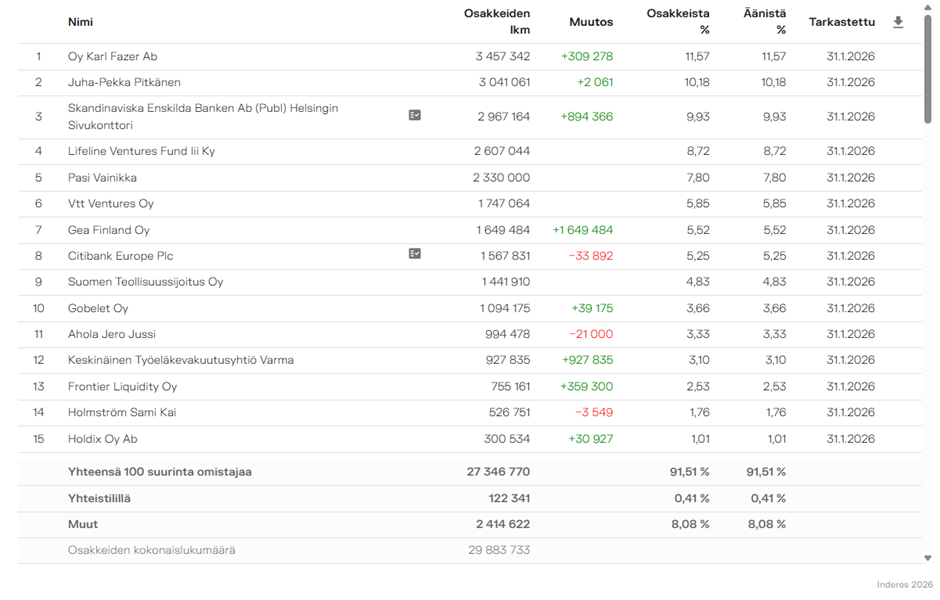
Solar Foods’ shareholder list at the end of January was particularly interesting following the recently completed share issue. Gea, as the anchor investor in the issue, has naturally increased its holding the most. It is encouraging to see that Solar Foods’ largest owner and strategic partner, Fazer, participated in the issue, which signals confidence in the Factory 02 project. A significant portion has also gone under SEB’s nominee registrations. Varma, Veritas, and the Finnish Broadcasting Company’s (Yle) Pension Fund have also joined as new investors. The participation of pension insurance companies is very positive, as they have completely different resources compared to the average investor to support the ramp-up of an industrial-scale production facility.
Here are Thomas’s preview comments ahead of Solar Foods’ H2 results on Thursday, Feb 26.
The company’s earnings release can be followed here at 12:30. On the day of the results, our attention will be focused on the commercialization of Solein in the United States and the next steps for the Factory 02 project. The project is supported by a significant funding round completed in January. H2 revenue will remain small, but management’s comments on the progress of Solein’s commercialization and the order backlog will play an even more central role.
In 2025, approx. 6 tons of Solein were sold.
The capacity of the F01 factory is reported as 160t/year. So, approx. 4% of the capacity was sold.
(€0.1M revenue, Solein €17/kg)
Thomas interviewed Solar Foods CEO Rami Jokela following H2
Topics:
00:00 Introduction
00:14 Work done towards commercialization
01:36 Focus areas for commercialization for 2026
04:53 Supporting customers and product development
07:28 Importance of strategic partners
10:20 Commerciality as the central theme this year
13:36 Investment decision for Factory 02
Thomas has written a new company report on Solar Foods based on the H2 results
In terms of the figures, Solar Foods’ earnings day did not offer any major surprises. However, the day solidified the key milestones for the current year toward the final investment decision for the industrial-scale Factory 02, which is critical for the investment case. The company has made good progress in lowering the risk profile of the investment case and making Factory 02 a reality, but at the current valuation, we believe the risks of the story still outweigh the potential. We reiterate our target price of EUR 5.3 and our Reduce recommendation.
They probably haven’t sold more because they haven’t dared to promise delivery. Solein still hasn’t received marketing authorization in the EU or the UK, and they’ve been waiting for it for over 4 years. Maybe this year then, and revenue will skyrocket.
It hasn’t been obtained in the States either. In the United States, they have Self-GRAS, which is not a marketing authorization. The FDA has not yet had anything to do with that status. According to the company, the next step is to receive a “no questions letter” from the FDA, which would convert the Self-GRAS into FDA-notified GRAS status, but even that would not yet be an actual FDA “food additive approval,” i.e., a marketing authorization for a substance intended for food use. The difference between official FDA approval and Self-GRAS is that if/when the FDA investigates the matter further at some point, it can ban the sale of Solein in the United States. So the path isn’t completely clear in the States yet either.
It is also important to note that GRAS status does not automatically apply to all intended uses, but only to precisely predefined applications, such as protein drinks, etc.
Here are Thomas’s comments on the progress of Factory 02’s design
Solar Foods announced on Monday that the advanced concept design phase for the Factory 02 production facility has been completed, and the company is now moving into the final design phase before the ultimate investment decision. We consider this news an expected and positive step towards the company’s first industrial-scale production facility. We emphasize that the final investment decision, which the company aims for this year, is at the core of the investment story, as it plays a critical role in achieving industrial-scale Solein production and concretizing the current growth strategy.
Yesterday, the following press release was issued:
Solar Foods Plc, press release 15 April 2026 at 3:00 p.m.
Solar Foods has been granted a US patent for the Solein® production process
Solar Foods has been granted a patent by the United States Patent and Trademark Office for the production process of its pioneering protein ingredient Solein, which utilizes a unique microorganism discovered by the company in Finnish nature. The patent gives Solar Foods the exclusive right to produce Solein for food use using gas fermentation organism and technology. The production process utilizing the organism has already been patented in Solar Foods’ home market in Europe, as well as in significant markets such as Canada, Australia, and China.
I should probably knock on wood, but Solar Foods’ share price has risen quite nicely lately. This is despite the fact that no major news has been reported one way or the other (excluding that US news item above). Perhaps the CEO’s positive and confident media appearance about a month ago is still being reflected in the stock price development? 
I’ve been thinking about the following. Solar Foods’ protein production method enables protein production without fertilizers. And both the wars in Russia and Iran have revealed to us that there are significant bottlenecks in global trade which, when blocked, endanger agricultural production in Western countries and, for instance, Africa. Thus, one could expect growing demand for fertilizer-free protein production in the future, if the security of fertilizer supply in global trade is not clearly improved.
In my opinion, the daily share price doesn’t matter when investing in Solar Foods. This is a long game. Hopefully, everything goes well and we move forward step by step; this could become a very big thing.
The company’s “space bonus” is an interesting addition on top of all this, if NASA’s ambitious plan for a permanent Moon base truly materializes and the interest of superpowers in space increases in general.
And EU: get the approvals for Solein sorted out immediately, please!
It depends on how you define fertilizers. All protein production does require nitrogen in some form.
Good point. I got too excited about my perspective and was imprecise here. Nitrogen and nutrients are also needed in the production of solein.
…but: with the same amount of nitrogen and nutrients, you produce significantly more solein mass than, for example, plant protein mass. Therefore, a geopolitical analysis as one perspective in this context is at least interesting.
It is clear that due to the situation in the Strait of Hormuz, global food production is already suffering from a fertilizer shortage. Harvests will suffer, and food prices will rise. The longer this war and uncertainty continue, the more readily an increasing number of states and food producers will begin to consider what needs to be done to prevent a similar situation from recurring. And since we live in an uncertain world and if the continuity of stable fertilizer supplies is not assured, then new solutions to these risks will be sought. This, in turn, could offer renewed interest in solein production.
Solein production alone will not solve humanity’s food challenges, but it can become one part of the toolbox. Especially since one long-term goal is to produce “green ammonia” in connection with solein production facilities, making them self-sufficient in terms of nitrogen. That would be a huge leap out of the world trade’s fertilizer flows.
These are reflections, visions. But interesting ones, in my opinion.
The strengthening of Solar Foods’ brand is taking steps in the right direction:
Could this news help reinforce the following view: given that Solar Foods is accepted into an EU project like this, surely those much-needed novel food authorizations from the EU will be granted to the company sooner or later?
Here are Thomas’s comments regarding this recent news.
Solar Foods announced on Thursday that it has joined the EU-funded BalticSeaH2 hydrogen economy project and received 350 TEUR in funding for the development of Solein production. We view the news as positive, albeit a small step in terms of scale, which strengthens the company’s position as part of the emerging European hydrogen economy ecosystem. The funding is directed toward developing the capacity of the Factory 01 production facility, and hydrogen is one of the main raw materials in the facility’s production process. The announcement does not result in changes to our forecasts.