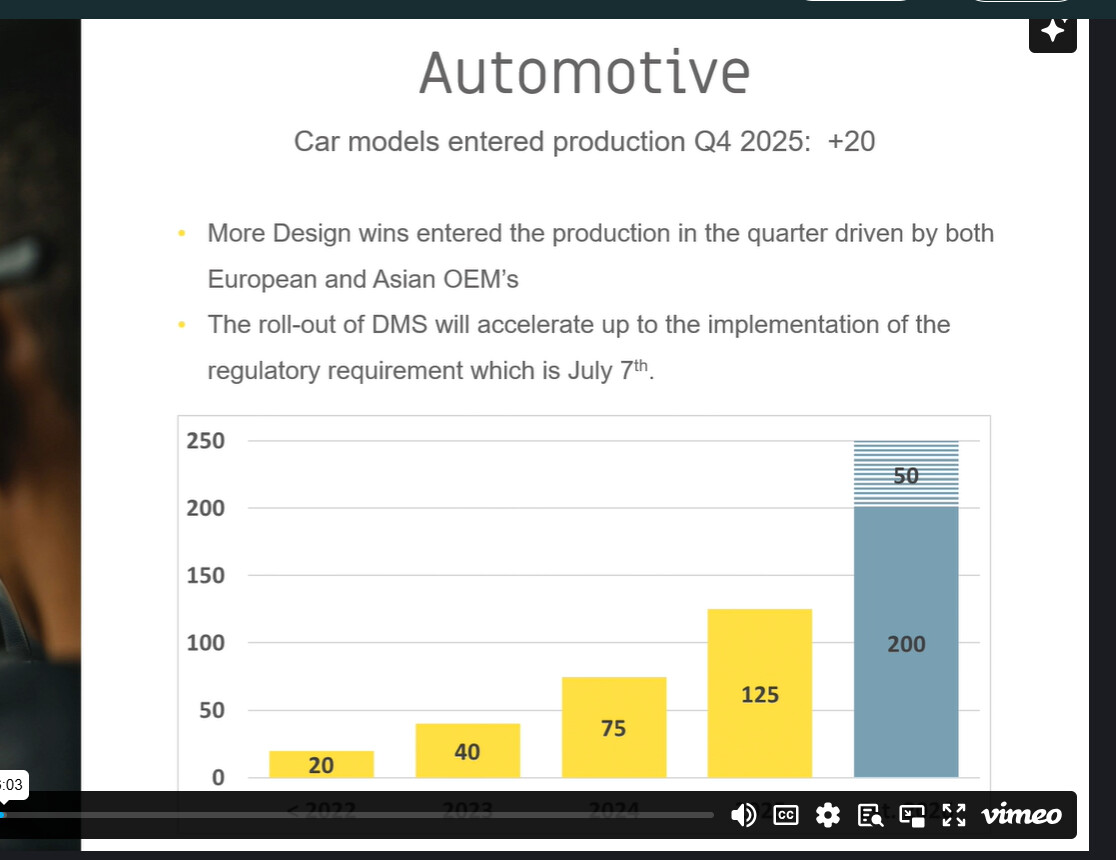
”However, we expect the share to trade upwards today by at least mid-single digits on the strong sales development within Automotive.”
This aged well, share price -15% at the moment
”However, we expect the share to trade upwards today by at least mid-single digits on the strong sales development within Automotive.”
This aged well, share price -15% at the moment
Based on this performance, this is going nowhere! The company’s operating cash flow just turned positive… And as I wrote earlier – the company has gone and bought a cash-flow negative startup! This is how you burn through investors’ money. My own exit is definitely on the trigger now. Just add a solid operating cash flow deficit from those eye-tracking breathalyzers to those figures, and here we go again, scraping the bottom of the cash drawer. The cash is drying up, and sooner or later, a share issue is coming. Before that, Krantz predicts that cash flow will be positive by late 2026, early 2027, late 2027… and then it won’t be, because the money from the offering is used to buy the next startup and we’re back in the red.
Is this how you do business?
The share price drops 15% and it’s total doomsday in here  in my opinion, the story is progressing exactly as it should. Price action is just noise on the side.
Run the calculations on what it means when the European regulations come into effect this summer.
In other words, it’s worth basing an investment case purely on facts, rather than emotions based on market movements. It could, of course, be that this is not what’s happening, but then our calculations would be different.
Personally, I’ve added to my position quite significantly today. At the same time, this became my second largest holding after Nokia.
But everyone carries their own risk, so everyone makes their own decisions.
Edit: I am reviewing this with limited information today as I’m on vacation quite far away. But I didn’t see any reason today to change my previous view. Short sellers are heavily involved here, though. I expect the tide to eventually turn in the other direction.
The company’s growth and margins in automotive are perfectly fine. But. The big but. The acquisitions and one license purchase:
Sightic Analytics
Affectiva
Imotions
Fingerprint cards license
Now it looks like the future is an internal cross-subsidization within the company, where the highly profitable automotive business finances the startup hype. I see a problem in the management culture and corporate governance, where a mindset of being able to buy one startup after another is accepted. Is the cobbler not sticking to his last?
I agree with you that Martin should cool it with further acquisitions for now. In a couple of years, the underlying situation will be such that things can be reconsidered.
Otherwise, I pretty much agree with user Lexus’s post. If and when the market ”predicts” six months ahead, SE’s share price will be at a completely different level by July/August. Upwards.
(not investment advice)
I only managed to catch the latter part of the webcast, but during the Q&A, Martin mentioned that the company is involved in RfQs “to a greater extent than ever before.” These SOPs are weighted to start in 2028–2029.
IS/OMS, however, is arriving for the mass market slower than predicted.
What stands out to me is the wording in Seeing’s latest quarterly report, which suggested that things are quiet on the RfQ front. (While some new RFQs have been deferred, existing production programs are expected to expand across European platforms as OEMs move to comply within the remaining regulatory timeframe.)
For me, there were two highlights in the webcast. I have been concerned about Smart Eye’s market share of cars sold in Europe. Martin answered in the Q&A session that he believes Smart’s market share in Europe will be 40 percent or more in July 2026, and this assumption is admittedly supported by Seeing Machines’ description of their own market share. This would mean over a million delivered cars per quarter to Europe. The second highlight was the description of the market for impaired driving prevention technology. Martin said that he hasn’t seen or heard any moves from Tobii in this market and hasn’t seen finished demos from Seeing Machines, implying that the Australians are behind in development. It will be interesting to see how, for example, BMW intends to solve this safety concern.
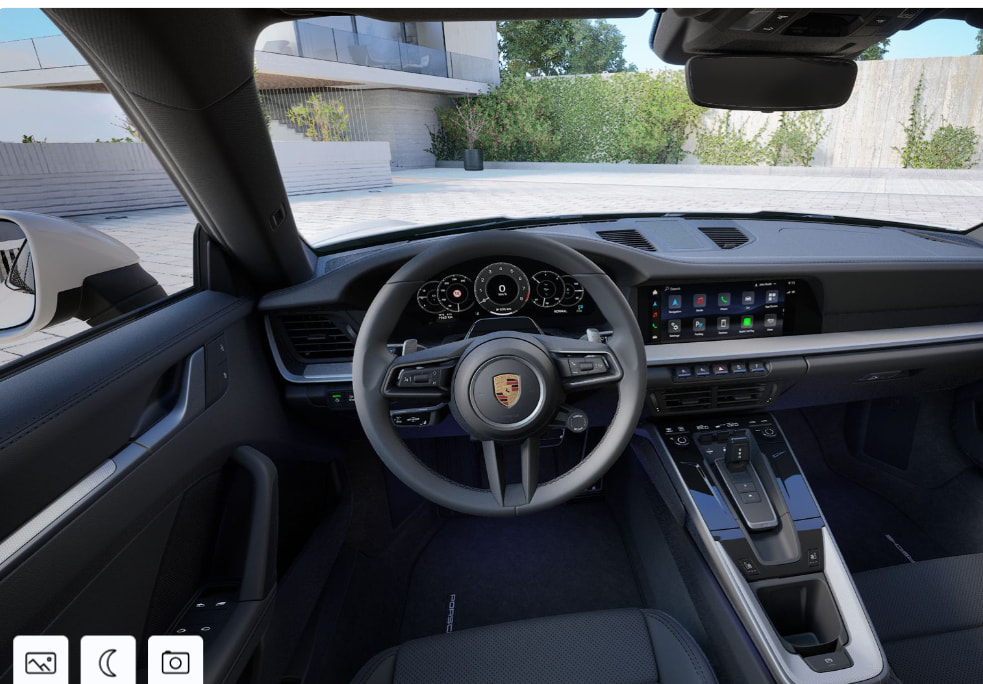
Just a few days after the end of the upcoming quarter, DMS will be mandatory in Europe. This is already visible in the fact that if you order an Audi or a Porsche here in Finland now, you get Smart Eye monitoring your safe travel.
Porsche 911
I have mixed feelings about the share price reaction after reading the interim report and watching the webcast. I’m wondering what caused such a sharp drop in the share price (-20%).
Was it due to the rather weak improvement in free cash flow (-34 MSEK) and the latest acquisition, which naturally slows down the target? In the webcast, the CFO responded to a question about free cash flow, stating that there will be positive free cash flow this year, but one could read between the lines that the acquisition pushed the target back by a quarter or two.
Another reason might be the weaker-than-expected development in car models in production during Q4 (+20). In my opinion, this isn’t very significant on a 12-month horizon.
A third reason could be the soft numbers in behavioral research and the business shrinking more than expected. On the other hand, the biggest expectations within the next 12 months likely focus on the strong growth in DMS revenue, so I’m not quite sure if the stagnation in behavioral research is that critical.
The sales figures were actually very good, and there shouldn’t be issues with the cash position before reaching positive cash flow. On the other hand, EBITDA shrank slightly from the previous quarter, so perhaps that spooked investors.
Personally, I can’t find a sensible reason or combination of reasons for a -20% share price reaction. I would understand a reaction of around -5%, but perhaps I’m missing something fundamental about this interim report.
The company has a 300 MSEK loan, of which well over 100 million is being burned on the Sightic Analytics acquisition, its negative cash flow, and the Fingerprint Cards license.
The repayment period for this pot is three years, and the operating cash flow for the completed Q4 was 2.8 MSEK in the black. That certainly provides a challenge for cash flow management. Q4 reveals that 295 MSEK remains to be repaid.
Where will the money come from?
Automotive stops lagging behind the forecast and provides self-financing during these 3 years. The current pace is not enough for this.
Behavioral Research is sold.
…or the money won’t be enough and we are facing who knows how many more share issues!
Debt is a brother when buying startups, but a nephew when paying it back. And even if the balance sheet and cash flow were brought under control over the next three years, instead of a budding dividend payment, they might go looking for another new startup to buy, right? Eyetracking is used at least in communication aids for the disabled. A year or two after buying something like that and massive returns await?
All in all, investors do not believe the acquisitions add value and consider them too expensive. Furthermore, investors do not trust management’s ability to generate shareholder value, believing they instead waste money on new acquisitions. There is also too much debt, and it cannot be repaid if automotive growth does not accelerate.
Quite relevant points. However, it is strange that the stock is reacting so negatively today, given that these issues are already old news. After all, automotive sales weren’t weak in Q4, were they?
The acquisition of Sightic was about buying data that would have been expensive to acquire and removing a competitor from the market, both based in the same city. It also prevented anyone else from buying it. Seeing already announced last year that its system recognizes driving under the influence. So, making such an acquisition was likely a necessity. Inorganic growth. If and when the goal is to prevent driving under the influence of substances, it will likely result in slightly more license revenue per device, or at least prevent it from dropping by losing out to the competition. The same logic applies to the Affectiva and iMotions acquisitions. Impatient investors won’t like it, but for patient ones, it’s even a reason to invest. And buying opportunities arise.
I must admit that when I bought a car in January, I tried to make sure it didn’t have monitoring; if my autumn order had been delayed by a couple of weeks, it would have been included and the price would have been a couple of thousand more. Of course, not all of that was due to the monitoring, but also the cosmetic changes for the new model year. I did get all the other gadgets for the car, though. In the future, consumers who doubt the reliability fortunately won’t be able to influence choices, as regulation will dictate it, and this will be reflected strongly in Smart’s revenue. Monitoring for everyone else  . Even though I didn’t want to support Smart in this instance, I did participate in the rights issue and helped the company move forward; shares were available for 25.5 SEK in the 2023 offering.
This might be a stupid question, which is why I’m asking those here who know the company better.
If the business starts growing as anticipated, but not quite fast enough to clear the entire 300 debt by the deadline, why is a share issue the only option being speculated? Why can’t the debt be restructured if, in say 1.5 years, the evidence of the business’s growth is concrete?
Or is a share issue a way to compensate for faith in the company?
Edit. Thanks @Kolothos_Apollonia !
My own strength, and perhaps also a weakness as an investor, is that I have been involved in businesses that were either started from scratch or grown from small to medium-sized at growth rates compared to which Smart Eye’s growth is light stuff. Perhaps that is why I “got so worked up” about this.
As a result of years of work, Smart Eye has great growth, a huge margin, and a very strong order backlog. Here is my interpretation in a nutshell of why the share price dropped and what the current situation is…
On December 11, 2025, the company announced it had entered the bond market and raised 300 MSEK through a bond. The company stated it would use this to pay off more expensive debt. OK. At that time, one could safely assume that there would be no share issues and investors could watch the company’s journey toward positive cash flow.
Two months later, the acquisition of Sightic Analytics for 60 MSEK, added to negative cash flow.
Now there is 134 MSEK in cash and, despite any sleight of hand, you have to subtract the acquisition from that. And at the same time, operating cash flow is barely positive. The management culture is apparently such that once money is in the account, they start throwing it at startup acquisitions, even though the cash flow doesn’t actually allow for this. Sensible debt has practically been destroyed in two months, and repayment has been built on beautiful startup dreams, on speculations that are a year or two away. I recognize the phenomenon well through my own work experience. The world is full of managers who start drooling when they are presented with a high-margin, scalable business case, and hype is generated about starting to do something that others aren’t capable of doing at all. Something that fits the existing business like a glove AS LONG AS A COUPLE OF SMALL THINGS ARE RESOLVED FIRST. Usually, these managers don’t get their way. At Smart Eye, it was different. Shorters predicted this, as did the pension fund that hit the panic button.
What, then, are those couple of small things I mentioned? There are typically three: 1) the product is unfinished, 2) the market is a question mark, and the third one, which is forgotten while drooling: the company’s liquidity is insufficient. Euphoria won, the cash lost. Now we have time-traveled back to an empty treasury regarding cash flow and the question of where the money will come from.
For my part, the milk is spilled since I didn’t realize to press the panic button when the acquisition of Sightic Analytics was announced. Only the Q4 operating cash flow revealed how badly things went wrong. Selling doesn’t help anymore; now I just have to see if the company can fix its operating cash flow to allow business to continue without a share issue, where investors with their diluting shares are taken for a ride.
How ready is the product from Sightic? The founders appear to be two ladies with police backgrounds, and I would imagine that technical expertise isn’t particularly high with that background. According to the product presentation, it screens faces and identifies alcohol and drug use, and is even able to differentiate between them.
I wonder if this can actually work reliably…? There were a couple of news articles from a few years ago on the company’s website, e.g., regarding a Volvo test, but it’s a bit concerning that there aren’t any very recent stories there.
If anyone can dig up more info on this, that would be great.
it turns out that the revenue is 24 MSEK. At least that much. The fiscal year is 9 MSEK in the red, so Smart Eye will have to cover this with other cash flow on top of that 60 MSEK purchase.
Then there are these “one little thing” category items. At least according to Finnish national legislation, an alcohol interlock in a vehicle based on eye movements will not pass. The equipment must be based on exhaled breath. Alkolukkolaki | 730/2016 | Lainsäädäntö | Finlex
So, as an alcohol interlock defined by law, it cannot function without a change in the law. I would imagine that the legislation is the same EU-wide, but I suppose Krantz and partners have taken this into account in those “startup-fun-listen-folks-this-is-gonna-be-huge” meetings. Right? This is how it is—every euro in the cash box is already earmarked for startup fun, and we investors are faced with the question of what the market for this actually is if the law already excludes the product from its most important application area?
Martin described quite clearly in the webcast that this intoxication feature is a different thing than an ignition interlock.
Smart Eye has already had drunk driving detection in production in its AIS products since Q3 2025. The first Design Wins for DMS have already been won. Martin described in the webcast that he hasn’t even heard rumors of Tobii’s solutions, and regarding Seeing, only talk but nothing concrete. In this respect, things look really good. Euro NCAP is already awarding points for the feature in “crash tests.” Smart’s strategy has been to be first to market, and here we go again.
@Kolothos_Apollonia, for an experienced business grower, you understand business, its financial side, and accounting surprisingly little. Of course, there is very little experience in Finland with companies of Smart Eye’s size that are still maintaining the same growth figures. Growing small sums of money with “growth percentages compared to which Smart Eye’s growth is light stuff” is, of course, its own little game.
”On 11.12.2025, the company announced it had entered the bond market and raised 300 MSEK as a corporate bond. The company announced it would use this to clear more expensive debt. OK. At that time, one could safely think that there would be no share issues and investors could watch the company’s journey toward positive cash flow.
Two months after this, the acquisition of Sightic Analytics for 60 MSEK plus negative cash flow.
Only two months after entering the bond market, every euro is already earmarked for something and repayment is dependent on the DMS order backlog and PowerPoint presentations built in visioning meetings.”
There are so many factual errors in your messages that I don’t know where to start.
The main purpose of the bond (300 million SEK) was to restructure expensive (up to 18.5%) debt into significantly cheaper debt (STIBOR + 7%), which stabilizes financing costs → meaning cash flow specifically improves and the cash position now has a clear safety margin to reach cash flow positivity without a share issue. Smart Eye has by no means “earmarked 300M SEK for PowerPoint visions in two months,” although I certainly understand the criticism regarding the company’s spending in previous years. In general, the point of such loan arrangements is to keep enough capital on hand, improve terms, and kick the loan forward. Smart Eye is in no hurry or desperate need to pay off a 300M loan if the money isn’t expensive and it can be used wisely to generate more money for the company’s coffers.
Cash reserves were/are not used for Sightic and Fingerprint Cards license fees; instead, share consideration and share issues were used. This is also positive from a cash management perspective. Rather, as a shareholder myself, I would argue that it would have been better to use cash if the stock is believed to be undervalued right now.
From a cash flow perspective, one of the most relevant figures is that while revenue grew by 22 million, adjusted cash flow improved by 14 million. Even if revenue continues to grow at the same rate as before – and now it is predicted with good certainty to grow even faster due to legislative effects – the cash flow will start looking very nice if it grows so scalably in relation to revenue.
If the company generates over 300M SEK in operating cash flow in its first full profitable year in 2027, interest expenses or a few million to cover Sightic’s poor result won’t matter. It’s worth focusing on what’s essential and maintaining an understanding of the proportions of things and sums. This is also understood among Smart Eye’s financiers, where the firm has been analyzed a bit more closely than by you, having decided to offer such a good sum on such good terms.
To my eye, the Sightic acquisition seems like a strategic and cheap investment when considering its opportunity costs. It closes off options for competitors and buys expertise, operations, and an existing business that would have had to be built anyway. Definitely one of Smart Eye’s best acquisitions.
There’s no need to panic too much while such amateurs share analysis and views filled with factual errors, pretending to be high-level professionals.
In my view, it’s contradictory that specifically an investment case based on Automotive scaling drops this heavily based on an interim report that specifically validates that Automotive scaling is no longer being kicked down the road by another year citing various delays, but is finally happening here and now. Well, others may have their own views – though too often based on the share price – in my own view, following this latest price drop, it is likely one of the best possible timings in terms of risk/reward to buy more Smart Eye.