Your investment strategy

My investment strategy is very simple: ETF/fund core + a few satellites. New capital to be invested between these at approximately 80:20 in the long term.

ETF/fund core: with monthly savings, emphasizing the USA and technology. Leveraged target holdings aim for even higher returns than normal. The idea is that, regardless of the satellites’ performance, there should be at least approximately 10%/year return.

Satellites: approximately 2-6 stock picks, intended to generate long-term outperformance relative to index returns. The previous sub-strategy here was to find undervalued smaller-cap companies in Helsinki with a home-field advantage. That didn’t work very well (the markets didn’t notice the undervaluation :slight_smile:), and now for the last 4-5 years, satellites have been sought based on industry knowledge gained through my own profession, i.e., from the technology sector. The aim is to find such “ad infinitum” return potential opportunities with significant risk. This has worked considerably better, for example, with the bullseye hit of Nvidia.

I have faithfully followed this strategy after the initial fumbling due to inexperience. CAGR for the entire investment career is 14.3%. For the last few years of the new satellite strategy, CAGR is over 30%, even though, for example, in '22, there was a 30% loss.

14 Likes

Tell me a bit about how you prompt that conversation and what information you provide as initial data.

2 Likes

Who has a better version of chat-gpt?

I tried with Perplexity

My stock portfolio has AMD, GOOGL, AMZN, AAPL, ASML, BAM, ISRG, JNJ, META, MSFT, MSTR, NOW, NVDA, SHOP, TSM, TSLA and V. How would you change it and why?

I received the following as an answer. In short: due to its bias, the portfolio is risky, and to reduce risk, some moves could be considered. This is essentially reasonable. Perhaps in the next question, I could try to explain that this is only part of the whole and intentionally contains more risk. Perplexity also amusingly provides links to sources, i.e., someone has asked something similar before…

If people have time to try different AIs, please share your experiences and those prompts/questions here as well.

Your current portfolio consists primarily of large-cap technology stocks, with a few exceptions in other sectors. Here are some suggested changes to optimize your portfolio:

  1. Diversify across sectors: Your portfolio is heavily concentrated in technology. Consider adding exposure to other sectors such as healthcare, financials, and consumer staples for better diversification.
  2. Add some value stocks: Your portfolio is growth-heavy. Include some value stocks or ETFs to balance growth and value factors.
  3. Consider international exposure: Your portfolio is US-centric. Add some international stocks or ETFs to gain global diversification.
  4. Reduce concentration in mega-cap tech: While companies like AAPL, MSFT, GOOGL, and AMZN are strong performers, they may be overrepresented. Consider trimming these positions slightly
  5. Add small and mid-cap stocks: Your portfolio lacks exposure to smaller companies. Consider adding a small-cap or mid-cap ETF for broader market coverage.
  6. Evaluate semiconductor exposure: You have significant exposure to semiconductors through AMD, NVDA, ASML, and TSM. Consider reducing some of these positions to lower sector-specific risk
  7. Include some defensive stocks: Add some defensive stocks or ETFs to provide stability during market downturns.
  8. Consider adding bonds: Depending on your risk tolerance and investment horizon, adding some bond exposure could help reduce overall portfolio volatility.
  9. Reassess speculative positions: Evaluate the role of more speculative holdings like MSTR in your overall strategy and risk tolerance.
  10. Rebalance regularly: Set up a regular rebalancing schedule to maintain your desired asset allocation and risk profile.

These changes aim to improve diversification, reduce sector-specific risk, and create a more balanced portfolio while maintaining exposure to high-growth areas of the market

1 Like

I started by just commanding this:

“15-share equal-weight stock portfolio. No funds or ETFs. Three years scope. I’m not after high dividends, as they are double-taxed at my end. Risk level medium-high is ok for me.

I’m not willing to make changes very often, possibly once a month if required.

So, which 15 stocks you recommend me to start with?”

It gave me a list, 15 suggestions with justifications.

After a while, I found a bit more money in my wallet, and I asked, “Please add one more, the 16th share.”

It replied to me:
"For the 16th share, I’d recommend adding Brookfield Asset Management (BAM).

Brookfield is a global leader in alternative asset management, specializing in real estate, infrastructure, and renewable energy. This brings a unique element to the portfolio, balancing the high-growth tech and consumer focus with some exposure to alternative investments, which can provide stability and diversification. Brookfield is well-regarded for its focus on long-term asset appreciation and sustainability-focused investments, adding a solid medium-high-risk growth stock outside the traditional tech and consumer sectors.

This addition rounds out the portfolio nicely with a strategic tilt toward asset management and sustainability."

I added MSTR myself; it’s my Bitcoin bet.

On the first Monday of the month, I asked (and will continue to ask) “Do you like to recommend any change? Not more than one - if any.” This resulted in an ABNB=>NOW swap (extensively justified). Generally, ChatGPT-4o-Plus justifies both sales and purchases profusely.

I chat with GPT in English because, in my experience, it reduces errors.

=====

I don’t worry about the equal-weight principle very strictly. I lightened up on rocketing TSLA and SHOP and invested in others.

This batch is really tech-heavy… but I’m not worried about it because I have diversification in other investments.

Now, after more than a month, only JNJ is in the red.

2 Likes

Interesting experiment :slight_smile:.

Not to stray too far from the topic, but with current LLM-based stock picking, one unknowingly ends up using a kind of dart-throwing monkey’s bluechip / large-cap strategy.

This is due to how GPT’s algorithm and training work. To simplify a bit, with the prompt you described, the model gives high probabilities to those tickers whose frequency in the training data is high (frequency bias). Quite presumably, these are precisely stocks like Microsoft, Apple, and similar.

As I understand it, even the 4o model does not actually have the capability to perform actual company analysis or portfolio analysis. For example, stock exchange recommendations are based (in addition to the word choices included in your prompt) roughly to a large extent on the position in which the random parameters (so-called temperature parameters) that adjust the model’s output are set.

10 Likes

That is certainly true. But GPT, of course, obeys desired filters. For example, that Mag-7 would be excluded.

But the problem will then likely shift to the next most popular stocks.

1 Like

Yeah, yeah. I’m not approaching this experiment with the feeling that there’s always a problem somewhere.

For me, this is an exciting, slightly rambunctious 10% experiment, from which I’ll almost smilingly return/move on to other ideas if necessary.

Greetings to all fellow Investors!
I’ve turned 50, and I’ve been a self-taught portfolio manager for about 5 years (before that, the stock market was familiar for a long time, but only with larger sums of money for these past 5 years). Recent discussions have highlighted the overheating of the US markets, the overvaluation of the Mag 7 (Magnificent Seven), and how the market is largely wrong about this, suggesting one should be wary of investing in US markets anymore (e.g., SP500 index, etc.).
A few days ago, Professor Aswath Damodaran stated, and I quote from an article:
”Damodaran owns all seven stocks, calling them “insanely profitable.”
The “Magnificent Seven” tech giants are a must-buy during market corrections, according to Aswath Damodaran, the New York University finance professor renowned for his valuation expertise. These companies—Tesla, Meta, Microsoft, Alphabet, Amazon, Apple, and Nvidia—are driving global markets and show no signs of slowing down, Damodaran told Bloomberg Television.
I strongly agree. I recognize overheating and am mentally preparing for a -10-15% drop during 2025. A cynic might note that if Helsinki hasn’t even managed to rise while major indices have been hitting highs for a long time, what will happen when that dip comes… When that correction comes (and it might come as early as the first half of 2025…), I’ll be ready with my net, following Mr. Damodaran’s thoughts…More winners at a cheaper price…

The stock market and the market are wrong for not investing in Helsinki, they don’t understand… Wrong, the market is always right, and crying letters won’t help… With these writings, I fear that the younger generation will sell winning stocks and end up buying Neste, Nokian Tyres, Withsecure, and other junk. And when these ‘grinding letters’ come even from respected portfolio managers…

What I have learned in 5 years. Only buy the best in its segment (second best is no longer enough), and you usually won’t get it at the cheapest multiple. Recognize momentum, don’t try to fight against it, don’t make investing too complicated. Be open-minded and recognize your own biases and fixed ideas early. If you have won with Nokian Tyres/Neste sometimes, it doesn’t mean it will continue in the future. If you are a portfolio manager and not an index investor, you really need to do something differently, recognize these momentums and be part of them, and recognize when it’s time to move on to something else (that momentum can last, for example, a few years). In Traders Club, there were warnings about Nvidia and that after 6 winning quarters, it was over. Well, it wasn’t over yet; let’s stay on board for a couple more years… And when you find that future winner, don’t immediately fall into the trap of selling the winner for quick profits. A winning stock can go through a 40% dip, and it requires guts to stay on board. We update how one should have bought Tesla, Palantir, etc., back in the day, but most would have sold it during the first dip…

The work of a portfolio manager is the most difficult of all professions; only very few beat the index. These winners are the culmination of evolution, changing their operating model to match environmental conditions on an accelerated schedule. For example, until autumn 2024, I was sure that cryptocurrencies were a pyramid scheme, but I recognized that big money momentum was shifting there, so I got on board (e.g., heavy weighting in Microstrategy). Now that almost everyone is talking about it, I decided it was time to get out and sold at the peak of the wave. I’m taking a breather now and watching where this settles… Perhaps now I’ll focus more on those who benefit from crypto trading, and I moved the Microstrategy money to Robinhood and similar operators…

These are some thoughts as I turn 50 and embark on about 5 years as a part-time portfolio manager… To young investors, I wish open-mindedness, but no ‘YOLO-ing’… Be brave, but not recklessly brave, and buy those Winners and the best in their field, and you’ll find them right there across the sea. Below the 200-day moving average, nothing good happens, and that applies to quite a few Finnish stocks; consider them only when the momentum and big money have truly returned. And most importantly, will 2025 be the year of small-cap companies? It might be, and the US market is currently very appealing for small-cap companies…

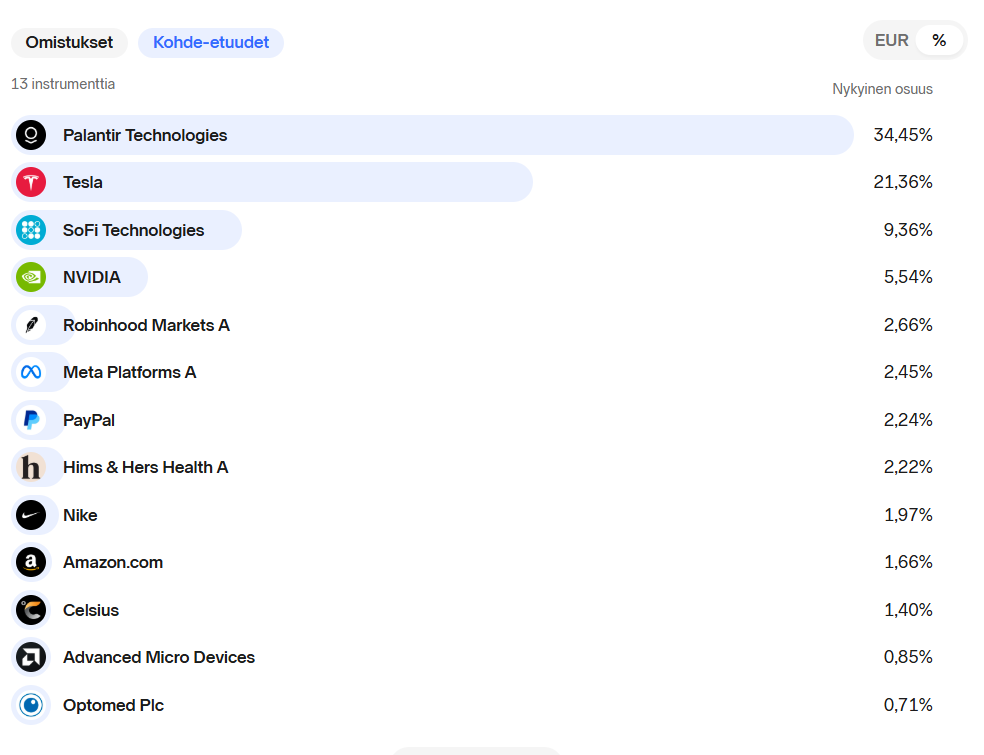
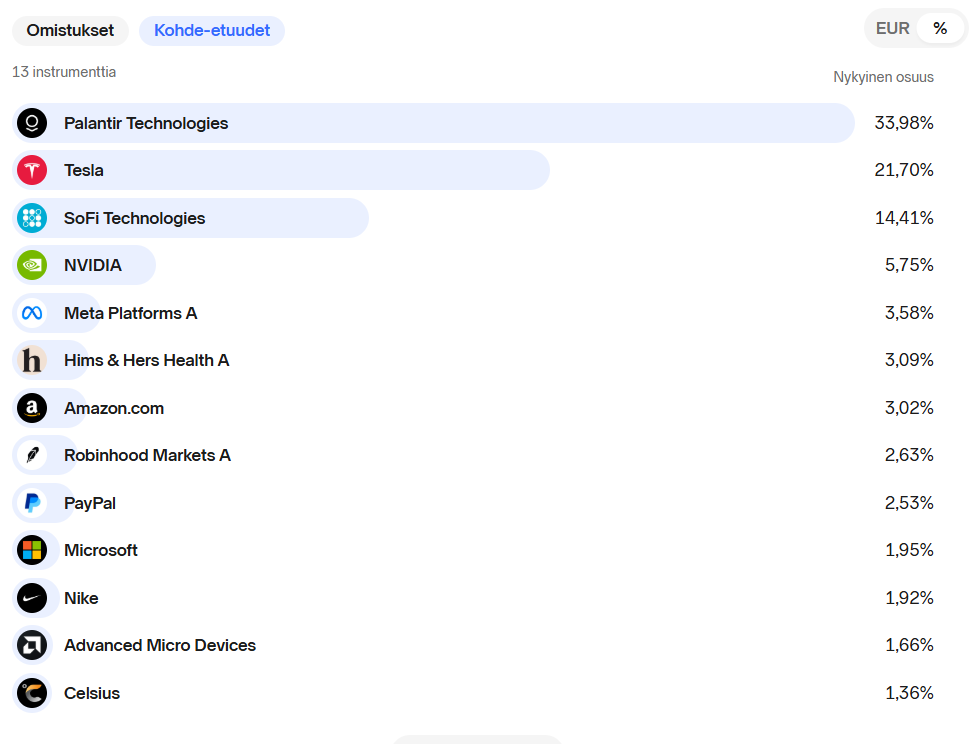
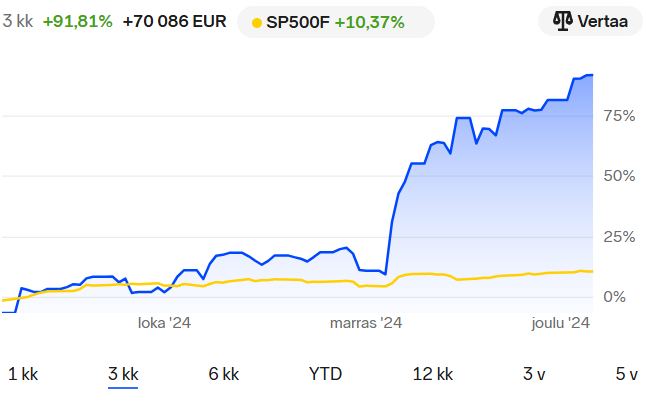
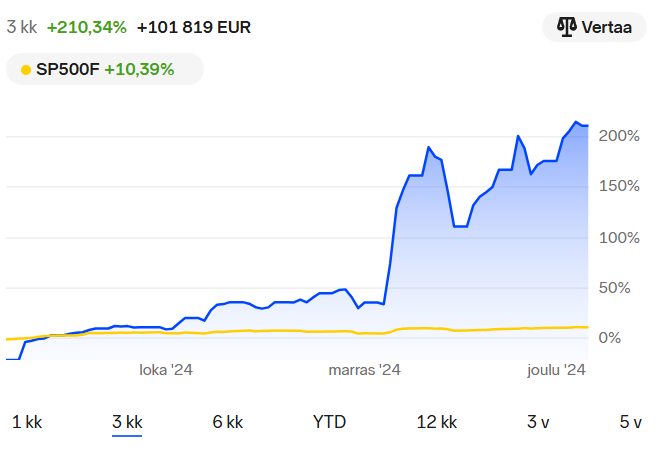
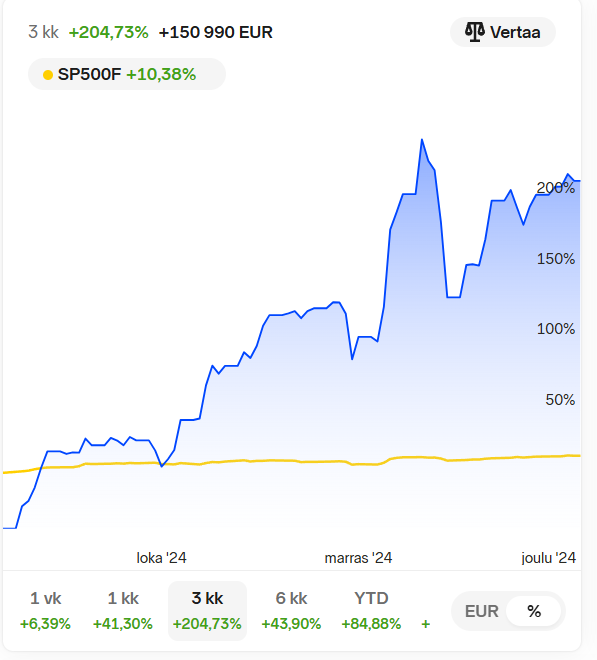
Below, to illustrate the investment strategy, are the contents and performance charts of a few portfolios, so it’s not just empty talk. I am now embarking on a long journey, from which I will only return at the end of the year; it’s good for a portfolio manager to sometimes distance themselves from the market, and I am confident in my choices.

Happy Independence Day to all! Respectfully, Largantil (Fortune favors the bold)
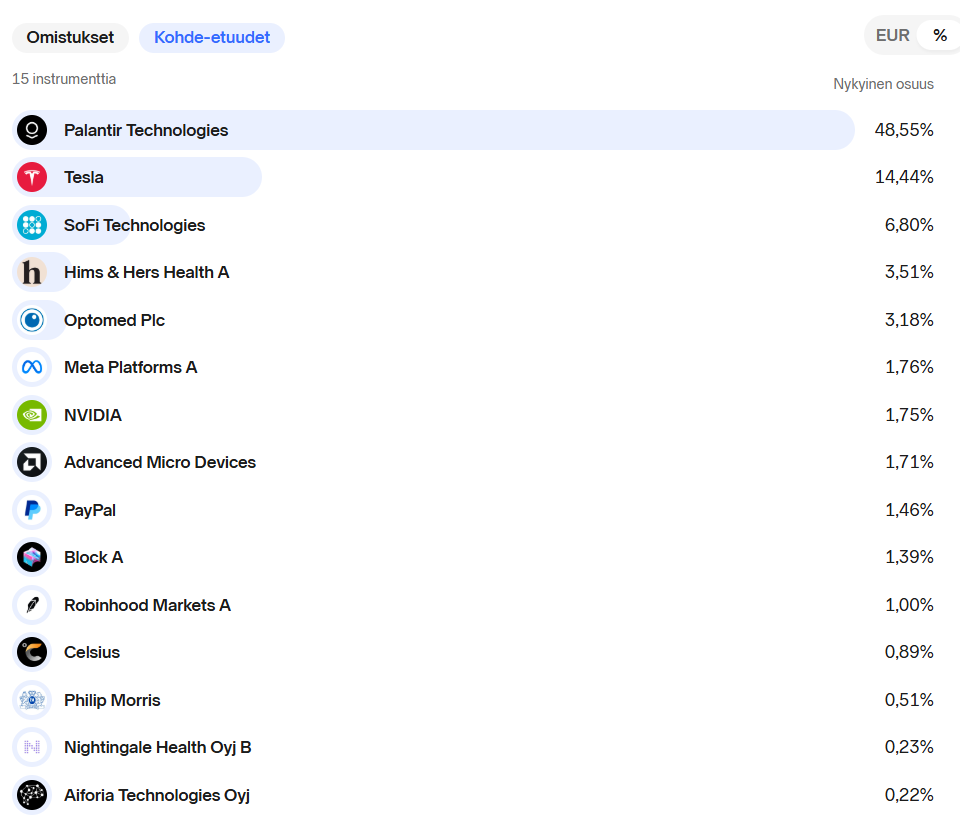
salkku 1
salkku 2
salkku 3
salkku1 %
salkku 2 %
salkku 3 %

40 Likes

Psst…..psst…..(whispers quietly)…..Why do you choose individual companies if the markets are always right?

15 Likes

Good question :grinning:
Why would someone want to swim or run as fast as possible…
Because I want to beat the index, I want to make money :grin: But most importantly, investing and everything related to it has become an elixir of life that mere index investing doesn’t provide; my days are exciting and rich in content as I have to follow things from different angles. For example, my father, almost 85 years old, works diligently in his garden and is also a passionate investor (buys and sells Fortum, Neste, UPM, etc.); perhaps that’s the magic behind his good brain function remaining intact…

At OP, there’s a so-called pension portfolio with two funds on continuous monthly savings: OP World and OP Moderate. Over the year, the return curve for that portfolio, without doing anything, is approximately 24%. So, it would have been easier, and for many, it’s definitely the best solution…

image

15 Likes

I do agree with the above reflection that 2025 could be the year for small and medium-sized enterprises, but not for all. Those whose momentum is gaining traction. That’s already happening with many stocks, but once positive results come in February, the pace will accelerate. I have a moderate emphasis on turnaround companies that have only started generating operating profit/free cash flow in recent quarters. These include, for example: Hiti, Talkspace, Honest.

Slightly larger counterparts whose momentum has already begun and shows no signs of stopping are Hims and Rocket Lab; there’s also fundamental backing, and in my opinion, these two will certainly have much more good coming in the future, as long as one has the patience to stay on board.

With a relatively small cash position, I want to focus on winning stocks in this market situation and have the patience to stay invested. There’s still a slice of Microstrategy in the portfolio, and the intention is to see how it progresses at least until the end of the year. Regarding Bitcoin, I also predict a strong next year for Irene, as their data center businesses are also drivers. A margin of safety in stocks helps; when already in profit, one can also slightly raise the average price.

4 Likes

When I bought my first shares 5 years ago, the idea was to grow dividend income so that at some point, dividends would reach at least 10k€ annually. Of course, the intention was also to pick slightly riskier companies for the portfolio and generate excess returns with them.

Now, 5 years later, dividend income is around 2-3k€ annually, and the portfolio as a whole is about 60k€. Index funds have also been acquired along the way, but their weighting is around 10%.

Since the war started in Ukraine, I haven’t really had the energy to follow the stock markets very actively; the plan has largely just been to hold. The only addition this year was in September; otherwise, purchases have only gone into funds each month. Due to my own passivity, thoughts have arisen: would it just be more sensible to divest from most of the stocks in my portfolio and reinvest them into index funds or ETFs?

By investing in funds, one probably achieves similar returns on average as with stock picking if percentages are looked at over the long term? The weighting could be, for example, 80/20 towards funds.

Could experienced forum members tell a beginner like me if there’s any sense in this consideration at all.. :grinning_face_with_smiling_eyes:

3 Likes

Investment recommendations are not allowed, but I would approach your question by considering at least these things:

-When are the investments intended to be realized, or when are dividends to be used for living expenses? If the goal is still decades away, taxation will eat into some of the compound interest effect if dividends land in an AOT (Arvopaperikauppatili - Securities Trading Account). In index funds or ETFs that automatically reinvest dividends, this slowdown does not exist, nor does it with dividends landing in an OST (Osakesäästötili - Share Savings Account).

-How much time do you want to spend on your investment hobby? And how much understanding of economics and markets in general, as well as your own financial management, might you gain if you decide to continue the hobby at least somewhat actively? Index funds, on the other hand, are a carefree way to accumulate wealth, freeing up time for other things.

-What kind of return are you aiming for? Is an index return sufficient, or do you want to aim for outperformance, even at the risk of ultimately losing to the index?

I myself have now been investing for a little over 5 years, and I have allocated my portfolio 60% to direct stock picks and 40% to index funds and ETFs. I can then fine-tune this one step at a time if necessary; for example, a 50/50 split has often been on my mind, and if I were to start losing to the index in the coming years, the allocation would likely lean in that direction. 5 years is still a relatively short time, and luck plays a significantly larger role than for those who can show a 20-year track record of clear outperformance.

Hopefully, this helped you get started in considering a suitable strategy for yourself. :slightly_smiling_face:

27 Likes

In December, the decision to change my investment strategy matured. Previously, I aimed to pick the best targets and invested money in them. Now I aim to pick the worst targets and invest money in all others except them. I imagine that finding the worst targets is perhaps easier than finding the best ones.

Because I don’t have time to go through all the world’s stocks, I will focus only on Helsinki’s First North and Small Cap lists. At the same time, I can hopefully benefit from the small-cap anomaly.

7 Likes

Alright then, monthly review, whether you wanted it or not.

A small corner of my investments, two months completely under the guidance of ChatGPT-4o. During which there were two changes of target. (The content I mentioned in the previous message is still valid.)

12.2% good. Beats S&P500, Nasdaq-100, and the king challenge, OMXHGI’s intrinsic value.

Strong drivers, of course, TSLA and SHOP rocketing.

In the red are AMD, JNJ, and MSTR.

===

I updated the GPT’s prompting so that I told it I would now want comments weekly, but that I still wouldn’t want to make more than about one change per month.

8 Likes

The main strategy is a boring retirement portfolio with automatic monthly savings, half into an SP500 index fund and half into a Nasdaq index fund. The goal here is to achieve an average 10% annual return with a horizon of approximately 20-30 years.

The second strategy is an experimental, smaller momentum portfolio in which I look for companies in an uptrend. The goal, of course, is to beat the Nasdaq index in the long term. I started this strategy a little over 2 months ago, as I mentioned in the Portfolio Returns thread. Each position has a stop-loss which I move as (if) the uptrend continues.

Currently, the hype portfolio includes these positions (position performance in parentheses)
SoundHound SOUN (+133.2%)
Redwire RDW (+35.9%)
Neonode NEON (+26.5%)
Palantir PLTR (+18.5%)
Red Violet RDVT (+14.2%)
Gold 4GLD .DE (+7.0%)
Uber UBER (+6.9%)
Uranium-etf URNU.MI (+2.9%)
Hims&Hers HIMS (+1.5%)
Kraken Robotics PNG.V (0.0%)
Ionq IONQ (-1.0%)
Paypal PYPL (-1.5%)
Salesforce CRM (-2.2%)
Bonesupport BONEX.ST (-4.8%)
Hydreight NURS.V (-5.3%)
D-Wave Quantum QBTS (-5.7%)

Speculative shares bought for fun:
ZenaTech ZENA (-18.3%)
SenesTech SNES (-22.4%)
Tonix Pharmaceuticals TNXP (-45.5%)

The main industries in the portfolio currently are AI, quantum computing, health/pharmaceuticals. Quantum firms, at least, have provided excitement and dangerous situations. The return of the hype portfolio over its existence, i.e., a little over 2 months, is now +8.2% (Nasdaq over the same period +5.8%)

4 Likes

The new year has begun, and now is a good time to plan investment strategies. As wiser people have said, it’s not about being right, but about how much money you make when you are right.

In his memos, Howard Marks has well summarized the important points of investment allocation. When considering allocation, one should first decide what their target risk is in this market environment and compare the portfolio’s allocation to it. For my part, my target risk at the moment is low (as is the required rate of return). If I compare the allocation of my investments to my target risk, it is at an acceptable level, but still a bit too much on the risky side. The portfolio consists of approximately 30% Nordic non-cyclicals, 20% Nordic cyclicals, 20% fixed income, 20% structured products, and 10% gold miners. The goal would be to increase the share of fixed income to 30-40%.

There is quite a lot in common in Howard Marks’ recent memos and Stanley Druckenmiller’s observations. Both highlight the low spreads on US corporate bonds. However, the rise in the US 10-year yield puts pressure on corporate bonds in both the US and Europe. It was also mentioned in a recent Yle Pörssipäivä (Yle Stock Market Day) broadcast that nervousness is already noticeable in the bond markets after the 10-year yield has risen. So now might be a good time to consider a plan if the nervousness in the bond markets increases and spreads start to widen. If this situation materializes, it will be an opportunity for me to increase my allocation to corporate bonds. I will probably make some of these investments in US ETFs with accumulating specs (I don’t like paying taxes periodically) and EUR hedged (better to hedge against a strong dollar). Interesting times ahead, as always.

5 Likes

Updated Investment Strategy:

Goals

  • :chart_increasing: Double return vs. MSCI World
  • :books: Learn new things
  • :tada: Have fun

STOCKS (65%)

  • :balance_scale: 55% best ideas, 10% other crazy ideas: allows for waiting and speculation
  • :pie: Max. cash weight 70%, leverage 30%

Best Ideas

  • :bullseye: Concentrated, 5-30% per target
  • :shield: r/r first: seek outperformance while protecting capital, be patient waiting for fat pitches
  • :globe_showing_europe_africa: Liquid companies in Western markets
  • :open_book: Interesting story
  • :rocket: Three growth engines: sales, margin %, multiples
  • :star: Quality: e.g., customer retention, market share, ROIC, TAM, predictability, team
  • :dollar_banknote: Cash flow positive within a year

Buy when

  • :money_bag: >30%/year expected return, ideally also bear-scenario >0%
  • :chart_increasing: Above 200 dma, ideally also above 50 and these are rising
  • :chart_decreasing: If stock or index is below 50 & 200 dma: demand >40%/year expected return, max. addition 5%/month
  • :cross_mark: Do not buy a company whose sales are declining!

Sell when

  • :-1: Expected return below 10% due to weakening fundamentals
  • :shortcake: Sell in tranches if expected return is below 10% due to price increase, e.g., ½ below 50, ½ below 200 dma
  • :light_bulb: A clearly better target is found or if weight rises above 30%

Other crazy ideas: no rules, max. weight 30% per target


CRYPTOS (35%)

  • :chart_increasing: Goal: double return vs. BTC
  • :coin: Allocation: BTC + a few others with adoption or cash flow, max. 1/10 for fun/speculation
  • :shield: r/r first: sell most in euphoria, add gradually in a bear market if BTC fundamentals are okay

Rebalancing between the three sections 1-2 times/year, best ideas always >50%


Background:

I am an active stock picker with a 10+ year horizon. Since the idea is not only a hobby but also to bring bread to the family table, I aim to clearly outperform the MSCI World index (with a passive strategy, I would invest the majority in this).

I am interested in growth, technology, and so-called quality companies, and I focus on finding these (55% of the portfolio “best ideas”). I only buy when the expected return is appealing. My return calculation is usually based on a simple two-year scenario analysis.

However, sitting on positions and waiting for buying opportunities is somewhat boring, and from time to time I also want to speculate with slightly riskier or even lottery tickets. So, a small allocation for these as well (10% of the portfolio “crazy ideas”).

A new part of my strategy is a slight reliance on technical analysis. The fact is that it’s generally advisable to buy rising assets and sell falling ones. On the other hand, falling knives also offer juicy opportunities, and it’s always nicer to buy cheap than expensive. I balance these by demanding a higher expected return from stocks below moving averages and otherwise technically weak-looking stocks, and by limiting their monthly purchase amount.

Cryptos are the most speculative part of the portfolio (35% of the portfolio), even though my base scenario is that Bitcoin will surpass gold’s market cap in the 2030s. I aim to continue beating Bitcoin’s return with market timing and a few altcoin picks, with r/r first. I will significantly reduce the current allocation if the hot market weakens from here.

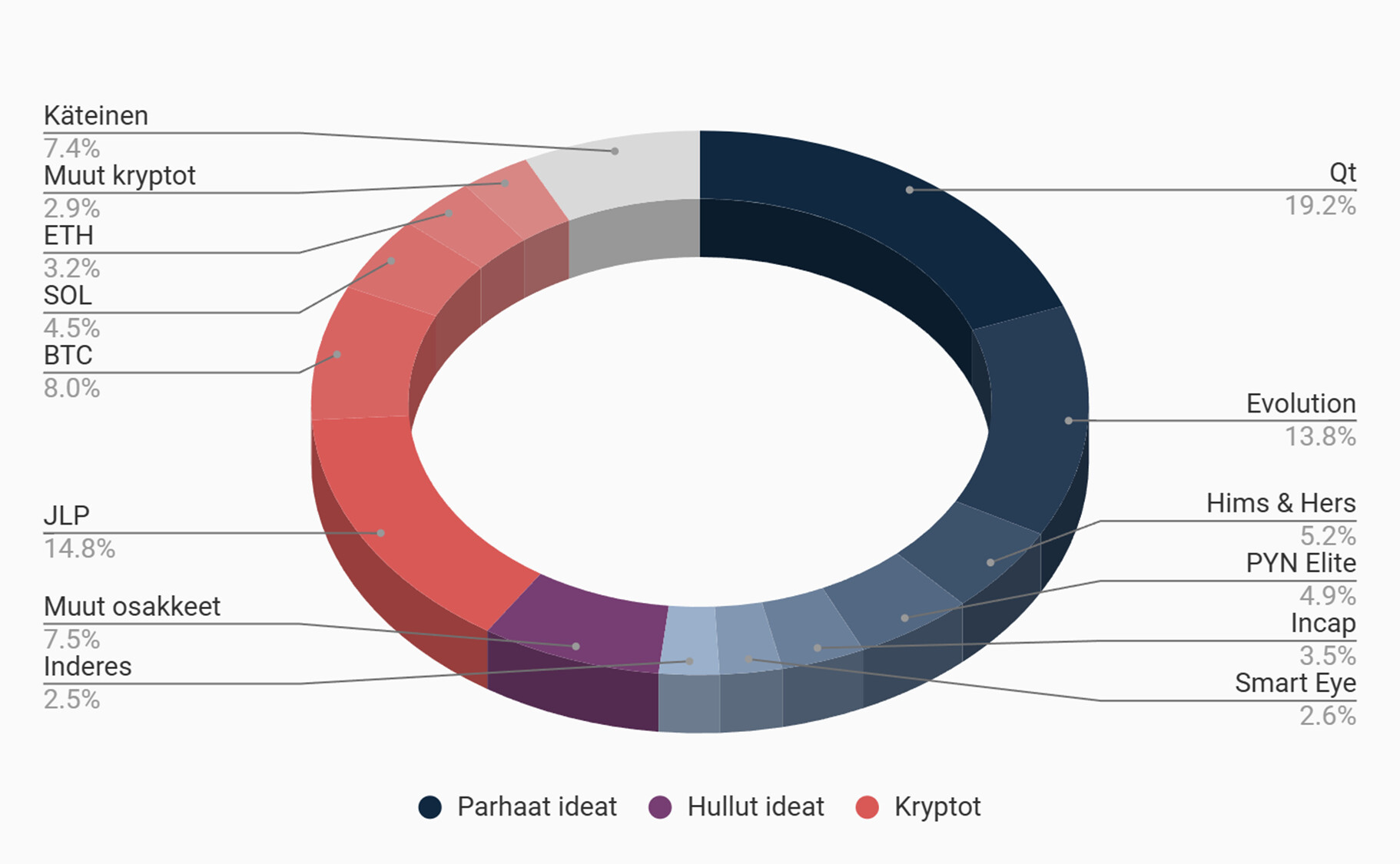
My portfolio currently:

image

I rebalance the three parts of the portfolio once or twice a year, depending on where I see the best expected return. Bets are placed only when the expected return is in my favor. Predicting the future is always challenging, and I don’t want to make it harder, e.g., by buying a debt-laden growth story where cash flows are years away or a company whose sales are declining. The portfolio’s cash weight can become significant if both expected returns and the market are weak.

I see volatility more as an opportunity than a threat; overreactions offer excellent buying and selling opportunities. I used to think “I am a long-term owner” or “I won’t sell the best companies too early.” Not anymore. I aim to allocate capital efficiently, meaning buying interesting companies cheap and selling them expensive. Sometimes the change from cheap to expensive can happen in weeks instead of years.

38 Likes

Now I want to share a super secret investment method that I have learned over the past year. After four years of struggle, it slowly starts to feel a bit more confident, and the hits are landing better too.

  1. Mainly buy large indexes
  2. If you want to take a view, buy companies that make good products and that you trust. Buy these when they are in a technical uptrend on a weekly basis, but possibly from the bottom of a trend channel.

That’s it.

You see, before, instead of doing number 2, I used to buy bad companies that make bad products when they were in a downtrend. It just doesn’t pay off, stop it.
If you don’t know enough about a company, then a technical uptrend is an even more important thing.

Have a good rest of the day

29 Likes