Your investment strategy

Equity investments (target): ~90% through funds and ETFs with broad sectoral and geographical diversification. Benchmark MSCI ACWI (IMI). I take a view with some degree of “quality” and “small cap value” tilts.
~10% direct equity investment “sandbox”. Mostly Finnish stocks (ease of use, imaginary home field advantage, tax matters). About 7 (5-10) companies. Looking for “quality and dividends”. Room for 1-2 potential “rocket stocks”.

How have you decided on the share of total equity investments within the pool you consider your investment assets?

3 Likes

I decided quite early on that my stock allocation would be close to 100%, as stocks yield the best returns in the long term. Since then, I’ve separated an emergency fund and evaluate my investment assets without this reserve fund.

So, from 1998 to 2024, I essentially went with full stock allocation the whole time. Now, for the first time and as an exception, I have started accumulating cash and gradually increasing its weight (currently around 20%), partly following in Buffett’s footsteps, and partly because there doesn’t really seem to be anything worth buying. This is an exceptional and first time that I am moving away from full stock allocation. We’ll see when the situation changes.

6 Likes

Hi there, I currently have a situation where I have very little time for stock analysis due to work and other life circumstances. However, I’ve previously maxed out my equity savings account and even doubled its value, so it doesn’t make sense to empty it and move the investments into indexes because of the tax implications. At the moment, my equity savings account only holds Berkshire Hathaway and Investor AB, as I view them as index-like investments. The rest of my portfolio consists almost entirely of index funds. What do you forum members think about holding Berkshire and Investor as index substitutes, and is it safe to leave them in an equity savings account without any monitoring?

I’m open to ideas for similar companies that could be added to an equity savings account to increase diversification.

4 Likes

I’ve been a passive, exclusively index-ETF investor for a long time. Extremely boring, but it works. My NUKL holding in particular has been rewarding for me.

On a mental level, I’d like to put much more effort into investing, but the fact is that a passive style has worked best for me.

But hey, there has to be some action. Raise the stress level a bit.

I carved out 10 percent of my capital. I opened an Equity Savings Account (OST).

I gave the GPT-4o AI language model (ChatGPT paid version) a prompt:

“15-share equal-weight stock portfolio. No funds or ETFs. Three years scope. I’m not after high dividends, as they are double-taxed at my end. Risk level medium-high is ok for me.

I’m not willing to make changes very often, possibly once a month if required.

So, which 15 stocks you recommend me to start with?”

Well, it provided a list with justifications. See below.

I put the cash on the line.

For the most part, it’s quite familiar, already expensive Silicon Valley stuff. I already own ten of those through ETFs; five are new to me.

I’ll check back with the AI regarding the need for updates about once a month.

=====

15-share portfolio allows some diversification. Here’s a list that mixes established growth companies with emerging players across technology, consumer goods, finance, and healthcare, keeping your medium-high risk and minimal adjustment preferences in mind:

  1. Apple Inc. (AAPL) – Strong product ecosystem and growth through services.

  2. Microsoft Corporation (MSFT) – Leading in cloud computing and AI.

  3. Amazon Inc. (AMZN) – Expanding in e-commerce, cloud, and logistics.

  4. Alphabet Inc. (GOOGL) – Dominant in digital advertising and AI.

  5. NVIDIA Corporation (NVDA) – A major player in GPUs and AI, with growth potential.

  6. Tesla Inc. (TSLA) – Global leader in electric vehicles and energy solutions.

  7. Meta Platforms Inc. (META) – Growth in social media, VR, and digital advertising.

  8. Taiwan Semiconductor Manufacturing Company (TSM) – Key semiconductor provider.

  9. ASML Holding N.V. (ASML) – Essential for semiconductor manufacturing equipment.

  10. Shopify Inc. (SHOP) – Beneficiary of e-commerce growth, with a strong platform.

  11. Advanced Micro Devices Inc. (AMD) – Growing presence in CPUs and GPUs.

  12. Intuitive Surgical Inc. (ISRG) – A leader in robotic surgery systems.

  13. Visa Inc. (V) – A reliable player in digital payments with global reach.

  14. Johnson & Johnson (JNJ) – Stable healthcare giant, strong in pharmaceuticals.

  15. Airbnb Inc. (ABNB) – Positioned for growth in global travel and experiences.

This list is structured to maintain exposure to high-growth tech and consumer companies, while adding healthcare (ISRG, JNJ) and finance (V) for some diversification. These companies have shown resilience, and their growth trajectories align with longer-term trends, making them suitable for a medium-high-risk, low-adjustment portfolio.

15 Likes

How do you view trading costs? I’m asking mainly because I’ve been wrestling (in my mind) with the idea of diversifying stock purchases over time specifically because of the fees. Of course, it depends on what constitutes a “small” lot; for me, it’s for example €200–300, at which point Nordnet’s €7 fee is already 3.5–2.4%.

3 Likes

At OP, the 1% fee on the book-entry account allows for one-off purchases as small as 50 euros; you don’t need to save up a lot, which is a nice thing, as you can make spontaneous additions whenever you want. On the equity savings account (OST), the fees are 5 euros, so there I have to stretch a bit and buy 500 euros’ worth or preferably more at a time, but I have bought for under 300 euros if a specific stock’s price is low enough and the costs are offset by the gains. Hopefully, that 1% fee finds its way to the OST as well one day.

The monthly index funds are then largely fee-free, so it’s a pleasure to reduce my own purchasing power by investing there every month.

12 Likes

Additionally, with Nordea, foreign purchases under 800 euros are also 1%, if I remember correctly.

2 Likes

At Nordea, the US minimum is 8 euros; previously it was 1% without a minimum fee.

Finland and the Nordics are 1% without a minimum. If a company’s share price is below 0.5e, it should be possible to buy without a brokerage fee (I haven’t tested this). Sometimes, however, I have bought a single Verkkokauppa share for tracking purposes with a brokerage fee of a couple of cents. The price development has shown that it wasn’t worth buying even that.

6 Likes

Nordea’s fees are 0.2% but at least €8.
If you buy, for example, from the USA or Germany for €2000, the fee is €8, i.e., 0.4%.
If you buy for €200, the fee is €8, i.e., 4%.

The exception is Finland and other Nordic countries, where for purchases under €800, the fee is always 1%.
If you buy for €2000, the fee is the same €8, i.e., 0.4% as above.
If you buy for €200, the fee is 1%, i.e., €2.

4 Likes

Every two weeks, €300-500 worth of Nordea shares, with a 10-year horizon. Additionally, 10% of the money transferred from my salary to the S- (grocery) account goes immediately into a passive US fund, where monthly bonuses also go.

Using dividends to buy more Nordea.

6 Likes

Insanely good start, +6.1% in a week. Post-election hype, Tesla rocketing.

Those stock picks are unlikely to bring much significant beta, assuming the portfolio roughly corresponds to a broad world index. If you sum up the weights of those stocks, the result is about 25% of the MSCI World index. Of course, the weight of those stocks with a smaller weighting in the world index is emphasized when you hold them at equal weight. But the choices certainly fit an indexer’s portfolio very well :slight_smile:

3 Likes

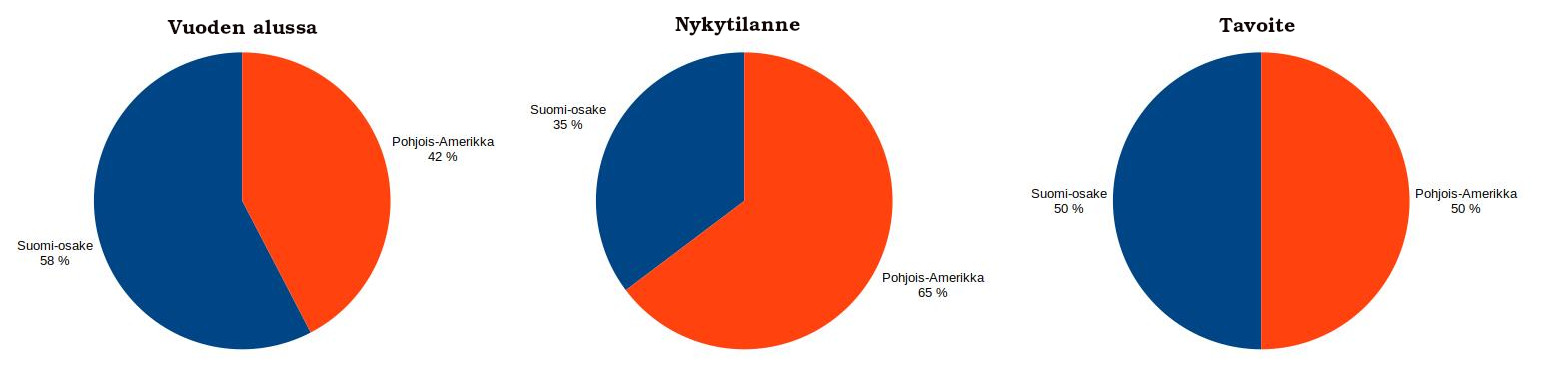
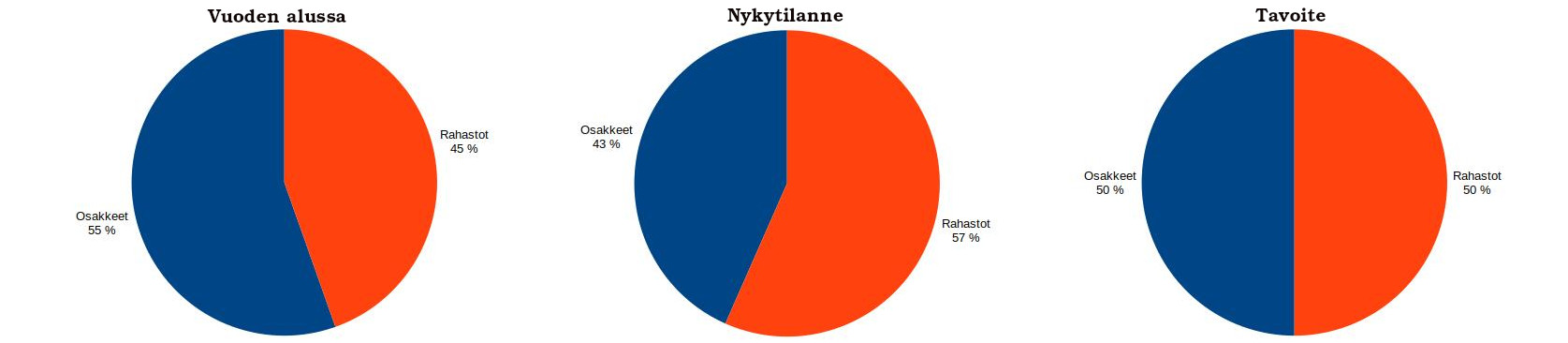
I reached my targets of growing funds over stock picking and increasing North American exposure over Finnish equities.


However, this mostly happened due to sales. In reality, toward the end of last year, I woke up to just how much money I was investing. One reason for this boldness could be considered the attempt to get margin credit from Nordnet. When the credit didn’t come through, I had to resort to the traditional way of freeing up cash from investments: selling. I targeted my stock sales at the Helsinki Stock Exchange. In fact, I haven’t sold foreign equities at all, and the intention is to buy even more if Nordnet has a Black Friday offer. I have also made minor fund redemptions and sold a bond ETF. I’ve trimmed crypto as well. None of this has significantly improved my personal finances, though; instead, my debt has turned into lower-quality debt. Towards the end of the year, it will become clear whether the debt burden has also grown, as my income is weighted increasingly towards the end of the year.

Since the sales were mandatory, I have simultaneously reduced my Finland weighting and added weight to funds. This is how I achieved the goals through sales. Next year, too, I might not manage without net sales. The redemption of Tradeka’s investment shares (tuotto-osuudet) early in the year will immediately push the invested capital’s performance into negative territory.


Farewell to Hesuli – replaced by global index investing

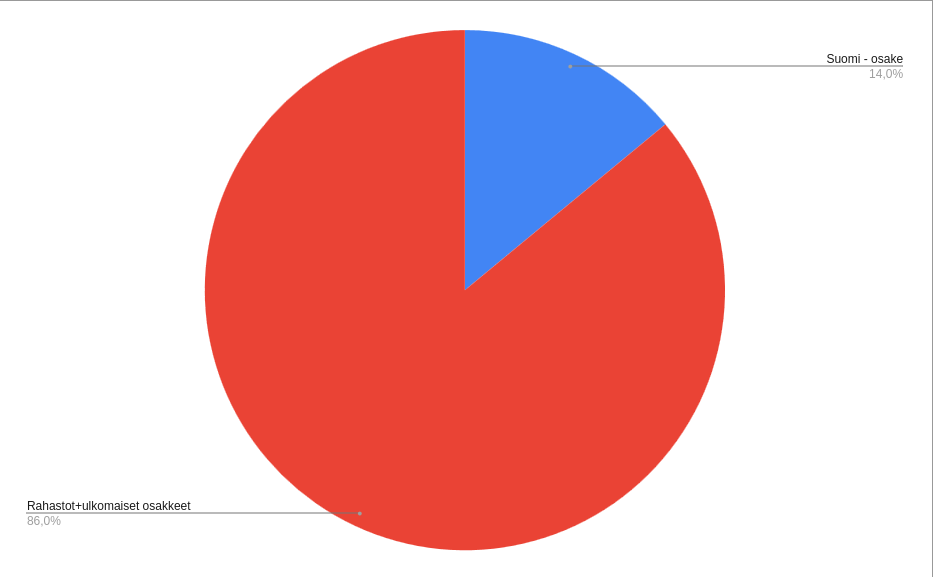
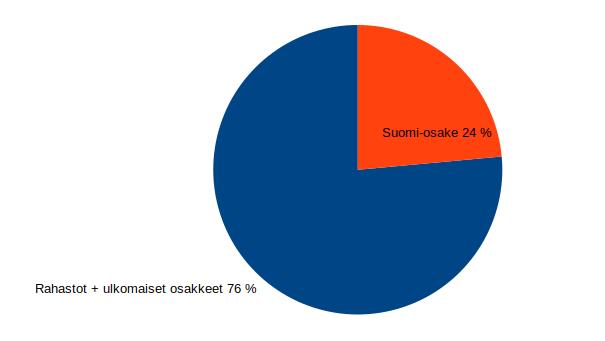
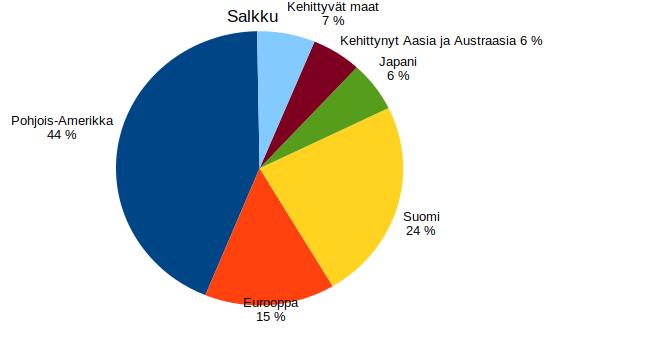
Initially, I thought I had already said everything there is to say about index investing, but the prolonged slump of the Helsinki Stock Exchange inevitably makes one wonder whether to abandon Helsinki entirely. In reality, though, I am not giving up on Hesuli; rather, the idea is a 14% allocation of the rest of the equity portfolio, with 86% in foreign equities and especially in funds. On top of this would come the hedge, calculated as it is currently.

Potential target:


Current situation:

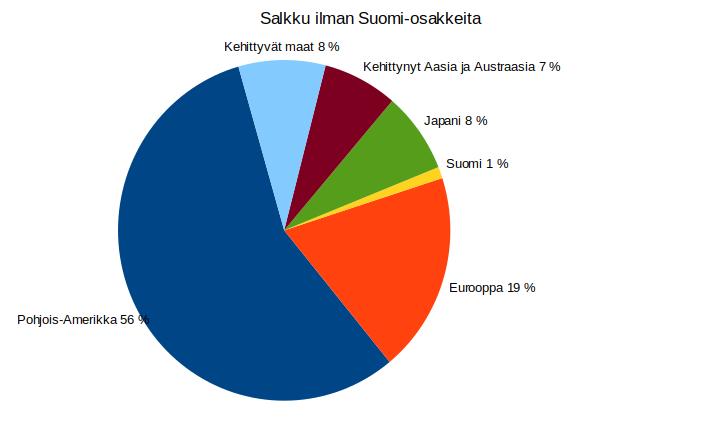
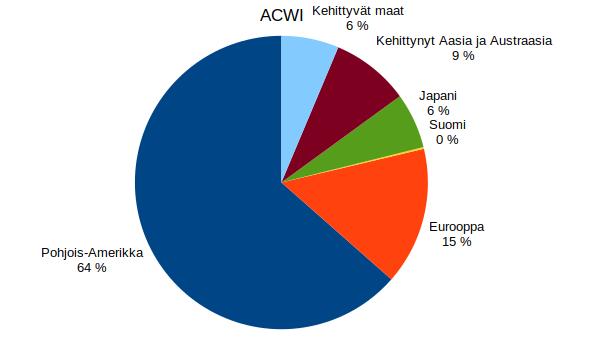
The Helsinki Stock Exchange would also become a somewhat non-strategic investment, much like crypto. This really shows how much confidence I have in Hesuli. The plan, however, is to maintain direct stock picks from abroad, as pure index investing feels too boring. Strategically, the goal is a geographic allocation aligned with the ACWI. This also paves the way for adding global index funds into the portfolio.


I also have exposure to Finland within funds.

I have considered the small share of the global index in the overall portfolio problematic, but if I start monthly savings into these, the share will inevitably be small at the beginning. That’s why it is important to reshape the current portfolio to fit this. Even in this potential future strategy, I will continue investing in emerging markets using the current selective approach. Therefore, I would likely avoid global index funds that include emerging markets.

In a way, this strategy being contemplated at a high level is converging with the current strategy. Likewise, my investments are converging towards the high-level strategy. I must emphasize that my strategy is based on an optimistic view. I don’t delve too deeply into the negative scenario, which at its worst from an investment perspective would mean liquidating all holdings.

The idea is to start tracking the portfolio of funds and foreign equities separately. The goal is to import the portfolio into Morningstar’s tool for easier tracking. I also need to consider the ratio of stock picking relative to funds. On the other hand, this strategy also paves the way for stock picking in the Japanese market, even though I have tried to keep myself disciplined.


Investment Strategy 2025

Investment objective:
The main goal of investing and saving is to provide a counterweight to my personal finances so that they don’t tip out of balance.

Investment style:
My investment style is primarily passive. Passive funds make up the core of the portfolio. In addition, I hold shares in 15 individual companies through an ownership strategy.

Investment horizon:
December 31, 2028 is the clearest target date for my portfolio, although the bank hinted that I could refinance the final loan installment with a new loan. Additionally, I am prepared for a temporary ~50% trimming of liquid assets if necessary.

New capital available for investing and total net worth:
There is no new capital available for investing. I reinvest part of the dividends into funds and, to a small extent, into stocks. The majority of dividends go toward building up the hedge. I do not take my total net worth into account when investing, as doing so might increase my risk tolerance.

Core allocation between asset classes:

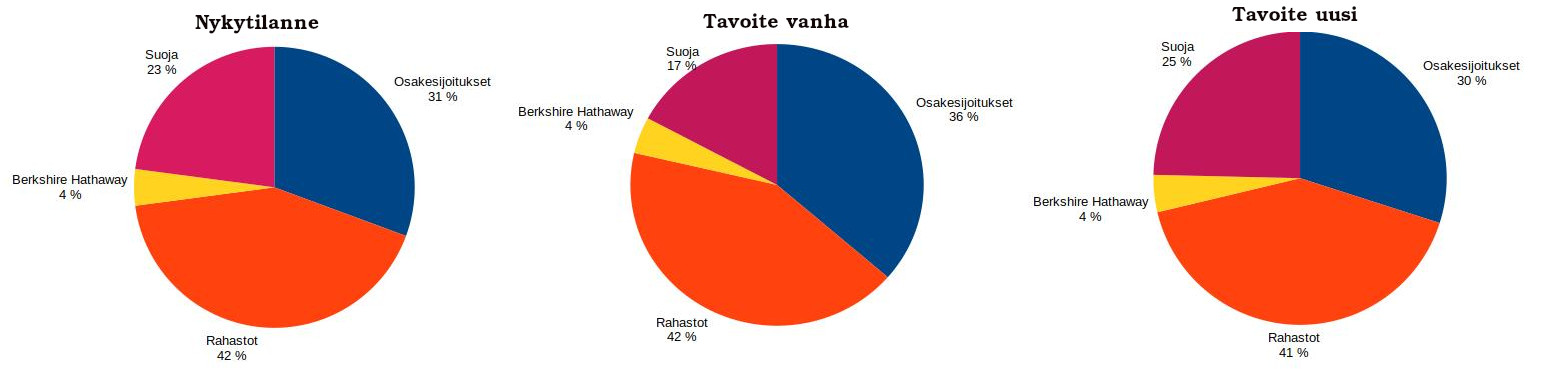
I have divided my portfolio components into four different classes, with volatility being the primary differentiator. Operating listed companies and unlisted companies carry the highest volatility risk due to their risk profile. Funds belong to a second, lower-risk class, as volatility is lower due to diversification. The third class comprises the lowest-volatility instruments (hedge), which include cooperative investment shares (tuotto-osuudet), cash, and fixed-income funds. The fourth class consists of inherently balanced investments.

The target percentage for the lowest-volatility instruments is determined by the final loan installment, a discretionary target portfolio size, and slightly based on the years remaining. The percentage decreases if I make extra loan amortizations. I also factor purchase prices into the allocation calculation. In addition, I have assigned funds a lower hedge requirement from the third class compared to direct stock holdings.

Thus, my allocation favors funds, and the goal is to reduce the amount of stock picking.

Berkshire Hathaway constitutes the fourth group, which I consider to be inherently balanced. Therefore, Berkshire Hathaway does not require a hedge, nor does it serve as one.

I added a discretionary target portfolio size here because the investment horizon might extend thanks to the bank’s promise to refinance the equipment loan. In reality, the size of the portfolio matters more than the portfolio allocation when considering loan repayment.


The goal is to grow the hedge and make extra loan repayments.

Portfolio rebalancing:
I have designated December as the month to review how to rebalance the allocation back to the plan. In principle, the intention is to rebalance using new purchases, but sales and purchases across asset classes are also possible. If the equity weight needs to be trimmed, I will primarily do so by selling direct stocks. If the hedge is over-allocated, when selling it I will buy funds or pay down debt, thereby reducing the hedging requirement. I am in no rush with rebalancing.

Market diversification:

The goal is to keep the North American weighting higher than the Finnish weighting. Investments in Europe are targeted/selective, but the further out I go, the more I invest in broad indices.

I have also invested in emerging markets using ETFs and active funds. I want to choose the emerging market exposures myself, selecting Latin America, Africa, Turkey, and Taiwan.

In North America, besides direct stocks, I have invested through four index funds and two small-cap ETFs. In addition, key funds include Seligson’s Global Top 25 Brands fund, Phoebus, and the OP-Asia index fund.

Time diversification:
The goal is to continue monthly additions to funds, even though the money comes from dividends. My actions have never been formal dollar-cost averaging, as I haven’t had large sums of capital to deploy.

Ratio of fund investing to stock picking:
I will continue with a sort of “Pluto model,” where fund investments are equal to or greater than individual stock picks. My stock picking is built around long-term ownership.

Anchor stock:

The key factor for the largest stock holding is that I can stay sufficiently up to date. For example, earnings webcasts in Finnish are preferred.

Currently, the largest stock holdings are fairly close, with Tesla being the largest. Among the holdings, Puuilo or NoHo Partners would be suitable anchor stocks.

Cash buffer:
The goal is to maintain a cash buffer for unexpected day-to-day expenses, but I have consistently failed at this. The aim is to utilize cash in the portfolio efficiently. In addition to fixed-income instruments, cash can be used for extra debt repayments, thus reducing the need for hedging.


Current Portfolio Situation

Allocation:
Stocks 31%
Funds 41%
Unlisted companies 5%
Cooperatives 19%
Fixed income 4%


Allocation trend this year

Portfolio rebalancing values via new investments 2025 target :
Add to hedge: €700
Reduce stocks: €1,673

Liquidity percentage 76% ( 75% )
I exclude difficult or slow-to-liquidate assets from the liquidity percentage:

  • Cooperative investment shares (tuotto-osuudet)
  • Unlisted companies

Dividend-paying companies 60% ( 68% )
This includes both listed and unlisted dividend-paying stocks.


Dividend growth has continued, but I no longer have a growing dividend as a target. Image updated on Dec 7, 2024. Tokmanni and IRSA still paid a dividend

Unhedged ratio 10.52% ( 1.76% )
This value is the percentage difference between the actual portfolio size and the target value used for calculating the hedge.
The portfolio size is €21,853.99. When multiplied by the unhedged ratio, the result is €2,299.04. The target value used for the hedge calculation is 21,853.99 - (2,299.04) = €19,554.95.

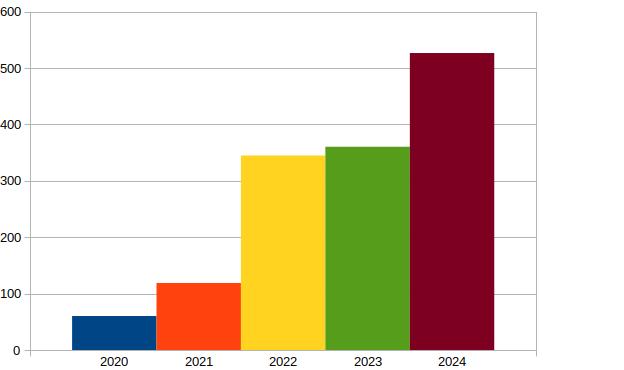
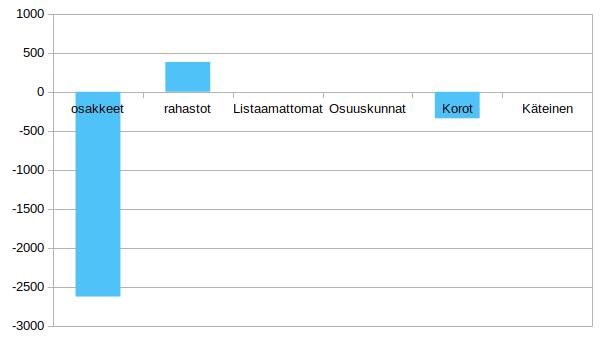
New investments and redemptions in 2024

Stock portfolio comparison against the All Country World Index Fund:


Practical Weightings by Asset Class:

Stocks:

Stocks remain on the chopping block if I have to trim my portfolio. NoHo Partners is in an accumulation phase, and I am specifically reinvesting NoHo’s own dividends back into it. In addition, I have considered selling other stocks to add to NoHo. Puuilo is also down to a small holding after sales.

If the equity savings account (OST) moves into the green, I plan to make small purchases using the Black Friday offer to reinvest Titanium’s dividends.

Funds:
The goal is fixed monthly savings into Phoebus. The savings amount consists of S-Group bonuses and dividends. Through the stock portfolio, I have aimed to ensure dividends are paid every month.

Unlisted stocks:
Unlisted holdings remain unchanged.

Hedge:
A significant amount of cash will be freed up from the hedge once I redeem the Tradeka shares. Within the hedge, I emphasize debt repayment. If I can save money, I will accumulate it in a savings account or similar, and use part of the cash to pay down debt.


29 Likes

Hi, a sincere question about the portfolio size. So, is the total portfolio around 22 thousand euros? If so, your strategy somehow seems quite complex given the portfolio size. Investments were quite well diversified, and presumably, the total costs are also somewhat significant if very small batches of shares are bought from the United States.

4 Likes

In OP, costs are 1% in small trades. Trading costs in other services totaled 52 euros last year. I will calculate the costs at the end of December, but I estimate they will be lower this year than in 2023. The Share Savings Account (Osakesäästötili) is probably what draws attention, but I have reliably kept it in the red all the time, so we’ll see more closely what I do with it if I can get it into the black. Before that, I will withdraw the dividends tax-free.

Investing is also a hobby to which I want to dedicate time. But this has been explained quite complicatedly, considering what is practically intended to be done next year.
sketch-1732472639292

25 Likes

Well, that’s an understandably explained strategy, and its execution is sure to succeed. Simple is beautiful. Good luck and success for the coming year.

1 Like

I haven’t written down my investment strategy anywhere; rather, it’s stored in my head, a collection of several thought patterns. Here are a few of the principles:

-Time in the market > Timing the market; don’t try to time it unnecessarily, as missing the most important up days quickly leaves returns modest.
-No sales of profitable positions. This is currently mostly dictated by necessity, as Kela doesn’t like capital gains (I’m a student). I don’t consider it impossible that I might sell profitable positions in the future, but I like the idea of cutting losses and letting profits run. With losing positions, I try to do a self-critical analysis, and usually, these are exited, especially if the position is large. With profitable ones, I stay in and raise the average price. When opening a new position, the goal is always to hold forever!
-Purchases every month, to maintain temporal diversification. However, when more money comes in, it just goes into the market.
-General optimism and respect for the market. Fundamentally, the market is right and rising; don’t argue, for example, that “S&P500 is expensive, Finland is cheap.” I would likely be wrong, and the market right.
-The biggest risk to my returns is myself, which is why about 70% is in index funds. The rest can be used for speculation, but even there, diversification is remembered. Currently, about 20% is in “quality companies” and about 10% in high-risk bets (BTC and growth companies). However, I don’t follow this slavishly; if something rises, its weight in the portfolio naturally increases too.
-The goal, of course, is to achieve outperformance with this 30% portion of the portfolio. If I can make it perform so well that the entire portfolio yields even 1% better than the index, the long-term impact on wealth is truly significant. However, I see the downside as relatively small, and it can even be thought of as just the cost of a good hobby. If I become a good stock picker, perhaps when I’m older, I can shift more strongly into individual stocks.

Easier said than done. Fortunately, sometimes I’m less interested in investing, so I don’t make too many changes. A more detailed playbook is about tactics, not strategy, so I could update that in the “What’s in your portfolio?” thread.

6 Likes

Sometimes there are good reminders not to be a hodler. If you hold, it’s worth sticking with excellent businesses

Screenshot 2024-11-29 at 20.22.06

I haven’t used the acquisition cost presumption before. In this case, it seems like a good option

15 Likes

Do you want to hear how my portfolio, guided by the GPT-4o AI language model (about a 10% slice of my investments), is doing after one month?

No matter - I’ll tell you anyway.

So, the portfolio’s principle is “Equal-weight stock portfolio. No funds or ETFs. Three years scope. I’m not after high dividends, as they are double-taxed at my end. Risk level medium-high is ok for me. I’m not willing to make changes very often, possibly once a month if required.”

It’s doing very well. A 6.3% gain in one month. In this negligibly short period, it outperforms the S&P500 and Nasdaq-100 indices. As well as the absolute value of OMXHGI.

Currently included are AMD, GOOGL, AMZN, AAPL, ASML, BAM, ISRG, JNJ, META, MSFT, MSTR, NOW, NVDA, SHOP, TSM, TSLA and V.

MSTR is my own addition, everything else is AI-driven.

Today, AI prompted an adjustment, which I obeyed:

Why Replace ABNB:

• It’s economically sensitive, relying on discretionary travel spending.

• Regulatory hurdles are increasing in major cities.

• Growth is tapering post-pandemic, and competitors are catching up.

Suggested Replacement: ServiceNow (NOW)

• Why NOW?: ServiceNow is a leader in digital workflow automation and enterprise IT services. It benefits from the growing demand for digital transformation, particularly among large enterprises, and has shown strong, consistent growth.

• Sector Balance: Replacing ABNB with NOW keeps your portfolio tech-heavy but shifts from consumer discretionary to enterprise software—a more stable, subscription-driven business model.

17 Likes

I negotiate with ChatGPT-4o about the contents of that AI portfolio on the first Monday of every month. The next time will be on January 6th.

If anyone is interested, I can tell you how things have gone so far, and what we’ll continue with?

17 Likes