Hey grandpa, 5G stocks are old news. Check these out: $ACB, $WEED, $TLRY, or even BTC and ETH ETFs. That’s where you’ll find excitement, volatility, and speed.
1 Like
This thread had completely passed me by, and it’s been interesting reading.
I thought I’d share my own strategy since there wasn’t an exact match. I’ve tried everything possible, but this seems to work best for me.
For investment decisions, I use: broker statistics, analyses + other news. I also try to study technical analysis.
The most important thing is that I avoid buying into falling prices. Generally, I take the view that those wiser than me are in motion, and it’s pointless to fight against them by buying. Why would I have the correct information about the price or companies, and others are “wrong”?
For example, if I thought Nokia was a winner in the 5G market, I’d consider it too high a risk to evaluate it now because I don’t really know. But if that’s the case and everyone is movingly unanimous about it, I’d buy Nokia even at 10-15% more expensive than now, and that’s perfectly fine with me.
In smaller companies, I sometimes take a contrarian view, but then I want to clearly see who is selling and who is buying, etc. For example, Harvia fell for almost a month after an excellent Q1 because Danske wanted to lighten its ownership.
I also use leverage quite a bit, but the same rule applies: not into falling prices. I’ve had experience with that, and it almost made me sweat.
And I don’t hold a long portfolio where bad investment decisions go. I admit to myself that I was wrong, cut my losses, and move on to new disappointments 
5 Likes
That’s what we all try to do. Falling knives in the skin hurt like hell. But dear Otto: how does one know that the price will no longer fall and that one can calmly pick up a pile from the bottom of the pit and then head uphill with it??
Uncle Masse has been trying to solve this problem for decades without success. A rare few have, and they are called stock millionaires 
Uncle Masse, FA, still in the entry-level league 
3 Likes
Good that you brought it up. You don’t, and that’s why I don’t even try.
So, I’ll elaborate on my strategy.
Here was my investment process back in the day.
- I bought company X when the price fell, but people were talking about overreaction or something.
- I bought more because now it’s even cheaper. The overreaction continued.
- Well, maybe it wasn’t an overreaction, but let’s buy now, it’s cheap and you get X% dividends.
- At the end of the year, I get tax deductions from this, so this was a good investment.
Nowadays, I operate something like this.
- I’ve been following, for example, Lehto, but I don’t know where the bottom is, and I don’t try to guess.
- Lehto has started to correct upwards by 10%. Positive news starts coming in. Sales have been good, new contracts secured, etc. I observe how Mr. Market reacts to the news. And it’s always good to follow more experienced investors

- I buy the company’s stock and don’t worry that I should have bought it cheaper. “It’s not worth buying this anymore, the train has already left.”
- If I guess the timing of the purchase wrong, I sell. If the trend continues to be good, I buy more.
6 Likes
With age, one of the most difficult, yet most important, skills in investing develops on its own. Namely, patience.
I don’t randomly put my money into falling or rising stocks, but instead, I rely on my own (and others’) research into a company, its business, and its operating environment. Although my choices could be described as “long-portfolio” investing, I don’t think they are. For some of my investments, “doing nothing” requires even several decisions a month - not to mention a year.
Markets or individual stocks fall for many reasons. I believe that the easy availability and quantity of information have increased volatility. I just linked Jeremy Siegel’s interview in the Market Direction thread. It also touches on how an investor should act in the current situation. (see approx. 01:00 ->)
My wife has the best investment strategy I know. She invests in the same stocks as I do when she sees me suffering the most. It has worked. 
10 Likes
The golden rule #9 has been slightly refined with new wording that considers a slightly longer-term perspective:
Margin of safety: expected return > 15% p.a.
The above wording increasingly guides one to consider cases over a longer period, which is also the perspective of my own strategy. For example, cases where Inderes’ target price (12 months ahead) cannot take into account significant long-term share price drivers… a current example could be the upcoming divestment from Garantia (Taaleri).
The year is halfway through, so a few words about my H1:
- So far, by far the best half-year for me. [Of course, the markets dipped around Christmas, and indices have generally risen sharply. Luckily, I bought quite a lot back in December 2018.]
- In 2018, it felt like many of my then-“core investments” seemed to stagnate. I knew that many cases would start to materialize if I just waited patiently (Remedy, Hoivatilat, Harvia). This has started to happen in 2019… the direction is right!
- Heading into the year, the portfolio was -10% (excl. dividends). In the spring, I sold off a couple of very small loss-making positions (Pantaflix, Nordic Mining) and loss-making purchase lots from Verkkokauppa… I have increased investments in core holdings throughout H1. Realizing those losses, of course, slightly distorts H1 returns.
- Currently, portfolio positions are +18.9% without dividends, and about +20% with dividends. In addition, I expect relatively positive development to continue for the rest of the year, because, for example, Remedy has a 17.6% weighting in the portfolio.
- I hope that within a year or two, Kamux, among others, will start to correct upwards. Additionally, Verkkokauppa, which has been an underperformer, will likely correct upwards “in a few years,” as operations are optimized from growth towards profitability.
5 Likes
I completely agree and I almost completely lack that quality 
So perhaps at this point, it would have been more fashionable for me to talk about price drivers.
I personally find it easier to structure things through examples, so let’s take a couple of companies.
Kamux
I have read the analyses and formed my own opinion, and I even see potential here. But it is not yet in my portfolio.
Why? Because the company or industry doesn’t interest almost anyone. All my sympathy @Petri_Kajaani 
So, do I buy Kamux now and wait for the market to wake up to Kamux’s potential? This could happen, or it might not. I am taking the view here that it will not happen in the near future. If there are signs of this, I am willing to buy Kamux at a higher price than now, and I won’t think that I should have bought it two years ago, etc. In the meantime, I will try to find other targets.
Harvia
I have owned Harvia for some time, but I would buy more at this price even though it is no longer “cheap.”
A new company on the stock exchange, a niche industry, theoretical world conquest. In addition, recent attention arouses interest. The main risk here is volatility, which makes me cautious.
I think that a price movement, whether up or down, is a self-reinforcing factor. If a company has a bad result / the price drops, all possible risks and dangers are seen.
If, on the other hand, the price rises, these initial factors recede into the background, and a reason for the rise is sought in the good things, even if nothing has changed in the company itself. Rovio is a good example of this.
These are, in my opinion, good situations to make purchases right into those falling knives.
Of course, then I haven’t been anywhere near the bottom because the same thing is already known to everyone.
So this is where I am trying to develop. I know the fundamentals, but above all, I try to sniff out those drivers.
8 Likes
My basic cornerstones in my investment strategy are:
- – If you don’t beat the index’s annual return, then settle for investing directly in the index
- – However, since you are aiming for a return higher than the index, invest in stocks
- – When volatility (VIX index) is low, the investment horizon is 1-3 months
- – As volatility rises, the investment horizon shortens (because risk increases)
- – The market is approached from top-down, i.e., from macrodata to microdata (world economy -> individual company)
- – Focus only on essential information and filter out market noise. Today’s news is often old information and already priced into the market.
- – Investment decisions are based 80% on fundamentals and 20% on technical analysis. Technical analysis only helps with timing.
- – Be creative, but don’t fall in love with ideas. Only good ideas move forward into trades.
- – Investment ideas are intrinsic. Don’t latch onto others’ ideas.
- – There are 50,000 investment instruments globally. Be patient.
- – Trades are made in pairs, which eliminates market risk (one long, one short). For example, from the same industry, say long Sonera and short Radiolinja :joy:
- – If a pair is formed from different industries, risk is adjusted by the ratio of beta values.
- – A target and stop loss are set for the trade. The stop loss is not touched, but the target price is "soft" (meaning if the target price is reached, capital is added to the trade).
- – Investments don't pay a salary; they grow wealth.
11 Likes
{“content”:“I have gradually developed the following factors for making a purchase decision:\n\nFundamental side:\n-Internal analyses\n-Dividend %\n-Industry outlook\n\nTechnical (for timing the purchase)\n-RSI\n-MACD\n-Moving averages\n\nValuation using Graham’s P/E model\nAdd a bit of macro analysis to this”,“target_locale”:“en”}
2 Likes
Good set.
Does that mean if Inde doesn’t follow, you won’t buy?
1 Like
Yes, I do buy those that Inde doesn’t follow, but I easily feel more uncertain about them. I aim to familiarize myself with the company’s strategy, competitors, and mainly P/E, P/B, EBIT% and its history from the figures. I also go through the company’s financial statements and interim reports. But Inde’s professional analyses certainly give good insight into the state of the company and the industry!
1 Like
I spent a long time wondering if it was worth spending time discussing stop-loss orders with someone who doesn’t use them and hasn’t grasped their importance in stock investing. But then I thought, maybe I could spend half an hour on this, so that some beginner investor would understand their importance and be saved from losing their assets.
When I started writing here, I think one of my first comments was when I tried to emphasize in some thread that in stock investing (trading), you always need a plan on which your investment decision is based. Everyone can form one based on their own skill level, and to me, it’s the same whether one has figured out the fundamentals themselves, uses an analyst’s estimates, or just relies on technical analysis’s price action signaling (I’m bad at translating, but I mean price action). The essential thing is that the grounds are written down (why), what profit is sought, and what the maximum loss is. The longer the trade/target, the more data it’s good to have and to update it as well (the situation is constantly evolving). It’s easy to remember things differently three years from now. If risk management is missing from the plan, the investment is broken and without purpose. Risk and Reward. Risk is the more important of the two elements.
I myself have been an investor for so long that my own development has also changed my investment behavior. So my strategy has changed almost completely. Most probably start by making purchases based on gut feeling, a friend’s recommendation, or otherwise FOMO-style. Then, at some point, they realize that the investment is at a loss. Until, after a few additional purchases, they end up selling in a panic when others start buying it. Then they can’t do anything until it’s too late again and the price turns downwards again. I have completely shifted from a buy and hold investment style closer to a hedge fund type approach, where the portfolio is updated as soon as the situation warrants it (or, for example, making short investments against longs if a larger temporary downturn is foreseeable). I have a long-term portfolio and a separate trading fund. The content of the longs also evolves. The trading fund is used for trades lasting from 30 seconds to a few weeks. Sometimes some of these move into the long-term portfolio because the trend continues (it can be a long purchase or a short sale). Often, I (too) have some understanding of the fundamentals, but the buy/sell decision is always based on price action, where I utilize various TA indicators.
Regarding Nokia as a target. I bought it long in early 2018, quite close to the bottom. I sold them off in early 2018, quite close to the peak. Since then, I have made dozens of short trades with Nokia, with slightly different stakes depending on the situation. During the time the money was not in Nokia, it generated returns in other assets. That amount of money has generated many times the profit all the time, instead of me holding it. The price has fallen about 20% since the time of sale. I have the opportunity to buy the lot back significantly lower again, if I consider it reasonable. The 2018 lows were 3.81 and this year’s lows were 4.17 so far. It is entirely possible that both of those will be broken downwards. Whether it is likely is another matter. But how many are prepared for it - is there an action in the investment plan for it? If the cash size is infinite, it is of course not a problem.
Nokia is in a weekly EQ, low 4.3070 and high 4.55. Friday’s close and the formation of the daily candle are borderline whether it can be read as a bull flag. This is supported by the price staying above ema26, but it is countered by the amount of bear volume on Friday (increasing relative to Thursday). I made a buy decision on a 15min timeframe, where the low formed at 4.4560. I made a buy decision at 4.605 with the idea that global market sentiment supports the continuation of the rise, as does Nokia’s overall situation (earnings report approaching, the probability of a negative earnings report decreases day by day, which often leads some investors to buy lottery tickets in hopes of a positive earnings report and the stock gets a boost). After-market purchases were largely bullish. But because Nokia has had a long decline and is now still looking for direction, I am not going to gamble with a big risk at this point (the purchase was relatively large), but will end up making a practical break-even trade if the rise stops. It is very likely that if we drop back near the low, the decline will continue downwards from there. I will reassess the situation at that point without any risk, but there is a possibility to get the same lot again at a lower average price. I can repeat this practically endlessly, so I will certainly find the bottom. The small loss incurred along the way will be recouped quickly when the rise begins.
In a normal situation, the stop would be set somewhere below that low of 4.4560 with some margin, but the situation is still so unclear that I don’t want to take any unnecessary additional losses at this point. If the rise continues, I will raise the stop-loss so that I get a small profit in any case, even if a sudden sharp decline comes unexpectedly. So, with good probability, the trade will be profitable in any case.
Many times it comes to mind, what happens to an investment, for example, in a situation where a person falls ill or gets injured, and is unable to manage their investments, and there is no stop-loss order to protect them?
Active investing versus passive investing is many times more profitable, but it naturally takes time and requires a lot of effort in other ways (information gathering, news monitoring, seeking investment partners/opinions, etc.). I am happy to read about good investment tips or successful strategies, but I would really like concrete examples. One must be a strong performer to be able to find a portfolio of long-term assets in the market that do not need to be updated, whose purchase prices are below the real value at the time of purchase (?), where stop-losses are not needed, and whose returns outperform basic index funds. There are so many fundamental analysts and calculators in the market that beating them is a respectable achievement.
An active investor behaves differently in different sentiments. It was easy to buy stocks for a long-term cash fund when the uptrend had been so long, starting from 2009. Ten easy years. Since the turn of the year, I haven’t added anything to my long-term cash fund, but I have lightened it. Although this year has been a bull market party since January, many kinds of worries have been lurking, and the sentiment has been surprisingly mixed and uncertain. Therefore, it has been safe to make only short trades and wait for the situation to develop - still being able to take advantage of the rises, but with less risk.
(This update might be a bit messy and incomplete, but I didn’t have the energy to think it through better beforehand. I wrote what came to mind - there would be endless stories on the topic).
23 Likes
This seems like a rather bold claim. What is it based on? At the same time, it has been stated many times that active funds lose to passive ones, precisely because of fees.
The problem with stop losses is how to time re-buying. In the worst case, you hit a stop loss and immediately turn back up. As I understand it, people previously wondered about this when your stop loss was a tick (?) away from the purchase price.
3 Likes
Most funds probably have regulations Like, how much can one stock weigh in the portfolio? As well as the sums they invest with. Trades like those would cause a slightly different kind of volatility in prices, unlike individual traders.
For example, a Daytrader might not even hold assets overnight. A Daytrader’s operations are considerably different from what an “active equity fund” does.
4 Likes
Sure, funds have limitations; I didn’t mean that as a direct comparison, but more as a stylistic one. The claim is still quite bold, as short-term trading is largely a zero-sum game, unlike longer-term longing. Of course, the shorter a trader’s trading horizon, the greater the potential for higher returns in theory. However, it’s hard to believe that this would be a good way to operate for very many people.
2 Likes
I could also throw in a story here and give a small tribute to @DayTraderXL, if you’ll allow it
Sometime in early 2015, when I was still very young, I was looking into fund investing and realized that “aha, I could even get returns on my money from something other than working, and protect my assets from inflation.” Well, after getting acquainted with fund investing, I quickly moved on to reading the basics of stock investing (this was because I remembered Medifilm’s existence and also examined the current holdings in its portfolio, which had been left in the portfolio by my father. I realized that I would eventually have to manage that portfolio, so I thought I had to know something). At that time, I mainly focused on what P/E, P/B, EV, etc. ratios are and what they mean. Later in 2015, I got to trade with party X with sums of 10-20K, who was just as ignorant about short-term trading in the stock market as I was (in practice, there wasn’t much of a strategy other than looking for stocks that had fallen a lot in the short term within the OMXH25 index and trying to make profits from them). The result: We first collected an average capital return of about 33% from a strong bull market (with complete luck, looking back now), but then we bought Orion after its first major dip (-12.5%, after the Q2 2016 report, if I remember correctly). Since we didn’t know anything about stop-losses at the time, and as a novice investor, I didn’t dare to sell losing stocks (and I, being foolish, somehow managed to justify holding the stock against Inderes’ recommendation, as I wasn’t familiar with Inderes’ service then), the result was eventually almost -50% on the meter, and significant losses through that.
I then had a small silent period with these matters, as 2016-2017 was a really difficult time in my life outside of investments, so I didn’t think much about such things. Occasionally, some well-performing stocks, such as Cargotec and Neste, were sold from Medifilm.
By late 2017, when I was at least somewhat “back on track,” I noticed that Nokia had become significantly cheaper, and before that, I had already become somewhat familiar with Inderes’ analysts and morning reports, etc. So I watched Mikael’s video on Nokia, when Nokia was closer to a 4€ stock. We then ended up buying Nokia from around the 3.9xx€ levels, and made good profits by selling when the price rose (I don’t remember/have time to dig up exact figures now, apologies for that). In 2018, I was able to make more decisions about Medifilm’s assets through party X, and we even tried trading with Medifilm before I turned 18. Even then, I didn’t know about stop-losses and their use. The result was some profitable trades, such as Nokia, but there were also losses there, from Outokumpu (which I wrote about in the “Investment Mistakes” thread earlier in late 2018). So: Since I had no knowledge of the existence of stop-losses/TA indicators, etc., I naturally fell for the traditional beginner’s mistake of catching a falling knife, and got big wounds from it This is brutally visible in the following return graph (blue curve is the development of my own portfolio, orange curve is the OMXHGI benchmark index):
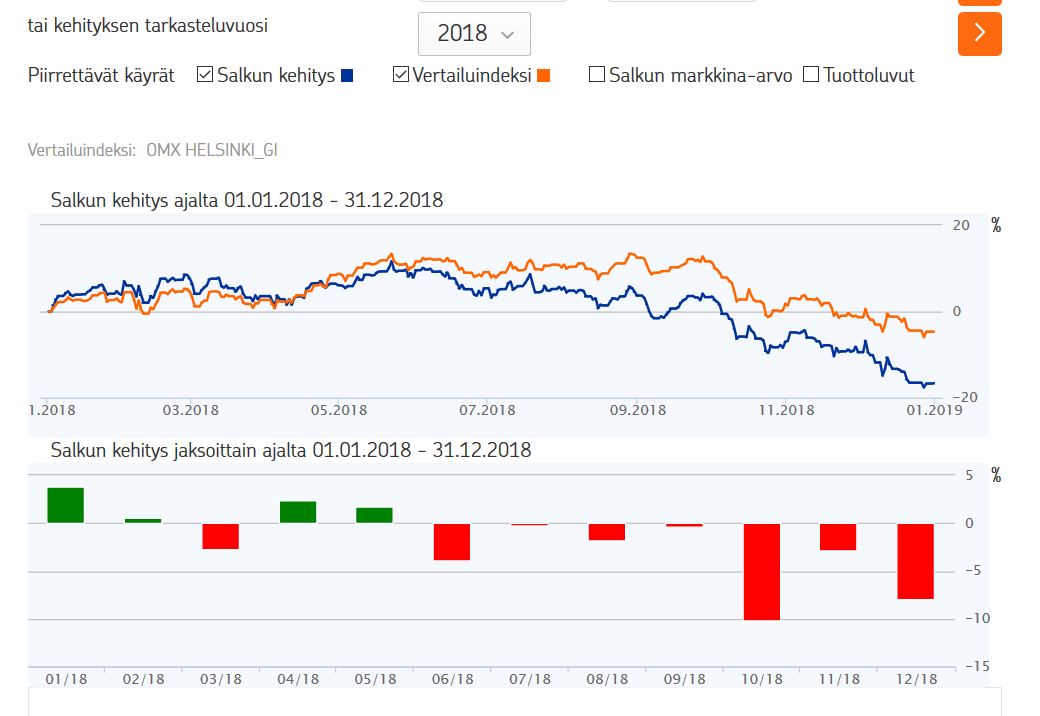
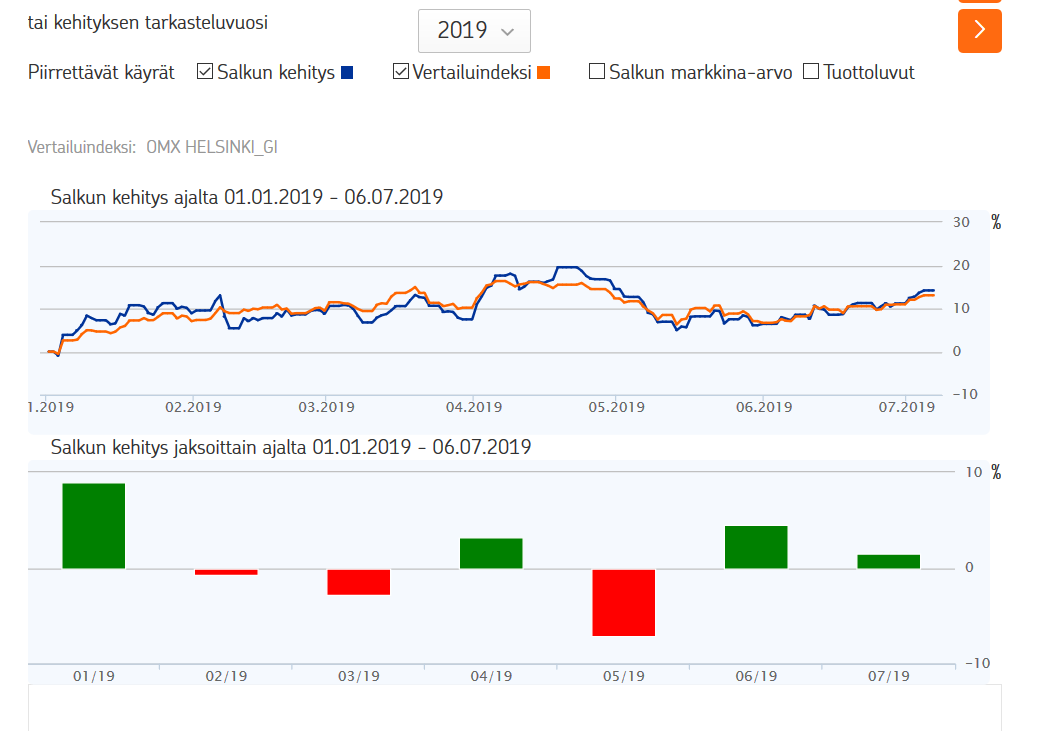
Only since late 2018, after coming to this forum and learning a bit about TA, stop-losses, etc., has this short-term investing started to go well, and long-term investments are also doing better and are better justified (thanks also to the fact that I started studying Inderes’ analyses very often and carefully  ). All thanks for this go to the forum members, but a special mention to @DayTraderXL (
 ) for sharing various graphs and information related to TA, which has resulted in me learning a lot about trading, risk tolerance, and stop-losses. So far, this is also highlighted by the difference in these two return graphs (blue curve is the development of my own portfolio, orange curve is the OMXHGI benchmark index):
Perhaps I would emphasize the importance of all this again: Nowadays, the Investment Forum, Inderes’ analyses and videos are things I browse and watch daily, and from which I get a lot of joy in my life, and at the same time good tools for good trading. This is actually a significant thing, because otherwise, I have faced a lot of headwinds since 2016, the details of which I will not disclose here; you can ask in a private message if you are particularly interested, but I can say that I have had to push through really tough things, even when my own strength was very close to a complete rock bottom. Without this investment community, without Inderes, things could actually be much worse for me than they are now.
But now: I will also open up the basic fundamentals of my investment strategy, now the fundamentals of those trades, which I did not open earlier:
- A clear stop-loss and target price (price level at which profits are realized) must be set for the tradable asset. The stop-loss is never adjusted downwards, but it can (and should be) adjusted upwards, for example, to the break-even level, if and when the trade materializes in that direction.
- The tradable asset must have a positive recommendation from an Inderes analyst, and a fundamental basis that allows me to justify the stock purchase (this means that I read Inderes’ analysis of the company and am able to understand why a positive recommendation is justified; I sometimes also use a DCF model to test the sensitivity of the asset’s valuation).
- The purchase of the tradable asset must also be justified based on technical analysis; for this, I use a few indicators depending on the situation, mainly pivot points (LL/HH levels, HL/LH levels, etc.), RSI, and MA/EMA curves, and some patterns (though rarely, because spotting them is still a bit tricky for me). In this regard, the stock’s trend (bearish or bullish), etc., must also be taken into account.
- The asset must be liquid enough; I usually use a minimum daily trading volume of 1 MEUR as an absolute minimum.
- If I am in a particularly negative situation in my personal life, I generally do not start trading, as emotions are known to cause bad results in such a situation.
- The tradable asset must be something that interests me at least on some level, and whose story and fundamental side I believe in enough to dare to invest in it.
I hope I didn’t forget anything, here it is
Finally, thanks to all the forum members who have encouraged me (too) to continue investing with their activity and encouraging words. I realize that I owe each of you a great debt of gratitude for this, and of course to Inderes, which is the origin and root of this entire investment community
Johannes S.
14 Likes
That’s why trading requires learning, and it’s not an easy task, nor is it for everyone. But for people like @DayTraderXL, who are truly competent in this area, it’s certainly a huge opportunity to generate significant outperformance compared to the index, no matter the situation.
2 Likes
It’s great to read posts like these. You’re learning and internalizing things quickly. TA is something you can always find something new about—one step at a time. In five years, you’ll be a professional, that’s clear. Just always remember to make sure you minimize losses. A trade is easy to re-enter with a small additional cost. Fundamentals are always helpful—DCF calculation is a good aid.
3 Likes
For myself, it’s easy to compare this to achieved returns. I know numerous colleagues in the same situation. I don’t know about funds, I was talking about private individuals. I’m surprised by the talk about those costs; they don’t play a significant role in active trading.
It seems that the use of stop-losses is not very common. Why would buying after that be any more difficult than in the original situation? Often, it’s even easier. Sometimes, it even happens that you end up buying again at almost the same price, but that’s part of active trading. You should re-read my justification for stop-loss; I think it was described precisely with its reasons.
edit - I set the stop after a while when I saw the price start to rise, as I had assumed
Naturally, I haven’t meant that everyone should become a trader. Nevertheless, and especially for that reason, stop-losses should be like muscle memory. Always in use. And that’s where this discussion began.
1 Like
The less volatility there is in the market, the longer the investment horizon should be. And vice versa – the more volatility, the better the probabilities of making a profit even within a day.
3 Likes