Sijoitusasunnot.com Group Plc

Morning news:

The real estate development and residential investment company Sijoitusasunnot.com Group Oyj (“Sijoitusasunnot.com” or the “Company”) is planning an initial public offering (the “IPO”) and listing its shares on the First North Growth Market Finland marketplace maintained by Nasdaq Helsinki Oy (“Listing”).

The planned IPO is expected to consist mainly of a share issue, in which the Company aims to raise gross proceeds of approximately EUR 5 million before IPO-related fees and expenses. The Company intends to use the funds raised through the planned IPO to implement the Company’s strategy and to develop and expand its business, including increasing the volume of property acquisitions, acquiring larger property complexes, and undertaking new development projects. The IPO is also expected to include an additional share tranche of approximately EUR 2 million, which can be utilized in the event of oversubscription.

https://group.sijoitusasunnot.com/tiedotteet/sijoitusasunnot-com-group-oyj-suunnittelee-listautumisantia-ja-listautumista-first-north-growth-market-finland-markkinapaikalle/

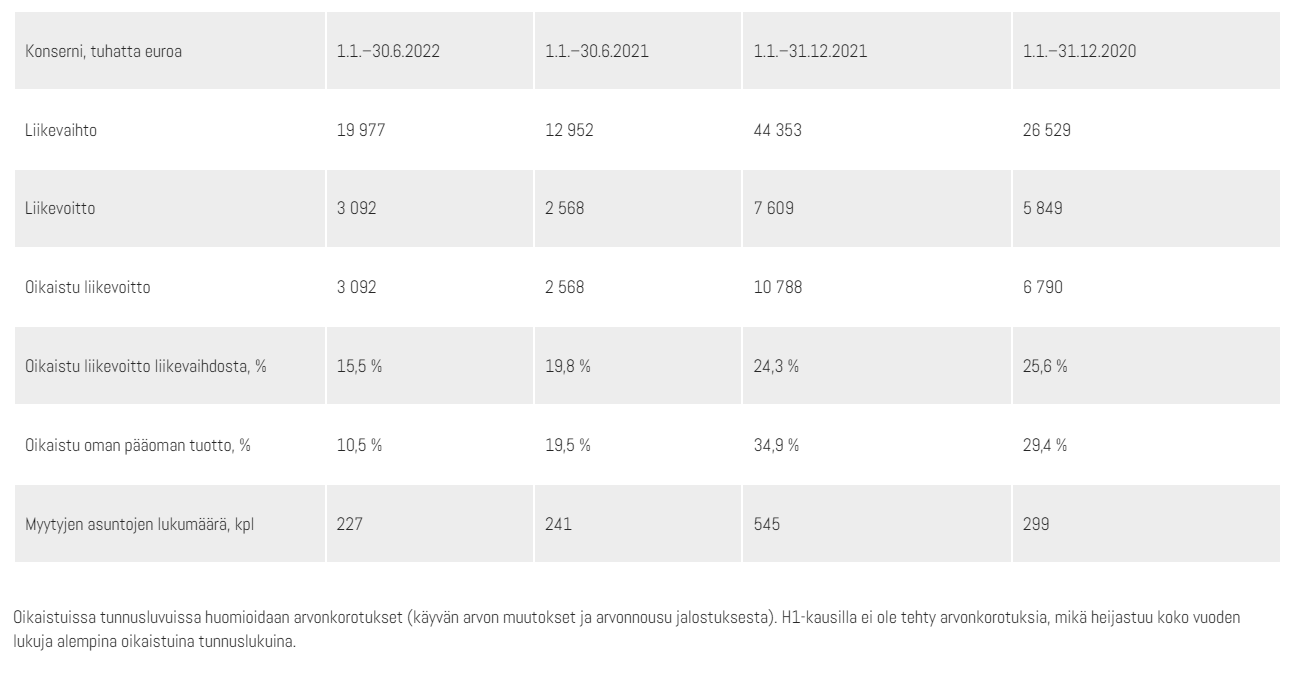
The key figures are as follows:

An interesting case, and how the adjusted operating profit is constructed in this case is certainly relevant.

  1. Profit generated from the development and sale of apartments
  2. Rental income from apartments in the holding portfolio
  3. Increase in the value of apartments in the holding portfolio
23 Likes

Let’s follow this one, as I’ve been monitoring the company’s offerings for some time now.

They certainly know how to sell, as a while ago they were selling apartment buildings in a bad area of my hometown and made it sound like paradise :sweat_smile: those apartments sold pretty quickly, and they promised rental yields of 7-12%.

I’m wondering what a cooling housing market will do to those rather high expectations :thinking:

17 Likes

Well, this is a very interesting and anticipated IPO for me as a real estate investor! I see Sijoitusasunnot.com as somewhat similar to Inderes for stock investors, but they don’t produce as much “educational material” and don’t have a similar community, but still have a large audience and a substantial email list of over 60,000 followers.

Sijoitusasunnot.com’s main business is real estate development, meaning they aim to buy entire apartment buildings or a large bundle of apartments, allowing them to acquire properties at a significant bulk discount. After this, necessary major renovations and repairs are carried out in the building and apartments, after which they are sold to investors through an investor list. Renovation activities and real estate development, real estate brokerage, and rental activities are conducted through their subsidiary Rajape Oy and Kauppa Käy LKV, respectively. In addition, their own real estate investment portfolio plays some role, but I don’t have exact figures on these.

Between 2016-2021, the company grew at an average annual rate of 75%, BUT extremely profitably, as the operating profit margin has always been over 20%. The company has gained a good reputation among real estate investors by selling good investment properties. They almost always sell investment apartments below the actual average prices of the area, which gives the investor the greatest value after buying a property from them.

The company has stated that the properties for sale are always selected so that they would work well in their own holding portfolio if the properties do not sell. Reasons why properties bought from them are good: location, usually well-renovated and repaired, often already rented, good rental yield, and most importantly, below market price, meaning cheaper ones are usually not found in the public market.

In reality, their good reputation has led to a situation where apartments are often reserved even within the first few minutes, and I see the risk as quite small that at least larger batches of apartments would be left to them.

Risks certainly include rising interest rates and a general weakening of the economic situation—do people have the means to buy as many investment apartments in the future, and can purchase intentions be postponed? On the other hand, even slightly larger players will certainly grow their portfolios almost always if suitable properties are found, and they find them.

One challenge in the current market is certainly the increase in construction costs, which, however, seems to be easing somewhat.

One risk is the same as with Inderes; if the reputation weakens and the audience leaves, there will be hardly any value left for the company’s operations. As long as things work, things work :smiley:

Many might also wonder if apartment buildings will run out if operations are carried out on a large scale. The answer is no. The company operates in the Finnish market, but there are a huge number of dilapidated apartment buildings here, and buildings are constantly aging, which is why there is a continuous need for renovation in properties.

A few things that interest me, which I hopefully will hear more about from the company.

-How do they manage to buy an entire apartment building? If there are several owners in a housing company, how do they get everyone to agree to sell, or where can they find parties who would directly sell the entire building?

-Buying a dilapidated entire apartment building certainly provides large bulk discounts, but at what point and how is such a large margin made when apartments are sold after renovation/repair still below market price? They have been able to repeat this with an incredibly good margin successfully for a long time.

-The company is quite a different player than others, but how will competition in the industry develop and affect the company’s operations?

-If I remember correctly, the number of apartments sold per year was about 450-550. What is the average profit per apartment sale after all expenses?

-In what proportion do all the company’s business operations generate revenue and profit?

Hopefully, we will have a good discussion about the company and the IPO price will be right! :smiling_face_with_sunglasses:

36 Likes

I’ve considered Sijoitusasunnot.com (Investment Apartments.com) a unique case in Finland even before there was any talk of listing, so it’s great to see it join the stock market!

You can get a good general overview of the company and CEO Henri Neuvonen by listening to the “Ostan asuntoja” (I Buy Apartments) podcast episodes where Neuvonen is interviewed: Spotify – Web Player
Spotify – Web Player

12 Likes

The following is purely my own personal experience and reflection. Many will surely disagree, but it’s good to spark discussion.

I don’t know what to think about this listing. The general trend in real estate investing is currently turning very strongly (though good deals can always be made in any market), and the general public can no longer enjoy this popular hobby in the same way as before. On the contrary, rising interest rates may even force real estate investors to sell their properties within 1-2 years. I would have been eager to invest in this company, for example, three years ago. The biggest real estate investment boom has possibly already passed. I genuinely want to believe that they are not trying to cash in at the last minute with this listing but believe they can grow their business as before.

They advertise a community of 60,000 real estate investors. However, this community of 60,000 clients seems to be more of an email list? Email lists are indeed effective, but they don’t tell the whole story about potential clients and their changed situations. The community is nowhere near the same as, for example, Inderes.

I am also a real estate investor and have used the company’s services, although those acquisitions were some time ago. Since then, I haven’t felt like I’ve received attractive enough properties from them and have been left with somewhat mixed feelings about some of their properties. A real estate investor should scrutinize land lease agreements, housing company loans, etc., very carefully. Sometimes surprises are revealed.

They really know how to sell and turn poor properties into luxury properties through marketing :joy: Sometimes there are old city rental houses in weak micro-locations that you really won’t be able to get rid of at a good price after acquisition, because the reputation of the area and the building is known among locals. On the other hand, sometimes there are genuinely very smart and good properties, but these rarely offer a big discount; quality costs.

They have had absolutely fantastic years, great growth, and truly competent people. But is now the right time for us private investors to join this story when the risks are truly elevated?

34 Likes

In addition, the entire building’s housing stock should be such that it interests their clients. Take, for example, the company’s only property for sale in Tampere at the moment: Sijoitusasunnot.com – Myytävät sijoitusasunnot & sijoitustyökalut It seems that all the small apartments with housing company loans have been sold, but at the same time, all the slightly larger apartments without housing company loans are for sale.

I don’t believe there will be problems getting rid of the apartments in that building, but marketing it only within an investor circle might not be enough.

Yep. I’m also on several lists. For me, at least, the companies get mixed up quite easily, so one company’s clumsy actions might be attributed to another in people’s minds. I don’t have anything bad to say about Sijoitusasunnot.com itself. But one of the companies in the same field, for example, advocated for network marketing in its investment guide as a way to earn extra income, which doesn’t exactly inspire confidence.

5 Likes

Sharing the same thoughts as “porvari” (bourgeois/conservative).

In my local market, apartments that would have been sold immediately to investors less than a year ago are now sitting on the market. With the current interest rates, the calculator just doesn’t like it, and price reductions haven’t started yet or haven’t been sufficient.

I also believe investors will be selling apartments, and new build properties with housing company loans will be especially under fire.

I have also been following the offerings on sijoitusasunnot.com (investment apartments.com) and have been ready if any sensible properties come up for sale. I haven’t needed to buy anything yet.

8 Likes

Antti interviewed Henri Neuvonen, CEO of Sijoitusasunnot.com. :slight_smile:

Topics:

00:00 Introduction of the CEO
01:17 What does sijoitusasunnot.com do?
04:00 Housing boom
05:20 Interest rates
06:00 Location
06:42 Yield requirement
07:25 Scaling
08:28 Listing
09:40 Strategy
10:20 Goals ​


Sijoitusasunnot.com Group Company Presentation Event Mon 14.11.2022 at 18:00

10 Likes

I listened to that provincial hype, and I felt like I’d experienced the same before: https://www.youtube.com/watch?v=rtCNWPZhuTo

Just now I read a Kauppalehti article where the company’s CEO expressed doubts about real estate investing in growth cities, and hyped places like Pori. Referring to that real estate investing thread, the first thing that came to mind was that surely these guys also have some listings in Pihlava. Google: sijoitusasunnotcom and Pihlava. Bingo: Sijoitusasunnot.com – Myytävät sijoitusasunnot & sijoitustyökalut

However, the word Pihlava is avoided until the very end, and the residential area is defined as Meri-Pori, which is quite a broad concept. Rarely do you see mentions of not having an elevator in such positive terms: “There are no elevators, so there won’t be expensive renovations concerning them.”

And as one might guess, in a 48-year-old dump, all essential building renovations are undone.

If the company’s business idea is to sell such junk to investors, then considering an equity investment, this company doesn’t make the cut.

Here’s the offering for the same Pihlava housing company through other brokers: Katkojantie 3 - Pihlava, Pori | Oikotie Asunnot

24 Likes

Adjusted operating profit consists of the following:

  1. Acquisition and sale of quick-turnover apartments (the majority of the company’s adjusted operating profit)
  2. Apartment development (recognized either through sales or as an revaluation if the properties are transferred to the holding portfolio)
  3. Rental income from apartments in the holding portfolio. Note! The properties, valuations, and income of the holding portfolio are transparently disclosed for review. Thoroughly renovated properties in the holding portfolio are valued on the balance sheet according to a yield requirement of approx. 6 - 6.5%.

We do not expect changes in the value of apartments already in the holding portfolio to have an impact on the company’s earnings. The company’s adjusted operating profit is not based on these.

The intention is not to actively grow the size of the holding portfolio and turn the company into a so-called balance sheet company. Instead, we aim to build a sufficiently large portfolio and offer it to larger investors. This way, it is possible that the yield requirement for the portfolio will be significantly lower than the current balance sheet values, and the company would realize significant additional profit from sales.

30 Likes

Heh, Pori is exactly the city I was talking about earlier where I was born :grin: Pihlava was still an ok place in the 90s, but nowadays it’s a really bad area, like all of Meri-Pori. As the population ages, residents have been replaced by city-supported housing residents, etc., so the situation is what it is. Square meter prices are well under €1,000/m2, and demand is 0. Finding new tenants can be difficult, even if the apartment is currently rented.

e. And to clarify, there is absolutely no intention to moralize the company or its operating methods.

5 Likes

The housing market has undeniably changed significantly. It presents both challenges and opportunities. In our view, these are the most essential points:

  1. The demand for apartments with low rental yields and high prices has decreased significantly among real estate investors. The most significant reason for this is the rise in interest rates. An apartment investor’s cash flow doesn’t work well if the apartment’s yield and interest rate are in the same ballpark.

  2. Properties with higher rental yields (e.g., +7%) are still selling quite well. We typically buy and sell such apartments; for example, this week we put a property in Jyväskylä up for sale, and reservations came in very well: Sijoitusasunnot.com – Myytävät sijoitusasunnot & sijoitustyökalut

  3. And then the most important point. Buying entire apartment buildings has been challenging for many years at a reasonable price. Now it seems that buying properties is easier than before. We have made good deals recently, and the outlook for purchases is still good. As in many other areas, we make our profit at the time of purchase, not sale (although we have a strong sales channel, but that only accelerates sales).

Overall, I consider this market even more favorable for us than it has been previously. We will likely be able to buy more properties. Purchases should be directed particularly to properties with higher rental yields, as their marketability is better. In a good market situation, “everyone” can sell apartments, but in this more challenging environment, our strong sales channel is a significant competitive advantage.

I personally like this market and am excited that for the first time in a long time, it’s possible to buy apartment buildings with better deals than before.

33 Likes

@Henri_Neuvonen I added a badge for you to indicate that you are a verified company representative on the platform :slight_smile:

16 Likes

If I go back to Pihlava in Pori (which is, of course, just a brokerage target), isn’t that high rental yield quite an illusion if, at the same time, the rentability of apartments is deteriorating (reference, for example, to Vuokraovi’s offering), prices are falling, and undoubtedly the financing of unfinished housing company renovations is becoming even more difficult? And isn’t there a real risk that, especially in these times, such housing companies will face conflicts of interest between shareholders, and the discussion of risks in such properties will wither away investment enthusiasm on that front?

A slight challenge is also that, at the same time, you should be making deals with light rhetoric, like a traditional real estate agent, but also profiling yourselves as a reliable partner for landlords. For example, that Pihlava sales video was actually quite funny, when it smilingly raves about how 48-year-old drains are plastic. As if that would make them eternally durable.

“Plastic drains built before 1975 are often PVC and PVC HT plastic. They are poor-quality light plastic drains, the surface of which typically hardens to a glassy state over time. The vitrified surface is susceptible to damage, because even a small mechanical change or shock can lead to the plastic cracking. These drains are also sensitive to temperature fluctuations and stresses caused by chemicals and oil.” (quote: Taloturva).

P.S. I’m curious to follow the domestic water pipe renovation, which, according to the presentation video for that property, will occur in 4-5 years. I would be surprised if bank financing is found for it, unless the state has developed various guarantee schemes before then.

7 Likes

Thanks for the comments! :blush:

We decided at a very early stage that we would operate fairly towards all stakeholders. This applies to our customers, property sellers, and our staff.

The risks are indeed rising interest rates and a general weakening of the economic situation, but as I wrote in an earlier comment, this will likely make buying more profitable.

Construction is slowing down, and we no longer see pressure for building costs to rise. The increased costs in this area are already included in the figures. Despite this, our development activities have been profitable.

Apartment buildings are certainly not going to run out anytime soon. The building stock is mostly quite old (built actively in the 60s-80s), so I believe we will find even more suitable properties in the future than we do now.

We buy entire apartment buildings from entities that own them outright. It would be very difficult to get several shareholders of a housing company to agree to a sale at a suitable price.

The margin for a poorly maintained apartment building largely comes from the fact that the property has been technically run down, and the price of the “shell” is very affordable. A significant portion of the margin also comes from dividing large apartments into smaller ones → the property’s per-square-meter rent increases significantly → net yield increases → the property’s yield requirement drops to around 6% after renovation → the acquisition price + renovation must be significantly lower than the value after renovation.

Our most significant competitors are those who compete with us for property purchases. Depending on the properties, these can be local small investors or the world’s largest funds. However, it is now evident that buyers’ willingness to purchase has decreased, so we have an opportunity to strike. This is why, in my opinion, the listing comes at an excellent time.

The range for sold apartments was accurate. The sales margin per apartment (euros / %) depends quite a lot on the property. More expensive apartments typically have a higher euro-denominated margin but a lower percentage margin. Affordable apartments, on the other hand, have a lower euro-denominated sales margin and a higher percentage margin.

20 Likes

Thanks for the good discussion!

The trend in housing investment may be a bit subdued, but for a community of over 60,000 housing investors, correctly priced apartments are still selling well, at least for us.

I agree that our community cannot be compared to the Inderes community. It is, in my opinion, a wonderfully created entity.

For example, we always draw up very fair land lease agreements if a property is divided onto leased land. The rent is reasonable, the terms for increases are clear, and the housing company can redeem the land for itself (e.g., every 10 years).

We have had great years behind us, but I believe even greater ones are still ahead. The risks are managed, and the opportunities, in my opinion, are good. We have typically been good at seizing the latter.

8 Likes

When talking about regions, it’s good to specify what is being discussed. Are we talking about Jyväskylä, Lahti, Kuopio, and Oulu, or Pihtipudas, Ähtäri, and Juankoski? There’s a huge difference between such locations. We primarily buy properties in locations similar to the cities mentioned above and do not venture into very small towns at all.

I have not, at least intentionally, doubted real estate investing in all growth cities. We also have our own euros invested in them. However, the challenge in the most expensive areas is that the rental yield can be on the same level as the interest rate, which means they don’t really work for real estate investors who use financial leverage.

Katkojantie in Pori is a property listed by Kauppa Käy Oy, our brokerage company. It is indeed a challenging property, but many real estate investors want to buy apartments with a high rental yield despite the renovation backlog, so sometimes we also take on this type of apartment for brokerage.

6 Likes

I believe that with these types of challenging properties, investors think like this:

a) The rental yield is so good that the investment amount can be recouped in a few years (in Pori, rental yields are approx. 15-25%).

b) The housing company is primarily maintained without major renovations for as long as possible.

c) It is understood that the value of the apartment will likely decrease or eventually drop to zero, but the rental income has accumulated more than this.

However, the market situation has changed in the sense that for so-called good properties, such as the building located in Lutakko, the best residential area in Jyväskylä (Sijoitusasunnot.com – Myytävät sijoitusasunnot & sijoitustyökalut), we still have a few apartments left, while in affordable suburbs, sales are good.

It is important that we can offer investors the types of apartments they are looking for.

13 Likes

That’s absolutely right. That’s how I too would hope things are understood. However, I fear that too many do not understand. That, of course, is the buyer’s responsibility, not the seller’s.

In any case, the quality of the sales targets is what creates the company’s value among real estate investors. Deals like the one you made recently with the rental company owned by the City of Tampere look like excellent strategic moves. Time will then tell how many such gems can be found on the market in the future. As a layman, I suspect that finding them will become increasingly challenging.

2 Likes

What is this excitement based on?
It’s unlikely that those who were previously able to buy entire apartment buildings have left the market. I could even see it the other way around, with the rest of those who have woken up to the “discount” market.

It’s unlikely that any private investors have been competitors in buying these before.

2 Likes