Women’s long-term success as investors is also supported by the fact that women are more cautious (and more rational) than men. Men tend to let things get out of hand and get overexcited. Eventually, when the dust has settled, the cautious yet brave one takes the pot, while the recklessly arrogant is left behind.
I encourage all men to find and get in touch with their inner femininity.
I would guess that men take more risks. They go with a heavy weight into individual risky stocks and chase really high returns.
It works for some, but for most, the money is gone. This could explain the differences in returns. I suspect that men also account for those outliers where risk has actually been rewarded.
But diversification, and thereby lowering risk levels, would probably be quite good advice for many. The stock market itself already carries risk, so does it need to be turbocharged by forgoing diversification or by using a lot of leverage?
In principle, even going all in on a single trade can be rational EV (Expected Value) maximization.
Even women over 70 can have strong self-confidence, even though it often fades with age. Today in Arvopaperi, for instance, the founder of the Women’s Stock Club shares her thoughts…
From the US, Haapanen will likely buy more tech, i.e., Microsoft, and is researching Salesforce. Eli Lilly is also being weighed up, especially because of its weight-loss and diabetes drugs.
I would have choked on my coffee if it had been Sinkko or Kim Lindström.
This. Why tie up money in tickers that don’t move, or that move against your position? What kind of satisfaction do you get from being right years down the road—sure, it was undervalued—compared to your money generating returns elsewhere during all that time?
E: Adding to SB’s snark, it’s great that one can analyze companies and identify undervaluation, but instead of buying, one could set an alert for the stock to signal a potential entry point. There’s no point in buying right when you “come up with” a buy target if there’s no support from the TA side. But if this is too difficult a concept, then never mind, you do you.
Exactly. Why doesn’t everyone just look at candlestick charts and make that 0.5% return a day. Just go long on the rising ones and short the falling ones. We’d all be quite a bit wealthier. And then just jump into stocks right as the undervaluation is starting to correct. You can spot that really easily, too. How do people not get this?
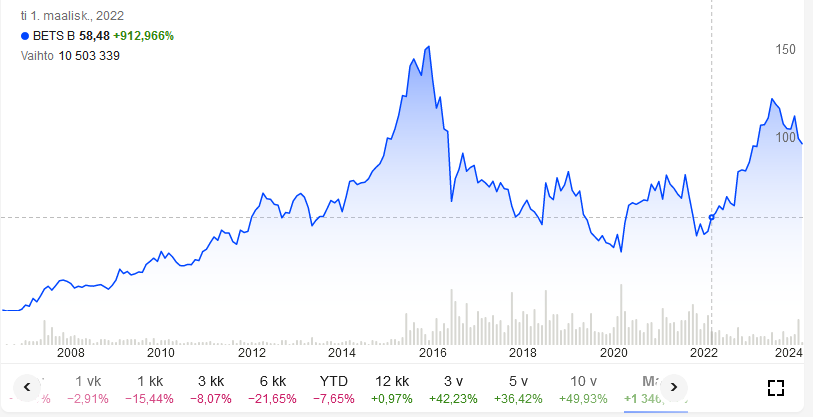
Let’s take one company from my portfolio, Betsson, as an example. The image shows the company’s share price chart and the moment I bought shares is marked (1.3.2022):
The sentiment surrounding the company was miserable at the time of my purchase. An investor who had held the stock for the previous 10 years would have earned only the dividends. The stock was in a clear downward trend and had missed out on the joyful “multibaggering” of tech, platform, and gaming company share prices that prevailed in 2021. An activist investor was demanding the CEO’s resignation. If I had gone along with this sentiment, I would have considered the company a poor investment and certainly wouldn’t have invested.
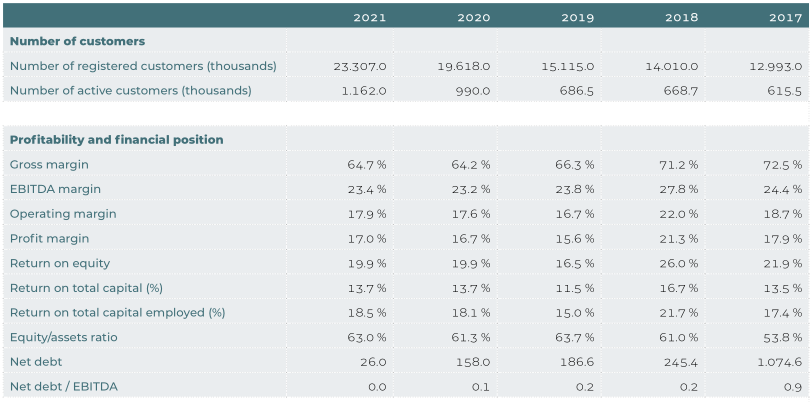
So, what separates a company whose share price collapses deservedly due to a miserable business from a value investment like this? You have to look at the fundamentals. Betsson’s fundamentals looked like this at the time of my purchase:
A falling share price but a growing business. The balance sheet had strengthened, net debt had been eliminated, and returns on capital had remained good. My purchase price was 55 kronor, meaning a P/E of 6.96 and a P/B of 1.29. Such valuations for a company like this reflect market pessimism. Since the purchase, Betsson has mainly continued its good performance and further grown its business profitably. Therefore, in my opinion, the share price has risen deservedly. Market sentiment changes all the time, but the quality of a company’s business changes much less frequently. The best returns are achieved by investing in good businesses at low prices.
Having observed that here and there, investors are jumping ship from “Hesuli” entirely and starting to buy the S&P 500. Diversification and, on the other hand, buying big moats is perfectly fine, but I think it’s quite strange to jump out of a market where valuation multiples have become “healthier” (corrected). Does the camel’s back break that quickly when returns aren’t constant? Or will the Finnish stock market yield no returns in the future either? Someone with a working crystal ball can tell us.
A lack of geographical diversification is a mistake, or at least it raises the risk level, but the OST (Equity Savings Account) is the right home for Finnish dividend stocks. It enables clear outperformance in the long run regarding dividends compared to an AOT (Book-entry account). Dividend investing is, in my opinion, a perfectly valid strategy even though paying out dividends doesn’t create additional value.
When do you think is the right time to increase the weight of HEX stocks in an OST portfolio if not now? Will Neste be bought again when it costs €40, Fortum €15, Tieto €28, Raisio €3, and Kamux at ten bucks?
For me, a 6-10% dividend yield from “Hesuli” into the OST is quite sufficient; I’m on the buy side now. Investment horizon 20 years. I don’t believe prices will “healthify” (correct) further than this except for maybe two reasons: an escalation of war towards Finland or a bubble bursting in the USA.
To the question of what this tells us, I think it’s about the short horizon of investors and possibly the 2010s uptrend. Sideways movement isn’t tolerated, and it isn’t even seen as an opportunity to accumulate a larger number of shares at lower prices.
Anyone marveling at Helsinki’s low valuations should ask themselves a question: if the market is as cheap as you think, why aren’t companies racing to buy back their own shares for cancellation? Why do companies let their stock valuations crash into the basement without doing anything about it? Why aren’t shares being bought back from the “retail crowd” to be retired forever, instead of letting the next retail investor take over a valuable share?
I don’t have the deep voice of experience from many bear markets, but it’s a rather bizarre situation that companies here can’t seem to find the buyback option in their toolbox at all. Many firms could easily buy back their shares with double-digit returns on equity with practically no risk—how can it be that even companies in low-ROE businesses don’t take advantage of this? In the US, there are dozens of companies that in this situation would step in and buy back shares even with debt, because they care about earnings per share (EPS).
As long as this isn’t done in Helsinki, then of course bear markets will be brutal—there’s selling pressure, buying pressure isn’t enough, and companies just stand idly by watching from the sidelines. It’s not worth being involved.
And Reka showed that in Finland, dividends can be used to pay the owner’s salary, the share price still rises, and if they want to, insiders can still sell at a very good price regardless. After all, buybacks would be buying a good dividend company away from the owners—the opposite of what a responsible board does when selling a good dividend stock to those who want it.
This. The age-old inner warrior and hunter of men is present even today. “kill or be killed”, “pedal to the metal”, “all or nothing”, “maximum attack”
The same hunter role is reflected in investing. Returns are wanted quickly, and in the attack, there is a willingness to bear heightened risk. The game only comes to the table by attacking.
On average, it is not a profitable tactic in investing. Women have a more stable approach.
This is not a generalization that applies to everyone, but there are far more of these market attackers among men than women.
I personally have noticed an investment style in Finland that I call the “wishful thinking” style.
You buy a company and hope the share price will rise, and in the meantime, you collect dividends. The company’s history is lackluster and it’s a so-called “sideways-crawler” (mörnijä), but you still hope that “maybe this time.” I’ve been guilty of the same thing myself, but I’m trying to break the habit.
Good examples from the Helsinki Stock Exchange are, for instance, Panostaja, Fiskars, Citycon, Lassila & Tikanoja, Raisio, etc. There are actually surprisingly many of these on the Helsinki Stock Exchange.
Because corporate management are people just like the rest of us, and they aren’t immune to investment psychology either. Furthermore, here in Finland, Nokia’s unfortunate timing with buybacks back in the day has likely created a high threshold for other companies to buy back their own shares as well.
And sorry, I can’t resist adding (even though I think you’re right) that when you have a hammer in your hand, problems always look like nails
There are differences, for example, the fact that in investing/trading the upside is infinite. A regular job pays what it pays. And trading can be done from anywhere in the world. The feeling of glamour probably depends on your own success (or loss).
I might be getting a bit ahead of myself, but I see it as quite possible in my case that trading will soon earn as much as my day job. And what about when it earns, say, 2x or 3x—at what point do you start thinking about where your time is best spent? Especially if those results are generated with just a few hours of work per day vs. the local 10-hour standard workdays.
Success can have an impact. However, doing anything for 15 years or longer inevitably makes the work feel like a mundane routine. People grow and develop all the time, and what was a big deal once might be replaced by new interests or values.
It’s true what you’re pondering: investing scales better than a day job where you sell your own time.
Trading has a very low barrier to entry and can be done by anyone who owns a computer. With a mobile phone and a starting capital of just a few tens, a profitable trader could already make a profit, for example with cryptos, and then scale up from there. So there are some 4 billion potential trader millionaires. The hungriest ones, of course, do this almost around the clock.
So the competitive field is massive, the prize is riches, and yet you make it sound like you can make big money as an easy side gig. How is this possible? Why aren’t all the world’s highly intelligent people already doing this? In India alone, there are over ten million Mensa-level highly intelligent people. Why don’t they start trading instead of grinding code?
Somehow this sounds like bull market talk.
I never said it would be easy. It requires relentless work and, above all, perseverance and a genuine desire to become good. It takes many years to earn a university degree; if people assume they can learn trading in a few months, the outcome is obvious.
However, for example, legendary trader Mark Minervini says himself that he dropped out of high school, and that if he can do it (succeed in trading), then anyone can.
The essential difference here compared to stock picking, bull markets, or the distress of the Helsinki exchange (Hesuli) is that they have nothing to do with day trading, although trending markets are certainly easier than stagnant ones. For a trader, there are opportunities every day in one direction or another. It doesn’t matter what Nvidia unveils tomorrow.