The book value is the company’s equity. It is obtained by subtracting the company’s liabilities from all the assets held by the company. When this remaining portion is divided by the number of shares in the company, we get the equity per share. There are certain situations where a company should not be valued according to its equity, such as a situation where the company is losing money and thus losing equity. Equity per share does not tell anything about the company’s profitability and therefore it is supplemented by return on equity (ROE%). A popular key figure P/E is obtained from a combination of ROE and P/B: Price/Earnings = Price/Equity / Earnings/Equity.
When the earnings report states that the company has made, for example, 0.40 euros earnings per share in the quarter, this 0.40 euros is added to the equity per share. So why, if an investor does not care about the equity per share but is willing to pay an outrageous premium for the stock, would they care about what the income statement presents?
Let’s take as an example the accounting firm Talenom, which recently published its Q2 results. A year ago, Talenom’s equity per share was €1.88. The company made 16 cents earnings per share in the second half of 2017 and 58 cents earnings per share in the first half of 2018. After paying a dividend of 32 cents per share and taking into account currency conversion differences, the company’s equity per share is now €2.36. How much was paid for the stock on the exchange? 17 euros! Listen up, dear investors. If this company ceased operations today, paid off its fairly large debt burden, and distributed the remaining capital among you, you would suffer an 86% loss on your investment. So let’s hope for a long and successful journey for Talenom.
Banks demand full collateral with premiums for loans and can still ask for several percent interest on the loan amount. Stock investors demand no collateral and accept a 2.5% dividend as long as the growth story is credible. Future growth is something that may or may not materialize. Loan receivables are protected by law, but a stock investor cannot be compensated for their losses.
I don’t really understand. I have read books on value investing, which strongly emphasize the fundamental factors of companies. However, the markets seem to operate in such a way that there is always some fool who will pay even more for this stock. Or that this is expensive, but have you seen what is paid for the competitor? Is it true that only in a crash do investors “take their eyes in their hands” and start to be interested in what their company actually had on its balance sheet?
What’s essential is the present value of future cash flows. It’s essentially the same as equity. If a company has 1 euro in equity and earns 1 euro in profit per year, would you only pay one euro for this company?
Future earnings are, of course, not certain, which is why it’s crucial to determine the required rate of return for valuing future cash flows. If it’s a riskier company, a higher return is demanded.
Then, there’s the other side, where the business operations are not as significant, and the asset base is what determines the share’s value. For example, in Orava, the share price is largely determined by equity rather than earnings.
In this market situation, companies are making excessively high returns, which can lead to overvalued valuation levels.
A really good opening, even though the matter is not that simple. However, you are much more right than wrong.
With such a long boom, investors have indeed gotten used to everything just going up and up. Both the company’s share price and its results. If you look at, for example, the P/E ratios paid by the markets, it is true that when estimating future years’ results, a ruler and a rather steep slope are currently used.
What happens then when the party ends, we slide into a recession, and companies face their purgatory? I have my guess, and in it, the cheerleaders of these sexy “but when this, this, and this happens, then it’s cheap” stocks will be the first to get burned. But we’ll see in due time.
I myself value the P/B ratio a lot, and I believe that gradually we are reaching the point where others will also start to value it. I even completely clear out any possible goodwill from the company’s equity. Not that I don’t believe in the ability of Finnish company management to admit their own investment mistakes in good times. No, no.
My own portfolio’s goodwill-adjusted P/B ratio is approximately 1.9x the companies’ book values. Measured by my own acquisition costs, it’s about 1.7x, meaning that the appreciation of the shares has also raised that a bit, even though there hasn’t been a big change in book values. Now I am actually buying a company for the first time that doesn’t completely fit my own mold due to the relatively large amount of its goodwill. But the industry, the valuation level otherwise, and the company’s budding turnaround are interesting. We’ll see if I catch it.
I don’t even dare to guess the goodwill-adjusted P/B ratio of the Helsinki Stock Exchange.
This gets to the heart of the matter. If a company generates 1 euro in earnings per share and the stock costs 10 euros on the market, does it matter whether the company has 1, 10, or 20 euros in equity per share? And does it matter if the equity comes with 0%, 50%, or 100% net gearing?
Is it harder to raise capital or to generate returns on capital? For companies with a high ROE%, the key question is whether the return scales with an increase in capital. If a company with 30% ROE makes an investment with a 20% return on capital, the company destroys shareholder value and the stock price falls. Making profitable investments is therefore inherently more difficult for companies with a high ROE%.
"Of course, it’s per-share intrinsic value, not book value, that counts. Book value is an accounting term that measures the capital, including retained earnings, that has been put into a business. Intrinsic value is a present-value estimate of the cash that can be taken out of a business during its remaining life. At most companies, the two values are unrelated. "
In the long run, returns on capital are what matter. In Munger’s words:
"In the long term, it’s hard for a stock to earn a much better return than the business which underlies it earns. If the business earns six percent on capital over forty years and you hold it for that forty years, you’re not going to make much different than a six percent return-even if you originally buy it at a huge discount. Conversely, if a business earns eighteen percent on capital over twenty or thirty years, even if you pay an expensive price, you’ll end up with one hell of a result."
It’s another matter whether one can find companies for their portfolio that can maintain their competitiveness and abnormally high returns over a long period…
Buffett is absolutely right that book value alone doesn’t determine an investment’s return. A pure book value investor would only look at the value of a company’s assets and compare that to the share price, but we’ve moved beyond this Ben Graham-era investment style. Buffett humorously likens it to taking the last puff from a disgusting cigarette butt on the ground. A modern view might be that profitability and cash flows are required as counterparts to P/B. A lower margin of safety can be accepted if the return covers the increased risk. I have noted a formula in my notes that Buffett is said to have used when looking for cheap stocks:
(Net Margin% + Dividend%) / (P/B). If the reading is over 10, the purchase is good. Stocks under two should be sold.
For example, Orion B: (20.32 + 4.8) / (30.21 / 4.99) = 4.15
Olvi: (10.5 + 2.4) / (32.9 / 10.64) = 4.17
calculated using rolling 12-month figures. Both would be cautious holds. Orion’s high P/B ratio is justified by an exceptionally strong net margin. All other factors remaining constant, a company that retains some of its earnings is more valuable than a company that does not. As a thought experiment, if an additional 141 million euros in cash were to appear in Orion’s balance sheet as equity, i.e., 1 euro per share, its return on equity (ROE) would fall from 32.2% to 26.4%. This would have no positive impact on the share price, as investors would lament the decrease in ROE. Isn’t that quite paradoxical?
Here’s a video and a discussion thread that discuss the formula, but I can’t find the original source. It was probably in written form, though. The formula favors holding companies with positive financial items. For example, Saga Furs, Ilkka, and Citycon are, according to this formula, excellent investments. For Saga, a significant portion of the earnings comes from financial items; for Ilkka, from Alma Media (Alma Media Oyj) holdings; and Citycon does not include changes in property values as part of its revenue. These factors cause the companies’ net margins to grow. Despite “magic formulas,” an investor must know what they are betting on when investing in a company and what company-specific risks are associated with the investment.
As a side note, I’ve been wondering why Swedish companies seem to consistently have high returns on equity across the board. Could the reason be as simple as the weakening of the Swedish krona against the euro? Returns earned in euros increase the krona-denominated profit.
To me, this is the core of the matter. When buying a share at a certain price, the return on the share’s cash flows must, at some point in the future (when?), cover the inflation-adjusted purchase price. Otherwise, the purchase is certainly unprofitable. Risk, in my opinion, only means that this goal is not achieved, and I recall reading this in Buffett’s letters as well. If a company pays no dividends at all, its monetary value is its liquidation value. Future investments are uncertain, so they must be discounted.
Book value is not the whole truth, because a company is exposed to different risks depending on the structure of its balance sheet. For example, a balance sheet with many accounts receivable is more susceptible to customer payment difficulties and financial crises. Investment companies are a category of their own: if the balance sheet contains shares in startups, who will pay a premium for that?
This is an interesting calculation. If you get a share yielding 6% per year at half price, its return over 40 years is exactly double compared to a full-price share. In practice, however, one should expect a decline. With such an investment horizon, how long would it be worth waiting?
x * 1.06 ^ 40 = 2x * 1.06 ^ y
y = 28.10
x is the number of shares.
So if it takes less than 12 years for the price to collapse, waiting is worthwhile. I did not take inflation into account in the calculation, which would shorten the time. A relevant follow-up question is under what conditions an overpriced share should be sold. However, this introduces more parameters.
In the blog post, success is measured by share price development. The same could have been written in the late 1990s about tech stocks that grew tens of percent a month without any fundamental development: this is the future and the potential of the internet is limitless. Millionaires were made by selling shares before the collapse. This was important. For some reason, the money in hand was more valuable than thoughts of limitless potential? With Amazon’s current market value, you could build Amazon seven times over.
Tech companies actually have the same characteristics as traditional smokestack industries. First, expensive investments are made and it is promised that once revenue starts to grow, the operating profit margin will skyrocket. The turnaround is always just around the corner. However, while not every player has the means to set up a factory, in the free internet there can be no such moats. It’s like a shopping mall aisle with a better user interface. I’d like to press CTRL+F and see which store has the item I want.
Amazon is a good company because its share price has grown strongly. Rovio “betrayed investors” when its share price collapsed. Martela was “exited with tail between legs”. This is something I don’t quite understand, but investors are consistent nonetheless. The stronger the share price development, the more hype. Better safe than sorry. Returns are made when you are considered a risky idiot who invests in worthless toilet paper. And when you sell a future star on the crest of megatrends and lose amazing compound interest just to get cash that rots to inflation.
Well, there were other points as well. Value investors have underperformed for the last 10 years (I think there was one year during this period when value investing outperformed, however these things are measured). More relevant, in my opinion, is this:
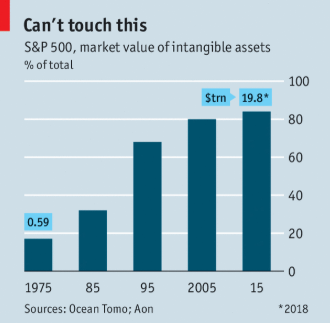
The amount of goodwill has increased significantly. As the text states, “this is not your grandfather’s stock market.” Another very real change is the development of technology and its scalability, which is on a completely different level than before.
The biggest difference from the tech bubble is that many technology companies are actually making staggering profits, still growing 10-40% annually, and have war chests of tens of billions. At the same time, their moats have become truly deep, and they have more “flanking” attack positions in other industrial sectors than fingers on two hands, figuratively speaking.
The final point of the text is also good: one should not focus on just one valuation metric, but open one’s mind to several possible metrics and preferably blend these in one’s portfolio. If you had only focused on companies with cheap book values, you would have missed many gems. On the other hand, picking only “Amazons” for your portfolio has been fun now, but that might not necessarily be the case in the future. In other words, diversification.
One reason I stare at the numbers is that it’s so difficult to deduce business profitability from the story, but the other way around, one can overcome their own preconceptions:
a) In 2017, the company had a return on equity of 13.7% and a net margin of 26.3%
b) In 2017, the company had a return on equity of 12.9% and a net margin of 1.7%
c) In 2017, the company had a return on equity of 8.7% and a net margin of 11.4%
d) In 2017, the company had a return on equity of 15.5% and a net margin of 10.5%
One of these companies is valued at 1.01 times its book value, another at 5.28 times, a third at 4.35 times, and a fourth at 33.58 times. One of the companies is a telecom operator, another a search engine giant, a third an online store, and a fourth a newspaper industry holding company. Can you guess which figures belong to which?
I view these internet companies as modern infrastructure. It saves on the income statement when the value of the internet portal to the user comes primarily from unpaid content creators. Of course, search algorithms are also important, and a functional service requires understanding user needs. The article is correct in that the strength of the current market is the growth in market capitalization of these FAANG companies, and value investors would not have touched them. You earn quick profits when you can sniff out these social media, tech, bitcoins, and cannabis stocks before their prices are high. Remember to cash out the profits too. A P/E of 100 valuation doesn’t correct itself by sales quintupling and margins doubling, but by the stock plummeting to a fraction of what it was.
Verneri, have you considered what is behind Amazon’s success? I have a suggestion. Amazon’s stock costs 1950 dollars. The company has issued 5-7 million shares annually over the last five years. From a 6 million share offering at this price, the company raises over ten billion dollars in capital. Isn’t it therefore clear that revenue and balance sheet will grow?
Amazon doesn’t seem to make stock offerings, where did you get that idea? The share capital has expanded a bit due to stock-based compensation…
If business growth happens automatically by making stock offerings, then why wouldn’t everyone just keep making offerings one after another?
My humble understanding of Amazon’s keys to success is long-term vision, the right strategy, an unwavering focus on customers, and excellent investor communication that profit generation doesn’t need to be expected for the next few decades.
You can see it here.
Shareholder equity on December 31, 2016, was 19,285 million.
An accounting change related to share issues brought in 687 million.
Net income for the period was 3,033 million.
Changes in currency values brought in 501 million.
Stock options brought in 1 million.
Share issues to employees brought in 4,202 million.
Shareholder equity on December 31, 2017, was the sum of these, 27,709 million.
In previous years, the importance of share issues in capital development has been even greater. As a low-margin online retailer, Amazon has good opportunities to generate revenue from its investments. The asset turnover ratio in 2017 was 177.87B / [(86.02B + 131.31B) / 2] = 1.64. The equity ratio (omavaraisuusaste) is also low at 21%.
What distinguishes Amazon from others, as I wanted to convey with the example in the previous message, is the incomprehensibly high valuation of the stock. The company can make share issues without significantly diluting the share capital precisely because of its high valuation. By buying the stock, an investor can thus concretely support the development of the company’s business.
Mmmh, yes, those are completely stock-based compensations for management/employees.
Amazon funds its growth with debt/cash flow, see the cash flow statement, it would also show if funding came from stock issues. I’m no Amazon specialist, but that’s what I quickly gathered.
I looked at the cash flow statement. The company has received monetary compensation for stock-based compensation, which has been paid by issuing new shares. This amount of 4,215 million for 2017 is somewhat illogically marked under operating cash flow instead of financing cash flow.
Edit:
This should probably be understood such that if an employee’s compensation is $100,000 and half of this is paid in company shares, the income statement first records the $100,000 as an expense. Then, the cash flow statement is adjusted positively by $50,000, and in the statement of changes in equity, $50,000 as stock-based compensation is separated from earnings. Thus, operating cash flow is the correct place for that compensation.
Apparently, that’s related to how new shares, not being a monetary expense for the company, are added to the cash flow statement. Apparently a controversial method as it inflates cash flow, even though from the shareholders’ perspective, there are costs due to the dilution of the share capital.
But these are still not share issues; otherwise, money should be flowing to the company.
You’ve misunderstood the meaning of a share issue (osakeanti). According to the Finnish Companies Act, a share issue refers to a situation where a company issues new shares or transfers its own shares that it holds. A share issue can be for consideration (maksullinen) or free of charge (maksuton).
In Amazon’s case, the company issues new shares and receives an employee’s work contribution in return. This compensation system is widely used within the company across different sectors. The number of shares issued increased from 474 million to 480 million last year. The purpose of the issue is to reduce costs and possibly to commit employees to the company. Reducing costs increases equity.
I originally started by addressing your suggestion that Amazon is constantly raising capital from the markets, which you claimed was behind the company’s success, when Amazon has in fact primarily financed its growth with cash flow and borrowing. That’s as much as I know about the company.
Edit: Note, “primarily,” if/when those stock-based compensations are viewed as offerings because they save on salary expenses, it doesn’t change the big picture, with the numbers remaining in the few billions vs. Amazon’s pure R&D investments, which were over $20 billion last year and propelled future growth (perhaps…).


 I originally started by addressing your suggestion that Amazon is constantly raising capital from the markets, which you claimed was behind the company’s success, when Amazon has in fact primarily financed its growth with cash flow and borrowing. That’s as much as I know about the company.