Local agreements are always talked about by companies. In reality, local agreements don’t happen. Local factory management has no authority to negotiate anything. This means decisions are made centrally at headquarters. This practice is directly a problem for UPM and MG companies. Currently, people are voting with their feet against the current operating model and moving to competitors in large numbers. I’ve been following this struggle at different tables for 20 years, and it’s constantly moving towards a stiffer direction. That’s not necessarily the smartest way to handle things. In one rather critically important unit, nearly 20% of employees have resigned in the last couple of years. And more are leaving. There’s probably no problem here either, but the work these people did required several years of work history to gain enough experience to take responsibility for the tasks.
Related topic: Metsä Group rakentaa uuden sellutehtaan, Kemissä iloitaan jätti-investoinnista – Katri Heiskanen: "Työpaikkoja tarvitaan" | Yle
Good Q1 guidance from the Board
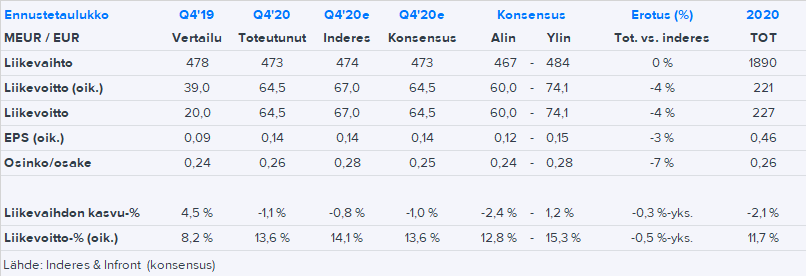
Metsä Board’s Q4 numbers were largely in line with expectations. The Q1 guidance was good, likely driven by a stronger pulp market and seasonally good demand for paperboards. The dividend increased, but with a lower coefficient than our forecasts.
In addition, Metsä Fibre’s Kemi pulp mill investment was confirmed. Metsä Board will also start a slightly complex investment program in Kemi (including bottleneck investments in the liner machine and the purchase of an unbleached pulp production line from Metsä Fibre).
The share price appears to have risen slightly into positive territory after initial hesitation.
Personally, I don’t like the arrogant operating methods of some domestic forest companies, whether we’re talking about personnel policy, environmental issues, or fair trade. For this reason, these companies will be missing from my portfolio, with the exception of Metsä Board, which also remains primarily because I inherited the fundamentals from my father.
As a forest owner, I have so far made all my timber sales with sawmills, even if the price received for the timber has not always been the best. If, on the other hand, I want to invest in the forest sector in some way, in addition to Kemira, which is in my portfolio, Ponsse will be the target.
EDIT: Proofreading
OP - Metsä Board Q4 earnings 11.2.2021

Yesterday, a very interesting acquisition was announced, especially from the perspective of Metsä Board and also Stora Enso, as Mayr-Melnhof is buying IP’s Kwidzyn mill in Poland. At Kwidzyn, IP produces folding boxboard, fine paper, kraft paper, and market pulp with a total of 4 machines and a capacity of 760,000 tons (likely mostly integrated with a 400,000-ton pulp mill). The mill was slated to exit IP at the end of the year to a spun-off (fine) paper company, where it would have been outside the core business. IP already sold its US consumer board business to Graphic Packaging a few years ago.
Mayr-Melnhof is paying EUR 670 million for the mill, which corresponds to an EV/S multiple of approximately 1.5x and an EV/EBITDA multiple of 7x. Last year, the mill achieved an operating margin of 18%. My understanding is that profitability has also been good or very good in the long run, and I don’t believe that Kwidzyn loses out significantly to Metsä Board’s and Stora Enso’s best board mills. There is a clear discount in acquisition prices compared to the stock market valuations of European board companies (cf. Metsä Board’s EV/EBITDA of 10x). In the USA, Graphic Packaging’s and WestRock’s multiples are roughly at these levels. No wonder Mayr-Melnhof saw the deal as good, and the stock is now up 3%.
What makes the arrangement particularly interesting is that the same Mayr-Melnhof recently acquired KotkaMills and its large folding boxboard machine. The Austrian company, with its renewed management (MM’s CEO is the former CEO of Mondi), has thus burst into competing in folding boxboards (MM has been a significant player in recycled fiber-based consumer boards in Europe). The folding boxboard market, important for Metsä Board and Stora Enso, has therefore consolidated, which is in principle a good thing for price discipline. On the other hand, in Mayr-Melnhof’s hands, KotkaMills and the Kwidzyn mill pose a couple of orders of magnitude more severe competitive threats to Finnish companies than an independent KotkaMills owned by private equity investors and Kwidzyn, which was on the periphery of IP’s strategy. It will be interesting to see how the market dynamics of folding boxboards develop and whether Mayr-Melnhof will continue aggressive market share seeking or if it will focus on generating cash flow to pay for the acquisitions.

(UPM, Helsinki, 17 February 2021 at 3:00 p.m. EET) – UPM has joined the EU Clean Hydrogen Alliance and is participating in the industrial clean hydrogen roundtable working group. UPM is also a member of the recently established hydrogen cluster in Finland. UPM is excellently positioned as the hydrogen economy develops and wants to proactively participate in its development and emissions reduction. The hydrogen economy is gaining significant importance as the European Union strives for climate neutrality by 2050.
“Clean hydrogen offers several interesting opportunities for UPM. We have our own renewable and CO2-free electricity, water resources, biogenic carbon dioxide, and practical experience in hydrogen production at UPM’s Lappeenranta biorefinery. Our expertise and resources enable the development of potential new business opportunities in the nascent hydrogen economy,” says Jyrki Ovaska, UPM’s Chief Technology Officer. Ovaska represents UPM in the EU Clean Hydrogen Alliance.
UPM has recently initiated the basic engineering for a new potential biorefinery, during which opportunities for green hydrogen production and utilization will be specifically explored. The potential biorefinery would produce 500,000 tons of high-quality renewable fuels for road transport, aviation, and as raw material for the petrochemical industry.
Clean hydrogen is seen by many industries as an important route to low emissions. Clean hydrogen is currently receiving a lot of attention, but large-scale scaling is still in its early stages.
“Several legislative preconditions related to the development of the hydrogen economy are still open. Through the alliances and cooperation networks now being established, UPM wants to be involved in creating an operating environment that promotes both investments and emissions reductions,” Jyrki Ovaska states.
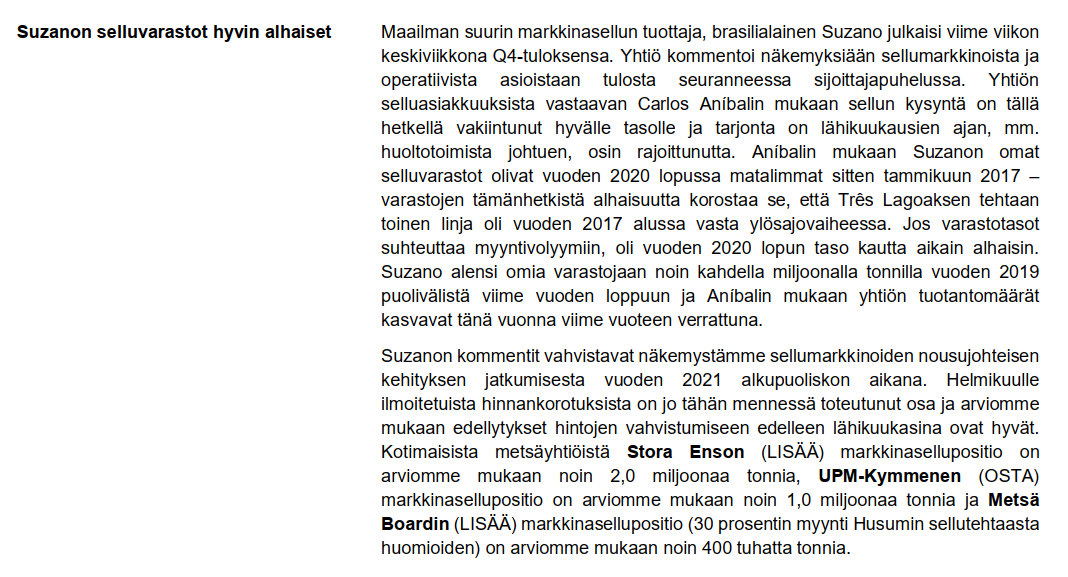
Well, now we have another Finnish company joining Bezos’s project. That will at least increase international visibility. Currently involved are, for example, Amazon, Microsoft, and Neste.
It’s not really about pulp, but it is about Stora Enso.
What do you think about this, and is there more information about it: https://www.storaenso.com/fi-fi/newsroom/news/2021/2/selfly-store-by-stora-enso-for-automated-and-unmanned-retail
And here are the cabinets in use: Pieniä kassattomia ruokakauppoja putkahtelee kaikessa hiljaisuudessa ympäri pääkaupunkiseutua | HS.fi
https://circa-group.com/the-company
Tomorrow, this company, which belongs to the cellulose chain, will start on the Norwegian stock exchange.
The idea is to produce renewable solvents from agricultural and forestry side biomasses for use in the chemical and pharmaceutical industries.

I don’t know if this is a good investment, but what if I bought a couple of thousands worth of shares first thing tomorrow morning, and if it rises in the coming days, I’d sell them?
Something like this in a couple of weeks 
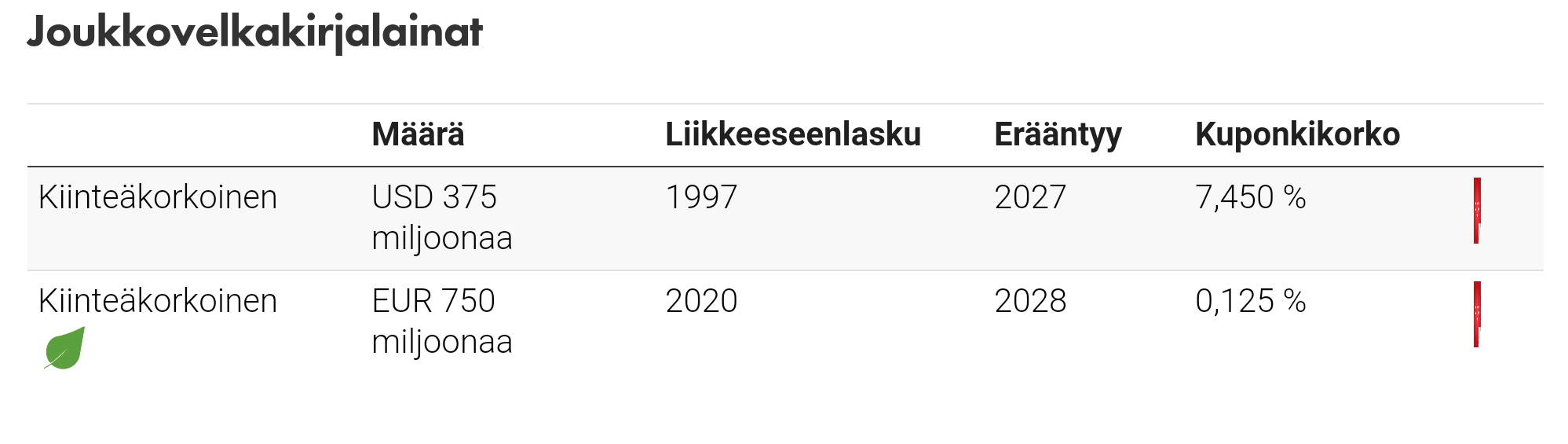
UPM has again secured cheap loans from the market. Not quite as cheap as the one sought in November (750M, fixed 0.125% interest, maturity 2028). Press release from yesterday:
https://www.inderes.fi/fi/tiedotteet/upm-laskee-liikkeeseen-toisen-vihrean-joukkovelkakirjalainansa
“UPM has successfully issued a new EUR 500 million green bond under its EMTN (Euro Medium Term Note) bond program and green finance framework. The bond matures in March 2031 and pays a fixed interest rate of 0.50%.”
The bond will be used to finance projects and investments enabled by UPM’s green finance framework, published in November 2020. The proceeds from the bond are initially planned to be used for the following framework categories: sustainable forest management, climate-positive products and solutions, prevention and management of environmental burden including waste prevention.
“The issuance of our second green bond was successful, and it was once again gratifying to see investors’ interest in it. This new green bond contributes to achieving the sustainability goals of our Biofore strategy,” says Tapio Korpeinen, CFO of UPM.
UPM now has to pay quite a different interest rate than before:
Source:
Labor Market | UPM Salaried Employees Demand the Right to Negotiate Their Terms of Employment – Trade Union Pro’s Malinen: “A Responsible Employer Cannot Act Like This Without Consequences”: UPM:n toimihenkilöt vaativat oikeutta neuvotella työehdoistaan – Ammattiliitto Pron Malinen: ”Vastuullinen työnantaja ei voi toimia näin ilman seuraamuksia” | HS.fi
In February, UPM announced that it would move from company-level agreements to local agreements in the future. According to the news, UPM no longer intends to conclude agreements concerning salaried employees with the trade union.
In principle, individual bargaining is a positive thing, but how does it work in a giant corporation? How can fair treatment of employees and the emergence of a favoritism system be ensured?
If bargaining is not transparent, there is a great danger that the company will become a mutual praise club where the culture silences critical voices.
How does making trade union activities more difficult affect ESG scores? ESG is a big theme today, and its importance is constantly growing.
Then there’s the post-effect clause of the collective agreement. The terms of the collective agreement remain valid after the end of the agreement period until otherwise agreed. However, there is no obligation to maintain industrial peace. Try to negotiate individually when the crew is on strike.
Behind a paywall.
At the Kymi mill, the disruption is in the bleaching line. The disruption is currently being repaired. At the Kaukas mill, the technical fault is in the recovery boiler.
Production at Kymi was shut down on March 17th, and at Kaukas, it will shut down tomorrow (March 21st). Production at both plants will restart on March 23rd.
There’s an update on Stora Enso in this morning’s newsletter.
Here are a few miscellaneous observations and thoughts on the recent news flow from the pulp market concerning the entire sector:
- The price of pulp has been on a record steep rise. Demand in China is very good, but supply has also been extremely constrained (maintenance, disruptions, logistics problems). In January, global deliveries were down 5%, and the ratio of deliveries to global capacity was 82%. Large price increases went through smoothly, which in my opinion would be somewhat unusual with these numbers if deliveries were rolling normally. February data is not out yet. Inventories are normal or below normal.
- At current prices, almost every pulp mill in the world is profitable or highly profitable, so operators have an interest in producing as much as they can. I would primarily expect supply constraints to resolve over time, so over the year, the primary responsibility for the price must, in my opinion, still lie with demand.
- Demand in China is better than in Europe. China also naturally suffers more from supply constraints. In China, paper and board prices have risen sharply, but the risk related to pulp prices lies here, in my opinion. If price increases hit the demand for paper and board, and prices are flexible (i.e., demand stalls due to price increases), then at current pulp prices, Chinese paper producers will be in trouble. This would likely curb pulp demand and calm the price.
- Wood prices (in Finland) are creeping upwards slightly. This will likely be reflected in forest companies’ numbers in H2. From the perspective of pulp production, this is not a problem at current prices, but the increase in price would create a certain pressure throughout the value chain and limit the potential for group margins to widen.
- New pulp capacity is coming onto the market in H2 and next year, although projects are delayed due to the pandemic, and risks of further delays still exist. This will somewhat limit the conditions for the price to continue trending northeast and stay there long-term. However, new capacity does not necessarily mean a price collapse if economic growth rolls on and demand is strong.
- Several massive greenfield investments in pulp and board production are planned in China. If China, despite certain competitive disadvantages, starts investing (state-led) money into pulp production, the entire dynamic of the global pulp market could change. This is pure speculation for now, but the issue is potentially significant, so it needs to be monitored.