It’s refreshing to see the discussion surrounding the forest industry beginning to liven up a bit. In my opinion, the sector is still viewed too much through the lens of “Finnish” players when discussing more advanced products and the direction of the industry in that regard. As I have stated before, the Norwegian company Borregaard produces exclusively these more advanced, higher-value products.
From lignin, they produce binders for construction, agricultural chemicals, batteries, and other industrial applications. For instance, in the case of concrete, lignin derivatives can reduce the water requirement. My understanding is that in fertilizers and feed, the primary benefit comes from improving the structure. They also produce vanillin from lignin, which replaces expensive natural vanilla as a flavoring, but more importantly, it replaces oil-based vanillin flavorings.
From cellulose, they manufacture products utilized in the food industry, pharmaceuticals, cosmetics, hygiene products, acetate filters, films (bio-based), yarns (bio-based), and bio-based coatings.
What remains is sugar, from which they produce bioethanol. It should be noted that bioethanol is, more or less, an end product made from a side stream. It is by no means a target product segment in itself, but rather accompanies the two more central raw material lines so that the entire tree can be utilized as efficiently as possible. Therefore, bio-based fuels should not be an end in itself for UPM either, but merely a way to utilize a side stream while the rest of the tree is used for higher-value products.
If we consider the green transition and the climate, the atmosphere doesn’t really care whether the carbon dioxide ending up there comes from burning fossil fuels or burning bio-based fuels. This fact is often forgotten when, for example, Neste’s bio-based fuels are celebrated, as those fuels themselves are not particularly “green”; they are simply energy-dense compounds suitable for combustion reactions, just like any others. From the atmosphere’s perspective, the positive impact of bio-based fuels is based more on production costs that are higher than those of fossil fuels, making them more expensive to use. The benefits of bio-based fuel are thus based almost exclusively on its scarcity (price), and only through regulation can this be harnessed. Businesses dependent on politics are risky in the long term.
Fuels are a highly politicized topic, so I expect a lot of back-and-forth on that front over the next few decades. Conversely, replacing oil with bio-based products is significantly less politicized, which significantly increases the chances of the bio-transition materializing. In the applications described above, the demand for bio-based alternatives will likely rise through both regulation and genuine consumer demand. Voters (consumers) rarely take to the barricades to insist that they absolutely want their food and medicine from oil-based raw materials rather than bio-based ones. The world of plastic-based packaging is also constantly evolving toward bio-based solutions, and “Finnish” forest companies are, of course, active in this segment as well. Development has been somewhat obscured by the K-shaped economy and the soft consumer demand of recent years, but long-term demand growth is definitely still there in the background. Packaging products are also constantly evolving, and I imagine bio-based packaging will be excellent in terms of functionality in a few decades’ time.
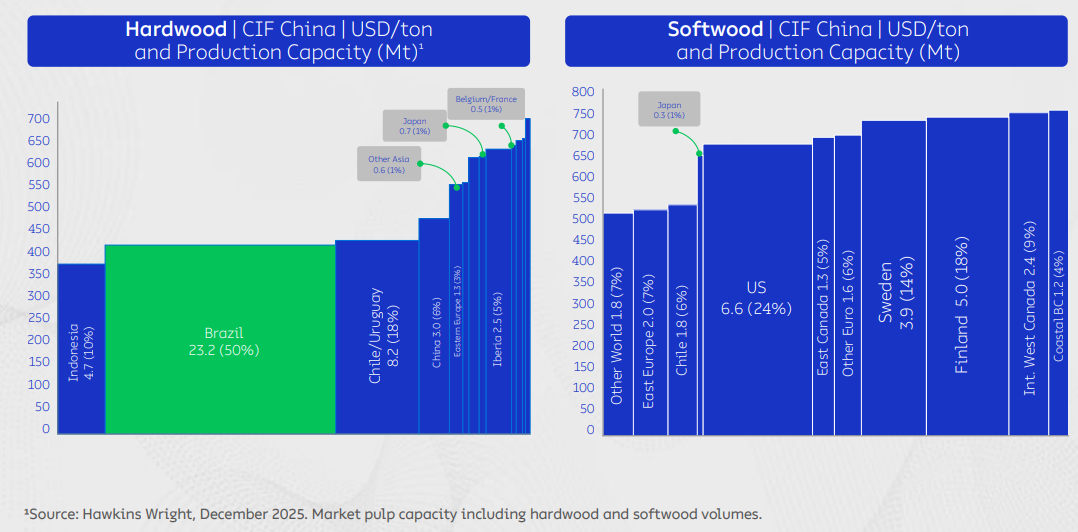
It is therefore very likely that there will be growing demand for bio-based products that replace oil. However, that does not mean that an individual company will be able to run a particularly impressive business if its competitive position is weak. In more advanced products, it is more likely to achieve a competitive position that enables high returns on capital, whereas in the more traditional forest industry products, only operational efficiency matters. I don’t know all the global forest industry companies very well, but I have followed the Nordic ones. Borregaard is a leading player, even on a global scale, in highly processed wood-based products. UPM and, to some extent, Stora Enso have aimed for this space, but with very poor success. I cannot say whether UPM has the ability to become a genuinely significant player in Borregaard’s territory. Borregaard is a very small player in relation to these forest giants, but the company has a long track record of successful business and innovation (not just in products, but also in processes). Ultimately, there are very few similarities between UPM’s core businesses and the production of these higher-value products. A genuinely profitable facility would probably use the whole tree itself, meaning its supply chain is independent, and in that case, the businesses don’t really have anything in common other than the parent company’s name. Personally, I wouldn’t buy the UPM story regarding high-value products at this moment, but rather the company’s extremely high efficiency in pulp production, and of course, traditional papers and stickers/labels will continue to generate cash flow far into the future. So far, as far as Finnish players are concerned, high-value products have been nothing more than marketing and sunk costs. However, this does not mean there is no demand for them at all, or that they are just some future promises of the industry. The industry has a proven player that is already making highly profitable business with these “future visions.”
Edit: Let’s add a note on biofuels before I get angry comments from Neste shareholders: obviously, in reality, bio-based fuel is better than fossil fuel, and especially in the case of SAF (Sustainable Aviation Fuel), it makes sense when there are no alternatives like electricity for the fleet. However, in the big picture, from the atmosphere’s point of view, the difference between different fuels is largely as I described. The biggest positive impact on the climate comes from price elasticity.


 Contents: