A new development for the former paper machine hall at Kaukas. Although, things are still in the early stages.
20 Likes
An invitation to a general meeting where the new Wisa Group would be spun off from UPM, including the appointment of the management team and other practical matters in the invitation.
Sometimes this type of stock market maneuver can invigorate a company and its share price. A textbook example is Mandatum’s spin-off from Sampo.
In this case with UPM and Wisa, I don’t yet understand why such a spin-off is being carried out. Currently, Wisa is under the wing of the “great and mighty” UPM, but after this, it will be archived in the graveyard of small-cap companies on the Helsinki Stock Exchange. Where it won’t be bought by indices, funds, or really anyone else?
I hope it turns out differently, but the logic behind this “Wisa out of UPM” move is not clear to this shareholder. If it has become clear to anyone, I would be happy to receive that information 
19 Likes
usually the parent company divests parts that are irrelevant to its strategy. Within its own company, the management can independently make investments they deem suitable and implement them directly. Inside UPM, they have to compete for investments against massive pulp investments. I wonder if UPM is running low on investment funds? Good luck to the newcomer.
14 Likes
Here are Viljakainen’s preliminary comments ahead of Stora Enso’s Q2 results, which will be released next Thursday.
We expect the company’s operating profit to have improved from the weak comparison period, but for the profit level to remain highly unsatisfactory. General market conditions have remained challenging in nearly all of the company’s business areas, and there are no signs of improvement in sight due to the uncertain and still sluggish economic situation and consumer demand in Europe. Although our view on the Stora Enso stock is positive, supported by a low balance-sheet-based valuation and a sum-of-the-parts calculation, we remain quite cautious regarding the company’s short-term earnings trend and what the Q2 report will bring.
2 Likes
Billerud announced its Q2 results today. The report is here. The comments on the European cartonboard market were, perhaps slightly surprisingly, not all bad, although forest industry investors still have no reason to head to the market square [to celebrate] based on this. At least in my interpretation, the CEO also flirts in the review with an interest in M&A or the moves of others, which is of course less surprising given the scale and structural nature of the sector’s business challenges.
13 Likes
More dimensions
In conglomerates, it is very common for one division to suffer because it has different cycles and KPIs than, say, the biggest revenue generator.
So, it could have a positive impact on Wisa when everyone has the same destination as their goal.
Another aspect is the big bad Kronospan; why not buy them out and shut them down - do it yourself, more/better, you money-grubber.
I can’t say how deep-pocketed the owner is, but we have certainly seen plenty of this in Finnish history.
Sell off and lock the doors. In the end, nothing will be left here for a livelihood but tar burning.
5 Likes
I wonder how much that Nippon Dynawave accident in May might be affecting U.S. demand for Billerud? Or are we seeing a real turnaround?
1 Like
According to online information, Nippon Dynawave’s production capacity is around 300 thousand tons per year. I don’t think such a small volume will have a significant market impact.
2 Likes
Here are Antti’s Q2 pre-game thoughts ahead of UPM’s Q2 results announcement on Thursday 
In line with the consensus, we expect the company’s operating profit to have grown clearly from the exceptionally weak comparison period; however, in absolute terms, the Q2 profit level has remained modest for UPM. The main focus of the report will be on the company’s H2 guidance, which will also play a key role in the stock’s price reaction on the day of the results. To meet our and the consensus forecasts, the midpoint of the range would need to be around EUR 615–620 million. However, the news flow from the forest sector has remained largely weak, and economic and inflation risks remain elevated, especially in Europe; therefore, we believe the risks related to the guidance are on the downside. In addition to the results and guidance, we will be monitoring UPM’s comments, particularly regarding the competition authority process for the joint venture planned for the company’s and Sappi’s paper businesses.
9 Likes
I doubt this is a game-changing issue for the overall market, and as far as I understand, ND’s product portfolio also differs from Billerud’s North American range.
Well, I don’t know. The challenges are quite significant and structural, so I wouldn’t get too excited about a sustainable turnaround based on that report just yet. For bottom-fishers, the situation could certainly open up short-term opportunities, considering that Billerud’s P/B was/is clearly below one.
5 Likes
I wonder how Wisa’s raw material supply will be managed; will UPM continue to supply the birch and spruce logs left over from logging sites to the plywood mills? As a thought experiment, could Metsä Wood and Wisa find each other? Or perhaps Koskisen. The mechanical side still seems challenging, although plywood apparently has a slightly better added value than mere sawn timber.
2 Likes
It is likely that other players do not have the resources to supply Wisa with that quantity of veneer logs. Koskisen processes the logs themselves, so selling logs to a competitor is probably not a particularly good business move. Generally speaking, brokering raw materials in the timber business is quite risky, capital-intensive, and the margins are small.
In Wisa’s case, I see it as a minor risk that their wood supply has been outsourced to UPM. This obviously depends a lot on the agreements between the two, but those can always be renegotiated. If this situation ever changes, sourcing logs will become challenging very quickly. UPM has been reducing the number of facilities under its control in Finland recently. I have been wondering whether we will see the day when the company withdraws from Finland entirely.
4 Likes
UPM delivers and mediates; perhaps Metsä Group can be a trusted partner for UPM in these matters. UPM certainly takes care to ensure that goods are produced responsibly, as the mess-ups of other suppliers could certainly blow back on UPM as well. For UPM, due to reputation and financing, this is a matter where mistakes aren’t just one-off million-euro fines; the share of green loans can be in the billions, and defaulting on their terms would cost tenths of a percent in interest, and you could also throw new loans into that same basket. Wisa (UPM Wisa) likely receives green loan funding as well, and they too must, of course, be careful with that status.
In Finland, pulp mills now have the cheapest wood in Europe, meaning the lowering of pulpwood prices is now visible in the delivered goods; I don’t know how many old winter logging sites are in stock. Right now, pulp mills are running at partial capacity; however, goods are coming from sawmills, and there is no great need to compete for the purchase of pulpwood. How does that show up on the bottom line? It seems that the price of softwood pulp in Europe is significantly higher than the statistical price in China. Canada cannot supply due to its forest fires, and the Nordic countries are limiting production partly due to increased costs, but maintaining the European pulp price level at a high point certainly generates profit for large pulp mills even at partial capacity and may permanently shut down smaller cardboard and paper mills—the competition is fair but tough. And as stated, the domestic price of pulpwood can now be kept low by limiting production. In Sweden, the price level has remained higher.
Metsä Board has produced a lot of cardboard for inventory, and for that reason, cash flow has been very poor. The plan is to idle cardboard mills more toward the end of the year and use the inventory to meet customer needs. It doesn’t keep you warm for long, but it could certainly appear as a surprise—perhaps not even that—but if they sell even a hundred million from old stock, it might show up in the figures, and someone might get excited. In reality, I looked into this and couldn’t make this work; I had a positive feeling when starting. The entire production at Husum is halted for July, due to US tariffs and likely partly due to the wood shortage in Sweden, which causes Kaskinen to suffer as well. All investments at Husum were shelved, and they are looking for buyers for the products in Europe. At the same time, Stora is starting up the Oulu mill in the same product category where China has just shifted from a buyer to a seller. In France, the state is rushing to help the forest industry, planning to invest in consumer cardboard to keep small pulp mills running.
9 Likes
It is also difficult for softwood pulp producers in North America. Canfor is permanently closing a medium-sized pulp mill.
https://www.euwid-paper.com/news/companies/canfor-to-close-northwood-pulp-mill-for-good/
10 Likes
It will be interesting to see how Wisa-group fares. During the UPM era, quite a few units were apparently shut down. Koskisen reported rather modest results for Q1. How will it go for the Finnish log producer? That remains to be seen.
1 Like
Q1/2026 is a pretty bad time to monitor unless you’re looking to find the bottom of the cycle in the plywood industry. Construction has only just turned toward growth from pitch-black figures, which is reflected in the seemingly endless wave of bankruptcies, starting from garage firms. I would direct my gaze even toward Q3 or even Q4 figures, when construction has only just begun to recover (Kesko’s reports provide a good picture of the materials).
5 Likes
True, Wisa also has production restrictions in place; apparently, production volumes can be increased simply by adding shifts. The capacity bottleneck could be raw material procurement, which would increase price pressure on high-quality birch. If a plywood mill is currently running one or two shifts, increasing production by adding another shift is a more than significant increase. Furthermore, the company is investing in more challenging plywood types, where there is apparently room: LNG insulation, vehicles, and other demanding construction projects. I believe the company will certainly improve, and I actually wonder why there is a desire to divest that right now. For me, the birch log potential is enough; more than half of my own investments are in domestic forests, and most of the money comes from timber production. Of course, one can take a small position in these listed companies as well, and that is why I started looking into them.
The underutilization of domestic wood compared to all other European countries is the reason why these companies are interesting right now. Central European industry relies heavily on coal and gas, and raw material procurement is difficult. The EU just addressed this by relaxing emissions trading, which will likely save, among others, European forest companies. It remains to be seen whether Valmet will build small recovery boilers next to coal power plants to maintain 4-hour operations in Europe, or if pulp production will shift rapidly toward modern units that produce energy cleanly and will soon also capture carbon dioxide. I didn’t care for Timo Soini’s quips back in the day, but the EU really is peculiar and difficult. So, wherever there is the EU, there is a problem—the slogan stands the test of time. EU:n päästökaupan on tuettava teollisuuden uudistumista ja reilua kilpailua - Metsäteollisuus ry
4 Likes
In my opinion, this is one of the most interesting questions regarding an independent Wisa, and the matter was addressed in the prospectus. If I recall correctly, the AI summary stated that UPM is committed to supplying for the first couple of years (naturally at market price, but reflecting UPM’s previous transfer pricing policy), and gradually Wisa will transition, or at least has the option to transition, to the market on its own. More detailed information can indeed be found in the prospectus.
8 Likes
The UPM live stream started a moment ago, but there is still time to join, and you can, of course, listen to it afterwards as a recording! 
Here are the main figures from the report to go along with it.
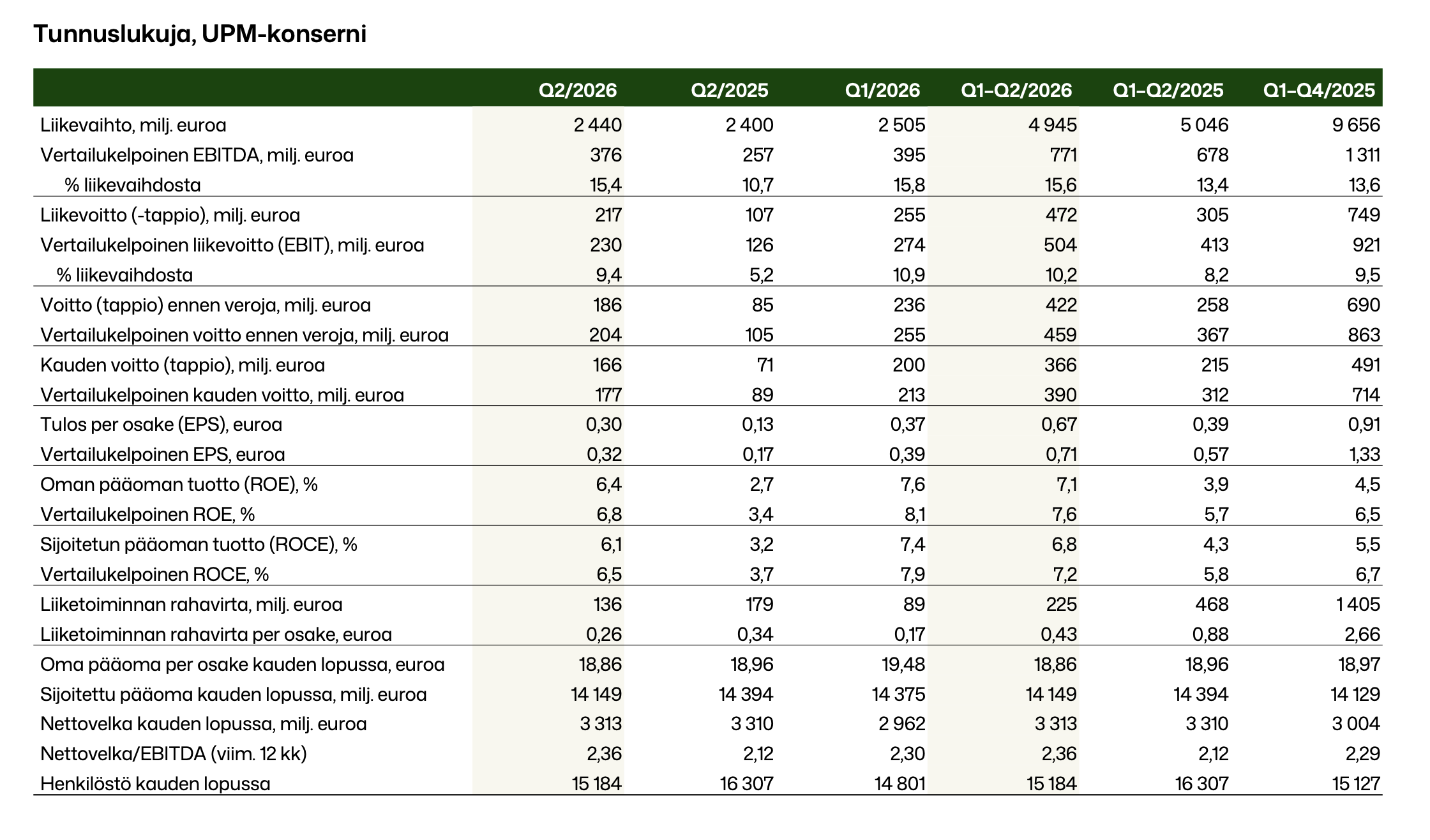
12 Likes
Here are Antti’s quick comments on Stora Enso’s Q2 results.
Stora Enso released its Q2 report this morning, which turned out to be slightly weaker than our and the consensus forecasts in terms of operating profit. Stora Enso does not provide earnings guidance, and in its outlook, the company continued to emphasize a predominantly difficult market environment as well as cost pressures still created by the geopolitical situation. The losses from the Oulu consumer board machine will not shrink in Q3 either. Preliminarily, the report leaves us with a somewhat bitter taste, even though we were not expecting any miracles either.
5 Likes