And this release doesn’t signal an improvement in the situation either.
10 Likes
It’s strange that the list included UPM Kymi, which is UPM’s most modern pulp mill in Finland. And Kaukopää, which is one of Stora Enso’s most important sites in Finland alongside Oulu—they have to get pulp from somewhere for those board machines, after all. I can better understand the inclusion of Kaukas and Joutseno, which have long been the mills that are the first to be idled. My own guess is that the first “Old Maid” (black mark) will fall on Joutseno, Kaukas, or EcoCell.
I wonder if the Kaukas biodiesel plant has been running while the pulp mill has been at a standstill?
9 Likes
UPM plans to increase pulp production with a mill expansion in Uruguay:
18 Likes
UPM is a global company, and the policy environment in Finland and Europe (forestry, restoration, energy, and other policies affecting costs) does not enable a proper return on capital.
9 Likes
The poor future demand outlook for softwood pulp is likely a more significant barrier to pulp investments in Finland. Although it is true that engaging in forestry is partly a thankless task in Finland nowadays.
14 Likes
Here are Antti’s comments on how Metsä Board secured the refinancing of its 250 million euro bond maturing in September 2027. 
1 Like
This question had gone unnoticed, apologies. In my opinion, both assessments are very much possible. Considering the Leuna entity as a whole, the technology seems significant given that they wanted to buy out the patents with actual cash. However, corporate communications (an observation not limited just to UPM) certainly wouldn’t admit it if the first scenario were closer to the truth.
6 Likes
Are we seeing the first victim of the new European consumer board market? The German-Dutch FOLBB (a small producer with ~245kt/year virgin fiber capacity) is applying for insolvency proceedings according to this news. The reasons cited are overcapacity, a difficult market situation, and high energy costs.
Baiersbronn Frischfaser Karton stellt Insolvenzantrag – 220 Arbeitsplätze gefährdet
6 Likes
China and South America will always be able to produce bulk goods cheaper and in larger quantities. When you combine this with the Finnish  forest industry’s poor ability to generate new innovative, money-making products and the high price of wood, we end up in this suffocating situation.
6 Likes
I personally believe that e-fuels could become a future growth story. Additionally, the surplus electricity production of pulp mills is occasionally very profitable during the winter. For this reason, I am not worried about the shutdowns occurring in the summer. In Finland, layoff arrangements (lomautus) are flexible (contrary to the image usually given of labor market flexibility), and thanks to them, mills do not need to operate when production is deemed unprofitable by the owner.
4 Likes
I am, however, concerned about that potentially permanent change in the softwood pulp market. Northern bleached softwood kraft (NBSK) might no longer be needed in the same quantities as before. Part of it is being replaced by short-fiber eucalyptus pulp, part by Chinese bamboo pulp, and part by South American plantation softwood pulp.
In order for a pulp mill in Finland to benefit from e-fuels and surplus electricity, the core business itself—softwood pulp production—must be healthy and profitable.
All signs point to the fact that in 5–10 years, there will be less pulp production in Finland than there is now. This is bad news for forest companies, society, harvesting chains, truck drivers, and forest owners. Forest owners should, at the latest now, diversify their investments increasingly away from the Finnish forestry sector.
18 Likes
All right, now the doomsday news coverage needed for my UPM forecast to come true is starting.
It’s a cyclical industry; the sun will surely shine there again, though this sector might still need some kind of tariffs or similar measures.
8 Likes
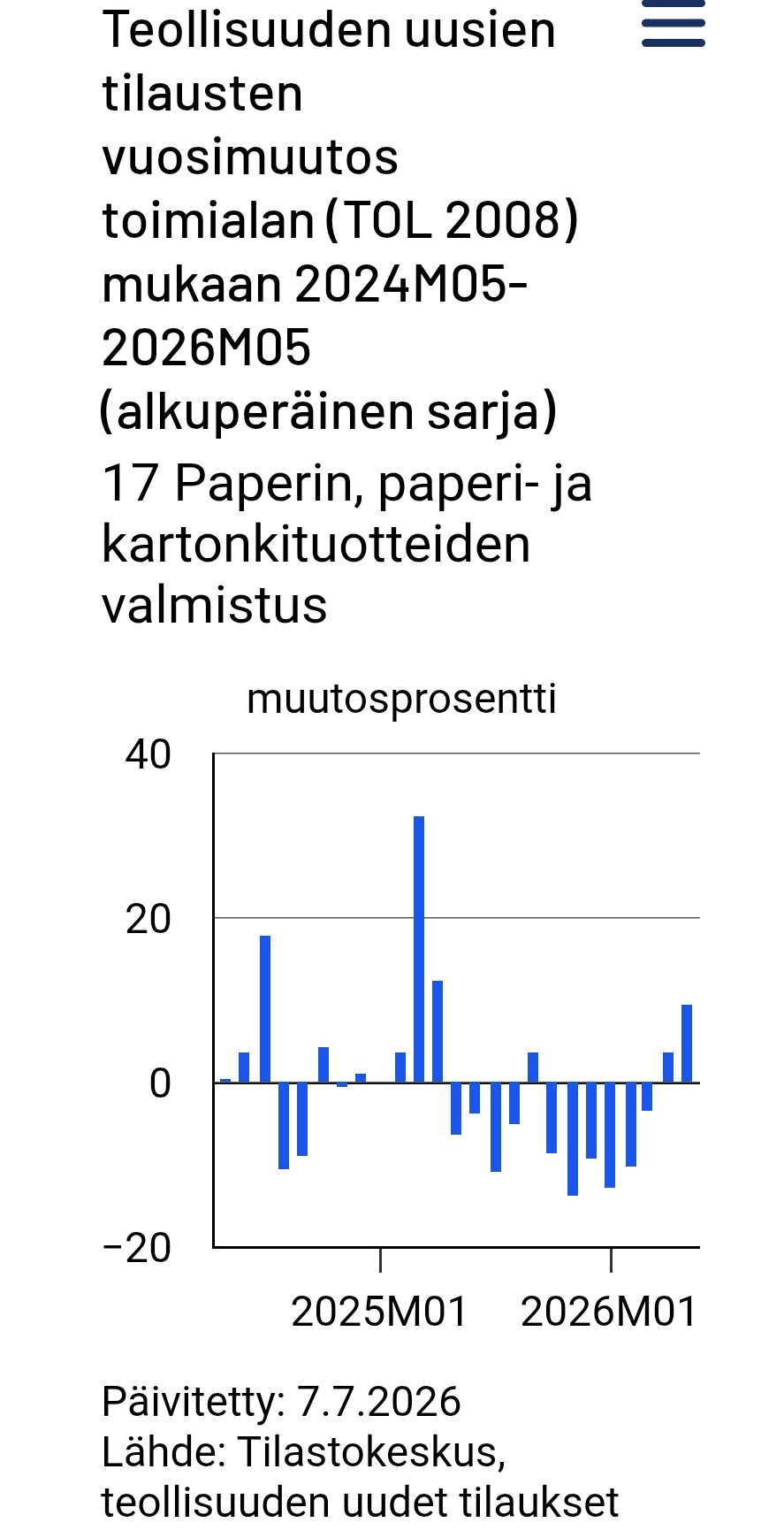
New industrial orders grew by 5.8% year-on-year in May 2026 | Statistics Finland
In May 2026, companies received more new orders than a year earlier in all examined main industries. New orders grew the most in the industry of paper and paperboard product manufacturing, where the value of orders was 9.5% higher than a year ago. In the metal industry, the value of orders was 5.1% higher, and in the chemical industry, it was 4.6% higher than a year earlier. New orders last grew year-on-year in all main industries over a year ago in March 2025.
Is it finally paper’s turn to shine?
24 Likes
Good news,
and in principle it would be easy for it to continue, 2025M5 (-6.5%) was followed by a long period of shrinkage
Note: 2025M5 is the first negative one after two big months of growth, i.e., almost 12 months in a row of negative performance plus one small positive month
6 Likes
I wonder if the orders to Finland were moved from the factory in the USA where that terrible accident happened? If I recall correctly, it was a 280,000-ton plant, which one would expect to be shut down for quite a long time now.
Not yet, the Inderes analysis says Reduce - so not yet.
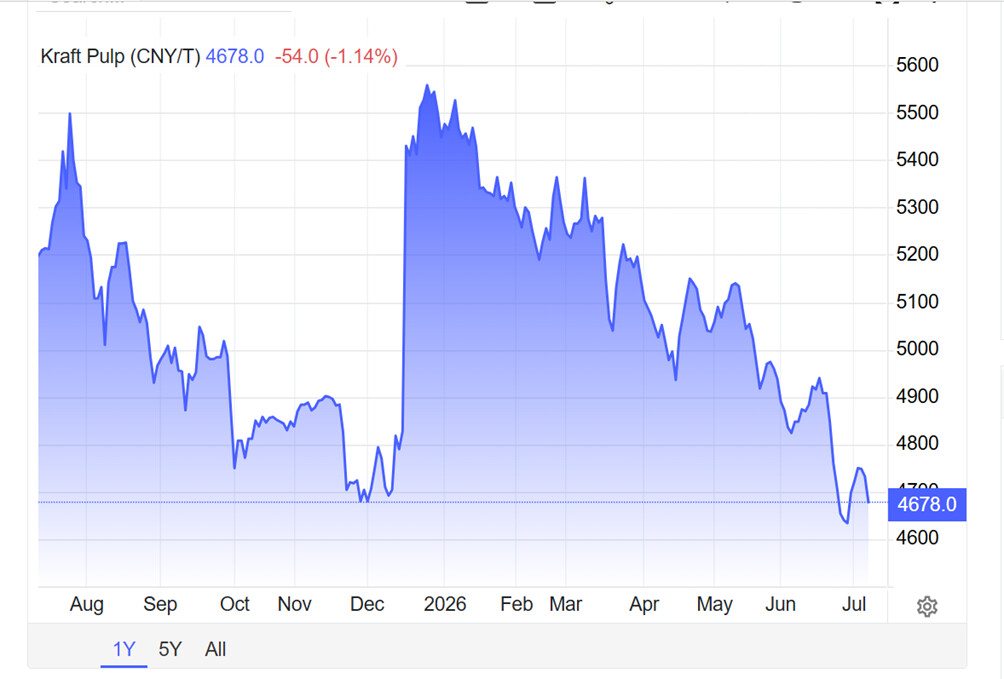
Fingers crossed that there’s at least an increase in volumes sold  But what about the price levels for forest industry products? The pulp curves don’t look very promising, at least:
7 Likes
It doesn’t look like it, and apparently, it’s hurting others besides Finnish manufacturers.
4 Likes
Metsä Fibre Joutseno has been at a standstill since March, and there is no end in sight. At the time, the company issued a statement saying that the situation was being monitored, and it has not changed its assessment over the course of the summer.
Furthermore, there is no sign of improvement in the global economy in any sector relevant to the forest industry. I therefore see no reason for optimism.
5 Likes
Domestic raw wood trade volumes for the beginning of the year are 25% below last year’s level. This means pulp mills in Finland will continue to operate at reduced capacity for at least the rest of this year. It would require a major pick-up in the wood trade for full production to even be possible, as wood is unlikely to come from Russia in the coming years, and it is highly doubtful we will ever see the same volumes as before 2022. So, we are waiting for structural adjustments.
8 Likes