Euroopan kommissio avasi tutkinnan SAP:in toimista, koska epäillään kilpailun vääristymistä sen ERP-ohjelmiston tukipalveluissa. Kyse on “on-prem”-versiosta, jota yritykset pyörittävät omilla palvelimillaan.
SAP vakuuttaa tietysti noudattavansa sääntöjä ja sanoo tekevänsä yhteistyötä viranomaisten kanssa. Yhtiö ei odota tutkinnan vaikuttavan talouteensa merkittävästi, vaikka sen osake laski heti uutisen jälkeen.
" Key Points
The European Commission on Thursday opened an investigation into possible anticompetitive practices by German software giant SAP.
SAP said it believed its policies and actions were fully compliant with EU competition rules.
The company is one of Europe’s most valuable, with a market cap of almost 282 billion euros ($331 billion)."
Blum (freely readable from the link below) had a good article about SAP’s challenges. The momentum provided by the cloud transition (forced upon customers ) will start to wane in the coming years. At the same time, AI can quickly reshape the competitive landscape, and SAP, known for its rigidity, does not convince all investors with its agility.
Such gambles are not something many companies could play:
\u003e That’s when Klein decided to give his corporate clients an ultimatum: Migrate your data to our cloud products, or we will no longer support you. The gambit paid off. Cloud sales started to boom and SAP today is the most valuable software company in Europe.
Competition is intensifying and high pricing is eroding customers.
\u003e The company is targeting artificial intelligence applications as its future, but faces competition from virtually every other tech giant in the world. Many customers are already unhappy with the expensive cloud transformation. Analysts at tech consulting firm Gartner reported concerns this year that the company is losing market share for some newer products outside of its core business and alienating clients because of its hard-nosed sales tactics.
Apotti’s little cousin, German SAP, published its results today.
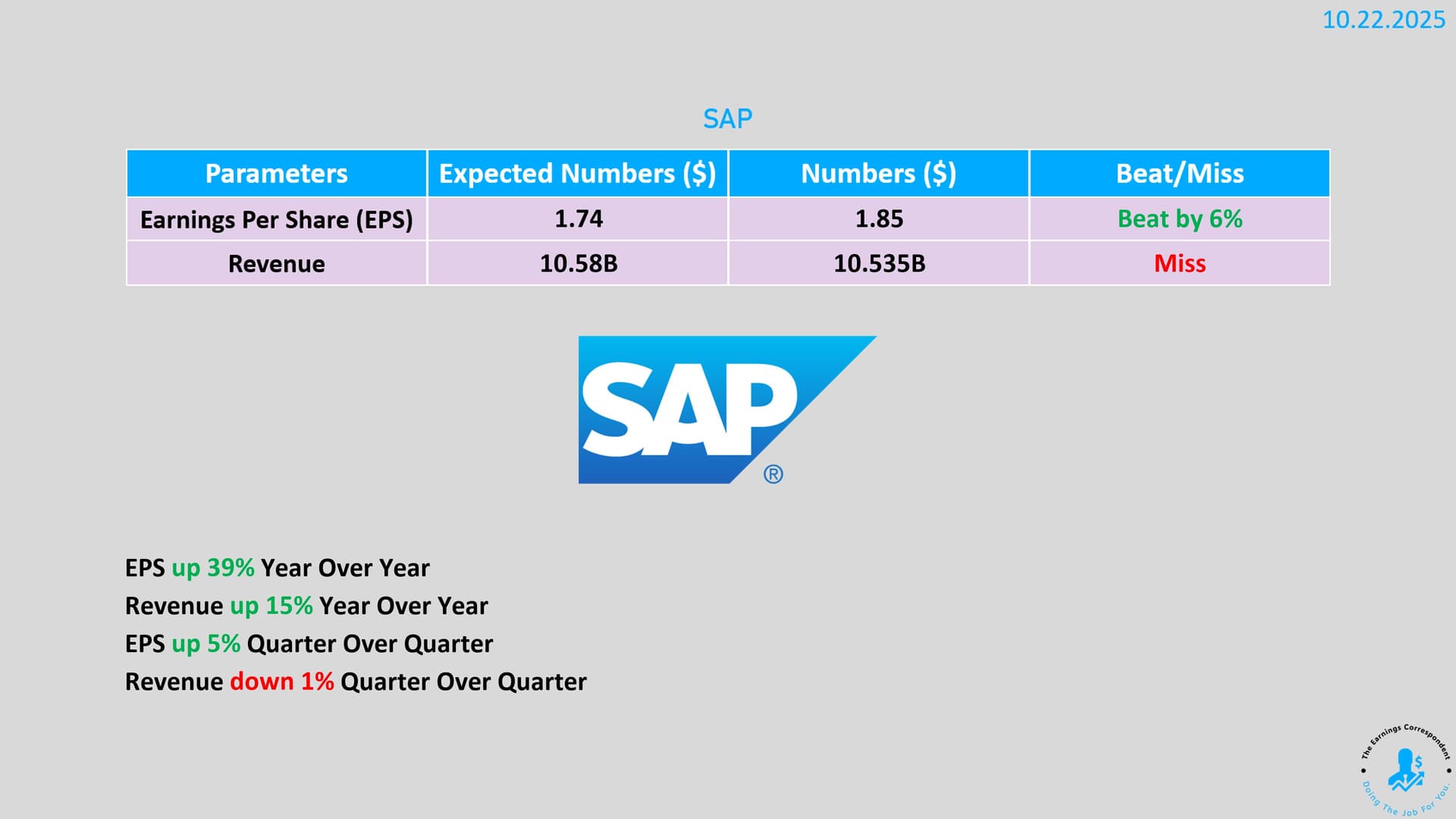
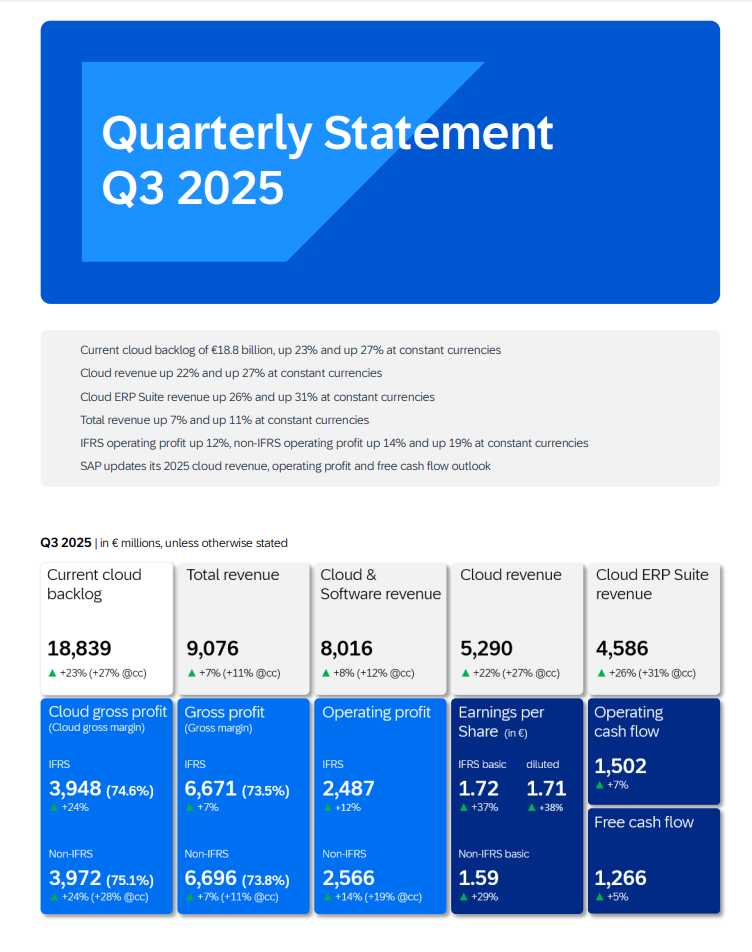
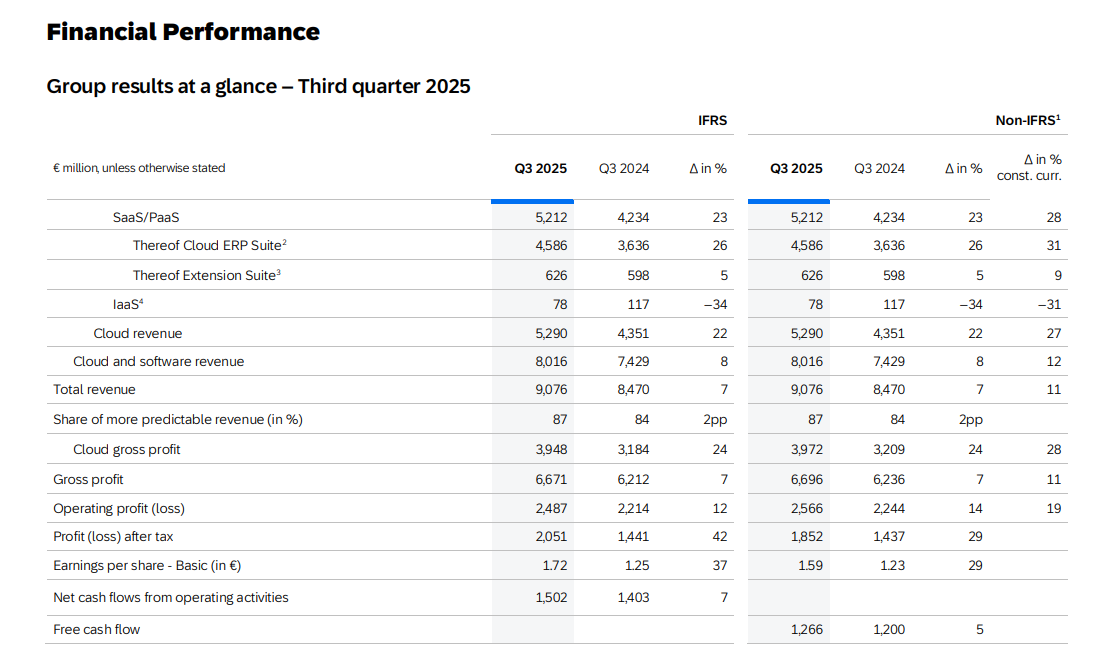
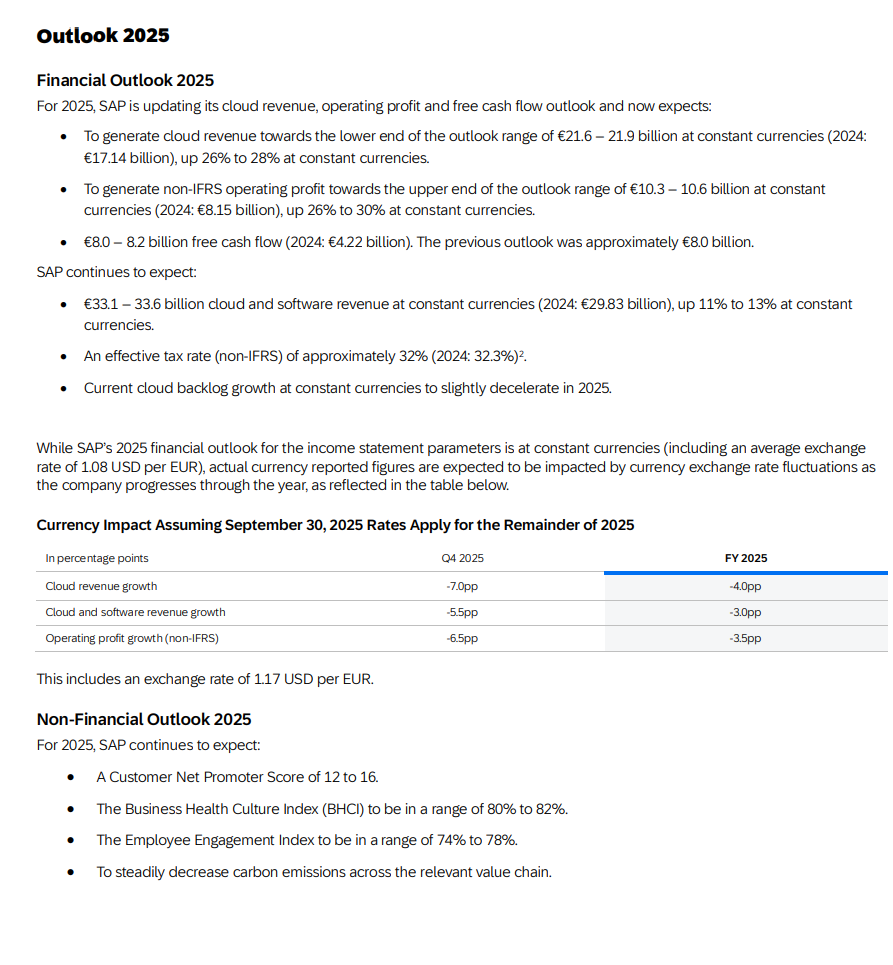
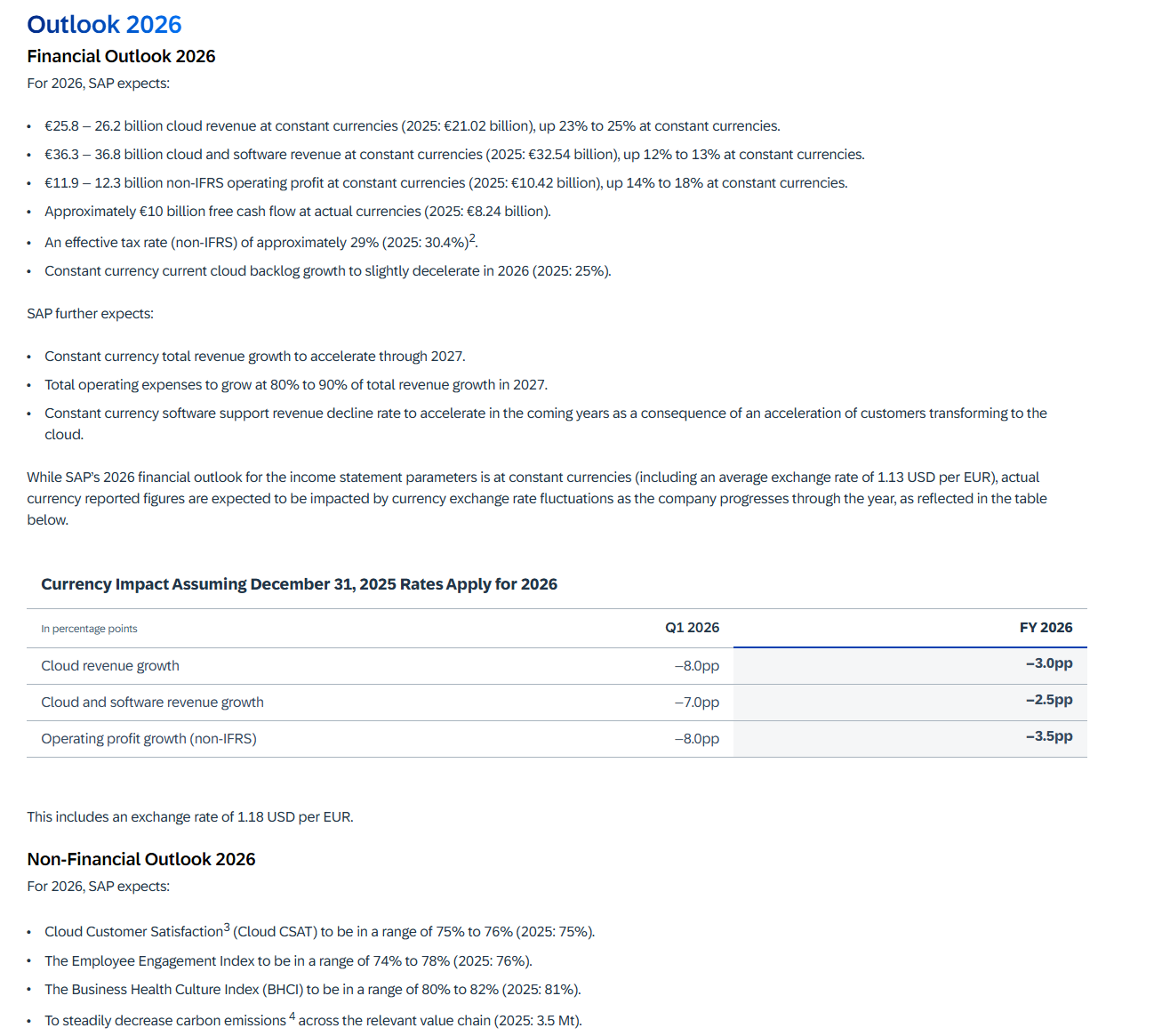
SAP’s third quarter was strong in terms of results, even though cloud business growth slowed down. The company managed to keep costs tightly controlled and even raised its 2025 earnings and cash flow forecasts. At the same time, however, it lowered its cloud revenue guidance to the lower end of the previous range, which on the other hand indicates a more cautious outlook.
The cloud services order backlog remains strong, and the utilization of AI is starting to show in efficiency. SAP appears to be adapting to economic headwinds in a disciplined manner - emphasizing profitability at the expense of growth, which likely suits this uncertain market situation.
SAP proposes concessions to appease EU competition authorities.
SAP has offered to make it easier for customers to switch to rival software, clarify the basis for its fees, and abolish its reinstatement fee as part of concessions proposed to settle an EU antitrust probe, the European Commission said on Friday.
SAP believes the investigation will not affect its finances.
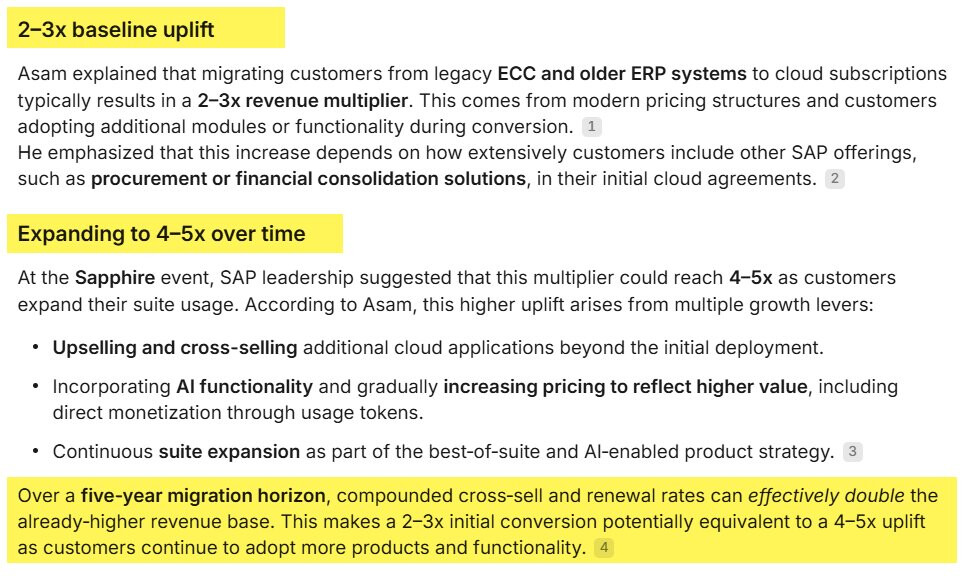
The tweet below states that, according to SAP, the transition from on-premise solutions to the cloud typically generates 2–3x additional revenue, which can grow to 4–5x over time through upsell, cross-sell, AI-driven pricing, and broader application suite adoption.
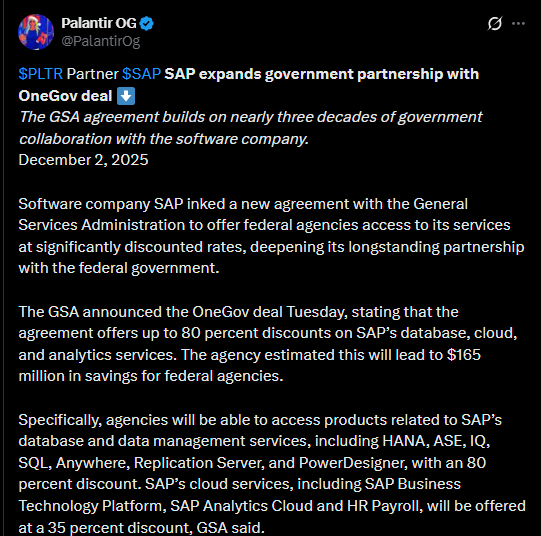
SAP has entered into a new OneGov agreement with the U.S. GSA, offering federal agencies its database, analytics, and cloud services at substantial discounts.
Discounts of up to 80 percent for database technologies and 35 percent for cloud services are available, which is estimated to save agencies approximately $165 million.
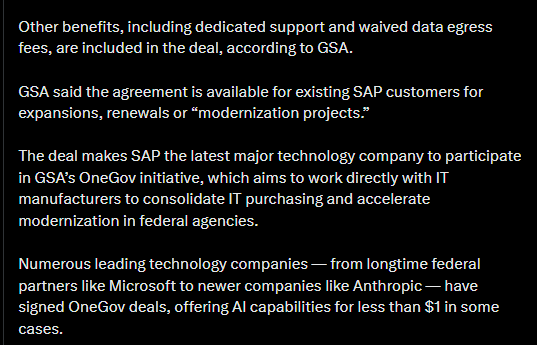
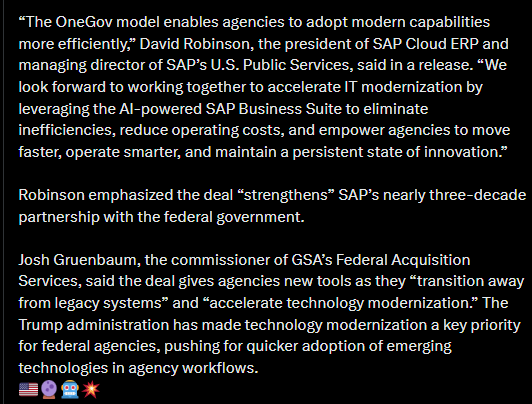
The agreement supports agencies’ transition from legacy systems to more modern ones; furthermore, it includes additional benefits such as dedicated support services and the elimination of data egress fees.
SAP thus joins other major technology companies in promoting U.S. government IT modernization and faster AI adoption.
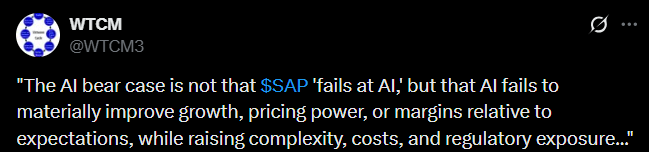
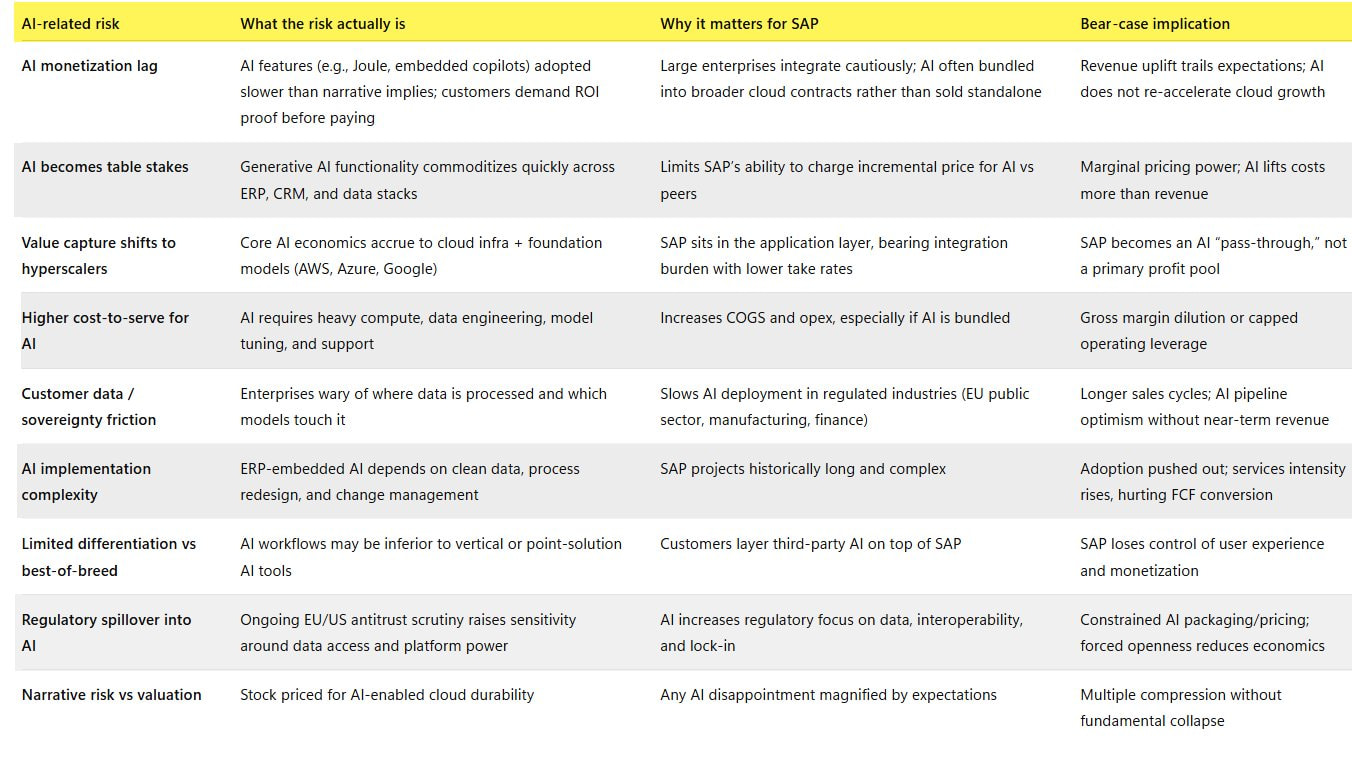
Here is an AI-focused and bearish tweet about SAP, highlighting that SAP faces significant AI-related challenges, such as slow monetization, intensifying competition, and high operational costs.
Value creation may shift to cloud giants, and strict regulation along with complex data requirements are slowing down adoption, meaning SAP might not necessarily reap the rewards. Additionally, technical complexity and high growth expectations create significant financial risks if SAP fails to meet the ambitious targets set by the market with its AI initiatives.
SAP might just get left behind in this transition.
Here is a link to Google’s blog, which includes Gartner’s Magic Quadrant on Cloud AI Databases. A completely essential topic in the AI era; SAP has clearly fallen behind and will likely fall further behind in the future.
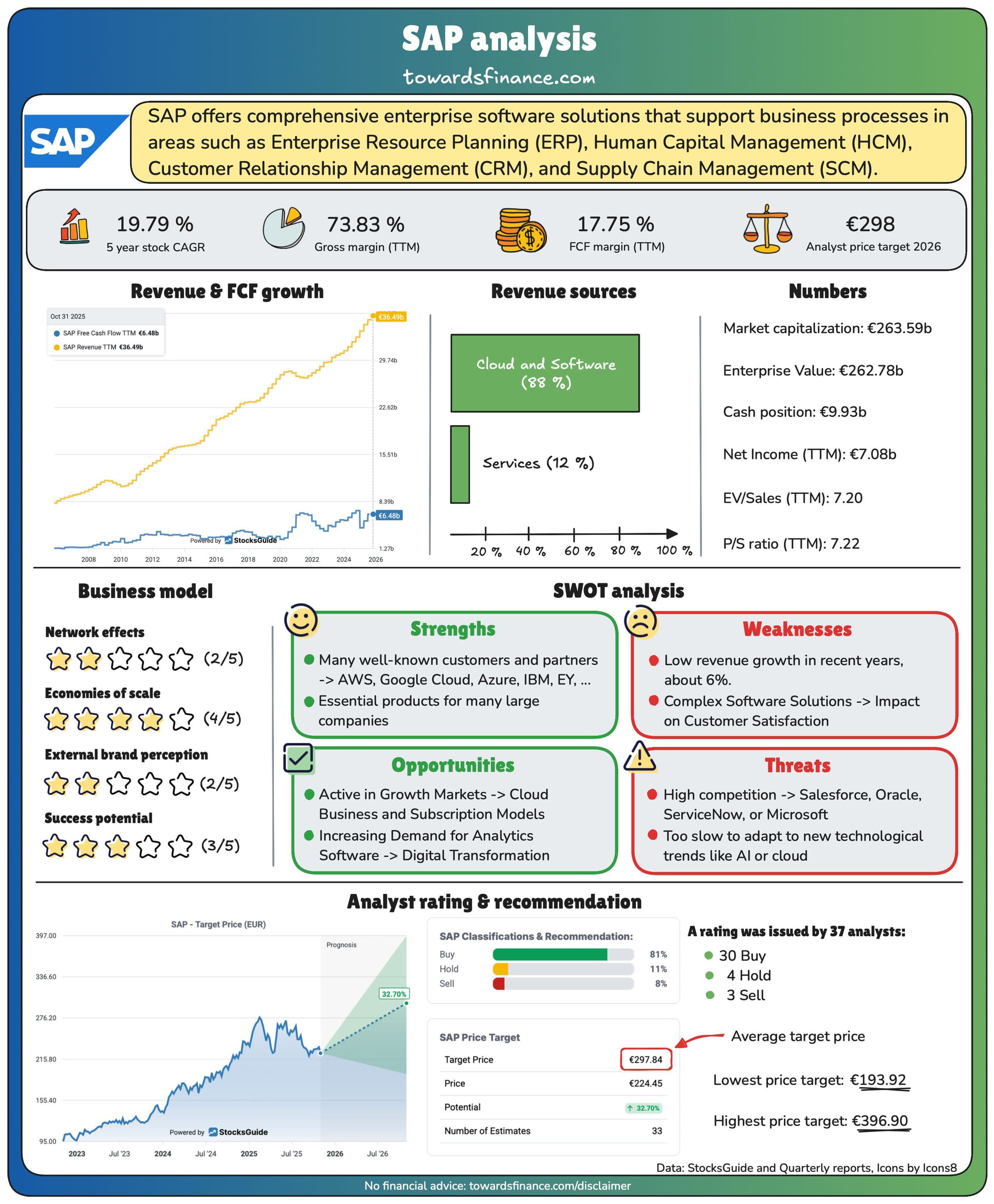
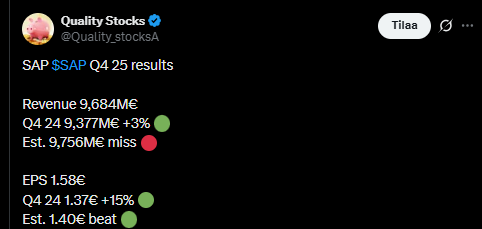
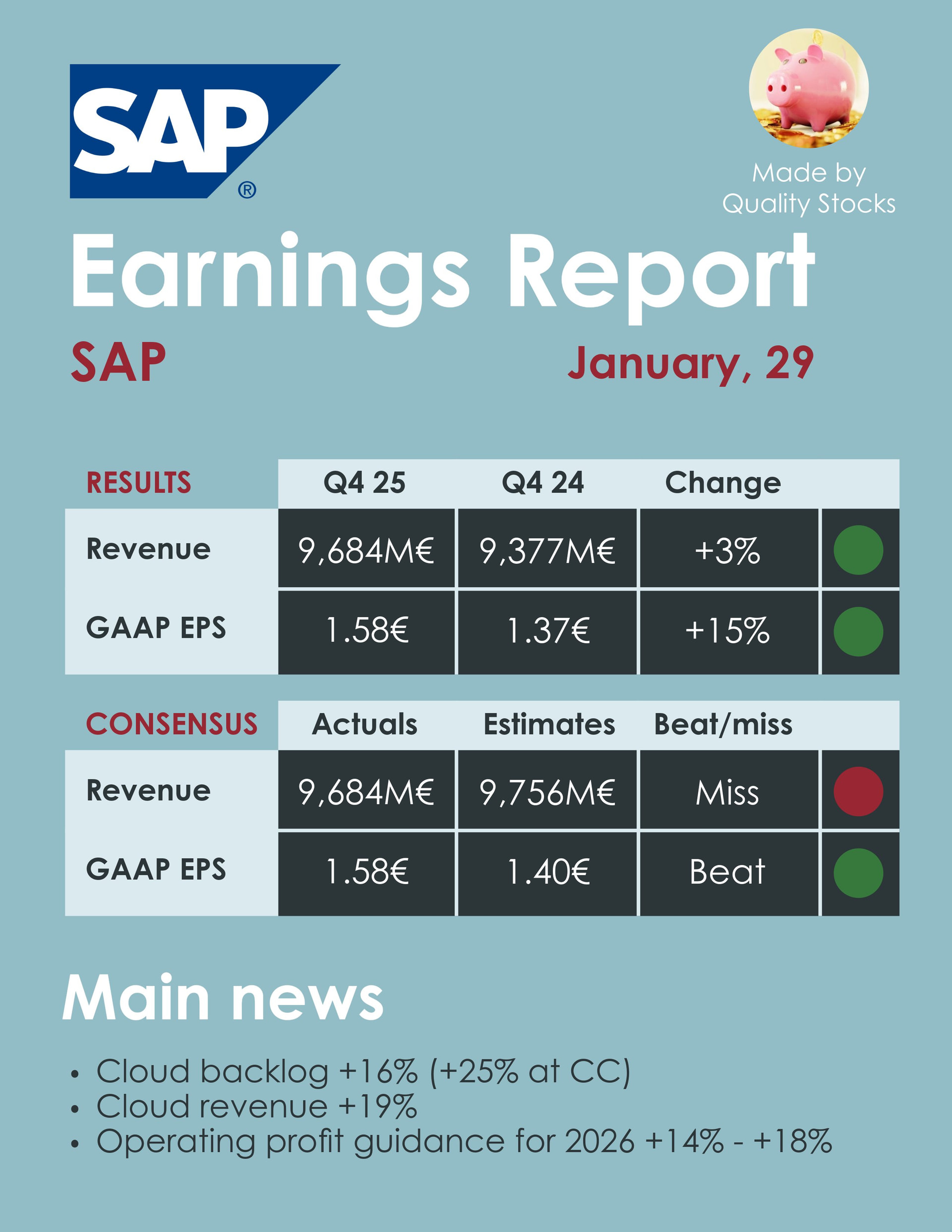
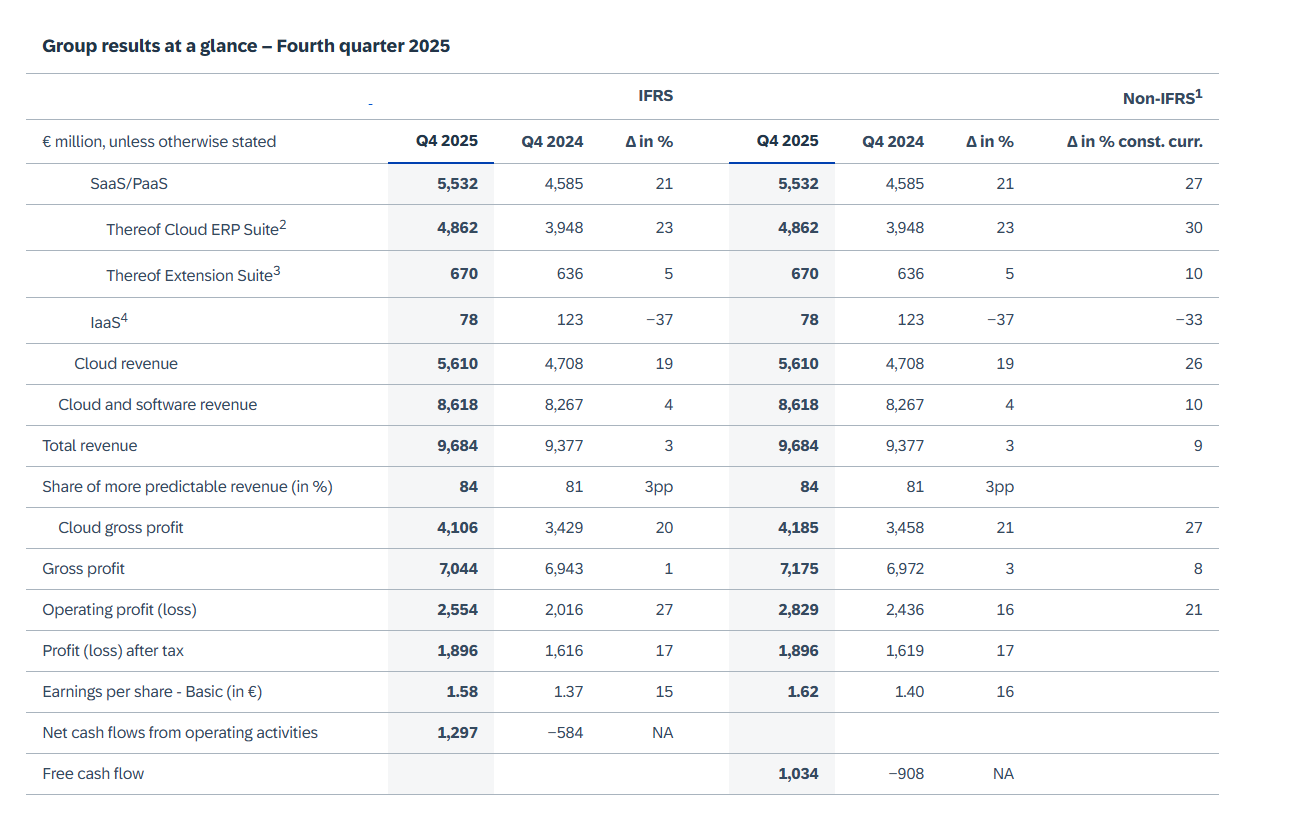
SAP’s latest figures were a bit underwhelming, even though cloud business grew, but that was already expected, and furthermore, new orders didn’t come in at the pace that was anticipated.
The biggest disappointment was likely caused by the future outlook and forecasts of slowing growth.
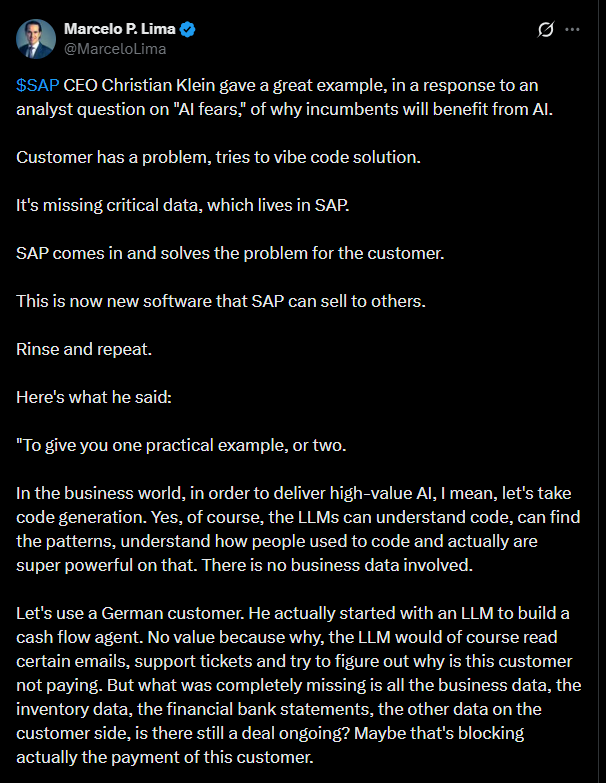
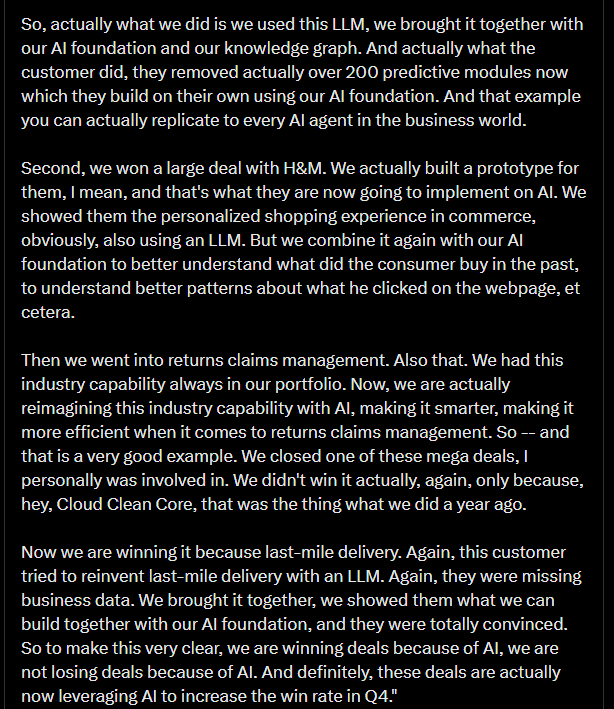
The tweet below highlights how SAP’s CEO explains why AI works best when combined with real business data. In other words, AI alone is not enough; background information is also needed. This is why SAP is reportedly able to help companies make better decisions and develop new services.
Now we are winning it because last-mile delivery. Again, this customer tried to reinvent last-mile delivery with an LLM. Again, they were missing business data. We brought it together, we showed them what we can build together with our AI foundation, and they were totally convinced. So to make this very clear, we are winning deals because of AI, we are not losing deals because of AI. And definitely, these deals are actually now leveraging AI to increase the win rate in Q4."
Usually, the average user doesn’t like SAP because the user interface isn’t the easiest and the system is so extensive and multifaceted.
But corporate management and the data analysis crowd surely like it because it provides such a great cross-section of the business globally.
The system is certainly rigid, and companies usually have to adapt to SAP’s processes rather than the other way around. SAP has such a large market share that they can operate this way.
SAP CEO Christian Klein plans to reorganize the company’s management and focus more on AI matters himself in the future.
He is shifting sales responsibility to Thomas Saueressig, who will become Chief Customer Officer starting at the beginning of April. The changes are reportedly being made because investors fear that AI will disrupt the company, and additionally, SAP’s own AI product Joule has faced criticism regarding its price and whether it provides enough value.
Also, SAP executive Muhammad Alam is leaving the company next year.
SAP’s pivot comes as investors flee software-as-a-service companies, fearing disruption by AI. Shares of enterprise software firms have been rocked in recent weeks as new AI tools raised the specter of users automating more tasks and workflow applications. At SAP, customers, resellers and investors have raised doubts about the prices and value of the company’s flagship AI product, Bloomberg reported last week.
SAP is shifting its pricing toward AI-based pricing, where customers pay based on usage rather than just a subscription. CEO Christian Klein warns that the change may temporarily weaken profitability and cause uncertainty, but the goal is reportedly to build a stronger and more competitive company in the long term.
Analysts at Barclays suggest this strategic pivot is unlikely to be a repeat of the company’s 2020 cloud transition, noting that the potential upside for SAP remains high.
However, they also highlighted significant execution risks, particularly as the firm attempts to balance the immediate financial drag of the latest changes against the need to build a more durable, AI-ready business model.
Investors are now looking to the upcoming earnings call for clarity on the exact scale of the structural shifts ahead.
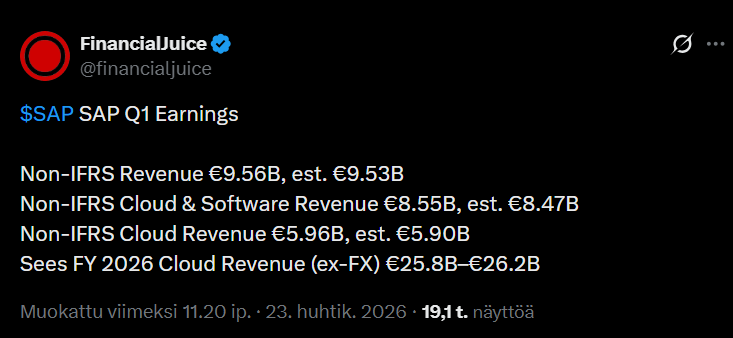
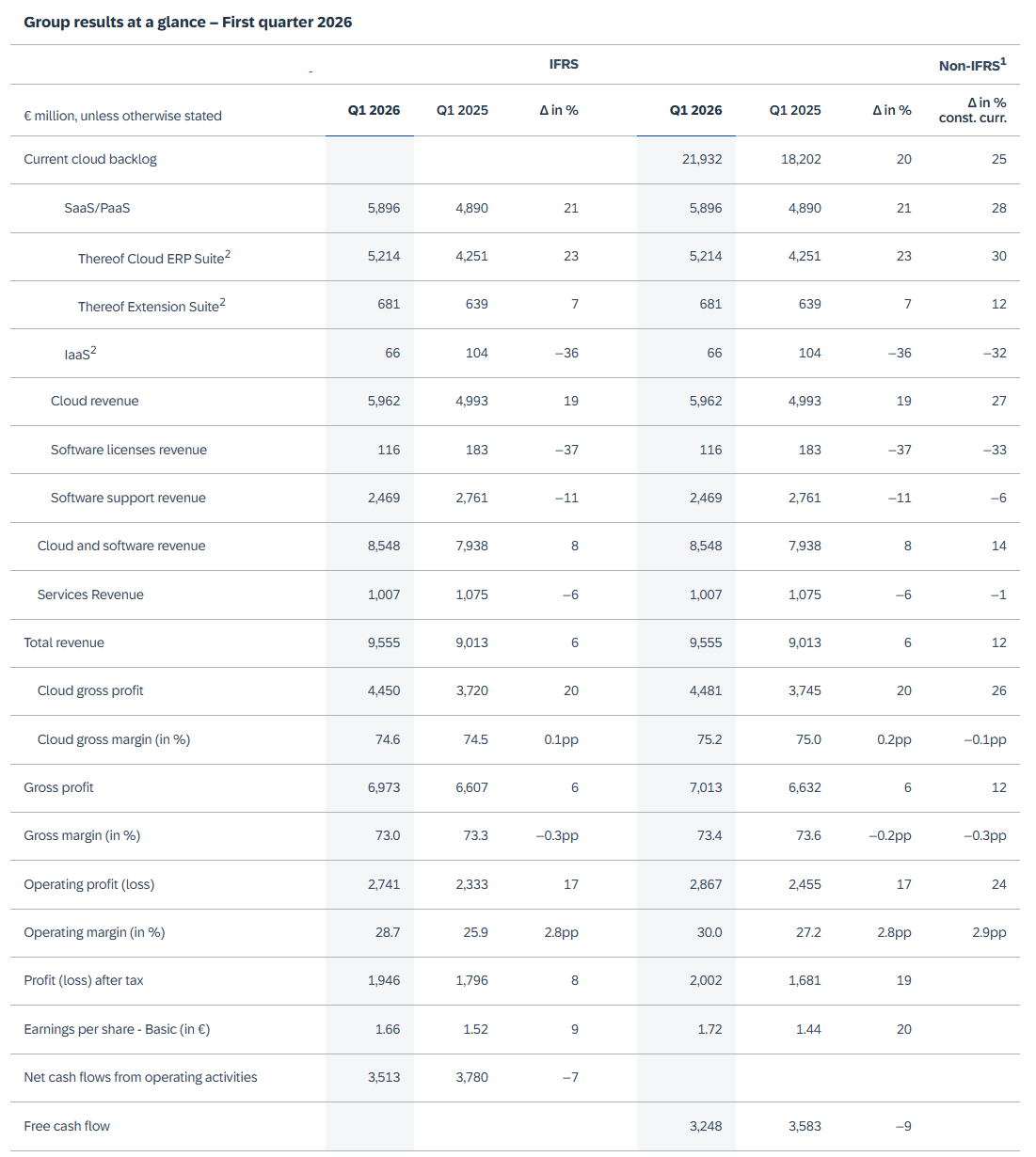
The year began reasonably well, and the company’s performance exceeded expectations, particularly thanks to the demand for cloud services. The company’s backlog also grew significantly, which eased investor fears of market disruption caused by AI.
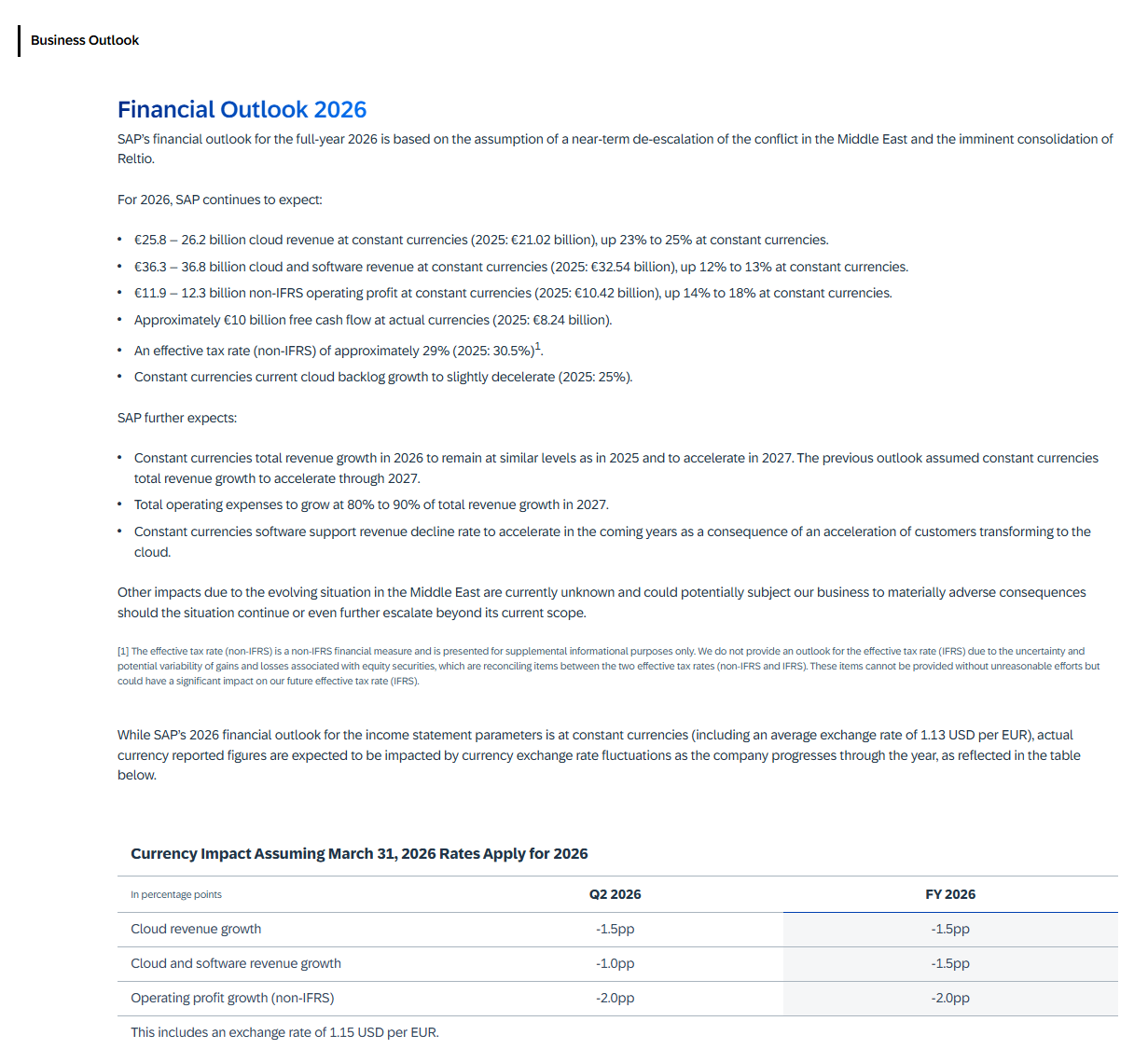
Customers remain committed to extensive system overhauls, and additionally, the growth of the cloud business is supporting the company’s profitability. However, the guidance anticipates growth moderating in the future; on the other hand, the relatively strong order intake shows that demand still persists.
The stock has risen following the results, but the YTD is -27
“We had a strong start to the year, with Current Cloud Backlog growing by 25% and Cloud Revenue up 27% at constant currencies. This performance is supported by our momentum in Business AI as we are already delivering real outcomes for customers today. We are growing faster than the market and are gaining share as customers expand across our Suite and with our AI solutions. At Sapphire, we will show how we are taking the next leap forward.”
Dominik Asam, CFO
“We delivered a solid start to the year, supported by disciplined execution in revenue and profitability. At the same time, we have remained focused on managing our cost base and maintaining profitability as we navigate an increasingly complex and uncertain macroeconomic and geopolitical environment.”
SAP plans to offer its AI tools to customers who are not yet using its cloud services .
This is a change from the company’s previous policy. The company wants to keep its customers onboard as new AI firms threaten traditional software companies. SAP also plans to change its pricing and help customers deploy the tools faster than before.
Chief Executive Officer Christian Klein is refocusing the software company around AI as it works to get customers to adopt the new technology and to keep AI firms from taking market share. That urgency has forced SAP to rethink its previous policy of offering the AI tools exclusively to cloud customers and as an incentive to on-premise clients who had not yet moved their systems to the subscription service.
This previous policy from SAP was actually quite absurd. The forced S/4 migrations are opening the door for competitors in many companies anyway. And when you add to this that on-prem brownfield (which, according to the grapevine, is by far the most popular way to migrate) excludes AI functionalities, it’s no wonder that—at least based on my own empirical observations—Microsoft, for example, has captured some customers who had been running SAP for decades, especially in the mid-market.
I would argue that this behavior is short-sighted. AI enables software development and opens doors for building new competitors and ecosystems on a completely new scale. Large, rigid, and expensive SAP will come to regret this.
 ) will start to wane in the coming years. At the same time, AI can quickly reshape the competitive landscape, and SAP, known for its rigidity, does not convince all investors with its agility.


 and perhaps for good reason: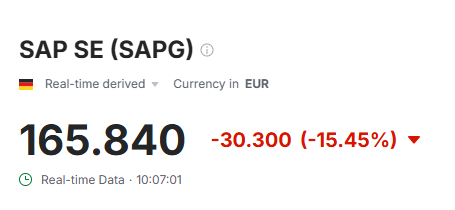

 .
.