Röko: New venture by CEO who 100x'd the value

Karlsson’s new round is a very interesting case.

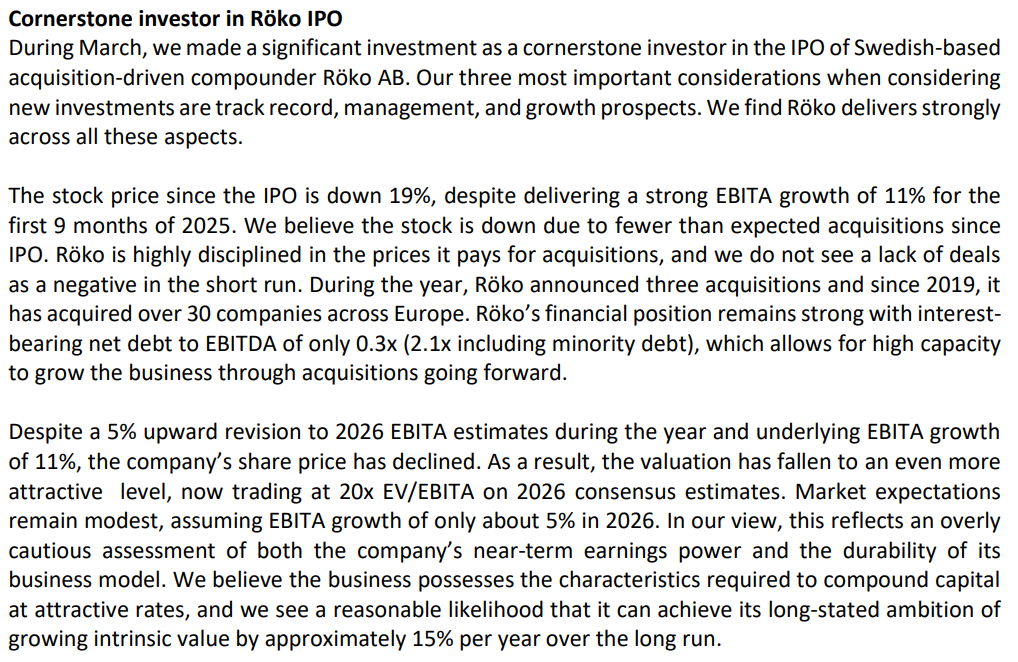
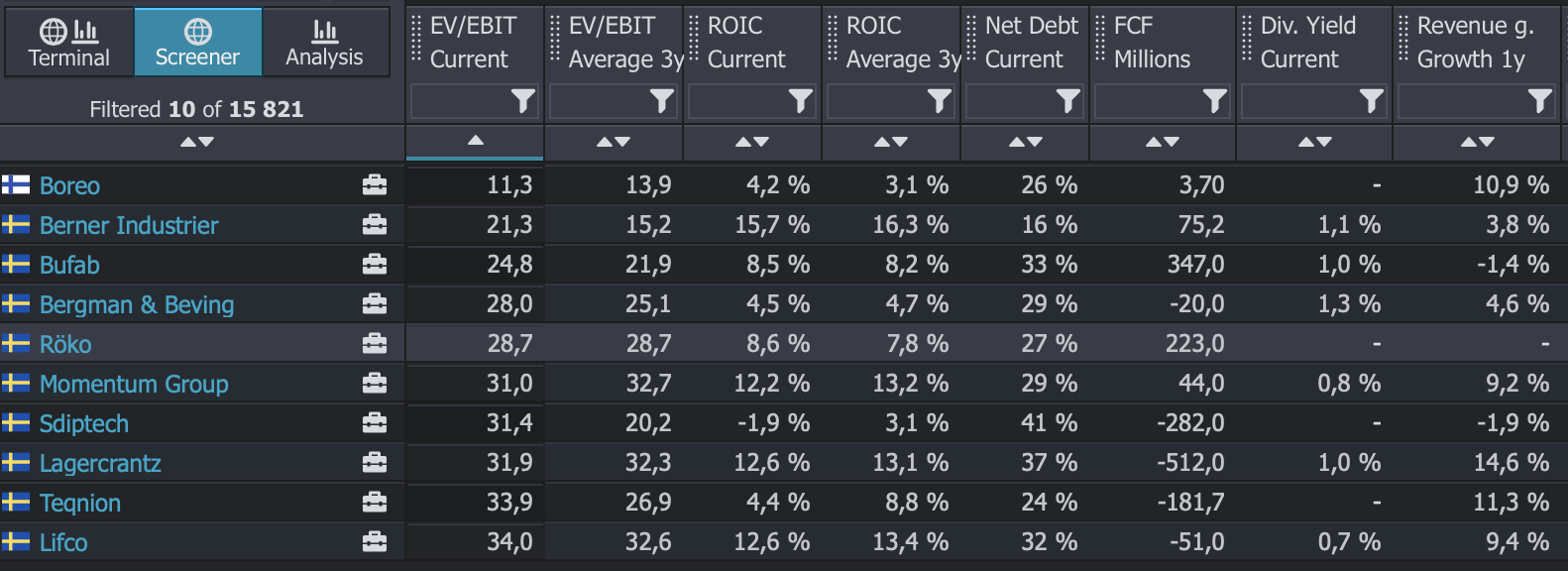
Röko’s stock price has fallen significantly, but Röko is still not cheap at its current price compared to its peers. Now it’s at roughly the same valuation as Lifco, which has historically been chronically expensive for years. For good reason, of course.

I also watched Karlsson’s presentation. A couple of things stood out.

Karlsson explains how he approaches M&A situations compared to other serial acquirers, or compared to Lifco. He states quite directly that Röko’s advantage is their small size, which allows them to grow faster through acquisitions than larger companies. He also praises that M&A is always a matter of trust between buyer and seller, and here Röko’s advantage is that Karlsson himself can directly participate in the acquisition, and the owner has weight in the situation.

An interesting company, hopefully it will become even more affordable in the coming months. The last couple of earnings reports have been OK, but the share price has still drifted lower. Now, however, insiders have also started buying.
Näyttökuva 2025-12-06 kello 14.44.02

9 Likes

It will. Reasons: Selling pressure, so far a limited number of people who know about this. Not all of them are buyers.

My own guess is that as selling pressure continues and there are few buyers, the price will correct sharply downwards. A short U-shaped bottom when sellers realize holding is a better idea. After that, a fairly steady rise, who knows for how long. Probably until the next crisis.

T: Waiting for entry, brooding over a nest egg

7 Likes

Good reflection! The small size is definitely an advantage vs. multi-fold larger serial acquirers (e.g., Lifco, Indutrade). If we consider a suitable acquisition target for Röko, a small or medium-sized company with approx. 2-10 million € EBITA, an average of 3-4 acquisitions annually is enough to maintain a growth rate of over 10%.

Roughly simplifying, a 4-5x larger Lifco would have to make 12+ deals annually to achieve the same growth rate, if equally small companies were acquired.

When acquiring these private small companies, one typically achieves the low valuation critical for the serial acquirer model, 5-8x EBITA. Valuations tend to rise when moving to increasingly larger companies, assuming their quality remains at the same level.

As the size grows, maintaining growth thus requires more and more small acquisitions, or alternatively, larger companies must be acquired :grinning_face_with_smiling_eyes:

Of course, these larger serial acquirers are still growing at a good pace, and someone like Constellation Software has been able to do it already at an epic scale. But it’s certainly easier to achieve that growth with Röko’s playbook when starting small :grinning_face_with_smiling_eyes:

A truly bullish argument could be that one can pay more for Röko than, say, Lifco, because Röko will grow faster and longer due to its smaller size :grinning_face_with_smiling_eyes:

I must also reveal that I opened a position last week, so it’s good to keep that in mind when reading my ramblings. My thoughts are therefore certainly already biased :cry: Pressing the buy button made me wince, and it hurt a little at the same time, as my portfolio includes, for example, the serial acquirer Relais Group from the domestic stock exchange at more than half the valuation :grinning_face_with_smiling_eyes:

My thesis, however, is that Röko invests 80-90% of its operating cash flow into growth (acquisitions), achieves approx. 15-20% ROIC on it, and this can be done for the next 10-15+ years. With these bullish parameters, a valuation of just over 20x EBITA (based on next year’s consensus estimates) doesn’t hinder the expected return much :joy: There are risks, of course, no getting around that. Let’s see if Mr. Market offers an opportunity for that famous cost averaging :grinning_face_with_smiling_eyes:

4 Likes

Yes, I agree that EV/EBITA is a quite valid valuation metric.

Initially, I thought that multiple arbitrage would be partially overlooked in a situation where Röko buys the company at an 8x EBITA multiple and leaves the entrepreneur with a 20% ownership stake in the new subsidiary. In this case, Röko’s valuation increases by the new subsidiary’s EBITA × 20, minus the price paid (considering the put/call option). For this reason, I still considered the multiple difference in the result to be undervalued for that 20% portion.

However, you are right that the arbitrage materializes when Röko buys the rest of the company in a few years. The undervaluation is only temporary.

3 Likes

Hi, thanks for this thread and discussion. I agree with what you wrote above, that the forum could use more discussion about capital allocators. Serial acquirers and investment company threads, as well as these company-specific threads. I have tried to keep the Fairfax thread alive, among others, but judging by the lack of discussion, there are apparently very few of us interested in this niche. It’s a bit of a shame, because there are many successful companies in this genre that might be “boring” but have simultaneously been excellent investments.

Apologies that my message didn’t bring any added value to the discussion about Röko. The company is completely new to me and I noticed this thread by chance. It’s good that a dedicated thread has been created for the company. This is exactly the benefit of discussion: finding new investment opportunities and learning new things even about companies you’re already familiar with. I’ll bookmark this thread and start following the company :slightly_smiling_face:

9 Likes

Wiser people can answer more comprehensively than I can, but as I understand it, the main reason for these option arrangements and minority owners in general is the raw entrepreneurial spirit required at the operational level in the subsidiary by Röko’s decentralized operating model. In practice, Röko’s headquarters would only want to focus on capital allocation. Subsidiaries are, of course, helped when necessary, even in the form of consulting/sparring, but they try to keep their hands off the daily business of the subsidiaries for as long as possible (unless there is a need to intervene, e.g., if the business starts to deteriorate).

So, if the local management of the acquired company or, for example, an entrepreneurial family retains that 20-25% minority stake, they will likely still wake up every morning to solve their business problems with the same entrepreneurial perseverance as before. At the same time, the entrepreneur who sold their company knows that they eventually have the opportunity to retire and sell the minority stake through the option arrangement. This is where the trust between the parties is emphasized, and the entrepreneur needs to see Röko as the forever home for their company, which isn’t going anywhere. As I understand it, the option arrangements are usually longer-term and are not based, for example, only on the cash flow development of the next financial year, after which the entrepreneur cashes out and moves to the golf courses.

By the way, the 2025 investor letter from the guys at REQ was released today: https://req.no/wp-content/uploads/2026/01/Investor-Letter-2025-2.pdf

There was more talk about Röko again, although there was some repetition from the previous letter too.

10 Likes

Here’s another interesting company that I came across through a great ‘heel story’ about the CEO on TikTok.

The valuation is still quite high, with a 2025 P/E of ~29. On the other hand, we are looking at 2026, and the forecasts for that year on Nordnet show a P/E of ~25, which is, well, still high. Of course, with different calculation formulas, you can make even these valuations look very cheap.

These serial acquirers should be studied more. Now one can only look back with envy at, for example, the hefty returns Lifco’s owners have enjoyed.

4 Likes

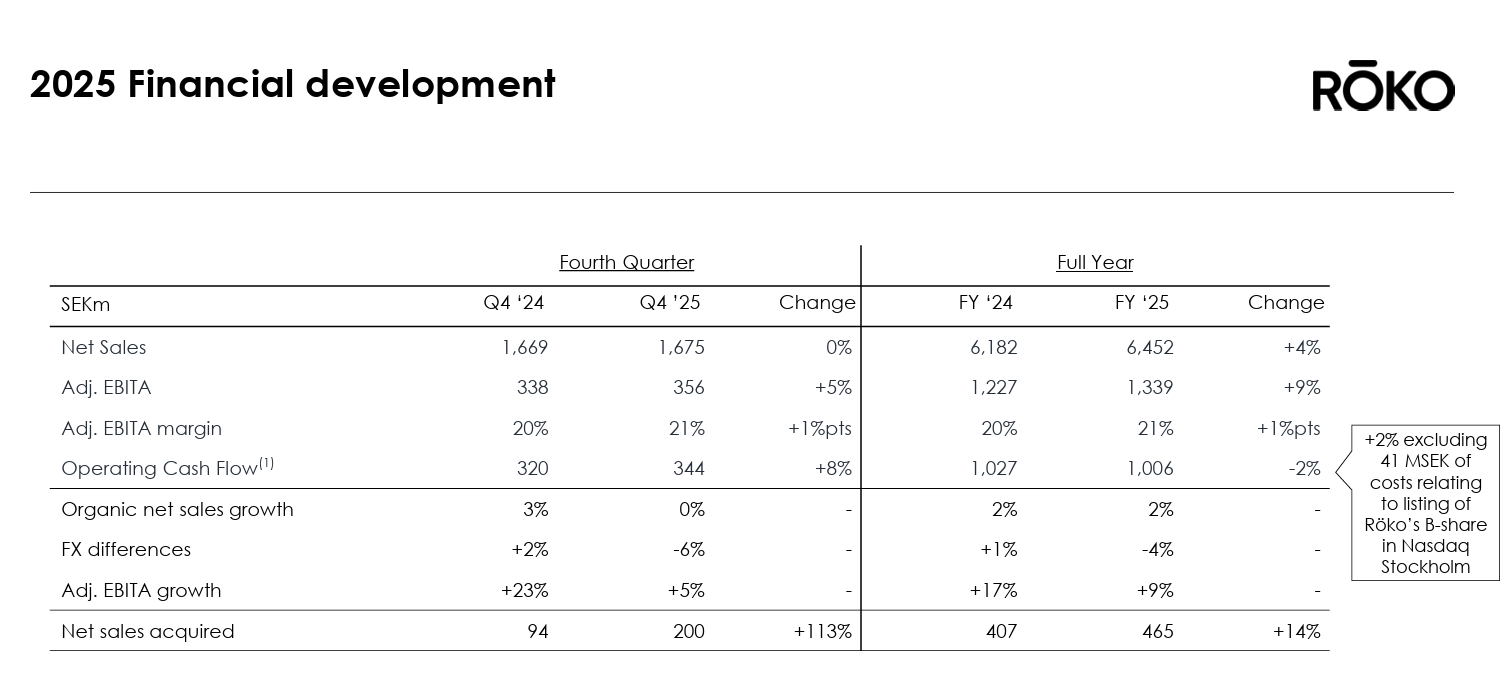
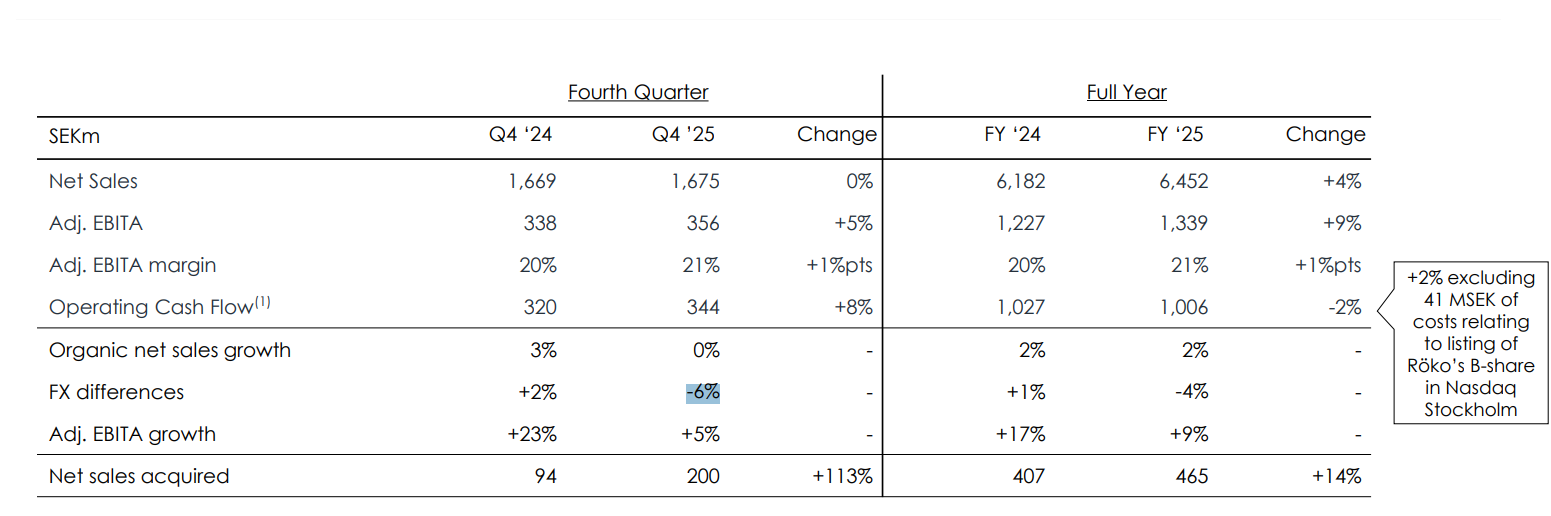
The strengthening of the krona hit Röko, but currencies are fluctuating back and forth. In terms of acquired revenue, slightly more acquisitions were made last year than in 2024.

  • Adj. EBITA increased 9% to MSEK 1,339 (1,227) in the year driven by acquisitions and organic growth, but with negative exchange rate differences
  • Adj. EBITA margin increased to 21% (20%) driven by acquisitions and organic margin improvements
  • Net debt / LTM Adj. EBITDA was reduced to 2.0x (2.1x) at the end of the year, driven by organic profit growth and good cash conversion
  • Three acquisitions, of which one add-on, with combined annual sales of MSEK 465 were completed in the year

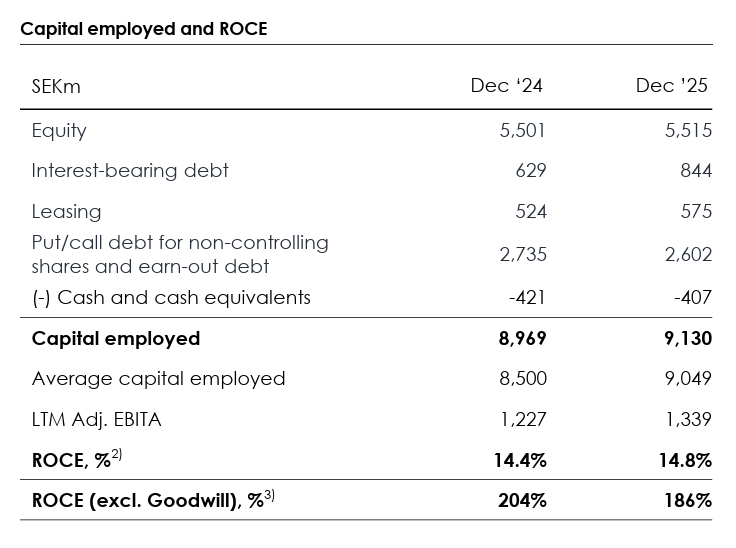
The acquired businesses are indeed real cash machines with very low capital requirements, which is reflected in a 186% return on capital employed excluding the “air” (intangibles) on the balance sheet. Of course, the shareholder looks at the total ROCE, as this “goodwill” reflects the cost of acquisitions beyond physical assets. That is slowly creeping towards the 20% level, which is a typical level for high-quality and mature serial acquirers.

Financially, there is plenty of firepower for making acquisitions, with the debt level being moderate and the company also having a good amount of cash left. Cash flow is also strong. Hopefully, the share price continues its downward trend, as this kind of moderate growth doesn’t spark great greed in the short term, which may offer opportunities for long-term investors at the expense of the impatient ones.

20 Likes

Verneri is filling the gaps in Inderes’ Swedish analysis operations and gave us a quick comment on Röko’s results :handshake: Here is the earnings call starting at 10:30 to accompany the report. By the way, these are record-breakingly short at Röko :smiley: In the Q3 call, Deputy CEO Johan was on the line for just under 8 minutes, briefly going through the key metrics and answering a couple of questions. Tellingly, towards the end of the call, I think you could hear someone (maybe the actual CEO?) knocking on the recording room door/window and probably hurrying Johan back to work :smiley: That’s how it is when the headquarters focuses on the essentials with a team of only eight people. In my opinion, many other companies ramble on for hours in their earnings calls about report details for no reason, when that time could be spent on the business itself :smiley:
15 Likes

I was out for a few beers yesterday with some guys from the industry, and a study was mentioned suggesting that more concise companies tend to perform better. :smiley:

I’ll have to ask next time what study it actually was. It does make sense, though, as good figures or a good business don’t need to be sugarcoated with verbal sugar. Bad ones, on the other hand… Well, there are experienced investors here, you know the kind of verbal acrobatics CEOs of poor businesses resort to. :smiley:

Addition.

A few examples.

Berkshire Hathaway communicates with investors ONCE a year at the annual general meeting.

Constellation Software stopped regular CEO letters in 2017.

A more recent example from the home front. Sampo’s Torbjörn answered questions very briefly and didn’t hide his frustration with analysts’ silly questions during analyst calls. :smiley: The stock performed quite well during his tenure as CEO.

22 Likes

It doesn’t seem like Röko reports pro forma figures anywhere? The company is starting to reach a size where pro forma calculations no longer have such a significant impact. However, it would still provide a more accurate picture because the balance sheet reflects the debt incurred from acquisitions, but the income statement doesn’t yet show the earnings (especially since acquisitions were made in December).

I was pondering Röko’s report by the fireplace on Friday evening. As Verneri already wrote, the strengthening of the krona (SEK) didn’t do any favors for the reported figures, as the majority of subsidiaries operate their businesses in other currencies, and thus the impact on Röko’s figures was as much as -6% in the final quarter and -4% for the full year. The krona has continued on the same path so far this year. Short-term noise.

Growth was then a bit lukewarm, as currencies resisted and it wasn’t the busiest year for acquisitions. Profitability was indeed strong and improved even further from peak levels, which nevertheless helped EBITA grow slightly both in the final quarter (+5%) and for the full year (+9%).

Since Röko is still at a fairly early stage as a serial acquirer, the impact of even a single acquisition on an individual year’s growth is quite binary. Either the deal is closed or it isn’t :smiley: Growth could have thus reached the target level if 1-2 deals in the pipeline had made it to the finish line. The company can’t really comment on this pipeline in more detail, and the processes going on there are often quite intimate, where relationships are sometimes nurtured for years as an entrepreneur slowly decides to give up, at least partially, on their life’s work and beloved “child.” Sometimes, something happens during the process and the deal is canceled entirely or delayed. Blemishes are found in the paintwork during DD (Due Diligence), or a maximum cash offer from some PE bully is taken instead, or something else.

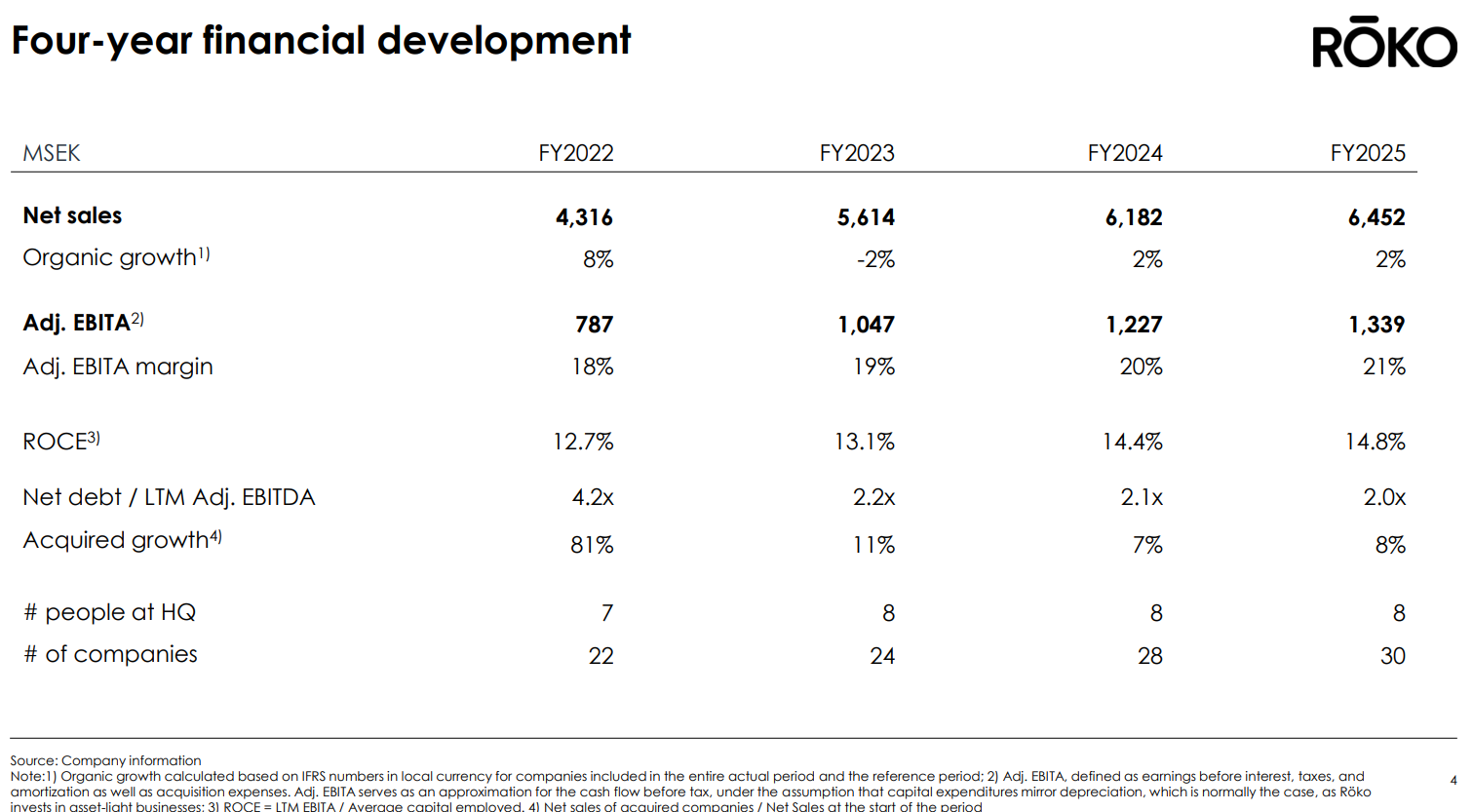
Long-term development is then quite sweet when you consider what the years 2022-2025 have been like. During these years, many former favorite stocks and companies perceived as high quality have completely blown up due to economic misery, inflation, interest rates, geopolitics, war, etc. etc. Meanwhile, Röko’s subsidiaries have on average achieved organic growth and slightly improved margins :smiley: Simultaneously, the group’s ROCE just keeps ticking upwards and leverage downwards, which admittedly also signals unmade acquisitions. However, at the same time, it tells a story of asset-light subsidiaries churning out abundant cash flow. Gradually, one becomes convinced of the average quality of the acquired businesses—meaning their ability to generate cash flow, defend or improve margins, and at least grow in line with inflation. Those graduation caps or conveyor belt lubricants won’t be immediately disrupted by AI either, as Verneri aptly wrote in one of his messages :smiley:

The serial acquirer model is beautiful in that these kinds of dull & stable “slugs” wouldn’t go anywhere on their own, but by masterfully reinvesting cash flows, magic happens in the long run.

18 Likes

10 Likes

Second deal of the year finalized :handshake: This time a golf equipment retailer from Norway :smiley: Revenue approx. 250 million NOK, or approx. 22.3 million €

9 Likes

Yesterday, a press release was issued regarding Johan Bladh’s appointment as CEO. The appointment takes effect on April 22nd, the day after the Annual General Meeting. Fredrik will continue working full-time as Deputy CEO, Chairman of the Investment Committee, and with acquisitions.

Born in 1989, Johan was the obvious successor, but such a rapid change was a surprise to me at least. But as I understand it, those veterans consider him very competent, so why not.

13 Likes

That happened much faster than I had expected! As noted in the press release, Johan was Röko’s first employee, hired by founders Fredrik and Tomas seven years ago. So, he was involved in every acquisition except for the very first one.

As I understand it, they wanted to build the Röko team from the ground up by bringing in promising young talent alongside seasoned veterans, so they would have time to grow with the company before having to step into big shoes as successors.

Johan actually has quite a substantial stake for a young man :smiley: He owns 2.66% of the shares and 10.11% of the votes :smiley: This is, of course, a prerequisite in this type of business. I would argue that one of Röko’s competitive advantages in M&A processes is that entrepreneurs considering a sale negotiate directly with Röko’s principal owners.

Thus, the principal owners/entrepreneurs from both sides are sitting at the negotiating table, which gives the promises made much more weight. I believe this is particularly important when the promise includes a “forever home” and a decentralized operating model, where the seller knows they can continue to run the business in peace after the deal, just as they always have.

15 Likes

Quite a lot is coming out of the acquisition pipeline now :handshake: This time from the UK. Third deal of the year.

ABP Group has consolidated sales of ca GBP 15m, 88 employees and will be consolidated in the B2B business segment in March 2026.

7 Likes

Röko has acquired four businesses since the beginning of December.

ITIB, 75 %, revenue 19 MEUR.

Lambda, 85 %, revenue 11 MEUR

Golfshopen, 80 %, 250 NOK

ABP, 85 %, 15 GBP

Roughly ~730 MSEK in total revenue. This means inorganic growth would be ~11% “pro forma” relative to the 2025 level.

17 Likes

Yep, on top of that, you could still factor in some small change from the earlier 2025 acquisitions:

  • June Topa Bathroom 20 MEUR → brings approx. 5 months of growth in 2026 → 95 MSEK?
  • August Oppold Systems 3 MEUR → brings approx. 7 months of growth in 2026 → 20 MSEK?

There’s no way to know the profitability of these 2025 and 2026 acquisitions without digging through the financial statements, but would one dare to estimate something like 10-15% EBITA growth for 2026?

Based on the 2025 realized figures, after a small share price dip, EV/EBITA has been hovering in the 18-19 range. The “sinful” forward EV/EBITA would then be something like 16-17? :smiley: Not a mega deal yet, but it doesn’t feel quite as bad anymore when pressing the buy button.

7 Likes

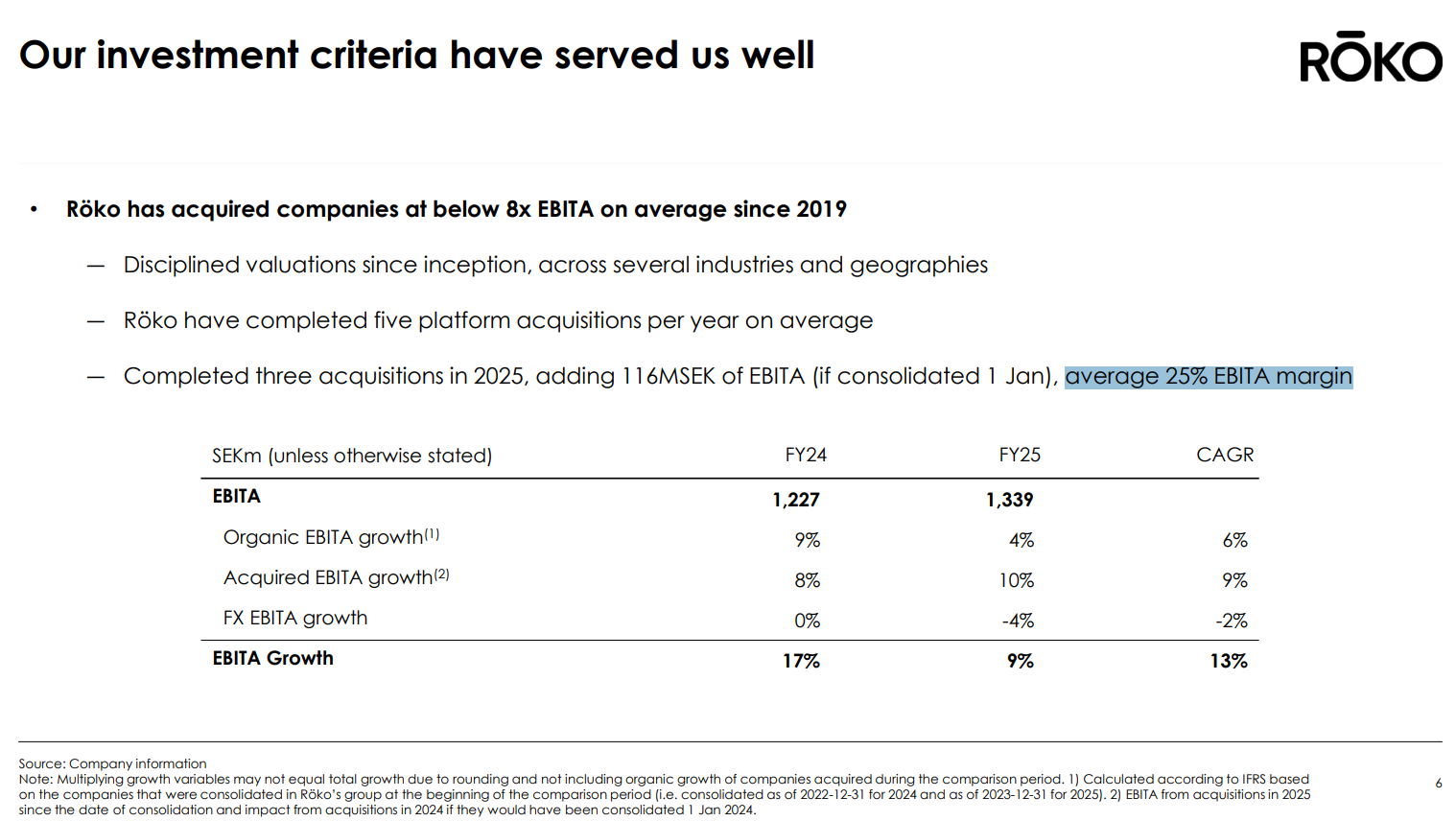
I tried to look for clues in the company’s own materials regarding the profitability of recent acquisitions. I actually found something in the Q4 presentation slides that I had missed earlier:

So the average profitability of the 2025 acquisitions was a notch better than the group’s approx. 20% EBITA margin in recent years. The official stated acquisition criterion regarding profitability seems to be an EBITA margin of >15%.

I’ve gotten the impression from management’s comments, however, that Röko emphasizes profitability in its acquisitions much more than many of its peers and, as a result, has ended up twice as high as the target level. So, high-profitability businesses have been found one after another.

It makes sense in itself when you’re operating across all possible sectors and Röko can’t always understand 100% of the details of the business being bought, given that the portfolio includes things like artificial flowers, golf equipment, CNC aggregates, auxiliary lights, etc. :smiley: After all, high profitability traditionally always indicates pricing power and a moat to some extent, and it provides a margin of safety against mistakes and tough times.

In itself, profitability shouldn’t have a groundbreaking significance—whether it’s 10% or 20%—if the businesses are otherwise nearly identical in terms of return on capital, cash conversion, investment needs, etc. I’ve thought this way in my own stock picking as well, and admittedly, those low-margin but otherwise “excellent” cases have more often gone south :smiley:

Then there’s someone like Costco, which has created massive shareholder value for decades with a very thin 3-4% EBIT margin :smiley: Of course, it’s a completely different business than a small or medium-sized European company, which is what we’re talking about in Röko’s case.

EDIT: the stated EBITA margin target was actually > 15%

14 Likes