Wiser people can answer more comprehensively than I can, but as I understand it, the main reason for these option arrangements and minority owners in general is the raw entrepreneurial spirit required at the operational level in the subsidiary by Röko’s decentralized operating model. In practice, Röko’s headquarters would only want to focus on capital allocation. Subsidiaries are, of course, helped when necessary, even in the form of consulting/sparring, but they try to keep their hands off the daily business of the subsidiaries for as long as possible (unless there is a need to intervene, e.g., if the business starts to deteriorate).
So, if the local management of the acquired company or, for example, an entrepreneurial family retains that 20-25% minority stake, they will likely still wake up every morning to solve their business problems with the same entrepreneurial perseverance as before. At the same time, the entrepreneur who sold their company knows that they eventually have the opportunity to retire and sell the minority stake through the option arrangement. This is where the trust between the parties is emphasized, and the entrepreneur needs to see Röko as the forever home for their company, which isn’t going anywhere. As I understand it, the option arrangements are usually longer-term and are not based, for example, only on the cash flow development of the next financial year, after which the entrepreneur cashes out and moves to the golf courses.
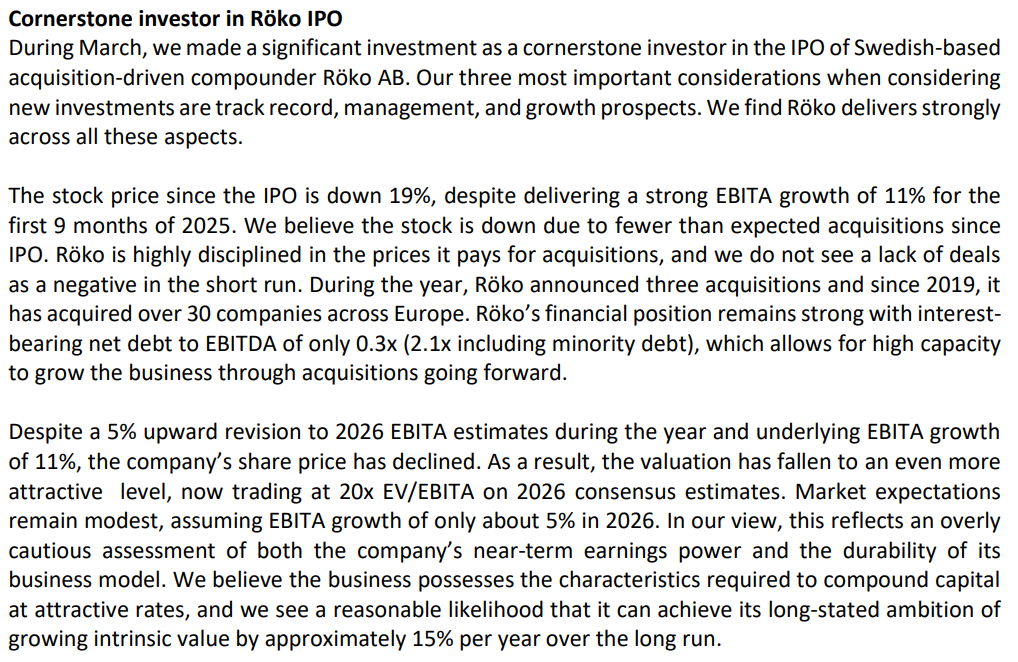
By the way, the 2025 investor letter from the guys at REQ was released today: https://req.no/wp-content/uploads/2026/01/Investor-Letter-2025-2.pdf
There was more talk about Röko again, although there was some repetition from the previous letter too.