Regarding that currency risk, the risk has actually materialized quite harshly lately for those of us whose portfolios consist largely of an S&P 500 ETF quoted in euros. The weakening of the dollar has eaten up almost all gains over the last 12 months! And in the same period, Nordnet’s Finland index has ticked up over 28%.
Of course, this doesn’t significantly affect my long-term investment strategy, but an investor’s life is full of such surprises.
7 Likes
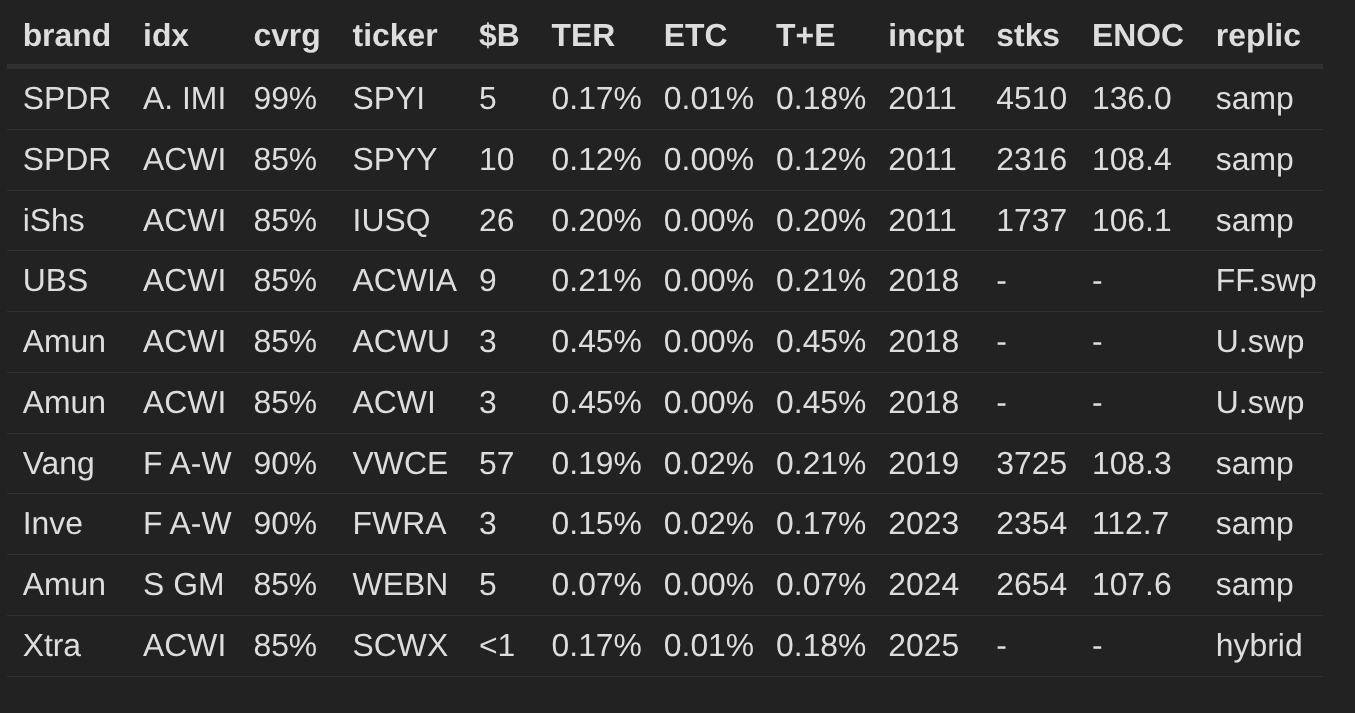
By the way, why is it that SPYI seems to contain only about half the number of companies compared to the index?
These ETFs that invest in the broadest indices use optimized sampling. As AUM grows, they add more companies to the portfolio. Here is a comparison of all-world ETFs.
https://community.rationalreminder.ca/t/comparing-index-replicating-ucits-etfs/39848/89?u=citizenj
7 Likes
Currently, I am doing monthly savings into several different funds at Nordnet. My main bank is OP, where I also have some investments (including a pension insurance policy that I no longer contribute to) and loans. Now that, since the beginning of the year, OP Bonuses can be invested or taken as cash, I’ve started wondering if I should just push all my monthly savings into the OP World (Maailma) Index fund. Over time, this would boost the bonuses, which would act as a monthly “dividend” + the fee would apparently be only around 0.13%. I would leave the Nordnet portfolio to grow in peace. Retirement for me is about 20 years away, so there is still (hopefully) time. Thoughts?
2 Likes
Hi. What are the a: leveraged ETFs with the best performance history available on the US market? b: non-leveraged ETFs with the best performance history?
I couldn’t find US-listed ETFs on Nordnet through the ETF list. Maybe I just don’t know how? There were only ones listed on Xetra.
OP World Index is very good for that. With larger monthly savings amounts, you could certainly also consider ETFs. Can’t really say more with this initial information.
- What funds do you have?
- How much is your monthly savings amount?
- How committed are you to staying as an OP customer for the foreseeable future?
You can’t buy either, so what does it matter? And such a selection principle based on chasing past returns is not recommended anyway.
4 Likes
Currently, 400 euros/month goes into Nordnet. There, the money goes into Handelsbanken USA & Europe, and Storebrand Global and Emerging. I also have Nordnet Finland, Sweden, Norway, and Sweden Small Cap (Sverige småbolag), but no additional money is going into those right now.
I’ve been an OP customer for over 20 years and my mortgage lasts until around 2032, so I don’t think I’ll be switching banks very easily at this point. Plus, back in the early 2000s, they managed to sucker me into a pension insurance policy, so that’s sitting there as well.
2 Likes
OP World Index is a very good product with the current cash-paid bonuses, but with your monthly savings amount, a better option might be ETF monthly savings at Nordnet, choosing SPYI or the I500, EXUS, IS3N combo for someone who prioritizes low costs over convenience. As a synthetic US ETF, I500 saves on hidden costs seen in withholding taxes, so it is actually about 0.2–0.25% cheaper than a corresponding physical ETF.
I don’t know the gross tracking difference of the OP World Index, so comparing it to ETFs is difficult. I tried to look into this once because my parents also invest in it, but I couldn’t find MSCI World Screened Gross Return Index data in euros. However, I suspect that even if OP is cheaper on paper, its actual costs are slightly higher than SPYI’s. I once dug into the actual costs of NN and HB index funds by comparing them to the index or an ETF tracking the same index, and it seemed that in practice, index funds lose to ETFs tracking the same index by a few tenths of a percent more than the expenses suggest.
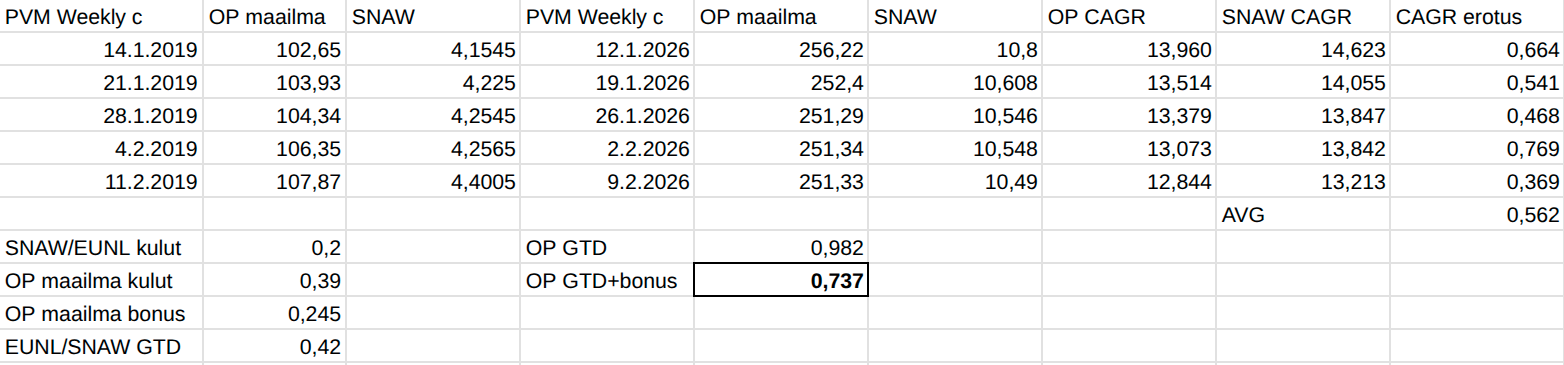
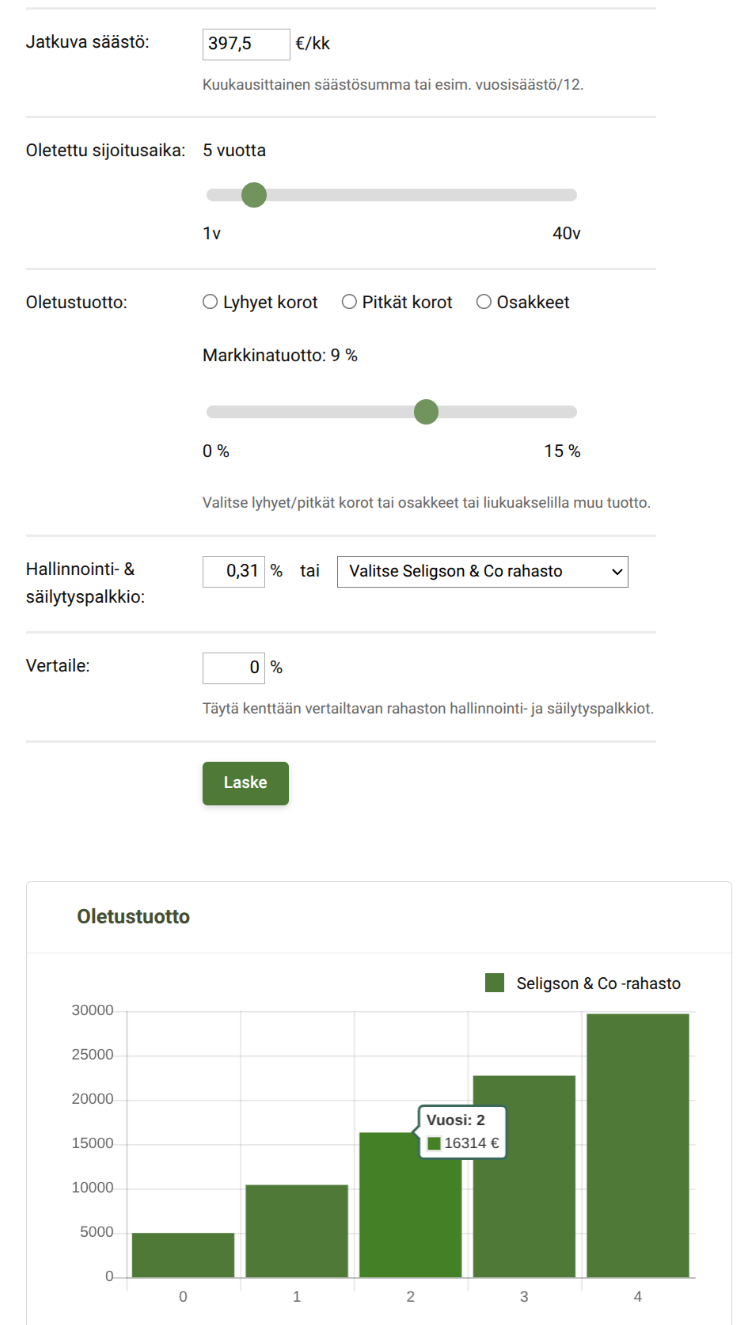
Edit. I took the initiative and compared the OP World Index to the SNAW ETF. This is an ETF tracking the MSCI World Screened index. The costs are the same as in EUNL, and both are very similar BlackRock ETFs. Since the EUNL GTD is known, I assumed the SNAW GTD to be the same and calculated the OP World Index’s GTD based on that. Due to assumptions, a small sample size, and normal GTD fluctuations, this is a fairly rough estimate.
OP World Index GTD, considering the bonus, is approximately 0.74%.
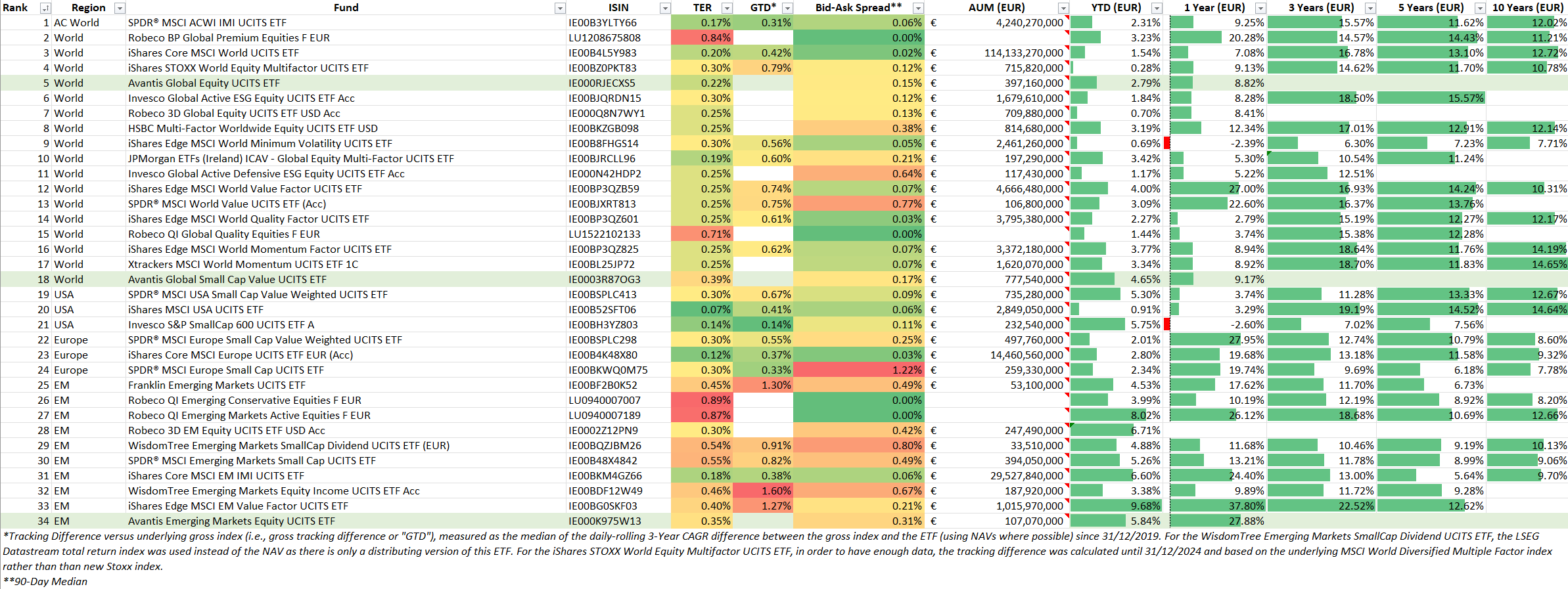
Here is some data from ETFs for comparison. For example, SPYI GTD 0.31%.
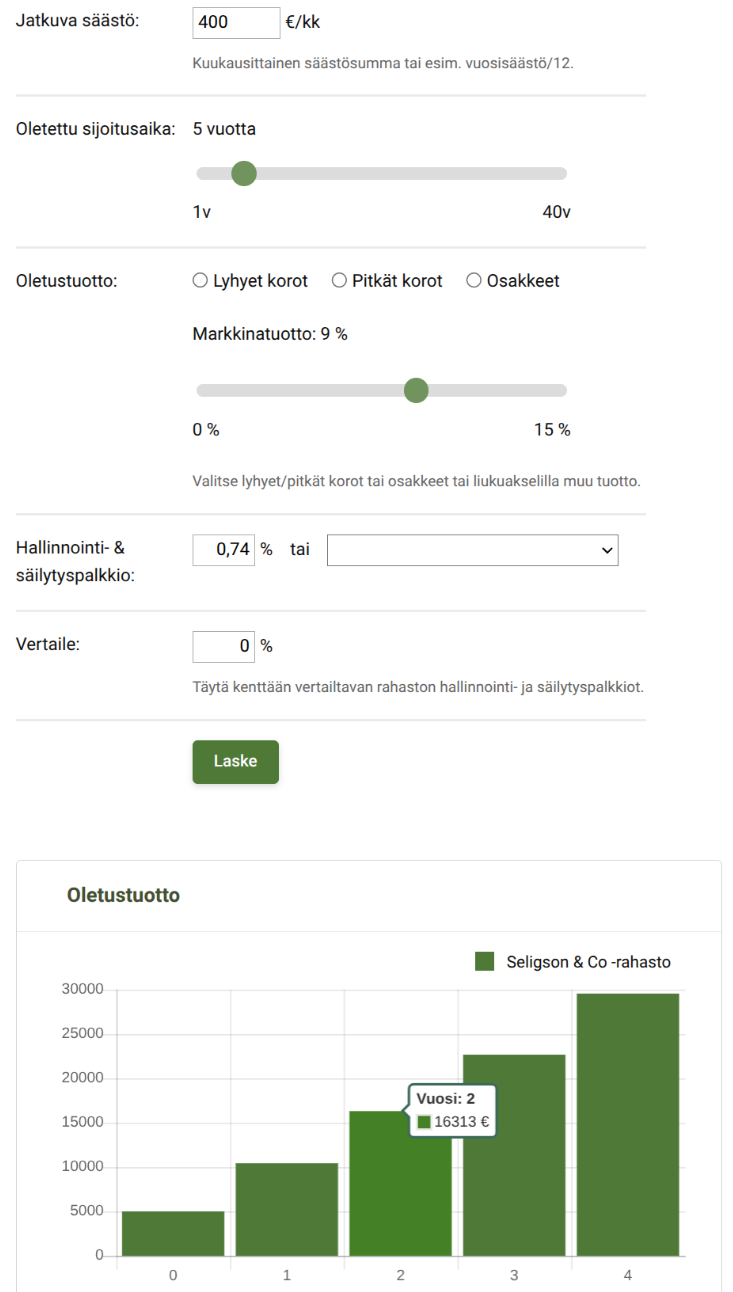
So, for example, with that €400 savings amount, SPYI vs. OP World Index already tilts in favor of SPYI in the third investment year. Of course, costs arising from selling cannot be estimated with the calculator.
20 Likes
I’ve been pondering a move from direct stock investments to the wonderful world of index funds and ETFs. I would likely achieve at least as good a result with less effort.
Index funds are quite straightforward products where you can reach an expense ratio of roughly 0.2%. ETFs offer even lower costs, but I’m not quite sure how to evaluate if they carry any external risks in the current uncertain global climate compared to traditional funds? Most ETFs are managed by US companies, even if they are domiciled in Ireland. Fortunately, European equivalents do exist, but their scale is significantly smaller.
As a first draft, a German and a US ETF made the list. These investment products are among the most common ones, but I’d welcome any comments if there are better alternatives available:
- Xtrackers Euro Stoxx 50 ETF 1C / Costs 0.09 %
- iShares Core S&P 500 ETF USD Acc / Costs 0.07 %
I have enough investment history behind me now that the transition will be a two- or three-year project in any case. However, I’d prefer to start investing directly in sensible options from the get-go.
1 Like
Probably the biggest risk of investing abroad is related to states deciding to socialize foreign holdings, e.g., the Russia case. I don’t think there’s a need to worry about US asset managers, but of course, it’s a good attitude to prefer European ones.
Do the ETFs have to be available in the NN monthly savings plan?
3 Likes
Great, thanks for this clarification. So at Nordnet, SPYI would be included in the monthly savings plan for 2.5 euros. If I remember correctly, you can set up the monthly savings agreement but transfer money there less frequently, which would result in lower purchase costs. I think the sell order fee was 15 euros. At Osuuspankki, that purchase fee (and selling?) was probably 8 euros, and I don’t think ETFs even accumulate bonuses.
1 Like
Monthly saving is a plus, but it’s not mandatory. 
I wouldn’t dare invest my own pennies in ETFs that are very new or manage small assets, even if the management fee were even lower.
There are no subscription or redemption fees for investing in the OP World Index. It might require owner-customer status, but it shows 0 euros in fees even if you put in a fiver.
1 Like
It’s not coming after all, the discussion was already about that ETF. And meeting the character limit..
1 Like
How long do these types of fund launches usually take before they become available for purchase?
Claude Sonnet 4.6 Extended guessed this 
I found an excellent point of comparison from UB’s own history. Here is a summary:
UB Renewable Energy – the best comparison
The press release for the UB Renewable Energy fund was published on August 3, 2023, and the special investment fund was open for subscriptions for the first time as early as August 31, 2023. So, only 28 days passed from the press release to the subscriptions.
In this case, FIN-FSA (Fiva) approval had apparently been obtained either before or at the same time as the release, as the subscription date was announced directly in the press release.
How does this compare to UB Megatrends?
Phase UB Renewable Energy UB Megatrends Press release Aug 3, 2023 Jan 15, 2026 FIN-FSA approval Before/same day Feb 13, 2026 (+29 days) Subscriptions open Aug 31, 2023 (+28 days) In the case of the UB Megatrends fund, FIN-FSA approval only arrived 29 days after the press release – meaning the process has been slower than with UB Renewable Energy. Now, 6 days have already passed since the approval.
Estimated date for opening subscriptions:
Based on the UB Renewable Energy model, subscriptions opened quickly in practice after FIN-FSA approval. Considering that UB now has all permits in order and marketing is underway, the most realistic estimate is:
Feb 24 – March 14, 2026 (weeks 9–11)
The most likely time is weeks 9–10 (Feb 24 – March 7), because UB has a clear incentive to open the fund quickly – portfolio manager Pasi Havi has already started and the marketing momentum is good. It’s worth checking the OmaUB service and UB’s website at the beginning of next week.

2 Likes
So you can’t buy US-listed ETFs on Interactive Brokers? Well, I guess not then.
As far as I understand, it’s not even possible from there without professional investor status, because of the EU and PRIIPS, but correct me if I’m wrong. Why are you digging for them on Nordnet if the intention was actually to buy from IBKR?
4 Likes
Oh, so that’s the situation. I’ll have to dig into it some other time when I have more time.
Hah, I was already one step ahead in my thoughts, sorry for the confusion. Yesterday I still meant Nordnet, but now that I’ve registered for IBKR, it naturally occurred to me that it might be available there. Maybe that’s not the case.
2 Likes