Raw Materials & Natural Resources - The Economy's Primary Sector

Otherwise, I wouldn’t have posted the things below, but since you kind of “asked”. :slight_smile:

In the story below, Stifel predicts a copper supply shortage this year.

Therefore, the article recommends three companies (though very little is said about them); the recommended companies are: Foran, Meridian, and Atex. Not companies I’m familiar with, at most just by name.

McGill says Foran’s 2026 production ramp “has seen ~20bps P/NAV expansion” in similar cases. “We think the complexity of ramping a 5ktpd mine/mill is significantly less than larger-scale Canadian operations, with history suggesting a quicker path to design throughput,” the analyst wrote.

For Meridian Mining, Stifel sees “a strong rerating story through 2026 as Cabacal marches through engineering and permitting milestones.”

Meanwhile, McGill says Atex offers leverage to high-grade exploration.

And these haven’t really been discussed on the Forum either. Here are the companies’ “investor pages”:

Atex Resources

ATEX Resources, Inc. is a mineral exploration company engaged in the acquisition, development, and commercialization of projects throughout the Americas. It has a stake in the Valeriano project. The company was founded on January 20, 1981, and is headquartered in Toronto, Canada. (source: Nordnet)

Foran

Foran Mining Corp. is engaged in the acquisition, exploration, and development of mineral resource properties. Its projects include the McIlvenna Bay project, VMS Primer, Bigstone, and Hanson. The company was founded on June 21, 1989, and is headquartered in Vancouver, Canada. (source: Nordnet)

Meridian Mining

Meridian Mining Plc is engaged in the acquisition, exploration, development, and mining of gold and copper. Its projects include Cabaçal, Espigão, and Ariquemes. The company was founded on December 16, 2013, and is headquartered in London, United Kingdom. (source: Nordnet)

And then there was also the Metso I mentioned earlier; if you start reading the thread from that point in the link, you’ll come across many copper news stories and announcements. :slight_smile:
https://www.investing.com/news/stock-market-news/us-supreme-court-to-hear-bayers-bid-to-curb-roundup-cases-4452649

3 Likes

A bill has been introduced in the United States to establish a mineral stockpile worth $2.5 billion. The amount sounds quite small, but perhaps it’s a kind of “initial stake.” :slight_smile:

The project aims to counter China’s dominant position and stabilize/moderate prices for raw materials critical to, for example, electric vehicles and the defense industry. The intention is to support domestic production and create a suitable price level that would protect the market from external price manipulation and ensure security of supply.

The bill prioritizes recycled material, but minerals extracted from mines would be eligible. Allied countries would be able to join the reserve if they contributed at least $100 million.

Minerals could be sold for private-industry or defense purposes. Any profit would be used to buy more minerals and keep the stockpile active in perpetuity.

US lawmakers introduce bill to create $2.5 billion critical-minerals stockpile | Reuters

4 Likes

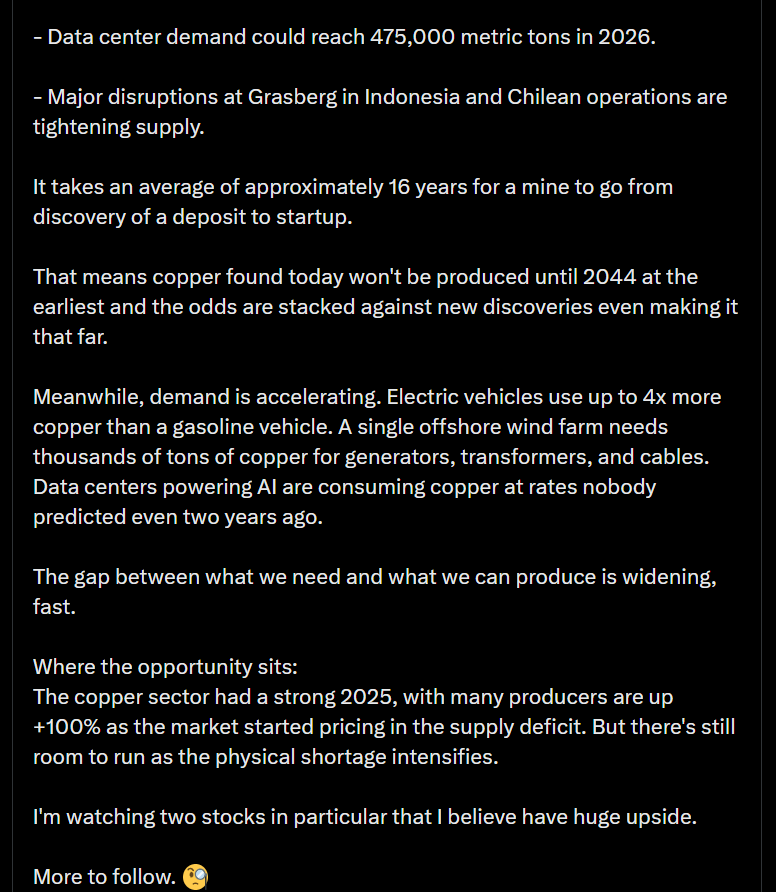
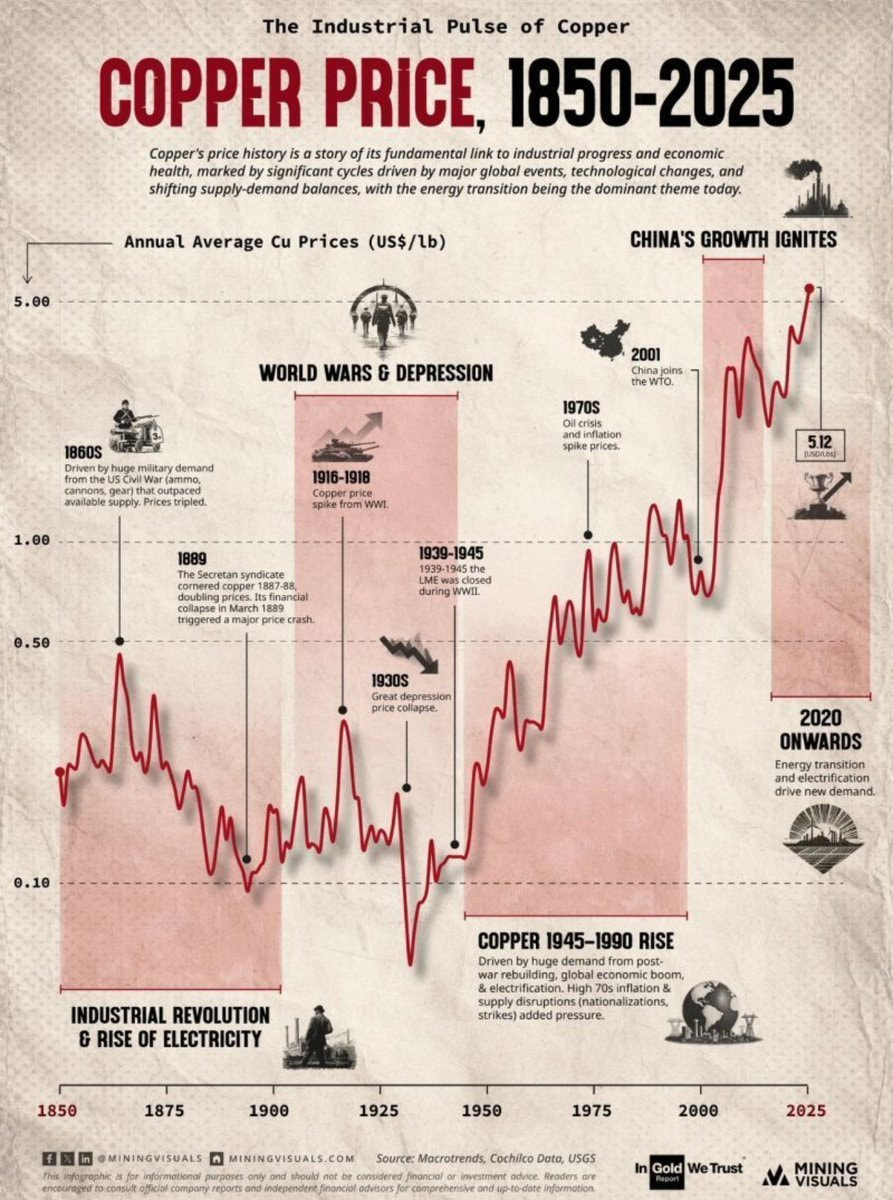
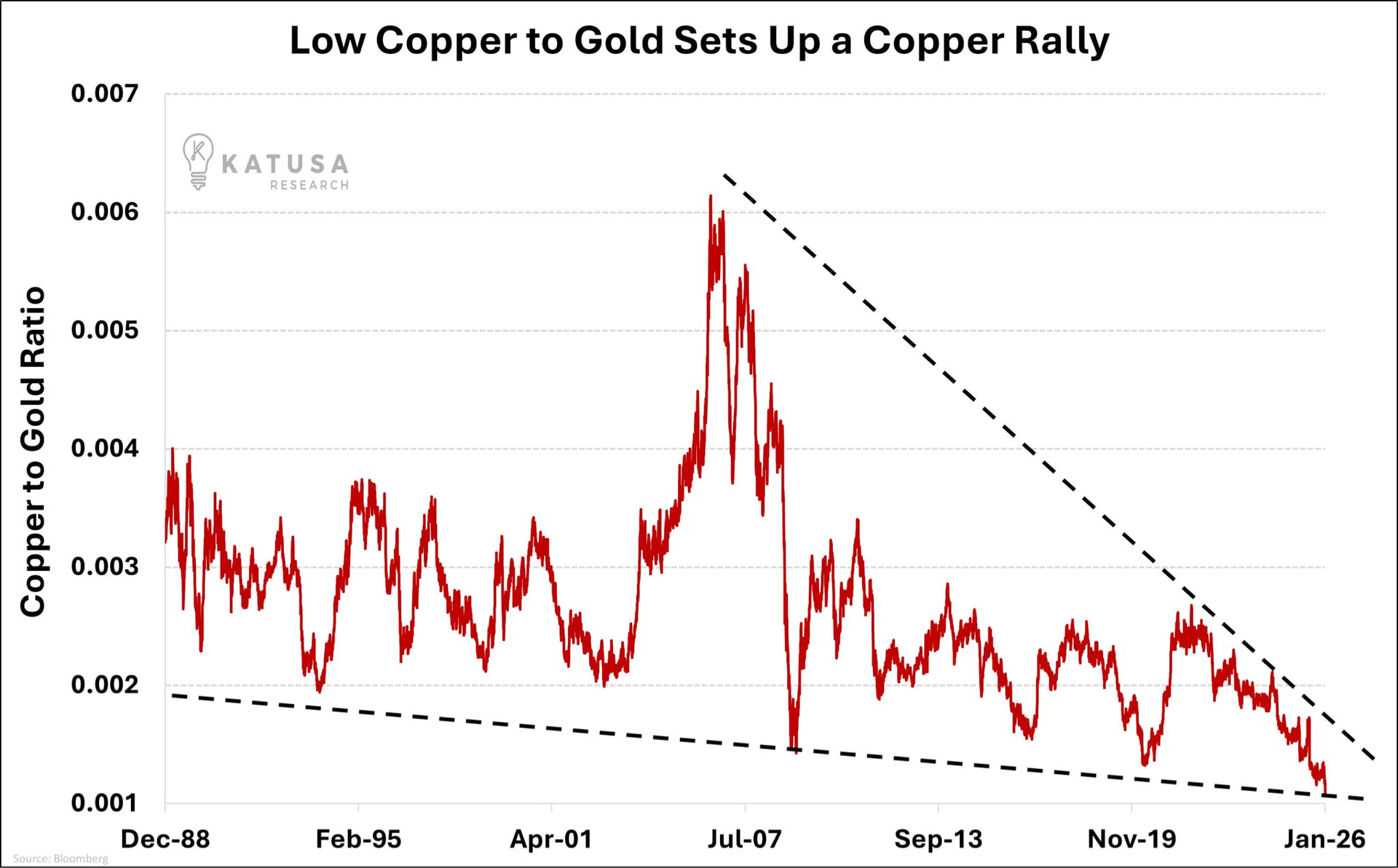
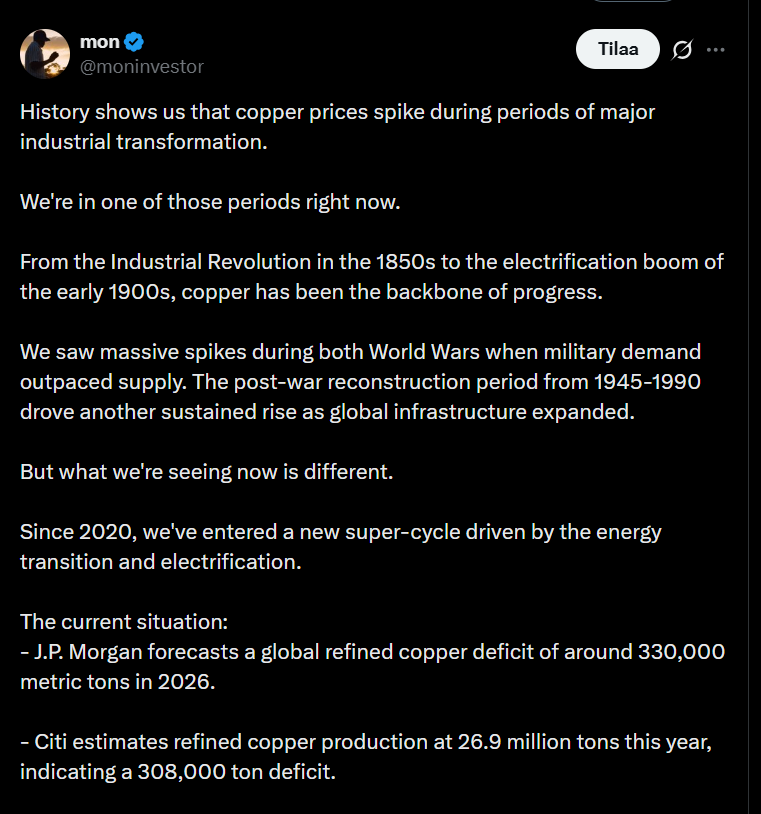
As can be seen from the tweet, copper prices have historically always surged alongside major structural shifts, and we are currently in the midst of just such a “shift.”

The green transition, electric vehicles, and the data centers required by AI are “consuming” copper at a record pace, yet it is impossible to establish new mines quickly enough.

A sharp deficit lies ahead, which will drive up prices and offer investors high-level opportunities, even though prices have already risen significantly.

https://x.com/moninvestor/status/2015082501333754140


6 Likes

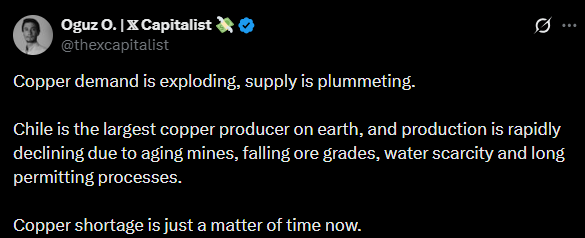
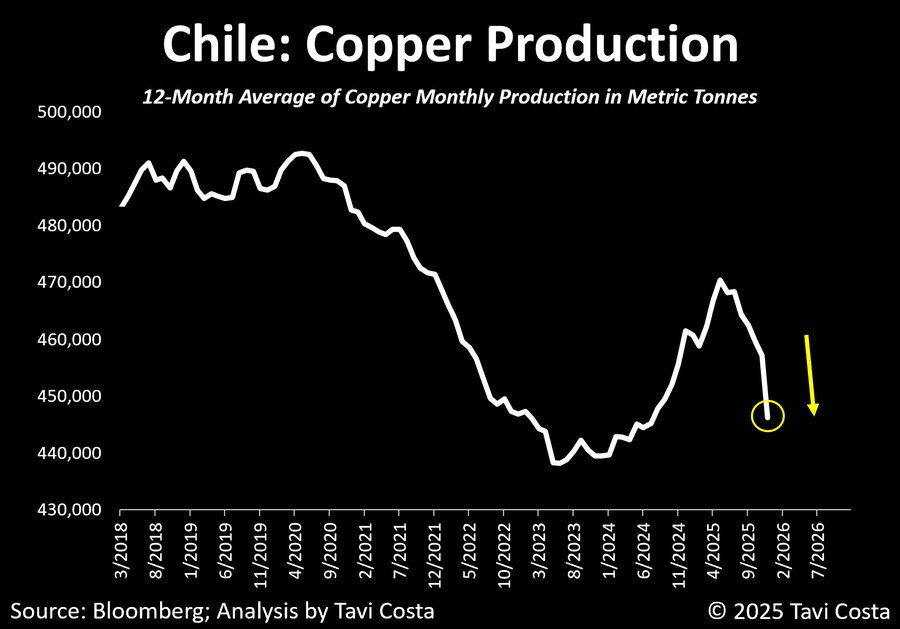
Chile is the world’s largest copper producer, but even there, copper production is decreasing further, as can be read below; reasons include bureaucracy, old mines, declining ore grades, etc.

https://x.com/thexcapitalist/status/2015410742250348655
image
image

12 Likes

Hannu Angervuo has been writing about metals in relation to their appreciation in value; the article covers gold and copper, as well as some silver and palladium. :slight_smile:

The largest producer of palladium is South Africa, where ongoing power outages have hindered the expansion of production. Metal market experts recommend, for instance, investing in palladium because increasing its production rapidly is relatively slow, while demand is on the rise.

9 Likes

Quite a fun/entertaining and interesting tweet about the “relationship” between gold and copper :slight_smile:

https://x.com/KatusaResearch/status/2017090577335275529


5 Likes

Copper prices fell as investors once again began to doubt China’s demand side. Inventories grew and copper has been so expensive in China that purchasing has slowed down; additionally, more copper is expected on the market anyway and China’s production is predicted to grow this year.

4 Likes

Merger talks between Rio Tinto and Glencore fell through yesterday due to disagreements over the purchase price. This was already the third time the companies have negotiated a merger. https://www.reuters.com/business/glencore-rio-abandon-merger-talks-2026-02-05/

Bloomberg’s Javier Blas laments the collapse of the merger in his piece, as it would have created a more balanced entity if realized; according to him, too large a share of Rio Tinto’s business is in iron ore and Glencore’s in coal mines. https://www.bloomberg.com/opinion/articles/2026-02-05/rio-tinto-and-glencore-are-both-losers-as-deal-fails-for-fourth-time?srnd=homepage-europe (paywall)

6 Likes

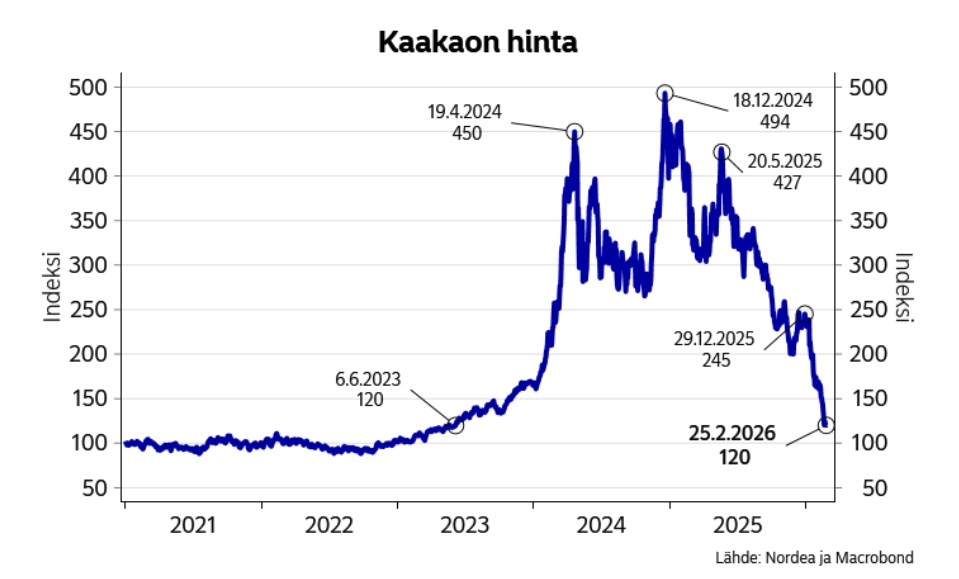
Chocolate prices finally seem to be normalizing:

12 Likes

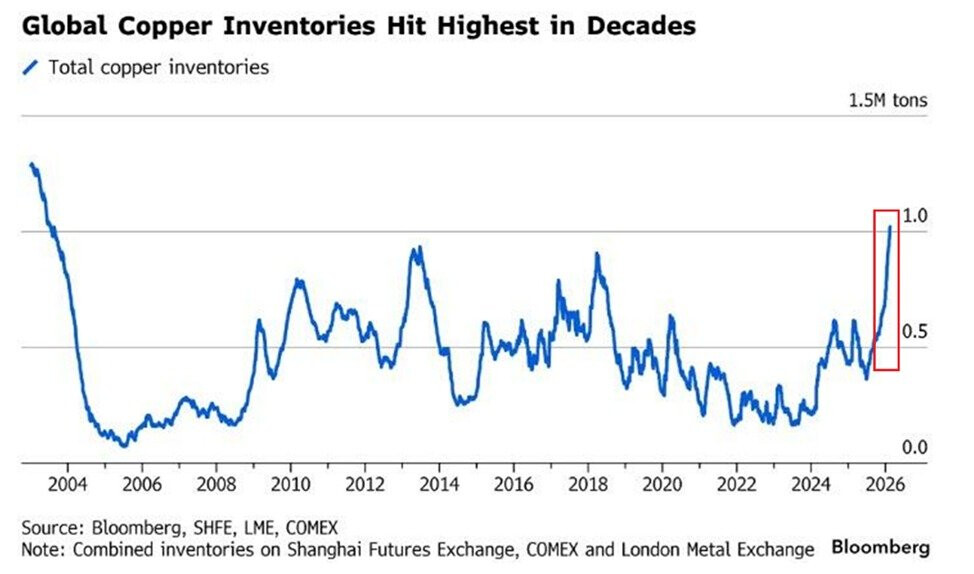
Copper demand is wild, but inventories are still growing fast. Copper inventories in Comex, Shanghai, and the LME are 1.02 million tonnes, which is the most in 23 years.

Inventories have doubled since September and risen 380 percent from 2024. :slight_smile:

https://x.com/KobeissiLetter/status/2025614977315283182


EDIT:

I’ll add this here as well, especially for the image in that tweet, which shows where the copper is. The tweet itself also has some good highlights.

https://x.com/jackprandelli/status/2025618622689771919


3 Likes

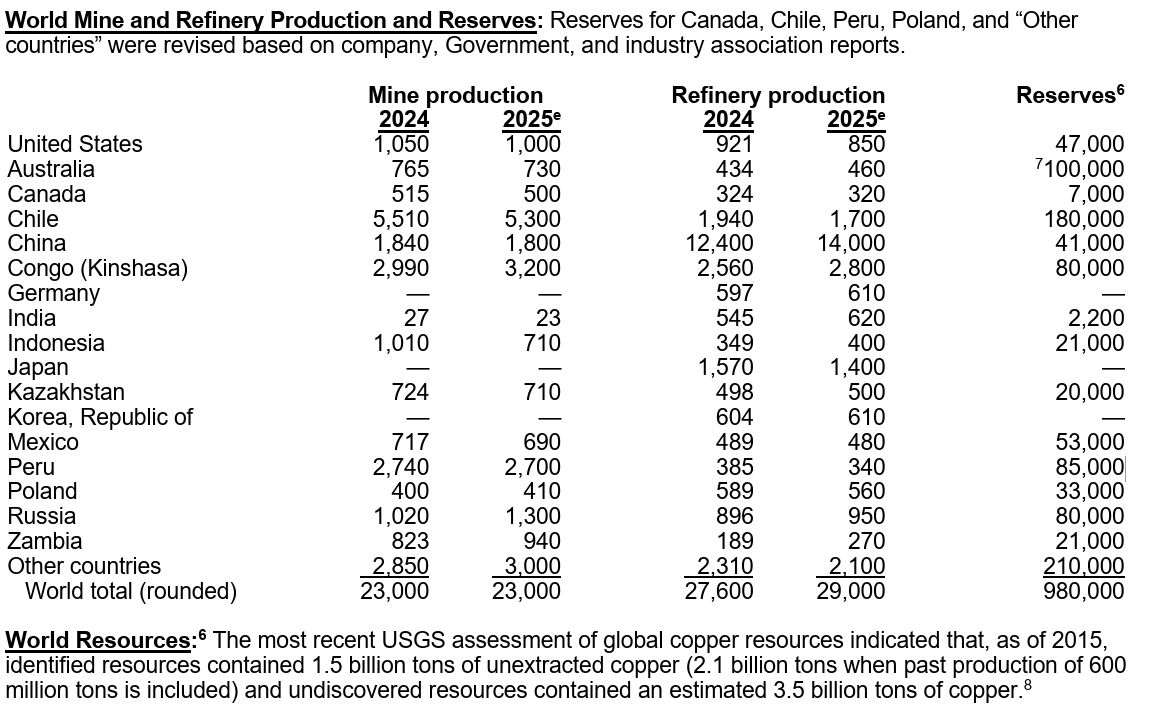
A couple of points are being missed here, as old 2022 figures are being used. It’s worth following the USGS Mineral Commodity reports annually, as the figures above were released in early 2023, and now the 2026 report has already been published in February. Without visualization, the 2026 copper situation looks like this.

What’s noteworthy here is that reserves (economically viable) have grown by 100 million tonnes since 2023 (880->980), even though 23,000–25,000 million tonnes are mined annually. Of the countries listed above, additional reserves have been found in Peru, China, Russia, and many other countries, despite the mining activity. The reserve figure for India in the tweet is likely incorrect; it’s probably a resource, i.e., the amount of identified copper without an economic assessment.

9 Likes

The price of cocoa has continued its sharp decline, down approx. 70% in a year, now at 6/2023 levels and 3,000 USD/t.
Additionally, the USD has weakened by approx. 12% in a year.

11 Likes

Natalie Beattie, Client Relationship Manager at the asset management company Baillie Gifford, has written a quick-read article about metals. :slight_smile:

Can metal prices continue to rise in 2026? In our view, investor interest in metals is increasing because the future of AI and electrification is being built as much with copper, lithium, and concrete as it is with code.

So far, however, this has not been widely noticed in the market: benchmark data shows that the materials sector is significantly underweight in investors’ portfolios.

Subheadings:

  1. Demand for critical metals on the rise
  2. The right direction is more important than timing
2 Likes

Raw material contracts are likely made for the longer term, but Fazer’s margins are starting to go through the roof here. Prices have been raised and pack sizes reduced. This price correction will hardly be visible to the consumer.

8 Likes

Yep,

in consumer products, the goal within the chain is to milk the so-called market price based on ‘brand value’ from customers. I.e., the price that customers are still willing to pay and at which sales occur. Whether the party is the manufacturer, producer, or retail chain. The fact that journalists are told a certain partial truth doesn’t mean that’s how things will operate in the future.

The role of competition is then to keep manufacturers, producers, and retail chains in check. Both at the product and chain level.

Perhaps this is straying from the topic of the thread, but it’s good to realize that the prices of certain raw materials are significantly different matters for different companies.

1 Like

Do you see American and/or European aluminum producer stocks potentially benefiting further from the geopolitical situation in the coming weeks? Many have risen slightly over the last few days.

I see that much depends on how long investors estimate the Iran war will last. The region has a lot of energy-intensive industry, such as aluminum smelters, the fertilizer industry, etc. Their production and deliveries are naturally under pressure right now. Global aluminum inventory levels have been low anyway. For an individual aluminum smelter/producer, a lot likely depends on where they source their energy and what their raw material mix is—i.e., whether they produce aluminum through recycling and/or from bauxite. There is a huge difference in energy requirements. One would expect large industrial energy users to have long-term energy price agreements. Any picks for potential beneficiaries yet?

3 Likes

Copper rose because Trump said he would postpone strikes on Iranian energy targets by five days as negotiations began.

Oil collapsed and the dollar weakened. Additionally, copper is also supported by China’s reduced inventories and recovering demand.

Trump’s comments caused ructions across financial markets, with stocks and bonds rallying while the dollar retreated and oil plunged as much as 14%. Copper jumped the most in almost two months in London before settling 2% higher to $12,167 a metric ton, as Iranian news outlets reported that there have been no negotiations with the US.

2 Likes

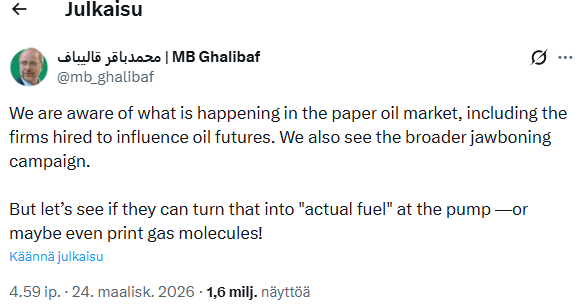
It seems that oil “demand destruction” is happening faster than futures prices would suggest. Battery companies CATL and BYD have seen their stock prices rise faster than oil companies. China is leaving no stone unturned in its efforts to break free from oil dependence.

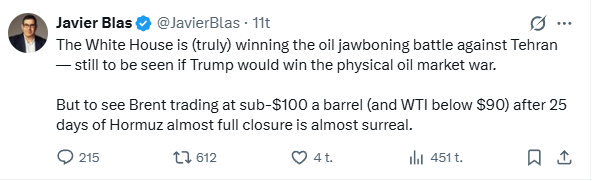
On the other hand, a growing number of experts are puzzled by crude oil paper trading and the futures barrel remaining below $100, especially when a 25-day Strait of Hormuz closure has removed a massive amount of crude oil from the market. Chevron’s CEO wondered why the price of oil hasn’t risen more, and a large number of analysts on X are expressing the same bewilderment, saying that Trump has already won the oil war through jawboning. This brings to mind the speculation that the price is being aggressively kept below $100 to prevent “demand destruction” from hitting Asia too hard. Then, of course, the Speaker of the Iranian Parliament boasts that the war will continue, and we’ll see how the physical situation begins to manifest in the market…

https://www.ft.com/content/b122ca1f-fc99-4749-9764-f1998b84dd07

9 Likes

The demand for copper will increase even further this year, as stated in the article below. The reasons for this are primarily the growing need for copper in AI centers, as well as mine closures and production problems, especially in Chile. The deficit is small in terms of percentage, but it can significantly raise prices because the entire market price is determined by the last available tons. From these reports, it can be concluded that copper may become increasingly valuable globally in the coming years.

While a 150k to 330k MT deficit represents only ~0.5% to 1.1% of a 28.7 million ton global market, commodity pricing is ruthlessly dictated by the margins. In physical markets with inelastic demand, the “marginal ton” of supply determines the price for the entire market; therefore, even a minor structural deficit typically triggers a disproportionate surge in spot prices to balance the books.

4 Likes