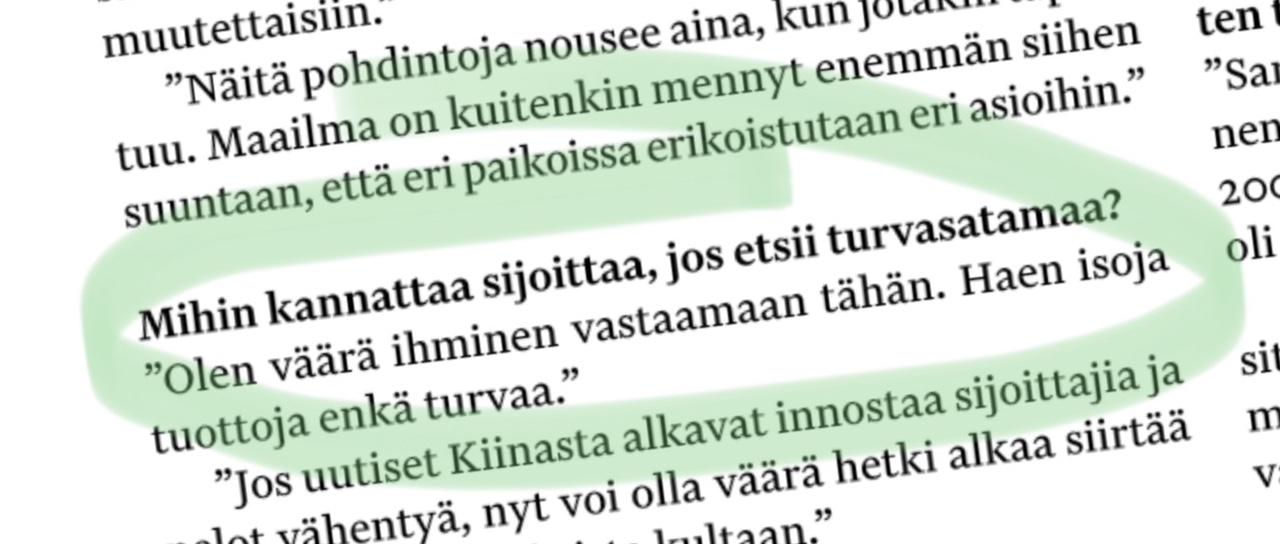
“The fund’s area of operation is the entire world, but the fund aims to concentrate all investments in a maximum of three countries at a time. Throughout its operation, the fund has invested in Southeast Asia. The fund’s investment targets are stocks, equity warrants, currency forward contracts, interest-bearing securities, and money market instruments. The fund’s base currency is the euro. PYN Elite is a high-risk equity fund. The fund’s investment decisions emphasize significant upside potential in the target’s share price/market and the associated expectation risk.”
Does anyone here have an opinion on this fund? I rarely consider actively managed funds good investment targets, but I have been considering this one. This would provide access to Asian emerging markets, which are otherwise quite difficult to diversify into. Currently, the main focus of investments is in Vietnam. There is risk in this fund, but it has historically performed well.
The portfolio manager, Petri Deryng, seems to have close to 20 million euros worth of the fund himself (there doesn’t seem to be precise information on this, but based on articles from a couple of years ago, his holdings were approximately 16 million euros).
The fixed management fee is 1%, plus a performance-based fee of 13%, which is only charged if the fund’s value exceeds its all-time high quotation. The costs are quite high, but still tolerable. Compared to other active funds, they are even quite reasonable, considering the quality and historical return of this fund.
The minimum subscription for this fund is 10,000 euros. This is actually the only reason why I haven’t invested my money in it yet, because I can’t significantly diversify purchases over time.
I have pretty much the same information about PYN Elite and Deryng. I’ll add that he made huge profits from his investments in Thai companies, and when the economy and company valuations there developed, he moved to Vietnam, where the economic and developmental situation is now similar to what it once was in Thailand. I know guys who usually don’t even glance at actively managed (and high-fee) funds, but they are on board with this one, and I believe it’s worth being on board. For me, the minimum subscription is too high for now, so I haven’t had to ponder it.
I’ve had a fund since 2016, when I went all in at once, averaging my investment over time, when there happened to be a small dip in the fund’s performance.
The fund’s fees are admittedly quite high, but in return, based on historical data, it has provided at least commendable coverage. Even after fees, the fund has beaten the indices by a large margin.
Risk can be thought of in many ways.
In the case of Vietnam, I personally thought it would be an unreasonable risk not to take a big part in a truly cheaply priced market whose growth rate is absolutely among the world’s best.
The wheels of the market economy have really started to turn in the country, and the government’s actions support this development. The securities market has been opened and will be opened further to foreign ownership.
When billions of foreign capital flood into the market, a rise in market valuation levels is somewhat certain.
It’s worth reading the investor letters from Pyn’s website for a few years back to start to understand the market and its “position” relative to, for example, Finland. Vietnam’s market development and growth potential are absolutely massive. Companies are hitting such annual growth figures that they wouldn’t be generated in even ten years here in Finland.
Elite has doubled its value on average every little over four years, and I have no intention of detaching from this until the fund unit’s value is measured in four-digit euro figures. That is, at the earliest when “Thailand happens” in Vietnam. I am completely convinced that Thailand will happen.
Good luck and success.
The value of the unit has conveniently cheapened recently.
Note, however, that additional subscriptions are 2000 euros, so only the first subscription is that ten grand.
I myself have been involved in this for a few years now. PYN Elite is an excellent (and probably the only) way to get exposure to Vietnamese mid-cap and small-cap companies. It’s one of the largest investments in my portfolio and one of my two active funds (the other being Seligson’s Phoebus).
In January I finally went into this. My confidence is reasonable, but the only thing that bothers me a bit is that reports or Peta’s blog never go through the misjudgements made and the reasons that led to them.
At least for me, going through them would increase my confidence, as mistakes clearly sometimes happen in a fund that has made strong returns.
That’s a short time for an equity fund; 5-10 years is a good period to observe development. Recent development has been subdued. I’ve been adding to this gradually since 2013, and the idea is to hold it for an even longer time, as there aren’t many alternatives for these Vietnamese small and mid-cap companies. This is a high-risk investment fund, which is good to keep in mind, and that’s why it’s important to diversify over time.
5 years +14%
10 years +378%
15 years +534%
20 years +2050%
Exactly. I personally view Elite as a clear retirement fund.
Vietnam’s economic development trajectory and market valuation are in a delicious position, thinking about the upcoming decade.
I see that being involved is not a risk; the risk would rather be the decision not to participate in Vietnam’s economic growth.
Elite represents a truly massive portion of my total wealth.
Many would say it’s too massive. Let them say what they want; I bear the responsibility for my own decisions. I trust Vietnam’s ability to grow into a pure market economy, and that development is truly accelerating. Communism no longer rules in this country.
Can you say more precisely when “recently” was - after the summer, early in the year, or even earlier? As I understand it, this generates extra profit if the dollar strengthens against the euro, and vice versa.
I myself still expected in the spring that the dollar would start to strengthen somewhat by the end of the year or during next year, but at the moment my view is that it’s probably not going to strengthen within a year, at least. I think the lock was done too early.
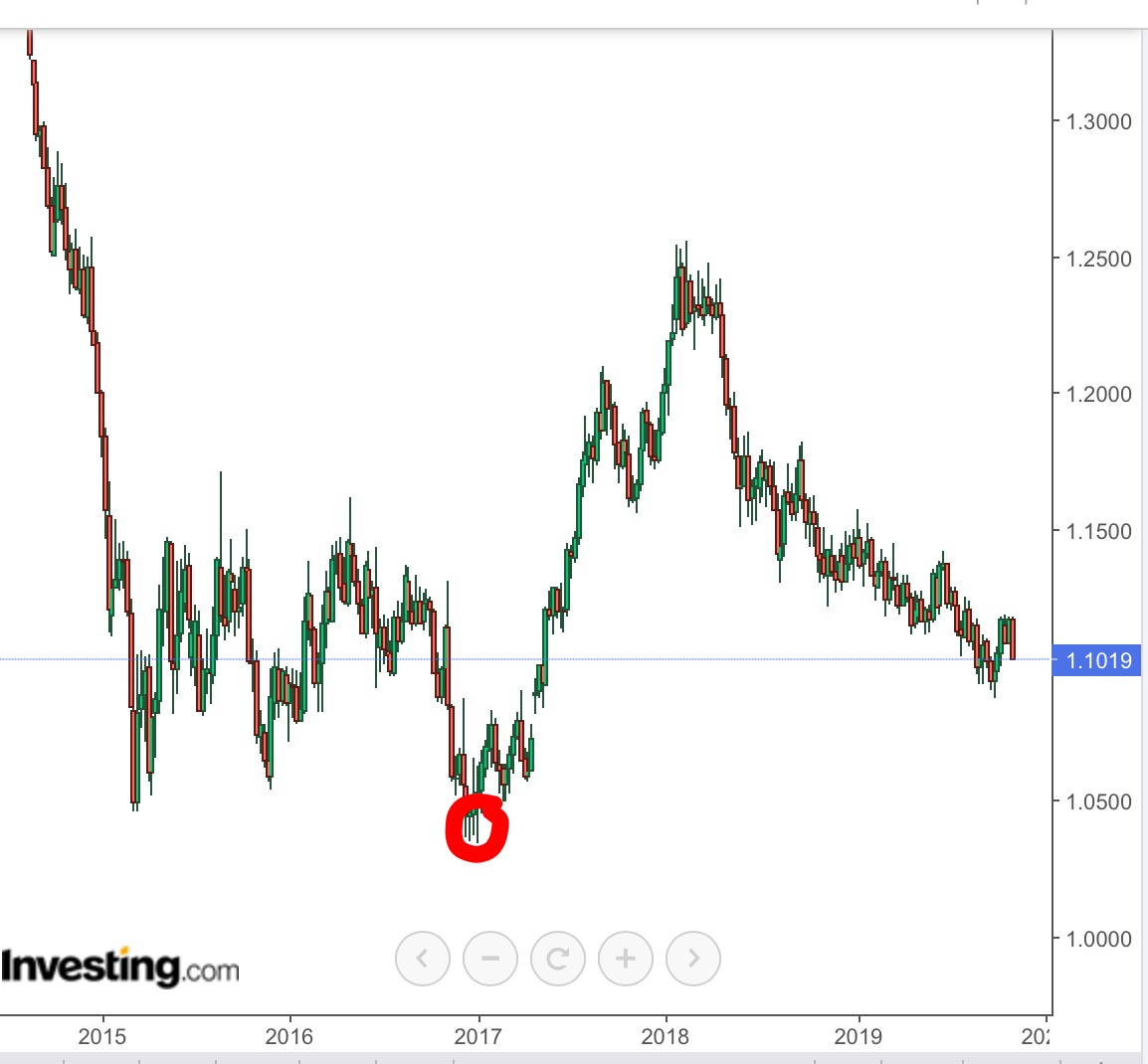
I was talking to Petri about currency hedging in 2017, and I expressed my opinion that the euro/dollar was bottoming out. At that time, Petri wasn’t ready to start hedging, so I got the hedge myself in the form of a EUR/USD long derivative.
If the global economy doesn’t slide into a recession next year, in 2020, and the trade war eases, then Pyn should finally start to move upwards. Petri expects strong earnings improvements next year from several top 10 portfolio companies, and if the market estimates similarly and starts to price stocks at least partly based on 2020e, then the value of the companies must rise, even if valuation multiples don’t increase.
In fact, several portfolio companies have become cheaper this year relative to their earnings. This cannot continue indefinitely. The portfolio seems to contain many stocks with a P/E ratio below 10 that are growing rapidly. Let’s hope for an upward trending year after a long time.
If I end up subscribing to PYN Elite, will the fund ownership show up on any of my book-entry accounts? I couldn’t quickly find a section in the documents where it would be listed when I looked on my phone out of curiosity.
In other words, do “pro level” funds work so that you only track it based on your own purchase price/the fund’s online service or similar?
I have quite a few investment loans myself, and even if I don’t use them as collateral, the bank has been more accommodating when I’ve transferred my stock and fund holdings there – they can directly see that the loans aren’t a problem for me.
The units are not visible in the book-entry account. However, you will always receive a quarterly report from them showing the number of fund units you own and their development.
The latest value of the fund unit can be seen on the fund company’s website. The latest value can also be ordered via WhatsApp, where it will automatically appear daily after ordering.
This conveniently reminded me that I need to consider a small additional subscription.
In the investor letter published just before Christmas, Deryng wrote extensively about the fund’s value development, especially during the last few years.
Thanks! I’ll have to read through it and see if I can get it into this month’s entry. Probably not until next month, but it definitely looks interesting.
In the latest Talouselämä (8/2020), there’s an interview with portfolio manager Deryng about the coronavirus. The man continues steadily on his own path:
I have been following this fund from time to time since its early days. The success has been tremendous. However, there is a slightly exceptional risk that is good to keep in mind, and that is that the entire fund’s operations are very strongly personified by Petri Deryng. He has managed the fund for its entire existence, over 20 years. If something happens to him, the fund will likely be adrift.
I’ve also discussed this potential “problem” I’ve been pondering with Petri.
Petri’s message was: don’t worry.
Firstly, he’s not going to abandon his creation and become a free agent; he’ll remain closely involved. They’ve playfully joked in the office that he’ll definitely still be at the helm even at 80.
Regarding the second, more fatal side of things, the view was that they have long-term plans sorted out for many years ahead, and even in the event of illness or death, nothing would change for the fund in the short term.
However, there isn’t yet an actual successor being groomed within the company who would step into Petri’s shoes if needed, for example, by visiting portfolio companies and meeting their management as Petri constantly does.
I would say that if Petri were to depart for one reason or another, nothing essential or decisive would happen to PYN’s investments within a couple of years. So, no one is going to mess with the plans and reshuffle the portfolio just because the boss kicked the bucket.