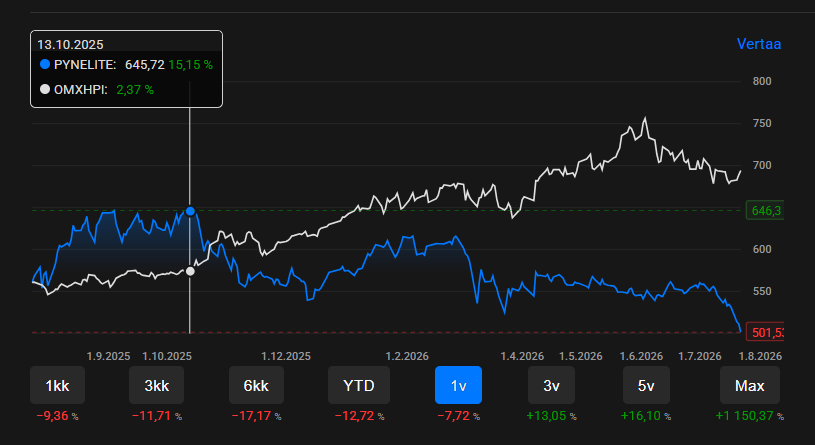
The economy is chugging along, but the stock market is struggling. PYN Elite is down nearly 25% from its highs  I wonder if Petri is adding to his holdings again, since “you can get it cheap”
11 Likes
Vietnam’s trade balance fell into a clear deficit early this year, despite the country having a surplus a year earlier.
“Industries of the future”  , i.e., agriculture, forestry, and fisheries, however, remained strongly in the black. The surplus was weakened by increased import costs and a decline in the prices of certain export products. Going forward, Vietnam aims to reduce its import dependency and increase the added value of its exports.
Vietnam’s merchandise trade balance posted an estimated trade deficit of 16.65 billion USD in the first six months, as compared to a trade surplus of 7.95 billion USD in the same period last year, according to the National Statistics Office (NSO).
Against this backdrop, the agro-forestry-fisheries sector remained a bright spot, maintaining a trade surplus of around 9.2 billion USD. This once again underscores the sector’s important role in easing pressure on the country’s overall trade balance.
1 Like
I jumped on the Pyn bandwagon around the time of the investor fair when they had that offer (at the 550 level, roughly). According to the June investor letter, Deryng himself was also adding to his position (via a bullet loan) in November 2025.
The July letter also summarized my own recent feelings quite well:
We continue to expect good earnings growth for listed companies for the full year 2026 and are dismayed by the stock market’s recent downturn.
One really has to resist the temptation not to overweight emerging markets here 
A few observations:
- I’m not much for technical analysis and past performance is no guarantee of future results, but an interesting point is that the fund has never had two consecutive years of losses since '99.
- The Vietnamese economy is clearly still performing well.
- Personally, I suspect the biggest factor here is the uncertainty caused by the situation in Iran (and perhaps those new tariff messes from the US side?).
7 Likes
I admit that my own confidence is enough to watch this for another couple of years, but there’s no way to sugarcoat those figures. The 10-year return is +93%, or just under 7% per year, while the world index has more than tripled in the same period (with dividends reinvested). And the longer you look at that “20% p.a. since the beginning” story, the more it looks like an achievement from the Thailand days: the stake multiplied twentyfold from 1999–2013 with small capital in a market that no one else was following, and since then, it has been growing at an annual rate of about 7%.
28 Likes
Economic momentum does not guarantee good returns for the stock market. China is quite an extreme example of this.
4 Likes
As long as these countries significantly restrict the repatriation of profits, the stock markets will continue to crawl and foreign investors will stay away. On the other hand, for communist regimes, the stock market is not an end in itself.
And I’m not just being a smart aleck without having the scars to show for it. Throughout the 2010s, I was heavily invested in emerging markets, specifically driven by the economic growth thesis, and it cost me dearly. Very dearly.
3 Likes
I would be interested to hear more about how Vietnam significantly restricts the repatriation of profits… I haven’t heard that those who have invested in PYN or Vietnam in general have been unable to repatriate both profits and losses.
13 Likes
Here is the latest fund review from PYN Elite 
The Vietnamese stock market performed miserably in July, with the index falling by about 10% at its worst. Better-than-expected earnings helped the market partially recover. Vietnam’s infrastructure investments are massive, and the rapid pace of implementation is adding pressure to an already tight financial environment. Real interest rates continued to rise.
7 Likes
Here is also an interesting article related to this. Hanoi apartment flippers trapped as market downturn keeps buyers away - VnExpress International
2 Likes
Vietnam’s economic growth accelerated, driven particularly by manufacturing, construction, and domestic demand; exports and foreign investments also grew strongly. British bank Standard Chartered expects growth to remain very strong, supported by infrastructure projects and new production capacity.
Vietnam economic growth accelerated to 8.4% year on year during the second quarter of 2026, exceeding an earlier 7% forecast as manufacturing, construction and domestic demand strengthened.
6 Likes
Here is the PYN Elite August review
After July’s dip, the VN-Index rose by 5.6% in August, driven by large-cap stocks. PYN Elite +5.5%. In its review, the FTSE Russell index raised Vietnam’s projected weight in the FTSE Emerging All Cap index to 0.49%. FTSE selected 27 Vietnamese stocks from various segments for its global indices. The first 10% tranche of passive investment flows is expected to materialize in the coming weeks. Vietnam’s infrastructure development remains a key investment theme, supported by strong public investments. HCMC launched 16 new infrastructure projects with a combined value of $9.5 billion. Hanoi launched six major projects, including two railway lines. The combined value of Hanoi’s projects is nearly $15 billion.
2 Likes