Good guess. They have invested in electric machinery in recent years and use their own liquid-immersion battery cell technology. Order books are full far into the future.
3 Likes
It seems to be readable for everyone, but here is a brief summary:
The CEO says “never say never,” but now is not the right time. As mentioned earlier in this thread, companies are looking at IPOs one or two years ahead due to the current weak state of the stock market.
The article also mentions the ownership structure as a favorable feature for a listing. 80% Coronaria, 10% personnel, and several organizations holding a few percent.
The article also mentions Silmäasema’s strong growth. Below is a screenshot from their website showing the result and some of its development.

At the beginning of May 2020, the company’s market value was approximately 86 million euros with a share price of six euros.
edit: typo
4 Likes
Stock market listing hinted at again
“ICEYE’s revenue rose to 95 million euros last year, and it has about 600 employees, a significant portion of whom work in Finland.”
28 Likes
Solar Foods’ share issue opened.
6 Likes
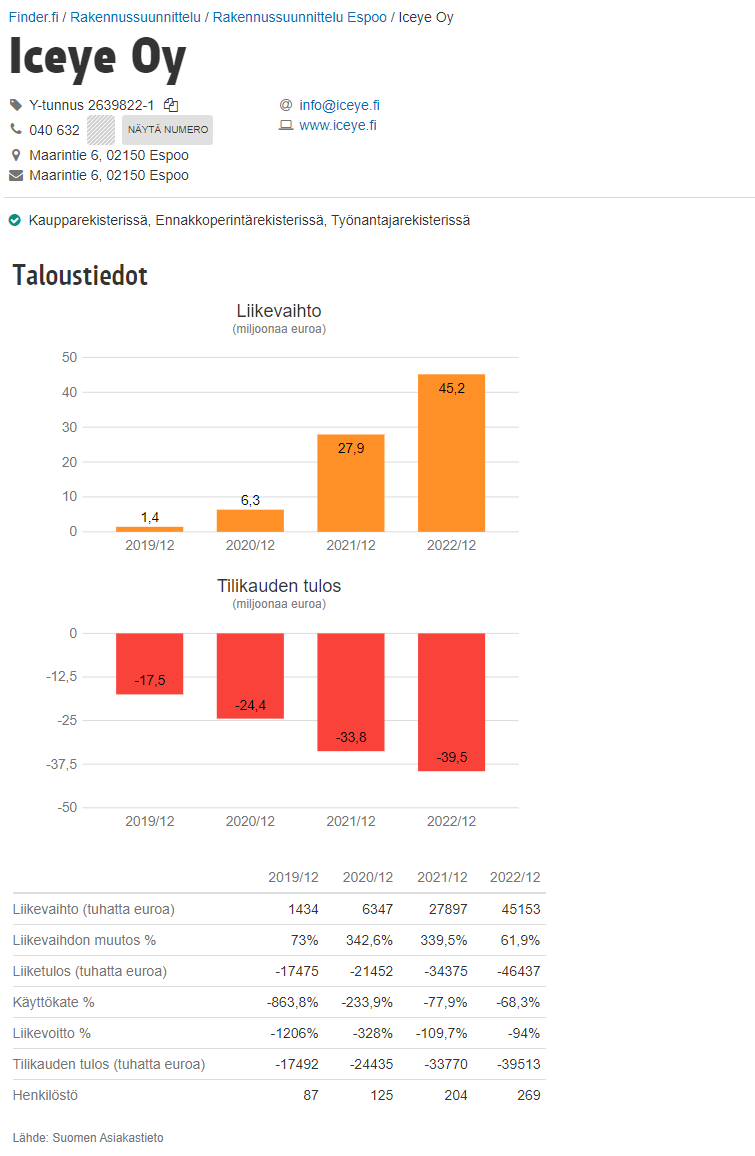
Satellite and space technology is indeed a field of the future. And already a reality today. That’s where our collective tax euros are being funneled. But what do you think about the company’s financial figures?
*State invests 40 million euros in satellite company Iceye – “Potential to become a significant listed company”
10 Likes
Looks like a space sector startup. Completely comparable to other startups in the field, which are usually somewhere around -90% to -99% down or bankrupt 
This one hasn’t made it to the stock exchange yet, though.
4 Likes
Let’s hope this isn’t just another infinite space black hole like the state finances. A bottomless pit – you can pour in an infinite amount, but the water level just won’t rise 
2 Likes
Could Dream Broker be going public?
I noticed they are looking for international funding and want to grow etc.
1 Like
Has anyone joined the Solar Foods offering? Personally, I would be very interested in participating, but financial and time constraints are weighing on me a bit. I became interested in the company when HS published an interesting article late last year.
Based on what I’ve read, Solein is a brilliant product. Its nutritional content is high-quality, the production process is interesting and intriguing, and the potential markets are simply enormous.
Maybe I’ll sell my TietoEvry shares at a loss and postpone my bachelor’s thesis a bit so I have time to study the prospectus in more detail 
I’d love to hear opinions and informed assessments from others on the matter.
7 Likes
Well, I read through the prospectus out of interest, but the numbers didn’t exactly give cause for cheers.
I can’t claim to have read the prospectus materials down to the last comma, but a large part of the presentation was spent showcasing how great a product Solein is and how the TAM is massive. I don’t doubt that. The actual business aspect and the amount of additional funding required (and thus potential dilution) took a backseat. Despite the breach of Danske Bank’s covenants (with the bank’s blessing, of course), the post-offering valuation is still a whopping 200 MEUR.
Perhaps the most interesting parts can be found at the end of the marketing brochure under “Risks related to the company’s financing and financial position”. The company has received plenty of EU funding, but building Factory II, which is crucial for scaling, would first require equity (or debt capital), and only after that will the EU grant cover the approved costs.
Unless a larger outside investor arrives, the company will remain in a semi-annual funding cycle and growing dilution, which will be used to pay off loans from the first production plant and keep R&D and the business running at even the low-growth scenario level.
The company’s reliance on crowdfunding says something. If the case were good or excellent, it would find a larger venture capitalist. Or Karl Fazer Oy, which is already an owner, would increase its investment. Now that the venture capital market has cooled, they are relying on crowdfunding and hoping that the capital received in drips will carry them across the “valley of death”.
A pity in itself; with these specs, this looks like yet another promise falling short on the verge of commercialization, which some foreign player will eventually scoop up from the bankruptcy estate.
20 Likes
Thank you very much for breaking down the prospectus and for your insight.
It was a good point about having to resort to crowdfunding. In my slight hype, I somehow only noted Fazer’s ownership of just under 14 percent, and it provided a sense of security.
I looked at the numbers myself too, and they aren’t exactly flattering. I’ll have to read through them more carefully during Tuesday before making any decisions.
Oiva Isännöinti
A couple of years ago, revenue was under 10 million; last year, it was over 40 million.
The target timeline for listing (IPO) is 2026-2027. Revenue and productivity will be in peak condition before then.
The buzz and spirit are incredible; it might even happen sooner rather than later.
I personally manage one regional unit, which is perhaps expected to deliver the most in terms of organic growth. Fair enough, we deliver what is needed.
I can tell you that good things have happened, and even more are yet to come.
Thought has also been given to how, once the listing occurs (which is naturally where the operational focus is right now), we will maintain the course and trajectory from there on out, while keeping customers as satisfied as possible. From an investor’s perspective, all the pieces are more than in place.
This is definitely not an “Injeq.” The horizon is decades away, rather than just the end of this year.
22 Likes
The growth has been good. What bothers me about these property management companies is that they seek growth in an industry where, from the perspective of housing cooperatives for example, costs should be kept as low as possible. As someone living in a housing cooperative, the most important thing in property management is that things run smoothly while costing as little as possible.
5 Likes
Yes. If you asked a hundred Finnish apartment dwellers for a comment on their property manager, I think there would be more negative comments than positive ones. They take the path of least resistance, prices are rising, and there was even a cartel. We also have IIS, which was convicted for the cartel and then bought by Tahkola. I should probably finally squeeze my way onto the housing company board to switch to Oiva.
3 Likes
Additionally, property management is a Finland-specific business, meaning growth opportunities are limited as international markets are virtually non-existent.
2 Likes
Property management firms generate these savings for the client in exchange for their fees by leveraging their market expertise and scale. These savings are far greater than a mere 15% reduction in the price tag of the management contract.
From a vendor’s perspective, a potential client is in a vastly different position when tendering, for example, an electricity contract for 2,000 housing companies compared to a small firm with only 60 (and those smaller firms don’t even tender in bulk; they do it one building at a time, only if and when the board “maliciously” demands it of their manager). In our case, this happens automatically every year, prioritizing the client’s best interest.
The same applies to almost all other services a housing company requires: maintenance, insurance, renovations, cleaning, energy-saving measures, etc. When a firm is the best in the market at these services, the savings for the client are on a completely different level than the price tag on the management contract. The cheapest management service won’t do anything about these matters unless you have the sense to specifically demand it. And even then, the execution is usually bordering on embarrassing. Not for everyone, of course, but for the vast majority.
4 Likes
Hasn’t Oiva also grown through acquisitions? Is consolidation an industry trend in the property management sector as well?
It’s a trend in this industry as well. Among the large design consultancy firms, for example, Granlund has already expanded into property management through acquisitions, and in addition to Oiva, another private equity-backed company, Kotikatu, is also active in the sector.
Yes, exactly.
Everyone (who meets the criteria) who is willing to join Oiva’s story is welcome.
Local strengths/competitive advantages are preserved, and the company framework supports newcomers and local branches with functional infrastructure. Digital intelligence (peltiaivo-älykkyys) is being actively built, so that all routine tasks will be handled without human labor in the future.
Kotikatu is indeed active in the real estate sector, being a company specialized in the physical care and maintenance of properties, but I don’t think you can get property management from them.
Property management is about running the administration of a housing company, not lawn mowing or adjusting the heating system. Kotikatu handles those as a maintenance company.
2 Likes