🏆 Pitch your best investment idea! Voting open until Sun Mar 1st 🏆

Pitch #4: UBER TECHNOLOGIES

How about a rapidly growing mega-tech company with a dividend stock valuation? This company isn’t completely unknown, but it’s not a crowd favorite either. Sentiment around the company isn’t at its brightest, but to my taste, it has strong growth drivers. Even the legendary Bill Ackman trusts Uber and has bet a couple of billions on the company.

For those on the forum who might not know, Uber is known for its platform that connects drivers and customers for mobility and delivery services. Uber is best known as a ride-hailing service (approx. 51% of revenue), but today, Uber Eats (approx. 46% of revenue), i.e., food delivery services, is also a significant platform. Additionally, the portfolio includes Uber Freight (approx. 3% of revenue), which is freight brokerage. Uber does not own cars or employ drivers itself; its operation is purely platform economy.

Uber’s business benefits from significant megatrends such as urbanization, digitalization, and the development of artificial intelligence and data analytics. The concentration of population in cities creates a platform for operators like Uber, as the service operates most cost-effectively in large cities. Uber primarily simplifies the lives of busy people in large cities, and one can personally observe in large cities that the service is becoming very smooth (rides are quick to get and payment is convenient) and affordable (the price of a single ride is starting to challenge public transport fares). With the help of AI and data analytics, Uber can optimize routes, pricing, and the matching of drivers and customers better than before. These trends provide a nice underlying current for the business.

Uber’s market potential is enormous. According to various sources, the global taxi and ride-hailing service market is projected to grow at an annual rate of approximately 9-11% in the coming years as urbanization progresses and consumers shift from owning cars to using services. Platform services like Uber are growing faster than this, as traditional taxis lose market share. In the food delivery sector, the market size is estimated to be between 200-250 billion dollars according to various estimates, with a growth rate of approximately 10% per year for the next five years or so. Urbanization, ease of service, and a growing middle class are accelerating market growth. Uber offers everyday convenience to busy city dwellers!

Why will Uber then win these growth markets? Because Uber is already the undisputed market leader; in its most important market, the United States, Uber’s market share in ride-hailing services is approximately 76%. Uber has 180 million monthly active users, a 15 percent increase from a year ago! I believe that in platform services, the winner eventually takes all: Market leadership is a competitive advantage that cannot be copied. The market leader’s brand is the most recognized, its app is already in most pockets, it has the most drivers in the city (meaning a driver is likely nearby and ready to pick you or your food up immediately), and additionally, the market leader’s fixed costs are relatively the lowest. Being the market leader is also beneficial for drivers: The market leader can offer you more customers, and a customer is more likely to be found wherever you happen to be. Uber thus benefits from significant network effects: More drivers, more customers, better service.

Uber is constantly developing its service. One example is the Uber One membership program, which already has 36 million members (membership $9.99 per month, generating approx. $4.3 billion in revenue for Uber annually). With an Uber membership, you get benefits from ride-hailing and food delivery services, which distinguishes Uber from its competitors. Due to the integration of ride-hailing, food delivery, and package services, Uber has significant cross-selling/advertising revenue potential. For example, if you order a ride to the office in the morning, the app might suggest a place where you could pick up your morning coffee. By developing this type of service, Uber can further increase user transactions through Uber in the future.

If we envision the future even further, I see that Uber has enormous opportunities ahead. Uber is already investing heavily in the development of drones and robotaxis, as well as other future visions. By 2050, the average person will no longer own a car, but will instead hail a dirt-cheap (humans disrupted out) robotaxi ride with their phone wherever they go (the service will likely be much better, cheaper, and smoother than public transport). It will no longer be worth cooking food oneself, as ordering food by drone to one’s balcony will be fast and relatively inexpensive. In the air, a food drone won’t even need to worry about traffic jams or detours; it can go directly from the restaurant to the customer. Packages will also arrive at your home by drone or robotaxi, depending on the package size, very quickly. Deliveries will no longer be handled or transported by humans at any stage; instead, AI and autonomous vehicles will take care of things. This ensures that prices are low, which further increases the popularity of services. If Uber can maintain its position as the leading platform until then, the company will be massive and present in everyone’s daily life! The company is investing heavily in these technologies, so this isn’t just my own daydreaming. The visions might sound crazy, but if these narratives dominate sentiment five years from now, the company’s attractiveness in investors’ eyes will be in a completely different league than it is today.

There are risks in this story too. The stock price has recently been pressured by fears of Elon’s robotaxis. The market seems to fear that Tesla will conquer the entire robotaxi market, leaving no crumbs for others, as rides can only be ordered through Tesla’s own app. I don’t believe this. It’s enough for Uber that at least someone else succeeds in developing a functional robotaxi, and in fact, they already have. Uber already has a partnership with Waymo, and Waymo rides can be ordered through Uber. Robotaxis are still a long way off, and in the meantime, there’s money to be made in traditional ride-hailing as well. It remains to be seen how the market will play out, but I personally believe that Tesla’s robotaxi will not be the only one when robotaxis become widespread and are globally permitted. Uber itself sees robotaxis as a great opportunity and has invested in several companies developing them. Uber is already investing heavily in the transition towards robotaxis and has made it clear that Uber does not intend to be the next Kodak or Nokia. However, the market tends to price Uber as such.

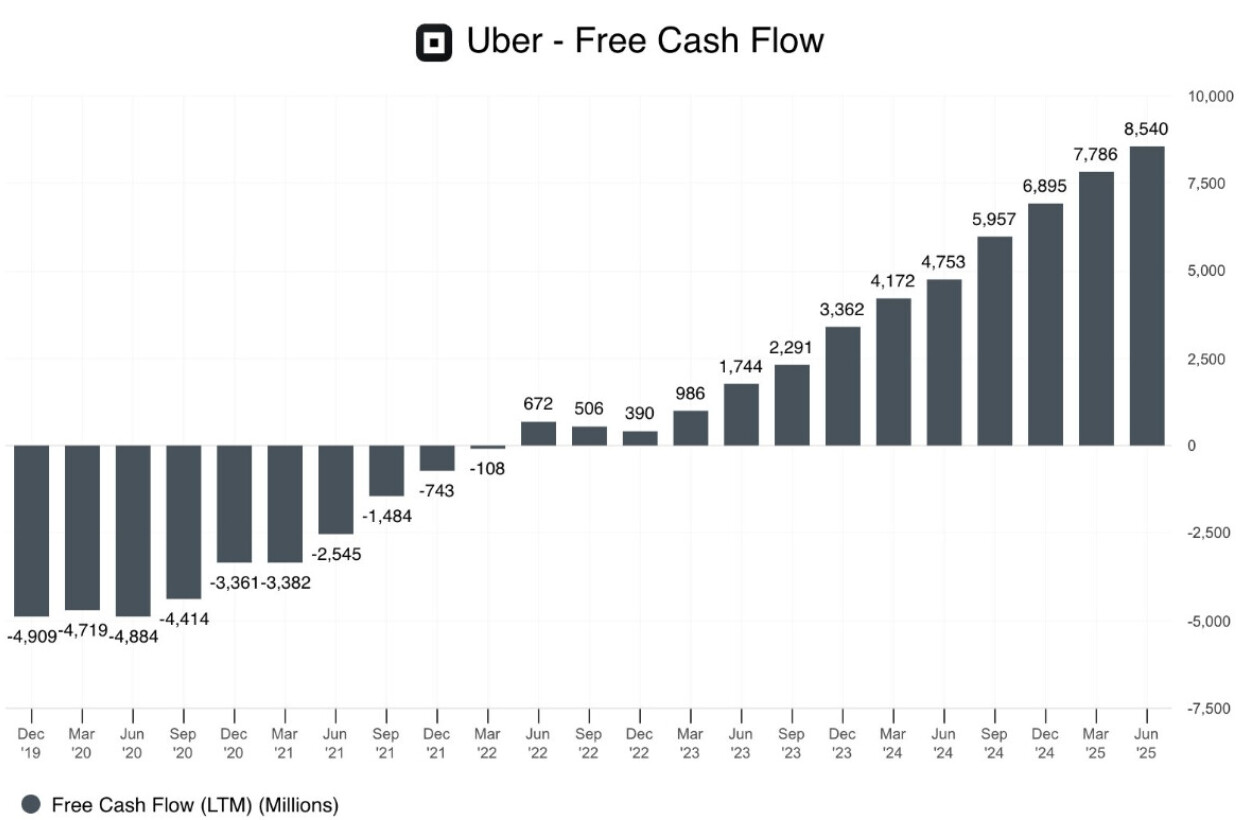
Uber’s main competitors in ride-hailing include Lyft and Bolt, and in food delivery, Doordash. Uber is the only one of these that is profitable. In addition to network effects, profitability gives Uber a competitive advantage going forward; more can be invested in product development than others, and if necessary, prices can be competed with more aggressively than others. I’m not claiming that Uber will permanently destroy these competitors, but a competitive advantage exists. Here is Uber’s free cash flow development; it turned profitable already in 2022, and since then, the curve points northeast:
image

Growth has been strong:

imageThe company’s market capitalization at the time of writing is approximately 192 billion dollars. The free cash flow for the preceding 12 months is about 8.5 billion, so the P/FCF (for the preceding 12 months) is 22.5. In my opinion, this is very reasonable considering that the company is growing by about 15% per year according to analysts’ forecasts (18% in the preceding 12 months, so the estimate is likely pessimistic). Few scalable US tech companies benefiting from megatrends can be acquired at this price. In addition, Uber has announced a massive 20 billion dollar share buyback program (about 10.4% of market capitalization), which could be expected to support the share price in the future. If one trusts that the company can benefit from long-term trends and continue to grow at least at its current pace, the investment opportunity is very interesting. If the company can convince the markets that it can be a leading platform also in the era of robotaxis and drones, the valuation will be in completely different spheres; in this scenario, today’s prices will be remembered with nostalgia.

In my opinion, this story holds truly great opportunities for a long-term investor. I have seized this opportunity myself and believe that in 20 years, the company has the potential to be one of the world’s most significant companies. I recommend learning more about the company and its product!

71 Likes

Pitch #5: Gravity Co., Ltd.

Thesis

Gravity (NASDAQ: GRVY) is a profitable, cash-rich mobile game company with a globally recognized IP (Ragnarok Online) and a large development pipeline. Short-term catalysts – both operational and governance-related – create an asymmetric opportunity over the next six months to a year.

  1. Strong Financial Foundation
  • Cash and cash equivalents: approx. 577 MUSD (latest quarter), ~90% of market capitalization, no debt. EV/EBIT < 1.
  • Continuous profitability - The company has been highly profitable for several years. Q2 net margin ~8% despite significant marketing investments to support global expansion.
  • Diversified revenue streams: several mobile and PC games, licensing.
  1. Operational Catalysts
  • Development pipeline: Several Ragnarok games in soft launch/testing phase and Ragnarok 3 under development. Even small news about Ragnarok 3 can boost investor sentiment. Ragnarok 3 will be released next year.
  • Global expansion: Q2 marketing expenses weighed on margins; if expenses normalize in H2, operating profit could recover significantly.
  • Strong position in Southeast Asia, Taiwan, and Japan; recent openings in Latin America and North America.
  1. Governance-related Wild Card / Hot Potato
  • GungHo, which owns 59% of Gravity, is under pressure from activist investor Strategic Capital to improve governance and capital allocation.
  • Possible outcomes within six months:
    • Full change: Management change → more autonomy for Gravity or a strategic review.
    • Partial change: Governance improvements → better investor communication and capital discipline.
    • No change: Status quo remains, but activist oversight continues.
  • Any movement in this direction could increase Gravity’s valuation if investors believe the company will be more investor-friendly in the future.
  1. Valuation Advantage
  • Market capitalization close to net cash level, which prices the core business at a very low P/E ratio with normalized earnings.
  • Downside limited due to strong balance sheet; upside potential from even small growth or valuation increase.
  1. Short-term Stock Drivers
  • September EGM at GungHo - potential governance changes.
  • Q3 results (November) - margin recovery if marketing expenses normalize. Possible cash > EV situation.
  • Possible new game releases or Ragnarok 3 updates.
  • Changes in dividend policy or share buyback program if activist pressure increases.

Risks

  • Valuation of the company simply does not increase due to so-called China/Korea stock sentiment, poor investor communication, passive parent company, etc.
  • Brand dilution if too many small-scale Ragnarok games are released without quality control.
  • Dependence on Southeast Asian revenues.
  • Internal conflict within the parent company could distract management’s focus from the core business.

Summary

Over the next six months, Gravity offers a cash-rich, profitable game company with several near-term catalysts – both operational (expense normalization, game releases) and governance-related (activist pressure on GungHo).

25 Likes

Pitch #6: DLocal ($DLO)

When hunting for potential multibaggers, I personally look for companies that the market has beaten down too much, where overly negative sentiment leads to significant undervaluation and a market mispricing. Such companies should still possess a competitive advantage and even be market leaders. DLocal meets these criteria and, in my opinion, also has an excellent opportunity for outperformance based on its fundamentals, even at higher prices. I believe it’s only a matter of time before the market also starts to recognize this.

DLocal was founded in Uruguay in 2016 under the leadership of Sebastián Kanovich to solve how large companies could easily receive payments from emerging markets on a single platform. In developing countries, making payments is complex for global companies and their customers because these countries have their own currencies, banking systems, payment methods, and regulations that don’t directly interoperate. DLocal steps in to offer large companies, such as Amazon and Uber, an easier way to receive and send money in countries where payment traffic would otherwise cause immense difficulty. It combines hundreds of local payment methods into one easy-to-use service.

DLocal’s market taps into the golden vein of global demographics. People in DLocal’s customer markets are moving towards the global middle class in terms of wealth, which enables them to use the internet and other digitalization opportunities, such as digital payments. In emerging markets, internet and smartphone penetration is growing rapidly, e-commerce is still in its early stages, and consumption is growing at double the rate compared to developed economies. The company operates in a market worth $2 trillion – and which is estimated to grow at high teens CAGR until 2030. At this stage, the company’s market share is only 1%, meaning there is enormous growth potential. It was listed on the stock exchange in 2021, when the company had the ingredients for success:

One API connected hundreds of local payment methods, and the service was already operating in 43 emerging countries in Latin America, Africa, Asia, and the Middle East. It was like Adyen, but focused solely on emerging markets, growing at a furious pace. Expectations were high, and therefore even small negative news would affect the stock price. Eventually, the journey that had just begun on the stock exchange started to look very bleak, at least based on the stock performance.

DLocal’s last quote when I was preparing this pitch was $10.97 (13.8.2025), which sets its market value at approximately $3 billion. DLocal listed in 2021 with strong growth figures and a high valuation that could not withstand negative news. After the listing, the market began to realize that fintech companies specializing in money transfers were not, after all, perpetual money-printing machines. The all-time high closing price was $65.73 (24.8.2021), and from its peak to today, it has fallen -83.31%. DLocal’s peer, Adyen, also dropped almost 50% from its peaks compared to its current price.

In addition, DLocal found itself amidst uncertainties, which accelerated negative investor sentiment:

  1. Muddy Waters published accusations on 16.11.2022, alleging inconsistencies in revenues, balance sheet, and subsidiary figures, as well as claims about customer cash flow reporting. On the day the report was published, the stock fell sharply. DLocal denied the claims, but trust suffered its first blow.
  2. In spring 2023, news spread about inquiries from Argentine authorities regarding possible misconduct or currency transfers. At the same time, lawsuits and complaints of mistrust from investors emerged.
  3. Finally, the then-CEO, SebastiĂĄn Kanovich, who originally founded the company as a startup in 2016, stepped down from his position.

However, these issues have now been resolved, and the company’s value still lies in the mud, even though the company has made significant progress since those years.

In August 2023, a new CEO took the helm:

Pedro Arnt, former CFO of MercadoLibre (the Amazon of Latin America). Pedro thoroughly understands the challenges of emerging markets (currencies, regulation, operating environment instability) and had been instrumental in building one of the region’s success stories. He saw an opportunity in DLocal to do it again.

DLocal’s figures:

P/E: ~24

Forward P/E: ~14.5

PEG: 0.7

ROE: ~32%

ROIC: ~27%

(source Finviz)

DLocal’s revenue has grown at an impressive pace, but margins have declined from 2019-2024. However, rapid growth has compensated for the drop in margins, still resulting in earnings growth:

However, this year’s Q1 report anticipates that margins have stabilized, and the trend could well reverse as volumes turn in DLocal’s favor:

The upcoming Q2 report (13.8.2025) will, in my opinion, tell a lot about the stability of margins.

What perhaps best measures DLocal’s growth is TPV (Total Payment Volume) – i.e., the amount of payments processed.

It has grown at a 62.6% CAGR since 2021. From $6.05 billion (2021) → ~$26 billion (2024).

2021 → 2022: 6.05 → 10.57 billion → +75%

2022 → 2023: 10.57 → 17.7 billion → +67%

2023 → 2024: 17.7 → ~$26 billion → +45%

DLocal is also not a debt trap; free cash flow has made significant strides in recent quarters, and there is ample cash with almost no debt:

Free cash flow grew Q4 2024 → Q1 2025 +22% – and compared to the same period last year, free cash flow tripled Q1 2024 → Q1 2025 +200%. At the same time, cash continued to swell.

Debt is approximately $54M, meaning net cash is about $458M.

Also, the Take Rate, i.e., the company’s earnings per transaction, has stabilized according to the report at 1.0%-1.2%. This is a remarkably important indicator for the company’s business. As transaction volumes grow in emerging markets (especially with the increasing prevalence of digital consumption), the company’s revenue grows linearly with payment volume (TPV if the Take Rate does not need to be lowered).

Markets love a high-margin turnaround company.

DLocal’s story has gone from rocketing growth to severe disappointments in a few years, and now to a situation where the business foundation looks more stable than it has in a long time. Margins are stabilizing, the cost structure has been adjusted, and the take rate has remained at a healthy 1.0–1.2% level. At the same time, TPV continues to grow strongly, meaning that future revenue increases can flow more directly to the bottom line. The company operates in a market whose size is measured in trillions, and where its current market share is only a fraction – thus, the growth potential is enormous. A strong cash position and almost negligible indebtedness provide room for both organic growth and strategic investments.

If this development continues and the market begins to re-price the company according to its improved fundamentals, the upward rebound in the share price is likely to be significant, especially from the current level. If the thesis succeeds, both earnings growth and the acceptance of higher valuation multiples will come together.

Edit: typos

50 Likes

Pitch #7: Symbotic – robots that pre-assemble store pallets

kuva

What does the company do?
Symbotic is a US-based warehouse automation company that supplies and often operates AI-driven robotic warehouses for retail and grocery distribution centers.
The system consists of:
‱ An aisle-free, high-density shelving/buffer structure (a new generation, released on 5.8.2025, increases storage capacity per square meter and/or reduces space requirements)
‱ SymBot robot swarms
‱ Software that picks and sorts products at the individual product box level and builds store-specific mixed pallets ready for delivery.

The company installs, maintains, and often operates systems on behalf of the customer with its operational services.

The company was founded in 2007 (originally CasePick Systems, name changed to Symbotic in 2012).

Q3/2025 Summary (quarter ended 28.6.2025)

  • Revenue: $592 M (+7.7% q/q)
  • Adjusted EBITDA: $45 M (+30.8% q/q)
  • GAAP Net Income: −$31.9 M (loss deepened ~49% q/q)
  • GAAP EPS: −$0.05 (loss/share deepened ~25% q/q)
  • Gross Margin % (GAAP): 18.2% (−1.4% q/q)
  • Balance Sheet/Cash: cash ~$778 M, interest-bearing debt ~$27.6 M ⇒ net debt-free (net cash ~$750 M)
  • Free Cash Flow (FCF): −$153 M (Q3; YTD +$293 M)
  • Q4/2025 Guidance: Revenue $590–610 M, Adjusted EBITDA $45–49 M.

(The company noted that the deployment of the new warehouse structure may temporarily shift delivery schedules but does not change the contract-based order backlog.)

Customers
Symbotic’s largest customers include Walmart (strategic partner), Target, Albertsons, C&S Wholesale Grocers, and in Canada, e.g., Giant Tiger.

On 16.1.2025, Symbotic agreed to acquire Walmart’s Advanced Systems & Robotics business and simultaneously entered into a $520 M development program; the agreement expands automation to Walmart’s Accelerated Pickup & Delivery centers (several hundred locations on a multi-year schedule). Additionally, the GreenBox joint venture with SoftBank offers a “Warehouse-as-a-Service” model with lighter customer capex (ownership SoftBank 65% / Symbotic 35%, initial funding $100 M).

Why is this an interesting investment?

  1. Structural trend: labor shortage, cost pressure, and service level requirements drive automation – Symbotic hits the “sweet spot” of grocery and retail distribution centers, where picking product boxes and building mixed pallets yield the most benefits.
  2. Large contract-based order backlog of ~$22.4 billion provides several years of visibility (e.g., Walmart program).
  3. Technical advantage: new “ultra-dense” storage/buffer structure increases capacity/square meter efficiency and speeds up processing.
  4. Towards recurring revenue: software, maintenance, and operational services, as well as the GreenBox model, will increase Annual Recurring Revenue (ARR) over time.
  5. Balance sheet strength: net cash ~$750 M and low debt support scaling and schedule fluctuations.

Risks

  • Customer concentration: Walmart is by far the most important – changes in the program will be felt.
  • Execution risks & scalability: large deployments → schedule slippages reflect on growth and cash flow.
  • Competition: Dematic/KION, Swisslog/KUKA (Midea), AutoStore, Exotec, Ocado Solutions.
  • Valuation: P/S is high compared to established, slower-growing industrial companies – growth and profitability must materialize.

Competitors briefly
‱ Dematic (KION): strong integrator in large projects.
‱ Swisslog (KUKA/Midea): strong in grocery retail, broad automation portfolio.
‱ AutoStore (Oslo): cube storage/ASRS – very dense, but application different from Symbotic.
‱ Exotec, Ocado Solutions: modular robotics (e.g., Skypod) and grocery solutions.

Investment thesis summarized
Symbotic is a ‘tool shop’ for warehouse automation
~$22.4 billion order backlog, Walmart backing, and technical advantage. Short-term changes in delivery rhythm (new warehouse structure) create buying opportunities for long-term holders. Net cash provides a buffer, and software/operations will increase recurring revenue over time.

My view: I consider the stock expensive at the moment, but the case is strong. On the watchlist and buy when the price is right.

Technical analysis briefly
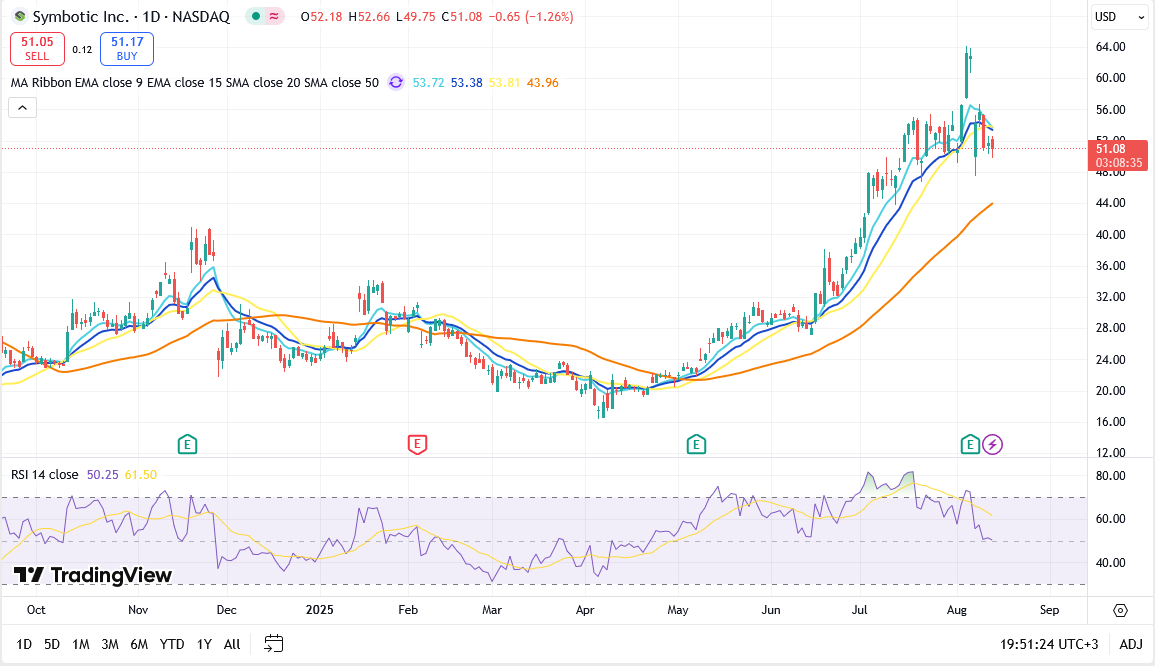
Looking at daily candles, the price is below the fastest moving averages, and the moving averages have turned downwards. RSI curves have also turned down. I would see the price potentially dropping to around 45-47 USD and then starting a new ascent from there.

kuva

Finally, a few Fun facts
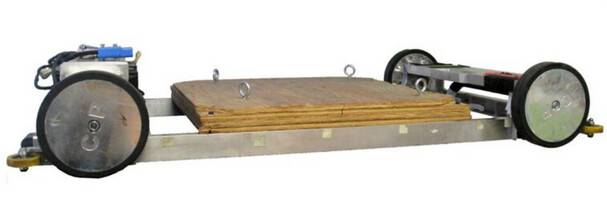
‱ The first SymBot prototype was made from a plywood sheet and four wheels.
‱ Robots drive inside the warehouse at over 20 mph (≈ 32 km/h).
‱ One outbound robot cell builds up to ~1,350 boxes/h – practical “3D Tetris”.

kuva

26 Likes

Pitch #8: FARTCOIN

Ladies and gentlemen.

Brace yourselves.

The FARTCOIN investment case:

This sounds like a joke, and perhaps it is, but I will now explain to you with a rather serious face why the FARTCOIN cryptocurrency has all the prerequisites to rise by at least 1000-2000% from its current market cap of 1.1 billion.

One FARTCOIN is currently worth about 1.10 USD. Without a doubt, anyone who understands anything about investing is now shaking their head and stating that the fair value anyone should be willing to pay for a cryptocurrency named FARTCOIN is zero point zero dollars. I am not trying to argue against that or entice anyone to invest in any cryptocurrency; I am merely explaining an irrational market phenomenon from the perspective of a fundamental investor.

For market context, let it be known that the well-known Dogecoin is currently trading at a value of 35 billion and has reached 60-70 billion a couple of times. The second largest meme, SHIB (a kind of parody of DOGE), has frequently approached the 20 billion level, and at the peak of the last cycle, SHIB’s market cap was about 40 billion. Then we have a bunch of smaller meme cryptocurrencies like TRUMP and PEPE, which have reached a market cap of 10 billion.

The mentioned 10-20x rise from the current situation would put FARTCOIN’s market cap in the range of 10-25 billion, which is a completely moderate level for a Tier 1 meme coin. Unlike Dogecoin, for example, the supply of FARTCOIN is fixed, and its creation does not involve the same kind of manipulation as, for instance, TRUMP-coin.

I will now argue to you why FARTCOIN is, however, much stronger than SHIB, PEPE, or TRUMP, and in my opinion, it has the full potential to be the DOGE of this crypto cycle due to its massive “mindshare” potential and brand value. DOGE is already a tired and outdated millennial meme, which Elon Musk has, at the latest, worn out.

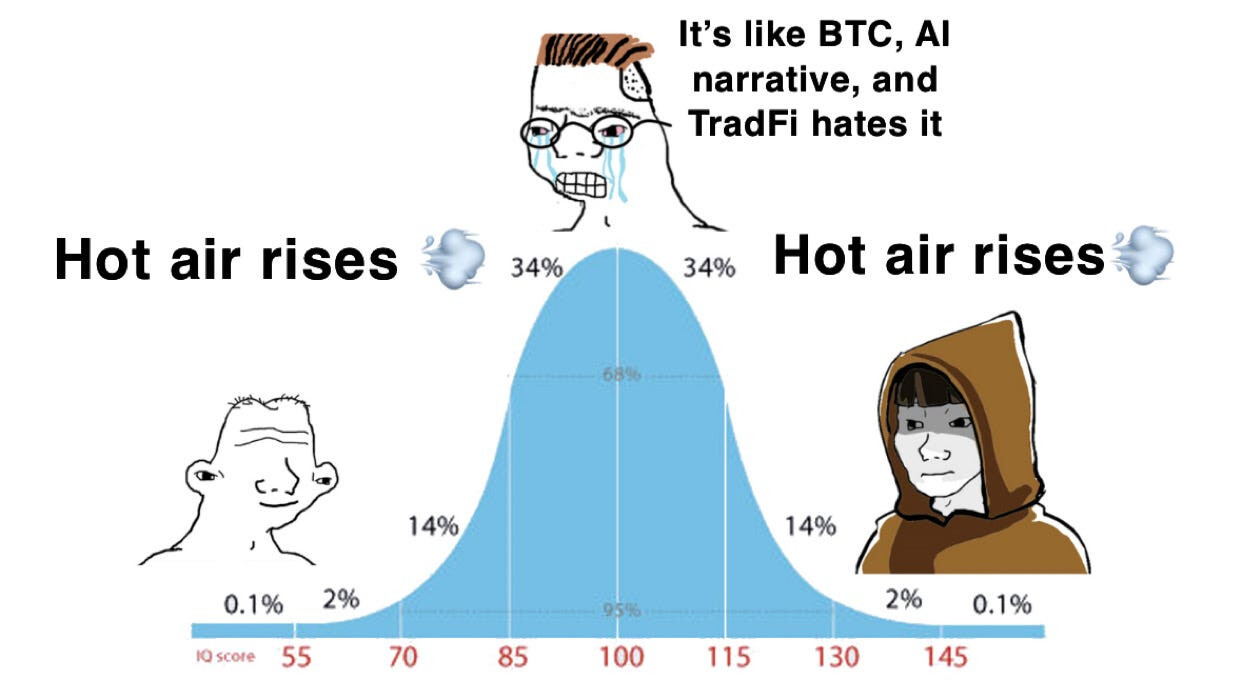
The nihilistic and economically insecure Zoomer generation yearns for a new outlet through which to give the middle finger to skyrocketing house prices, Boomer companies, and AI-stolen job markets. FARTCOIN works on every level of the IQ distribution and has no cultural limitations. The humor is crude but not particularly offensive, making it the perfect universal meme crypto.

image

The Hot Air Rises slogan cultivated in connection with FARTCOIN is self-ironic and at the same time perfectly describes the crypto bubble and perhaps the broader market situation. The silly, childish humor simply works in this context, as I have yet to see anyone able to mention the FARTCOIN cryptocurrency with a straight face. Furthermore, the FARTCOIN origin story, of a “perfect” meme coin hallucinated in the backrooms of Truth Terminal AI, hits on the hottest investment narratives.

What prevents anyone from inventing an even funnier meme coin? Nothing, but FARTCOIN has reached critical mass and risen from among endless trash coins to be tradable on every major crypto exchange platform. FARTCOIN has also already been brought into public consciousness through financial news and social media in connection with its previous rise. If/when the crypto bubble reaches its final manic climax, a lemming-like herd of newcomers will gravitate around the strongest narratives.

And then the hot air rises again :dash:

46 Likes

Pitchi #9: Grab

Joku oli pitchannut jo Uberin, mutta nostetaan esiin kilpailija joka kasvaa kovempaa ja ei kĂ€rsi samoista autonomisen ajon riskeistĂ€. ErÀÀnlainen Uber steroideilla, jos sallitte. Jos olet kĂ€ynyt Kaakkois-Aasiassa, pitĂ€nyt silmĂ€si auki ja nĂ€hnyt muuta kuin massage parlorien likaiset vĂ€liverhot, tiedĂ€t mistĂ€ yhtiöstĂ€ on kyse. Muutenkin, olisiko ollut kiva hypĂ€tĂ€ Uberin kyytiin vuonna 2023, kun yhtiö oli juuri kÀÀntynyt kannattavaksi? Osakehan on tuosta nelinkertaistunut, kaikkien huulilla ja ei ole olemassa ihmistĂ€, joka ei nyt Uberia tuntisi
 En sano ettĂ€ Grabilla on sama edessĂ€ (osakekurssin osalta), mutta tĂ€nĂ€ vuonna tulemme saamaan ensimmĂ€isen kannattavan vuoden yhtiölle.

Lukuja pÀhkinÀnkuoressa
Market cap 21mrd USD.
Liikevaihto 2025e 3,4mrd USD. (+22% YoY)
Gross margin? n. 40% (2024)
KannattavuuskÀÀnne? TÀnÀ vuonna. :sunglasses:
Velkaa? Nettovelaton. :sunglasses:


Grab Holdings (GRAB)

Yhtiön historia lyhyesti
Grab Holdings perustettiin vuonna 2012 Malesiassa nimellÀ MyTeksi, alun perin taksisovelluksena. Pian se siirsi pÀÀkonttorinsa Singaporeen ja laajensi toimintaansa mopokyyteihin, ruokalÀhetyksiin ja digitaalisiin maksuihin, kehittyen vÀhitellen Kaakkois-Aasian johtavaksi superappiksi. Vuonna 2018 Grab vahvisti asemansa ratkaisevalla siirrolla: se osti Uberin Kaakkois-Aasian toiminnot, ja Uber sai kaupassa 27,5 %:n osuuden yhtiöstÀ. Yksi suurimmista kilpailijoista poistui nÀin kÀytÀnnössÀ pelilaudalta. Grab listautui Nasdaqiin joulukuussa 2021 Altimeter Growth -SPACin kautta noin 40 miljardin dollarin arvostuksella. Nykyinen mcap on noin 21 miljardia dollaria, huomattava alennus IPO hintaan siis.

MitÀ yhtiö tekee?
Grab toimii kahdeksassa maassa ja yli 800 kaupungissa, tarjoten integroidun alustan liikkumiseen, toimituksiin ja rahoituspalveluihin. Liiketoiminta jakautuu kolmeen pÀÀsegmenttiin:

  • Mobility: kyydityspalvelut autoilla, mopoilla ja takseilla.

Grabin Mobility-segmentti on yhtiön suurin tulonlĂ€hde ja toimii hyvin samankaltaisesti kuin Uber, mutta Kaakkois-Aasian erityispiirteillĂ€. Grabilla on yli 5 miljoonaa kuljettajakumppania ja laaja valikoima kyytejĂ€ — autoista ja takseista suosittuihin GrabBike-mopokyyteihin. MerkittĂ€vĂ€ ero Pohjois-Amerikkaan on, ettĂ€ Grab usein hallitsee itse ajoneuvokantaa: se ostaa tai liisaa ajoneuvoja kumppaneilta kuten BYD ja Hyundai ja vuokraa tai myy ne kuljettajille. TĂ€mĂ€ mahdollistaa sĂ€hköautojen kĂ€ytön edistĂ€misen, alentaa kuljettajien aloituskustannuksia ja varmistaa tasalaatuisen kaluston, mikĂ€ helpottaa huoltoa ja alentaa kustannuksia.

Markkina-asema on useimmissa maissa ylivoimainen — esimerkiksi Malesiassa 97 %, FilippiineillĂ€ 91 % ja Thaimaassa 85 %. Vain Indonesiassa kilpailu on tiukkaa (n. 50/50 Gojekin kanssa). Mobility-segmentti tuotti viimeisen 12 kuukauden aikana noin 1,1 miljardia USD liikevaihtoa noin 55 %:n EBITDA-marginaalilla, mikĂ€ tekee siitĂ€ yhtiön kannattavuuden kivijalan.

  • Deliveries: ruoka- ja pĂ€ivittĂ€istavaratoimitukset sekĂ€ pakettikuljetukset GrabFood- ja GrabMart-alustojen kautta.

Grabin Deliveries-segmentti toimii kuten DoorDash tai Instacart, mahdollistaen ruoka- ja pÀivittÀistavaraostokset ravintoloista ja kaupoista, jotka kuljettajat, noutavat ja toimittavat. Markkina on jopa MobilityÀ suurempi, ja Grab on selvÀ markkinajohtaja kaikissa maissa paitsi Vietnamissa, jossa se on tiukasti kakkosena. Yhtiö ei rajoitu vain vÀlityspalkkioihin, vaan tarjoaa kauppiaille rahoituspalveluja, kuten kÀyttöpÀÀomalainoja ja laskurahoitusta, sekÀ on laajentunut itse kauppiaspuolelle.

Segmentti on kÀÀntynyt nopeasti kannattavaksi: vuoden 2022 -54 %:n EBITDA-marginaali on noussut nykyiseen 14 %:iin. PitkĂ€llĂ€ aikavĂ€lillĂ€ johto tavoittelee 4 %:n GMV–EBITDA-konversiota (GMV on mittari, joka mittaa alustan kautta myytyjen tavaroiden kokonaisarvoa). Mainosliiketoiminta on merkittĂ€vĂ€ tulosveturi, ja sen osuus Deliveries-GMV:stĂ€ kasvoi viimeisellĂ€ neljĂ€nneksellĂ€ 1,7 %:iin edellisvuoden 1,3 %:sta.

  • Financial Services: digitaaliset maksut (GrabPay), lainat, vakuutukset sekĂ€ digipankkipalvelut, kuten GXS Bank.

Grabin Financial Services -segmentti sai alkunsa turvallisuussyistĂ€: kĂ€teismaksujen sijaan yhtiö lanseerasi GrabPayn, joka mahdollisti kuljettajille kĂ€teisettömĂ€t transaktiot. Palvelu on sittemmin kasvanut kattamaan laajan valikoiman tuotteita, kuten sĂ€hköisen lompakon, maksukortin, “osta nyt, maksa myöhemmin” -ratkaisut, Ă€lypuhelinrahoituksen, lainat kuljettajille ja kauppiaille, vakuutukset sekĂ€ kassanhallintapalvelut. KeskeisimmĂ€t osa-alueet ovat maksut, pankkipalvelut ja luotonanto, ja GrabPay toimii sekĂ€ prepaid-lompakkona, ettĂ€ korttilinkitettynĂ€ maksutapana, josta Grab ottaa pienen siivun jokaisesta transaktiosta.

Pankkipuolella Grab on laajentunut Singtelin kanssa perustetun GXS Bankin kautta Singaporeen ja Malesiaan, ja asiakastalletukset ovat nousseet 479 miljoonasta dollarista 1,4 miljardiin vuodessa. Lainakanta on kasvanut kahdessa vuodessa 196 miljoonasta 566 miljoonaan dollariin, kattaen monentyyppisiÀ lainoja. Johto korostaa luottoriskin hallintaa, mutta kuten usein pankkitoiminnassa, todellinen kestÀvyys testataan vasta talouden heikentyessÀ. TÀtÀ riskiÀ ei siis pidÀ sivuuttaa.

image

Oma ekosysteemi ja mahdollinen vallihauta
Grabin kilpailuedut perustuvat vahvaan superappi-ekosysteemiin ja johtavaan markkina-asemaan. Verkostoefektit ovat palvelun ytimessÀ: laaja kuljettaja- ja kauppiasverkosto lyhentÀÀ odotusaikoja, laajentaa palveluvalikoimaa ja houkuttelee uusia kÀyttÀjiÀ. TÀmÀ parantaa kÀyttöastetta ja tukee kannattavuutta.

Monipalvelualusta yhdistÀÀ kyytipalvelut, ruokalĂ€hetykset, pĂ€ivittĂ€istavaratoimitukset, digitaaliset maksut ja vakuutukset yhden kĂ€yttĂ€jĂ€tilin taakse. Ah, onko shoppailu koskaan ennen ollut nĂ€in helppoa? TĂ€mĂ€ helppous mahdollistaa tehokkaan ristiinmyynnin ja tukee nopeasti kasvavaa mainosliiketoimintaa (+45 % YoY). LisĂ€ksi Grabin kattava transaktiodata kyytien, toimitusten ja maksujen kautta tarjoaa merkittĂ€vĂ€n edun luottoriskien hinnoittelussa ja petostorjunnassa rahoituspalveluissa. Skaala ja vahva brĂ€ndi tekevĂ€t Grabista selkeĂ€n markkinajohtajan Kaakkois-Aasiassa: sen markkinaosuus alueen ruokalĂ€hetyksissĂ€ on noin 54–55 %, ja se hallitsee kyytipalveluita useissa maissa. Grab on kĂ€ytĂ€nnössĂ€ synonyymi taksille ja ruokalĂ€hetyksille (sama kuin Woltataanko? Otetaanko Uuberi?).

Riskit
Grab toimii dynaamisilla mutta hajanaisilla markkinoilla, joissa kilpailu ja sÀÀntely voivat vaikuttaa kasvuun ja marginaaleihin. Paikalliset kilpailijat, kuten Gojek/GoTo, Foodpanda ja ShopeeFood, haastavat yhtiötÀ tietyissÀ maissa, mikÀ voi tietenkin johtaa hintakilpailuun ja asiakashankinnan kustannusten nousuun. Makrotalouden heikentyminen voi vÀhentÀÀ tilausten mÀÀrÀÀ, ja aggressiivinen alennuskampanjointi painaa marginaaleja. Rahoituspalveluiden kasvu tuo lisÀksi mukanaan luottotappioriskejÀ sekÀ lisenssi- ja sÀÀntelyhaasteita eri maissa. Onneksi liiketoiminta on hyvin hajautunutta, ja yhden segmentin / maantieteellisen alueen heikentyessÀ voi tukea löytyÀ muista. Mainitaan riskiksi vielÀ tekoÀly ja itseohjautuvat autot. Kuitenkin regulaation, sekÀ autojen kalliin hankintahinnan takia en nÀe sen olevan uhka hyvin pitkÀÀn aikaan Kaakkois-Aasiassa, jossa keskiverto ihmiselle esimerkiksi Teslan ja FSD hankinta olisi jopa kymmenien vuosien palkka. TÀmÀ riski on taas enemmÀn validi esimerkiksi Uberille lÀnsimaissa.

image

Kasvun ajurit ja markkinan koko
Grab hyötyy sekÀ rakenteellisista ettÀ yhtiökohtaisista kasvun ajureista, jotka tukevat laajentumista Kaakkois-Aasian nopeasti digitalisoituvilla markkinoilla. Urbanisoituminen, mopotaksien vakiintunut asema ja nuori, mobiilihÀrpÀkkeistÀ innostunut vÀestö luovat vahvan kysyntÀpohjan pitkÀlle tulevaisuuteen. Kauppiaiden kiihtyvÀ digitalisaatio vauhdittaa on-demand-taloutta erityisesti ruoka-, pÀivittÀistavara- ja pakettitoimituksissa. On-demand-talous tarkoitta talousmallia, jossa hÀrpÀke/palvelu/ruoka on saatava juuri nyt, heti.

Toimialaraporttien mukaan alueen internet-talous (erityisesti liikenne ja ruokalĂ€hetykset) kasvaa ripeĂ€sti; ruokalĂ€hetysten kulutus oli noin 19,3 mrd USD vuonna 2024 (+13 % YoY). Grabin hinnoitteluoptimointi ja laaja palveluvalikoima ovat kiihdyttĂ€neet GMV:n kasvua (+20 % Q4/2024) ja nostaneet MTU-luvun 47 miljoonaan Q2/2025 (MTU: kuukausittaiset transaktion tehneet kĂ€yttĂ€jĂ€t). Mainosliiketoiminta tarjoaa korkeakatteista lisĂ€tuloa, ja rahoituspalvelut – kuten GrabPay, lainat ja vakuutukset – vahvistavat kĂ€yttĂ€jĂ€pitoa ja nostavat ARPU:a hallitulla riskitasolla.

Vaikka Grab toimii jo yli 800 kaupungissa, markkinapenetraatio on kokonaisuudessaan yhÀ alle 10 %, mikÀ jÀttÀÀ huomattavan kasvupotentiaalin, kun offline-kulutus siirtyy vauhdilla on-demand-kanaviin.

Ohjeistus vuodelle 2025
Grab ennakoi vuoden 2025 liikevaihdon olevan 3,33–3,40 mrd USD, mikĂ€ merkitsee noin 19–22 %:n kasvua edellisvuoteen verrattuna. Oikaistun EBITDA:n odotetaan asettuvan 460–480 MUSD vĂ€lille, mikĂ€ vastaa 47–53 %:n kasvua vuodesta 2024.

Kannattavuus ja kassavirta
Grabin kannattavuus on parantunut selvÀsti siirtymÀllÀ kasvuvaiheesta tehokkuus- ja kassavirtavetoiseen malliin. Q2/2025 liikevaihto oli 819 MUSD (+17 % YoY) ja nettotulos kÀÀntyi voitolle 35 MUSD:iin , mikÀ heijastaa sekÀ kustannuskuria ettÀ kÀyttöasteen paranemista kaikissa segmenteissÀ.

Korkeakatteinen Mobility-liiketoiminta on edelleen tulosveturi, mutta Deliveries-segmentin marginaalit nousevat nopeasti palvelun tiheyden ja logistiikan optimoinnin ansiosta. Mainosliiketoiminnan skaala ja rahoituspalveluiden valikoitu kasvu lisÀÀvÀt tulospohjaa ilman suuria pÀÀomainvestointeja, ja mainoksien potentiaalia tuskin on vielÀ tÀysin osattu hinnoitella osakkeeseen.

Kassavarat olivat kauden lopussa 5,6 mrd USD, mikÀ tarjoaa merkittÀvÀn puskurin voitokkaaksi kÀÀntyneelle yhtiölle. Oletan, ettÀ yhtiö hakee uusia yritysostokohteita (tÀstÀ jotain spekulaatiota saattaa netistÀ löytyÀkin, se jÀÀköön toiseen kertaan).

image

Arvostus
Grabin nykyarvostus heijastaa siirtymÀÀ tappiollisesta kasvuyhtiöstĂ€ kannattavaksi ja nopeasti kasvavaksi jĂ€ttilĂ€iseksi. Markkina-arvo on noin 21 mrd USD, mikĂ€ vastaa EV/Sales noin 4-5x ja vuoden 2025e oikaistulla EBITDA:lla laskettuna EV/EBITDA-kerrointa noin 20–23x.

Kun huomioidaan, ettĂ€ oikaistu EBITDA ja vapaa kassavirta kasvavat nopeasti, kertoimet laskevat merkittĂ€vĂ€sti 2026–2027 ennusteilla (’26e–’27e EV/EBITDA 17–14). LĂ€nsimaiset vertailuyhtiöt, kuten DoorDash tai Uberin Delivery-segmentti, hinnoitellaan usein korkeammilla kertoimilla, mikĂ€ viittaa siihen, ettĂ€ Kaakkois-Aasian regulaatio-, kilpailu- ja valuuttariskit diskontataan vahvemmin Grabin hinnoittelussa. Nykyarvostus tarjoaa sijoittajalle mahdollisuuden osallistua pitkĂ€n aikavĂ€lin digitaalisen penetraation ja ekosysteemin syvenemisen tuomaan tuloskasvuun ilman, ettĂ€ joutuu maksamaan preemiota. EdellyttĂ€en, ettĂ€ yhtiö jatkaa marginaalien parantamista ja pitÀÀ markkinajohtajuutensa. Myös alueen nuori vĂ€estö, kasvava vauraustaso sekĂ€ laajentuva mahdollisuus internetin ihmeellisiin palveluihin on merkittĂ€vĂ€ tekijĂ€ yhtiön tulevassa kasvussa.

Miksi sjoittaa juuri nyt?

Grab on juuri nyt kiinnostava sijoituskohde, koska yhtiö on tehnyt vaikeimman vaiheen kÀÀnnöksen: se on siirtynyt tappiollisesta kasvuyhtiöstÀ kannattavaksi ja voimakkaasti kassavirtaa tuottavaksi markkinajohtajaksi. Se menestyy alueella, jossa Uberilla oli vaikeuksia. Vahva 5,6 miljardin dollarin kassapositio, selkeÀ johtoasema Kaakkois-Aasiassa ja alle 10 % markkinapenetraatio luovat poikkeuksellisen hyvÀn pohjan tulevalle kasvulle.

Jos Grab onnistuu pitÀmÀÀn kilpailijat takanaan tai syömÀÀn ne kokonaan pois, ja jatkaa operatiivista tehokkuutta, nykyinen arvostus (n. 5 USD/osake) voi osoittautua varsin houkuttelevaksi entrypaikaksi pitkÀn aikavÀlin omistajalle: kyseessÀ kuitenkin yhtiö, joka todennÀköisesti tulee dominoimaan Kaakkois-Aasian delivery-ja kyyti markkinaa seuraavat vuodet, mahdollisesti myös vuosikymmenen. Markkina onkin alkanut herÀilemÀÀn yhtiön kohdalla, ja viimeisen 12kk aikana yhtiön osakekurssi on noussut reilut 60%. Markkina ei vielÀ kuitenkaan nÀe tarpeeksi vahvaa kÀÀnnettÀ tapahtuneen, nÀetkö sinÀ?

Edit: kirjoitusvirheitÀ

107 Likes

Pitch #10: Pharming Group - A Rare Opportunity with Rare Medicines

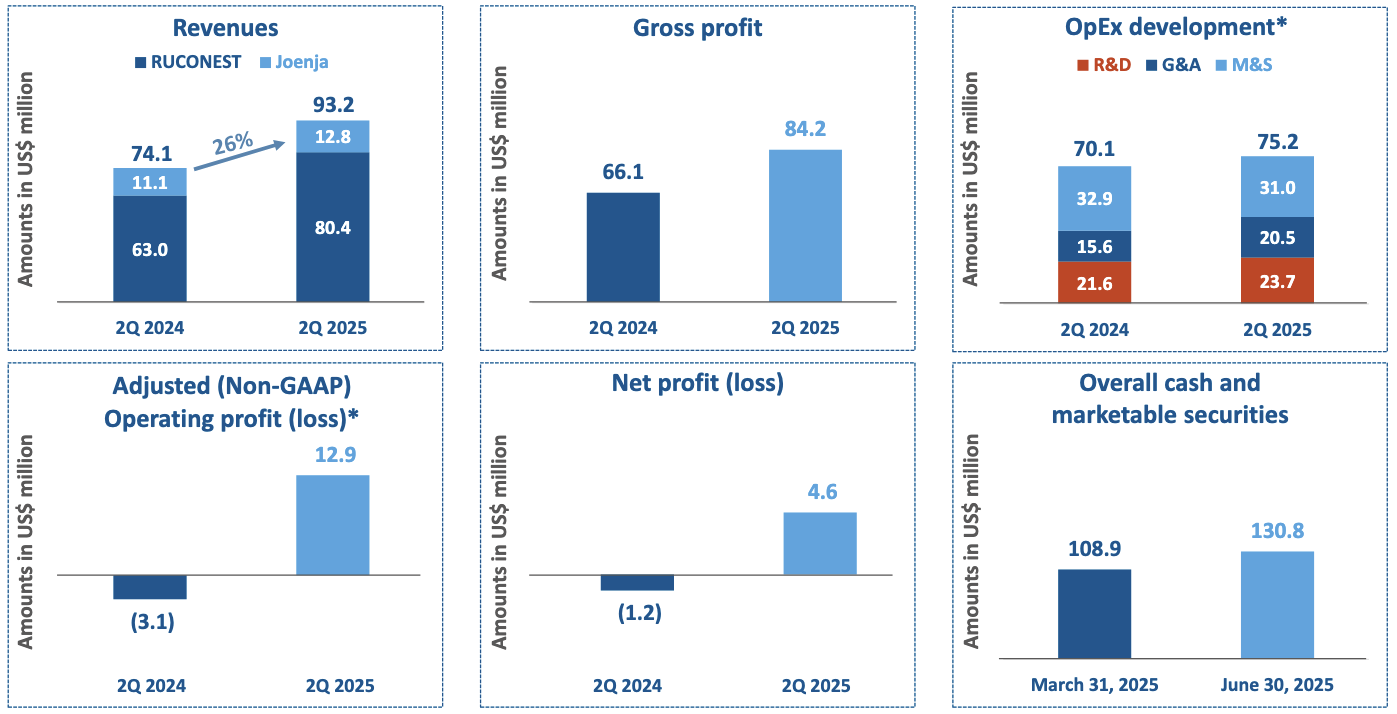
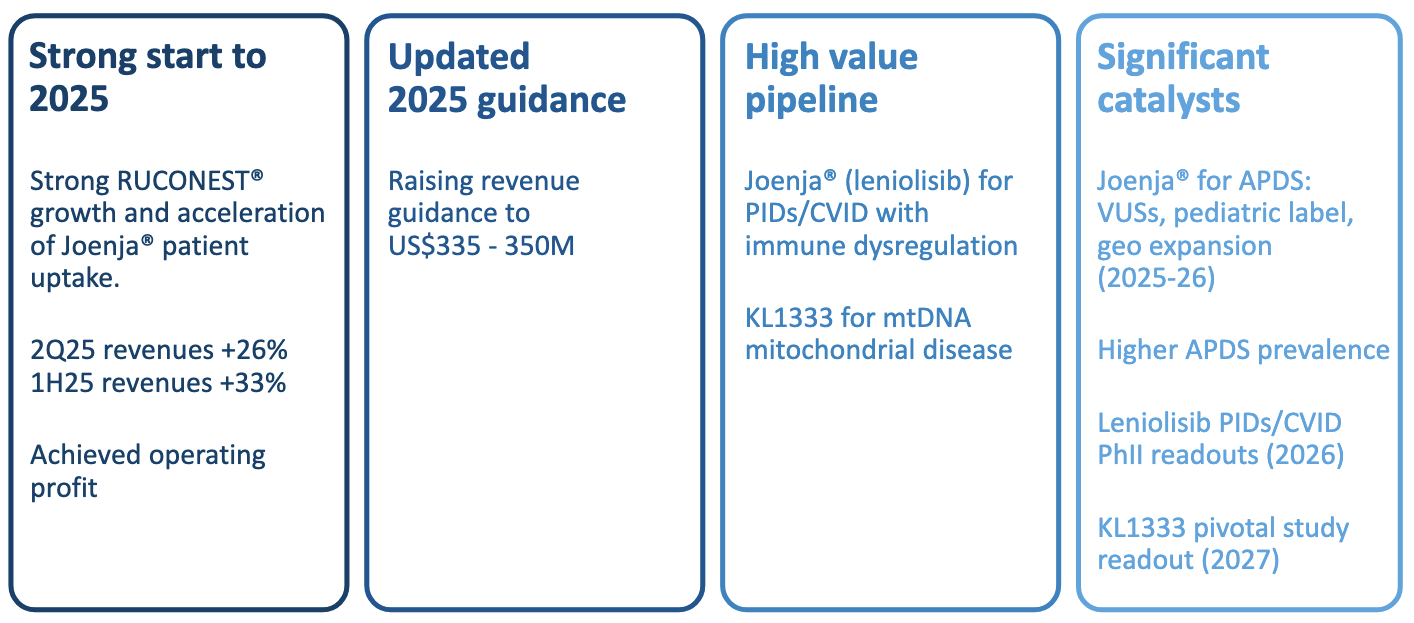
Pharming Group is a small Dutch pharmaceutical company that focuses its drug development on medication for extremely rare diseases. Unlike a typical development company, Pharming has actual pharmaceutical products for sale in addition to future promises, which bring it significant growth-oriented revenue and cash flow. Following this year’s positive profit warning, revenue is expected to be hundreds of millions of dollars, and at the end of June, the company held cash reserves and equivalent assets amounting to a hefty 131 MUSD war chest. The current cash reserves and cash flow from sales are guided to be sufficient to pay for the development of future products, so investors’ pockets do not need to be tapped for funding, and in fact, the company is now rather looking for promising acquisition targets in the market.

kuva

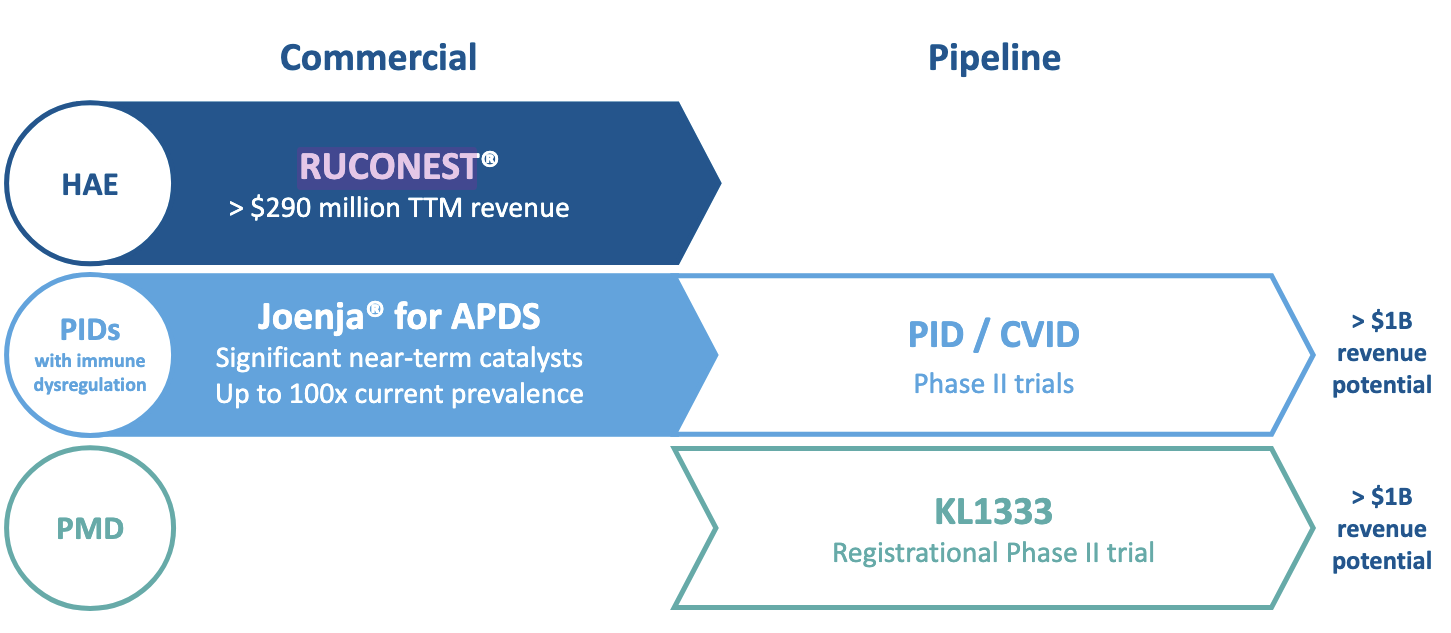
The company has three main pharmaceutical products for sale and/or under research, which I will go through in more detail below, one by one.

kuva

Ruconest

Ruconest is a preparation made from the milk of a transgenic rabbit, used to treat acute severe hereditary angioedema, i.e., a type of swelling of the skin and mucous membranes caused by an allergic reaction. This expensive drug is applied only to the most severe cases, and it must be used to treat attacks lasting for days, so each individual new customer generates tens of thousands to hundreds of thousands in revenue for the company annually.

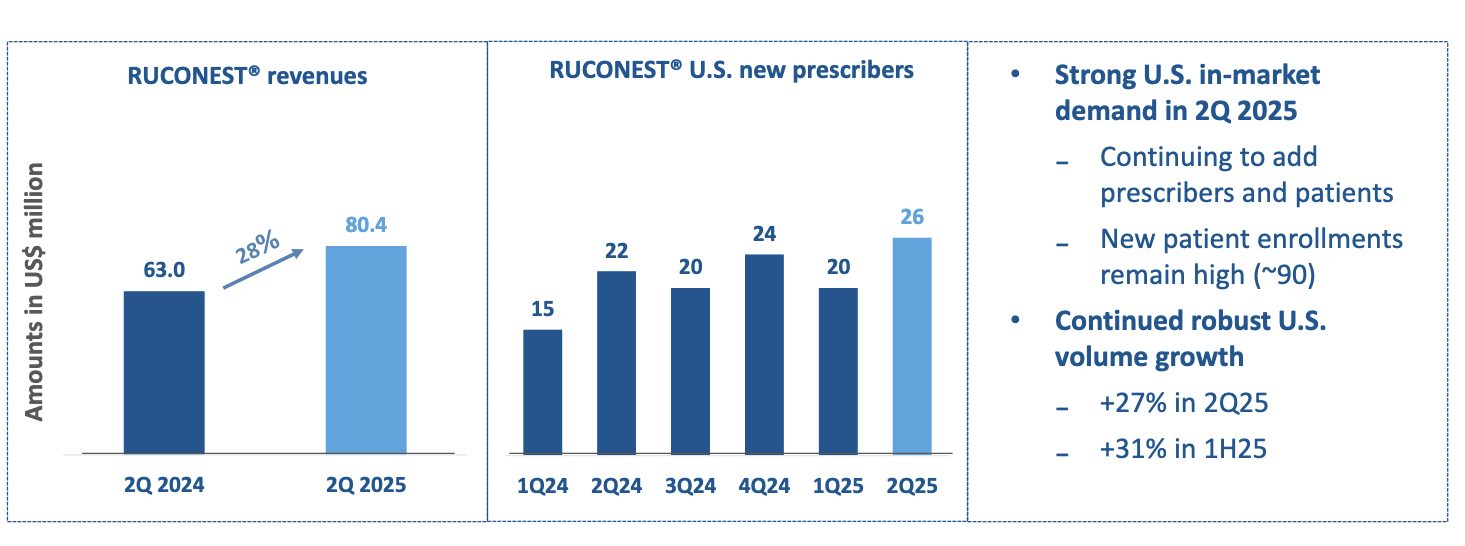
Although the number of new users increases at a slow pace of only about twenty per quarter, Ruconest has generated nearly 300 MUSD in revenue for the company over the past 12 months. The American FDA has recently approved competing drugs for the market (for example, KalVista’s Ekterlyn), so there are some question marks regarding the product’s longevity. For now, however, sales and revenues are still growing, and it always takes time for competitors to make a breakthrough, so for the foreseeable future, the cow can still be milked well.

kuva

Joenja

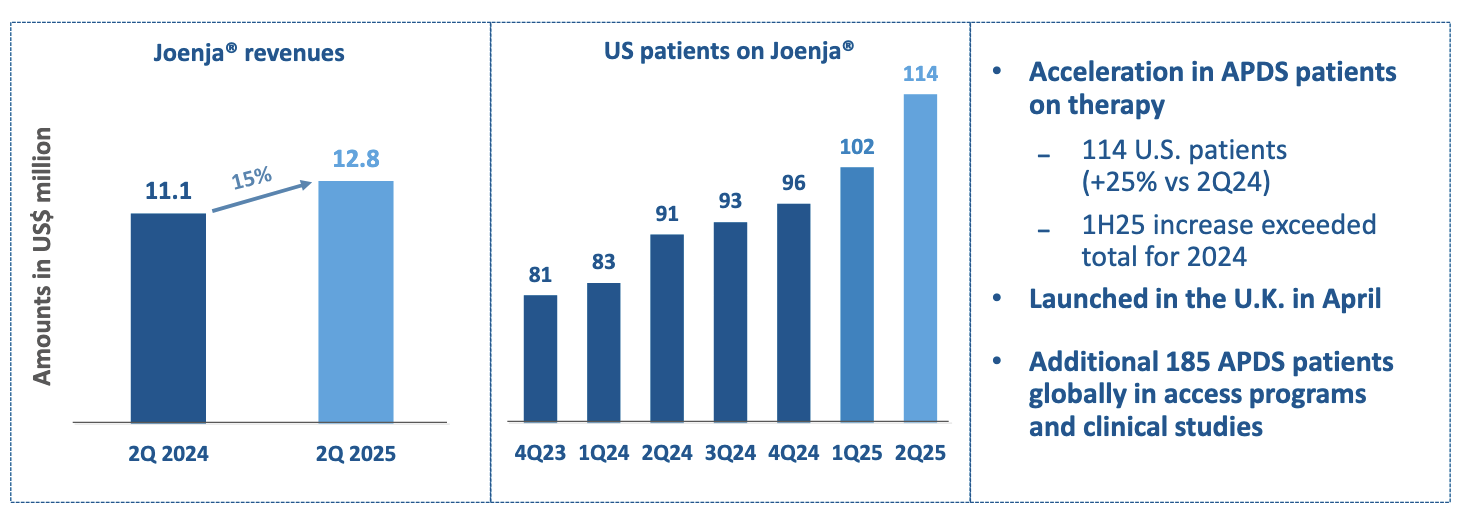
Joenja treats a rare primary immunodeficiency condition called APDS (Activated PI3K delta syndrome). Primary immunodeficiency is a condition in which the body’s immune system is genetically unable to defend itself against infections. Joenja inhibits PI3Kή hyperactivity and thereby improves the patient’s immune system function. Currently, there are over a hundred patients using the drug in America, out of a total of five hundred potential patients. The numbers may sound small, but each of them is invaluable and generates approximately 400 kUSD in revenue for the company per year.

However, Joenja still has further potential to develop into a true blockbuster drug, because there are so-called VUS patients (Variant of Uncertain Significance) worldwide, who, according to new studies, may prove to be APDS-related, and thanks to whom the prevalence of APDS could be significantly greater than previously thought. With the latest research, the company expects the redefinition of VUS patients as APDS sufferers, and thus Joenja users, to start reflecting in revenue growth already by the end of the year.

Geographical expansions into Europe are also underway, as well as further research into the drug’s use for 4-11 year olds, which, if successful, will significantly expand the valuable drug’s customer base. In addition, as a wild card, it is being investigated whether Joenja could also treat other immunodeficiency conditions. It is not yet known how big a hit this will be, but clear possibilities for a blockbuster drug exist, and if everything goes well, sales of several billions are clearly being discussed. However, information on potential success will not have to be waited for long, as a significant stream of announcements regarding these possibilities is expected already this year and next.

kuva

kuva

KL1333

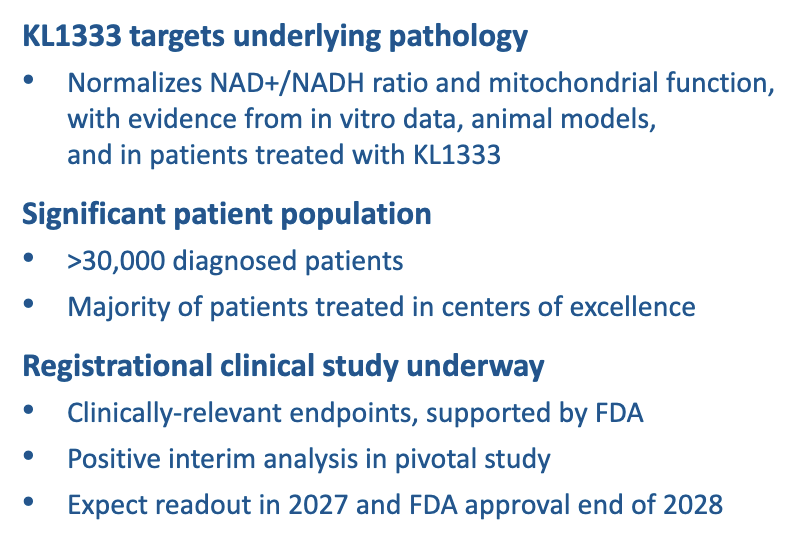
In 2024, Pharming announced it would acquire Swedish Abliva AB for 66.1 MUSD to gain control of a very promising drug candidate for primary mitochondrial dysfunction. This is a genetic defect inherited from parents, due to which cells do not receive enough high-energy compounds, which can cause, among other things, muscle weakness and heart failure. There are over 30,000 diagnosed cases worldwide, so there is demand for the drug, and if successful, this will become another blockbuster drug in Pharming’s portfolio in the coming years.

kuva

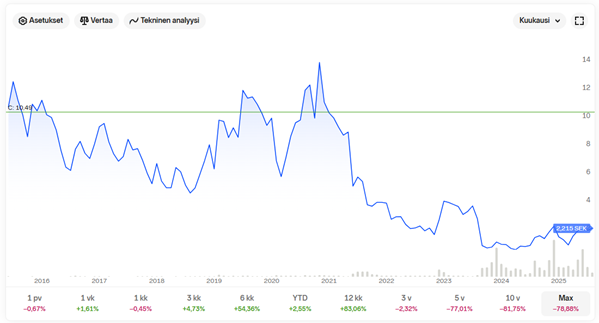
At the time of writing, there are only 21 owners on Nordnet, so there is still plenty of time to get on board, and with a continuous stream of news and profitable, upward-trending revenue, it’s easy to smile as a Pharming owner.

kuva

26 Likes

Pitch #11: Nanexa

Company in brief: Nanexa (www.nanexa.com/en) is an Uppsala-based pharmaceutical company founded in 2007, which develops an ALD coating method for controlling drug dissolution. Despite being 18 years old, the company is still the size of a hot dog stand (MCAP ~30M€, 13 employees in Q1/2025) and its operations are very much start-up oriented.

Nanexa’s technology allows drugs to dissolve evenly for up to a month. This offers several benefits:

For the patient: From daily or weekly dosing to monthly dosing, less to remember, medication is absorbed evenly, fewer side effects, fewer hospital visits (if administered by a professional), and as a result, better treatment response.

For the healthcare institution: Fewer patient visits to manage, lower dispensing device costs, less need for controlled storage space, and reduced per-patient cost.

For the pharmaceutical manufacturer: Better treatment response, increased demand for drugs through ease of use, additional sales and margin.

The technology is being tested with, among others, the GLP-1 drug liraglutide, and Nanexa’s largest owner is GLP-1 giant Novo Nordisk. Other projects have included the administration of cancer treatments, e.g., blood cancer drugs.

About the Technology:

Nanexa’s Pharmashell method is based on coating drug substances using atomic layer deposition (ALD) technology. By controlling the coating thickness, particles can be made to release the drug substance at different times, enabling steady dosing for up to a month. The coating materials are basic ALD materials, i.e., Al2O3 and ZnO.

ALD technology is in daily use, for example, in microelectronics requiring the highest quality (memories, microprocessors), and Nanexa has successfully demonstrated its functionality in drug coating as well.

Nanexa has its own production line that is GMP (Good Manufacturing Practices) approved. This was built in collaboration with Applied Materials, but Applied recently withdrew from the partnership (likely because drug coating is not their focus).

Nanexa has had a few own projects (NEX-18, NEX-20, NEX-22), of which only the NEX-22 project has been continued due to a funding gap. This project focuses on researching liraglutide, and good results have been obtained in Phase 1 tests. NEX-18 and NEX-20 projects also investigated existing drug substances and the control of their administration.

Even dosing reduces side effects, such as nausea, which is typical in GLP-1 drugs.

Less frequent dosing better ensures regular use of the medication.

Coating also improves drug shelf life and reduces the need for a cold chain.

Nanexa has collaboration projects with pharmaceutical companies for coating other drug substances with Pharmashell. Novo Nordisk (which also became a co-owner of Nanexa) and AstraZeneca have been mentioned by name, but there are others as well. Information on these projects is scarce.

A good presentation on the technology here: https://nanexa.com/wp-content/uploads/2025/06/Nanexa-DDF2025-final.pdf
Picture1

Figure 1 Liraglutide plasma concentration as a function of time. Comparing two dose sizes of Victoza and NEX-22A 10mg. NEX-22 provides over 1 nmol/l even after 20 days. Source: the presentation behind the link above.

Potential:

Competing long-acting GLP-1 solutions based on other technologies have been licensed to Novo (Ascendis, up to 285MUSD) and Eli Lilly (Camurus, up to 870MUSD). These are, to my understanding, at an earlier stage than PharmaShell.

The technology is suitable for many different drug substances, meaning there is an almost limitless number of potential applications. By coating existing drug substances, FDA approval can be kept lighter.

A very small MCAP combined with large licensing fee potential enables significant multi-bagging, as even a single licensing agreement is realistically estimated to be 5-10x the company’s current market value. Furthermore, bringing even one licensing agreement to completion enables the continuation of the suspended NEX-18 and NEX-20 projects, and potentially one agreement could multiply the company’s market value by tens.

The collaboration project with Novo Nordisk included a fixed-term exclusive agreement for the technology in the GLP-1 sector, but the agreement is nearing its end or has already ended. No information has been released on this yet, but on Discord, an extension or a proper licensing agreement is eagerly awaited. It is realistic to expect more information by the end of 2025.

Risks:

The current cash reserves are sufficient for approximately 3 quarters, so the pressure to secure the first agreement is significant.

A small valuation also means significant dilution during offerings. The next offering is expected in early 2026 if no licensing agreements are signed before then. The 2023 offering was not fully subscribed, which led to the freezing of two development projects.

No project has yet progressed to Phase 1b/2. In the NEX-22 project, this phase is planned to start at the end of the year and will last several years. Although Phase 1 results are good, some customers may require results from Phase 1b/2 before signing agreements.

Novo Nordisk’s co-ownership has so far prevented licensing agreements with other potential GLP-1 customers and may otherwise hinder collaboration.

With Applied Materials having withdrawn from the collaboration, it is unclear who would act as a technology partner in the manufacturing of coating equipment suitable for production. Before Applied, Nanexa used equipment from Finnish Picosun, but that company is now also under Applied’s umbrella.

A small company’s negotiating position with significantly larger pharmaceutical companies in a poor cash situation can lead to unfavorable agreements.

If you invest in Nanexa, you must consider at least one additional offering and be prepared to at least double your investment. Otherwise, the risk of dilution could lead to a significant loss.

Nanexa’s Pharmashell technology has demonstrated many clear advantages in drug delivery, preservation, and associated side effects. The technology is suitable for many different drug substances, so the potential is enormous, but medical approval processes are very long. If Nanexa has to take its NEX-22 project (Liraglutide), for example, all the way to FDA approval itself, this means another approximately five-year testing endeavor. Without licensing agreements, Nanexa will therefore have to raise money from investors multiple times.

As Nanexa has not yet been covered by Inderes, analysis is only available through Emergers: www.emergers.se/nanexa-c25/
Picture2
Figure 2. Nanexa’s stock price development over its stock market history on Nasdaq Spotlight & First North Sweden exchanges. Screenshot from Nordnet. Valuation has varied between approximately €10-30M.
image

Figure 3. The new Nokia, or rather Nanexa. A comment from a random bull on Shareville

13 Likes

Thanks to everyone who pitched! :star_struck: Now it’s time to eagerly await the results of the vote until next Monday at 09:00. Currently, leading the race almost neck and neck are Uber and “Uber on steroids”, i.e., Grab. :money_mouth_face:

Go ahead and vote for what you think is the best pitch or pitches for the rest of the week! :muscle:

21 Likes

Monday marks exactly one year since Pitching Competition #1 closed. This weekend is probably a good checkpoint to review how things have developed.

Without further ado:

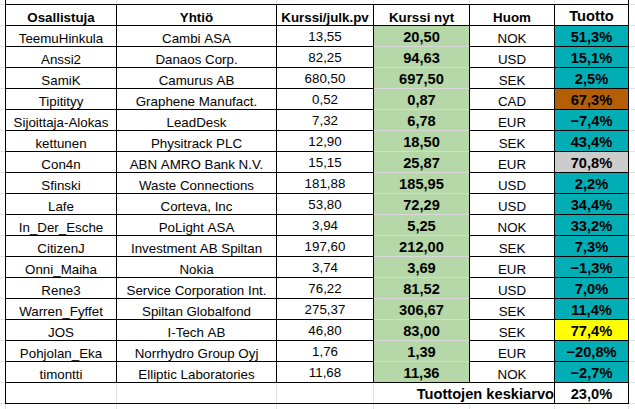
@JOS won the year-long review period with their proposal I-Tech AB, which, despite suffering a significant -28% stock price drop today, still managed to deliver an excellent 77% return. A strong performance, Congratulations!

@Con4n’s suggested ABN AMRO Bank also achieved very good ~71% returns and took silver! Congratulations!

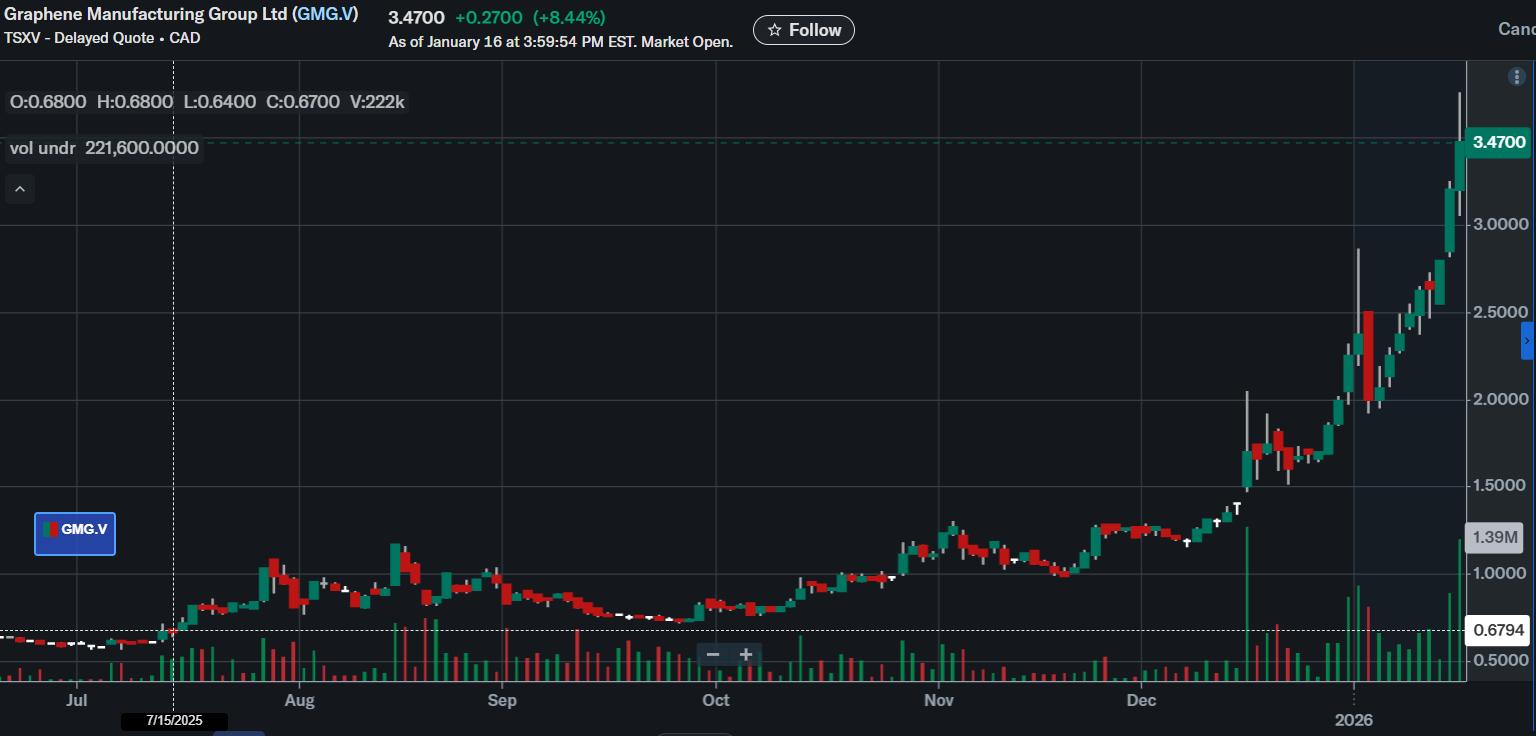
@Tipitityy’s proposal Graphene Manufacturing also close to the top, 67% returns. Congratulations!

There were also other strong successes, let’s highlight:
@_TeemuHinkula 51%
@kettunen 43%
@Lafe 34%
@In_Der_Esche 33%

image

The average return for the entire group was +23% per year. Maybe I should start following this competition and forget my own stock picks. :smiley:

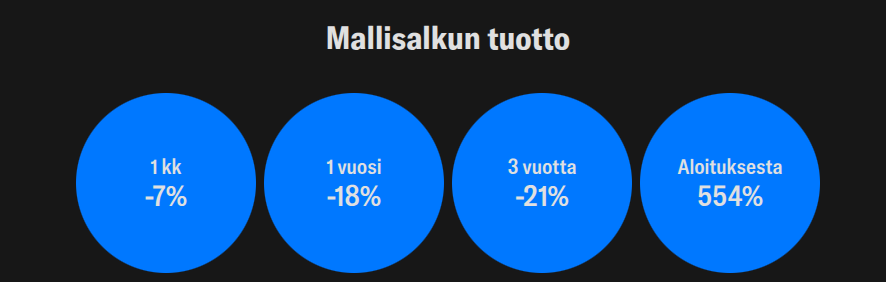
The benchmark might not be 1:1 relevant, but if there’s any consolation, the model portfolio has been beaten by the group. Of course, 1 year is too short a time to draw any real conclusions.

image

67 Likes

The clock just struck 9, and the official voting period for the competition has thus ended. You can still like, of course. :smiley:

For a while at the beginning of the competition, it looked like Uber’s pitch would take the win, but then from the back left came “Uber on steroids,” or Grab, as the person who submitted the pitch put it, and overtook Uber. Grab’s pitch garnered an impressive 94 likes within the official voting period! :1st_place_medal:

But whose pen gave birth to the winning pitch? Drum roll
 :drum:

@Ituhippinen Congratulations on a well-deserved victory! :trophy:

Securing second place in the competition was Uber with 70 likes, and DLocal took the third spot on the podium. Congratulations also to those who submitted these pitches, and a big thank you to all participants! :muscle:

57 Likes

Thank you very much @Tomi_Valkeajarvi !

I’ll take this opportunity to thank those who liked the posts as well.

But most of all, I thank the pitchers who take the trouble to chew up companies into a presentable format and share them with others! At least for me, these pitch competitions have been really good places to learn. Writing and reading pitches has also helped me notice what I should focus on to understand something about a company’s business model. Since everyone does this company “chewing” completely for free in their spare time here, it’s also nice to see that they are appreciated (precisely with these likes!).

Thanks also for organizing the competition! It’s good to create an external motivator to get oneself going and to strive to articulate one’s own research more simply. :handshake:t4: :slight_smile:

P.S. I don’t own Grab. Not yet, at least!

54 Likes

Congratulations @Ituhippinen on the win!:flexed_biceps:t2: Greetings from the runner-up, the writer who lost in the Uber pitch.:smiling_face_with_sunglasses:

As a competitor, it’s certainly frustrating to come in second, especially when the situation looked very good for me at the beginning. But as an investor, I am very satisfied! I had only superficially familiarized myself with Grab while learning about Uber, but I didn’t even know that Uber owns such a large share of the company. So, thanks for a great lesson!:folded_hands:t2: After all, the most important thing in this business is to learn something new every day and move forward.
41 Likes

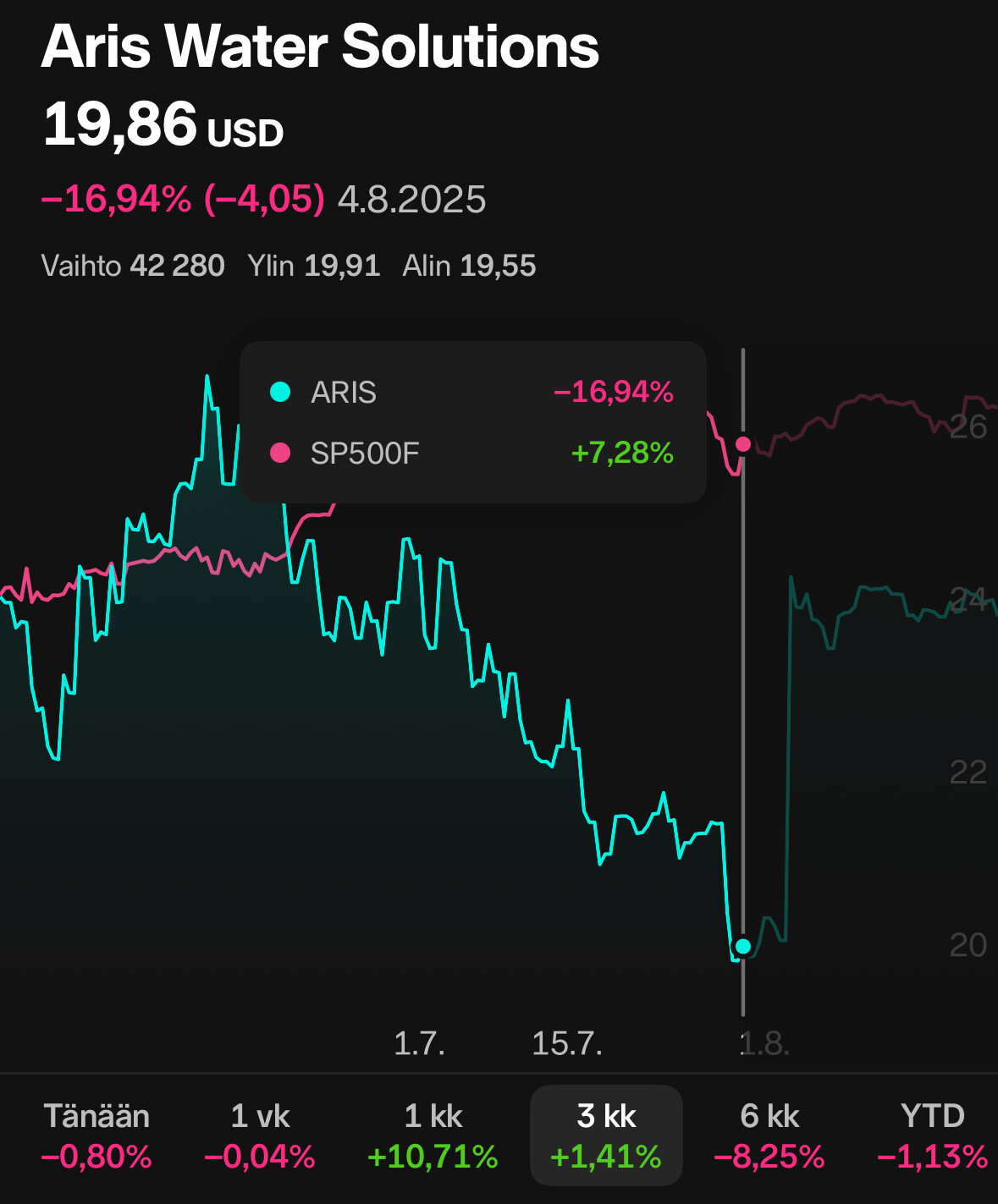
The competition is already over, but let’s share one more bonus pitch. This original pitch by @Sfinski was unlucky and lucky at the same time, as I received the pitch in advance on August 4th, before the competition was even announced. Why wasn’t the pitch included in the competition? Because a few days later, the company received a takeover bid. :face_with_crossed_out_eyes:

IMG_2843

I don’t know how the audience would have voted if the takeover bid had come during the competition, but this certainly deserves a special honorable mention. :star_struck: Here’s the pitch itself.
Bonus Pitch: Aris Water Solutions Inc.
image

Aris Water Solutions, Inc. is a leading, growth-oriented water management and solutions company specializing in unlocking the value of complex wastewater streams from the oil and gas industry by providing comprehensive, sustainable water treatment and recycling solutions with a focus on the Texas and New Mexico regions.

image

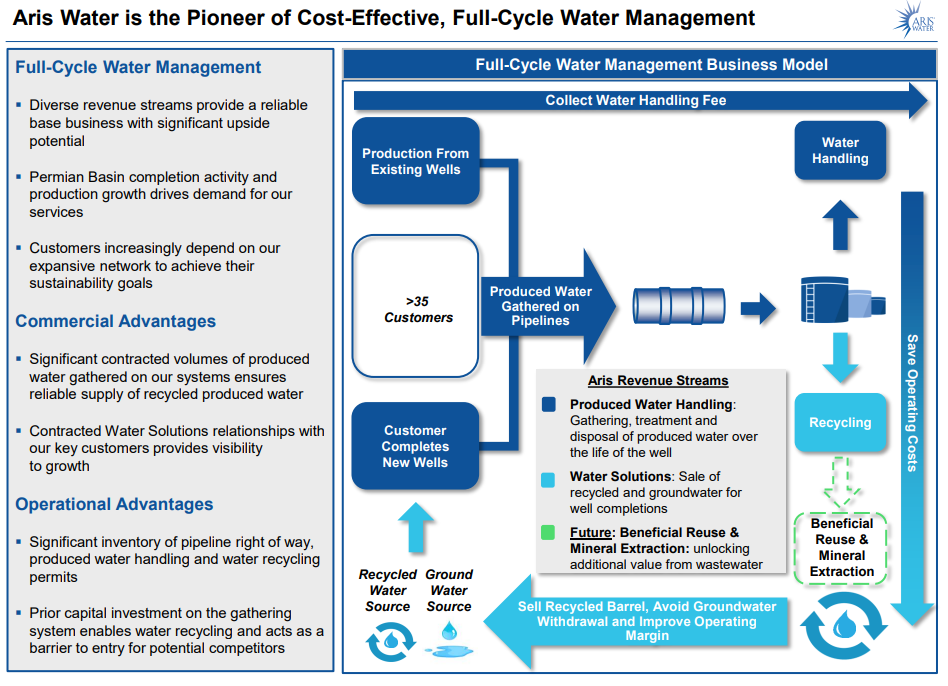
Aris Water Solutions primarily operates through two main revenue streams:

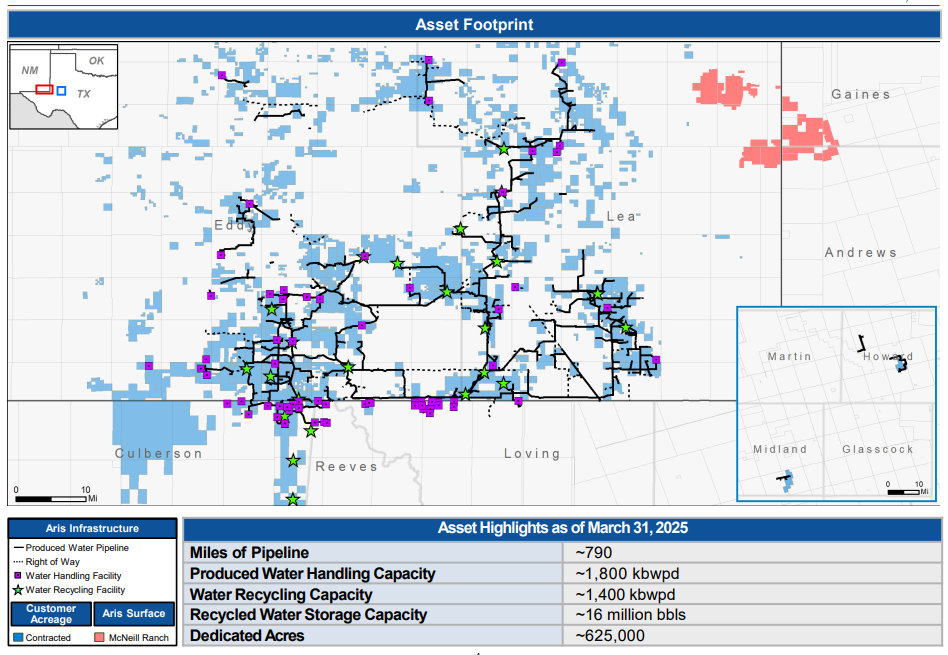
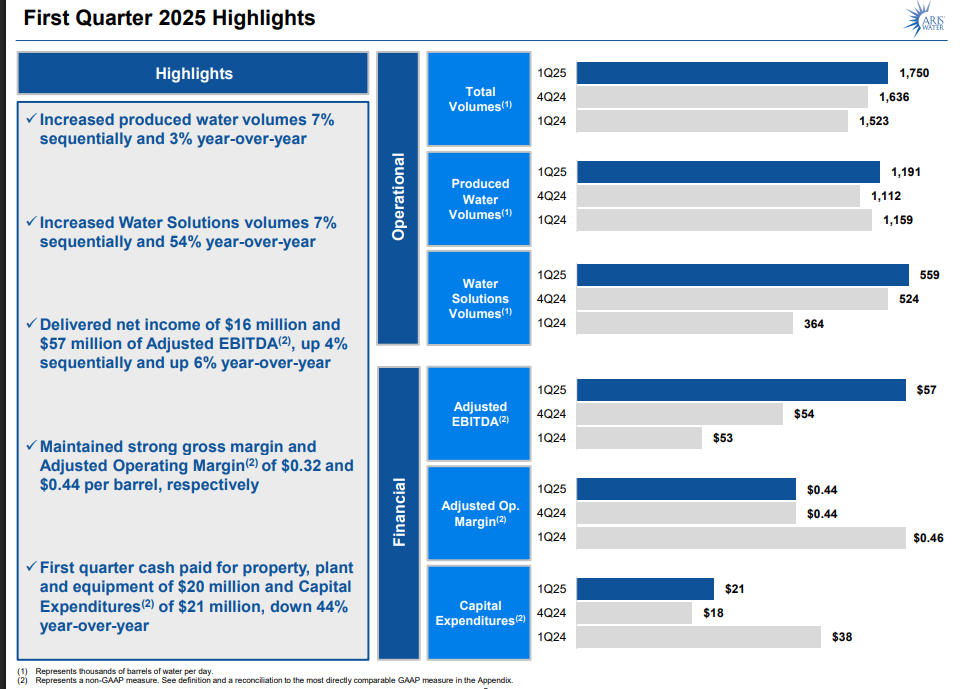
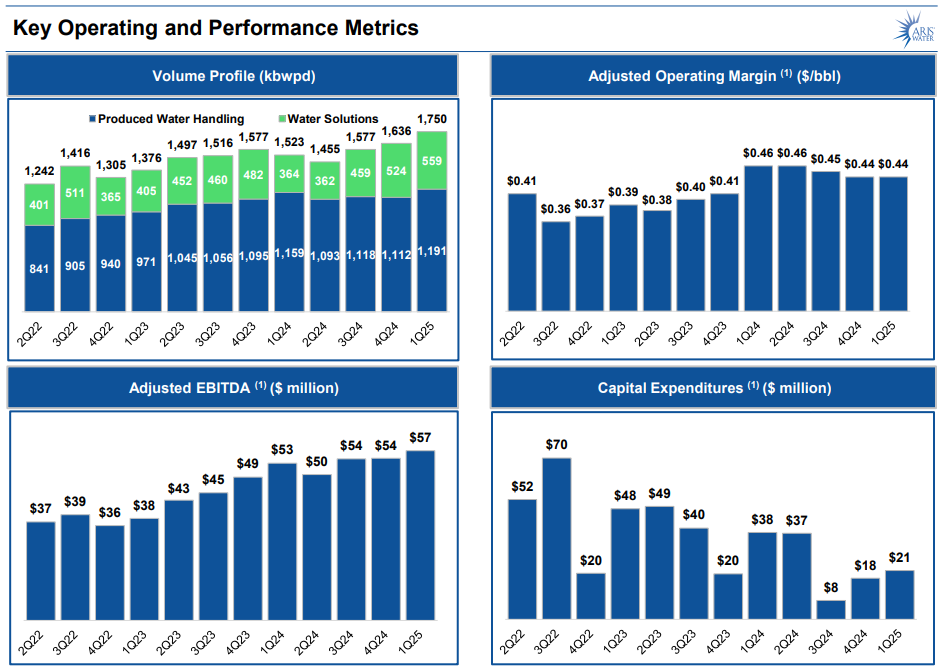
  • Produced Water Handling: This covers the collection, treatment, and disposal of produced water throughout the life cycle of a well. As of March 31, 2025, Aris had approximately 790 miles of pipeline and produced water handling capacity of approximately 1,800 kbwpd (thousand barrels of water per day).
  • Water Solutions: This includes the sale of recycled water and groundwater for well completions. The company has water recycling capacity of approximately 1,400 kbwpd and recycled water storage capacity of approximately 16 million barrels.
  • Future Revenue Streams – Beneficial Reuse and Mineral Extraction: Aris is developing and adapting technologies for the treatment of complex water for reuse across various industries. It is seeking permits for beneficial reuse, with preliminary permits expected in 2025 and initial water discharge in 2026. The company also focuses on identifying and extracting valuable minerals from wastewater commercially, with an iodine extraction site selected for commercial operations expected to commence by the end of the first quarter of 2026. Other minerals, such as magnesium, lithium, and ammonia, are being evaluated for technologies.

image

Positives:

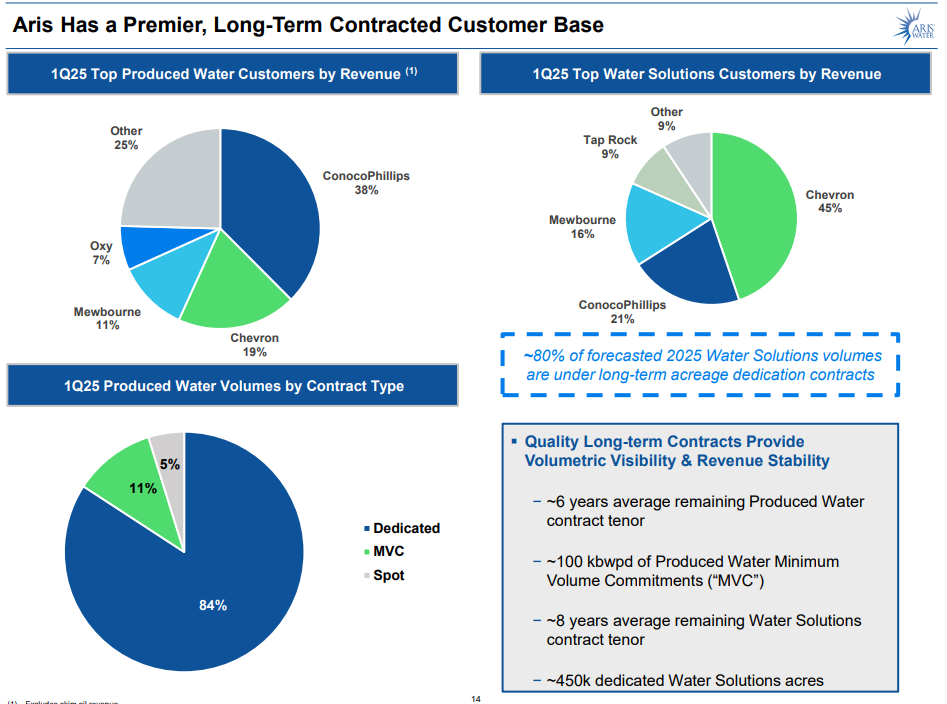
  • Premier, Long-Term Contracted Customer Base: Aris benefits from high-quality, long-term contracts with an average remaining term of approximately 6 years for produced water contracts and minimum volume commitments (MVCs) of approximately 100 kbwpd. For water solutions, approximately 80% of projected 2025 volumes are under long-term acreage dedication agreements with an average term of approximately 8 years. This provides volume visibility and revenue stability.
  • Aris focuses on high-return organic growth opportunities with existing customers and is selectively open to new customers and projects. It also thoughtfully evaluates opportunistic, strategic acquisitions based on strategic fit, technology, financial returns, and customer quality.
  • Aris maintains strong balance sheet strength and flexibility, with $347 million in available liquidity through its revolving credit facility as of March 31, 2025, and a leverage ratio of approximately 2.2X (target 2.5X–3.5X). The company successfully refinanced its senior notes, demonstrating strong investor confidence.
  • The company has a policy of sustainably increasing shareholder returns and has declared its fifteenth consecutive dividend of $0.14 per share, while also considering potential share buybacks.

image

image

image

Negatives:

  • Reliance on Oil and Gas Industry Capital Expenditures and Commodity Price Volatility: The demand for Aris Water Solutions’ services is directly tied to the capital expenditures of oil and gas companies in the Permian Basin. These expenditures, and thus the demand for services, are highly dependent on domestic and foreign political and economic conditions, particularly the level and future expectations of oil and natural gas prices. If commodity prices remain volatile or decline, it could lead to a reduction in customer drilling and completion activities, a decrease in demand for Aris Water Solutions’ services, and a deterioration in contract prices and revenues from oil by-products exposed to crude oil price fluctuations.
  • Intense Competition and Potential In-House Management of Services by Customers: The company operates in a highly competitive industry for both produced water handling and water solutions. Competition may intensify if competitors expand their operations or if current and potential customers decide to manage their water services in-house rather than outsourcing them to companies like Aris Water Solutions. This competitive pressure could adversely affect the company’s ability to maintain current revenues, expand operations, and renew or replace expiring contracts on acceptable terms, potentially leading to a loss of market share.

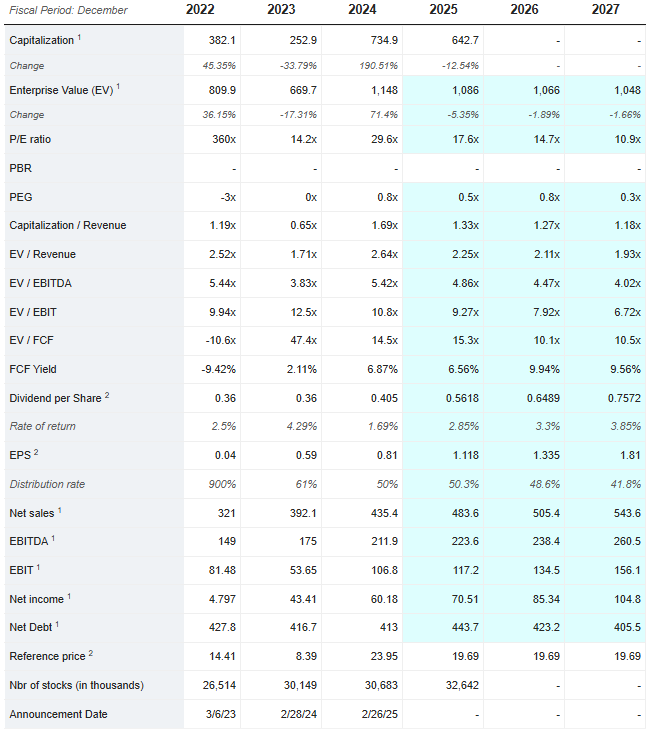
After Friday’s decline, valuation levels have recovered slightly, although it still cannot be called cheap, given that it is indirectly an oil/gas sector company. However, decent growth is expected.
image
image

38 Likes

Who will lift the cat’s tail if not the cat itself. :grinning_cat_with_smiling_eyes:
A little over a year and here we are :rocket:

image

39 Likes

It’s been quite a while since the last competition, and now might be a great time to set up the next pitching contest. Especially since we’ve seen some serious rotation driven by AI disruption fears, and many a company has been beaten into the ground—even though looking at the indices, you might imagine the stock markets are going through a boringly calm period without any major movements. :smiley: On the other hand, there are also those whose business is genuinely under threat.

So, what are your best investment ideas right now? Tell us and you could win amazing prizes as well as, naturally, plenty of fame and glory! :trophy:

Competition rules:

  1. Pitch what you consider the best investment target (long or short) by sending your pitch to me as a private message. I will aim to post the pitch to the thread as soon as possible without revealing your username.
  2. The entry period lasts until Wednesday, 25.2. at 12:00.
  3. Voting takes place by liking a pitch. You can give likes to as many pitches as you want.
  4. The voting period ends on Sunday, 1.3. at 21:00, at which point I will conduct the vote count.
  5. The winner is the one whose pitch receives the most likes. The winner’s username will be revealed after the competition is settled, unless the participant requests otherwise.

Prize: 12 months of Inderes Premium (value €200) + a surprise prize sent by mail (priceless). :gift:

Finally, a disclaimer:

Messages from competition participants should not be interpreted as investment advice. Participant messages are intended for informational and entertainment purposes only. Any statements, estimates, and forecasts are the views of their respective authors. Referring to the forum rules, individual investment advice is a licensed activity and therefore prohibited, but general discussion about companies and shares is permitted. Inderes is not responsible for the content or accuracy of the information presented. Forum users are responsible for their own investment decisions and their results.

Now, go ahead and tell us your best investment idea! :money_mouth_face:

23 Likes

Pitch #1: iShares Brazil LTN BRL Govt Bond UCITS ETF

An ETF that invests in Brazilian government bonds. Brazil has the world’s second-highest real interest rate after Russia. The SELIC policy rate is 15% and inflation is 5%, meaning you get a risk-free 10% return, albeit with currency exchange risk. Usually, when the Fed eases, Latin American EM currencies have strengthened. The fund’s running yield is 12.95%.

DE000A2QP4D2

BlackRock

iShares Brazil LTN BRL Govt Bond UCITS ETF (DE) | BLTN

The fund aims to track the performance of the J.P. Morgan Brazilian Zero-Coupon (LTN) Bond Index (Index) as closely as possible.

19 Likes

Just a reminder that the competition is anonymous. Send your pitches to me via DM and I’ll publish them. :grinning_face_with_smiling_eyes:

3 Likes

Pitch #2: IONQ - An American Quantum Technology Company

Background:
The subject matter is truly challenging and requires a lot of dedication. The entire industry is still in its early stages, meaning we are currently reading story number three from the Arabian Nights. Therefore, I will list the main points here in summary and provide more background material as links at the end. This investment is only suitable for someone who has a natural interest in researching companies in the field. This will be a bit of a jumble, apologies. I’ll try to pick out the essentials.

Business:
I became interested in this myself last summer when I noticed IonQ had acquired the British company Oxford Ionics. In my opinion, Oxford Ionics’ technology provides a technological edge over competitors, especially regarding the scaling of qubit counts.

I have sifted through a bunch of companies from the perspective of technology and business potential, and I believe this company stands out as one that has a realistic chance of achieving the breakthrough that has been expected for decades.

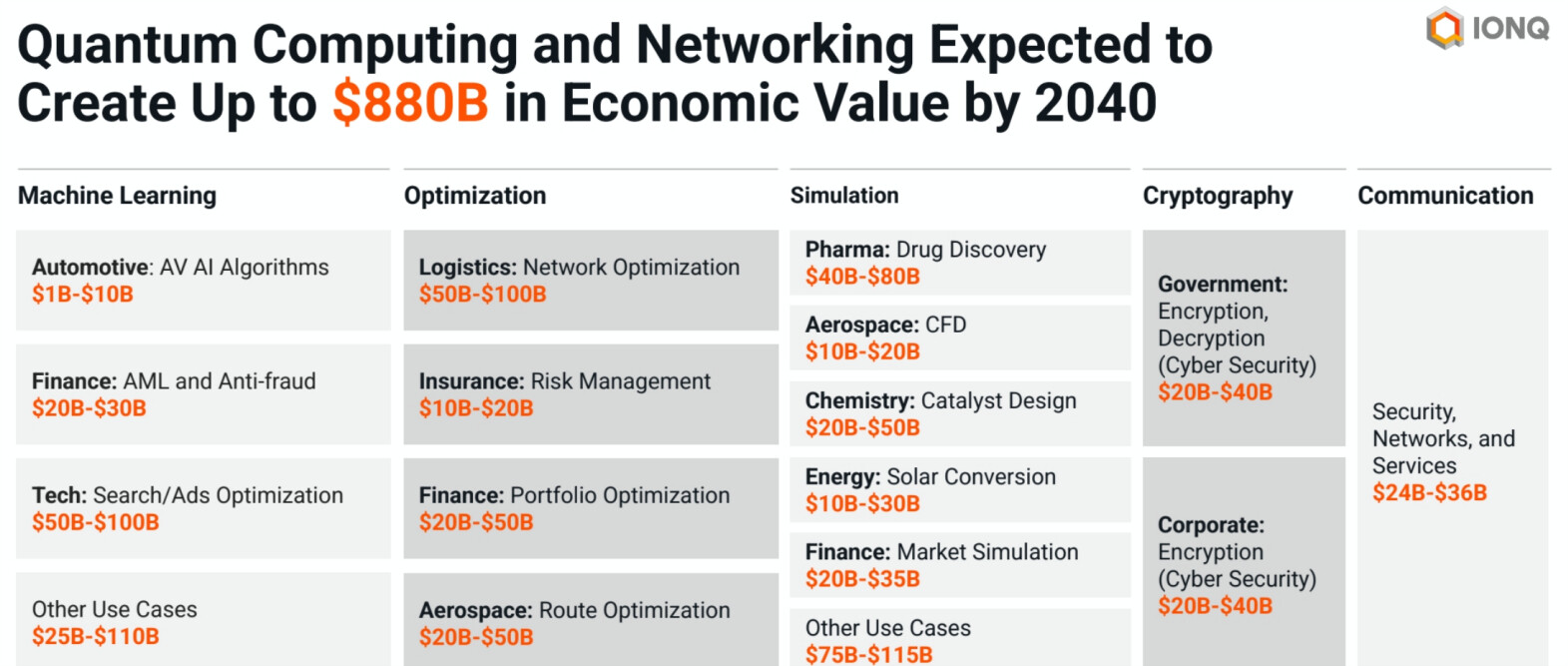
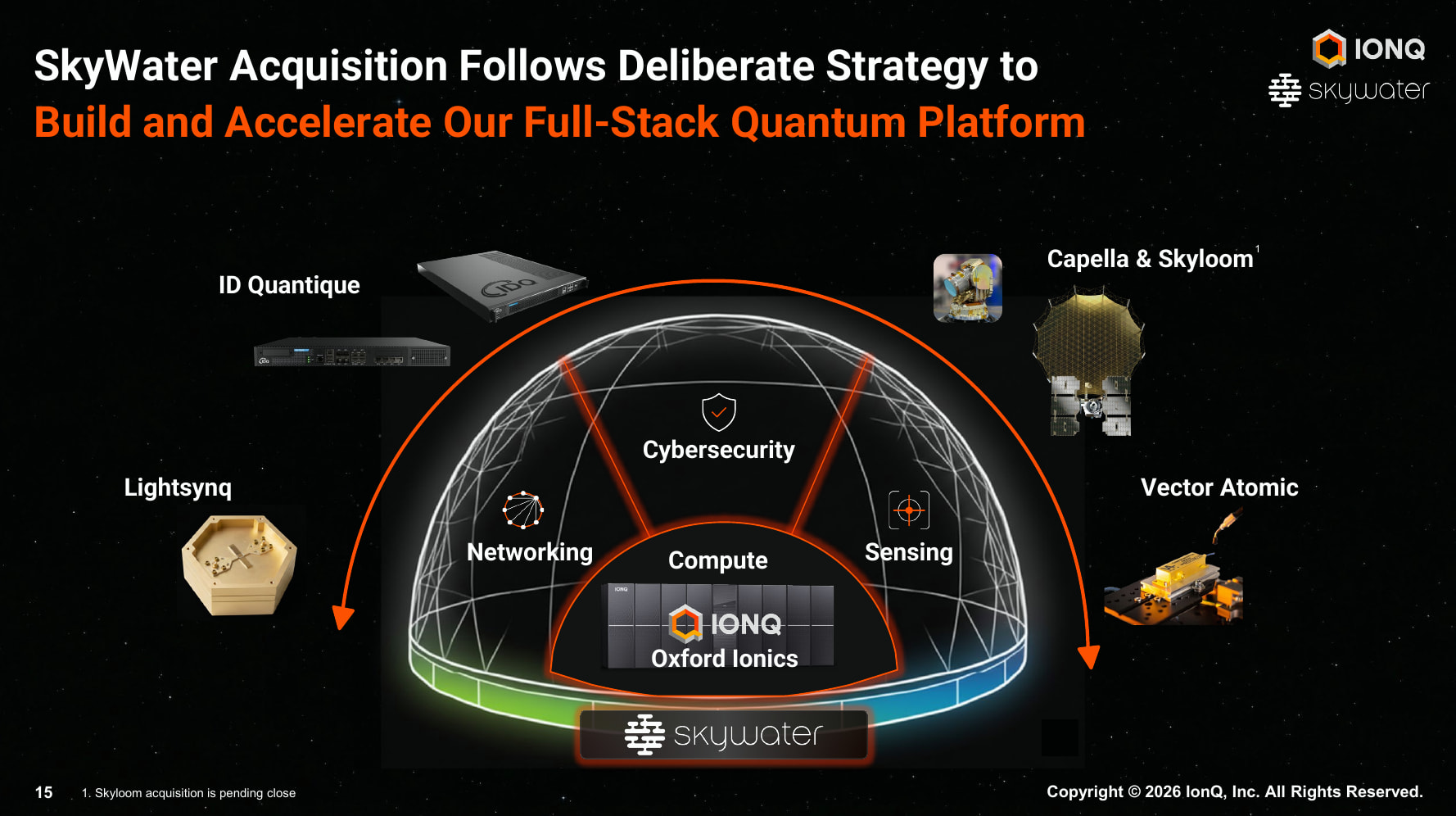
IONQ operates in every area of the quantum business. It has made aggressive acquisitions over the past year and is active “in every area” (security, networks, sensing, computing). Metaphorically, this company is a kind of internal ETF for the quantum sector.

Business of Quantum / Economic value:

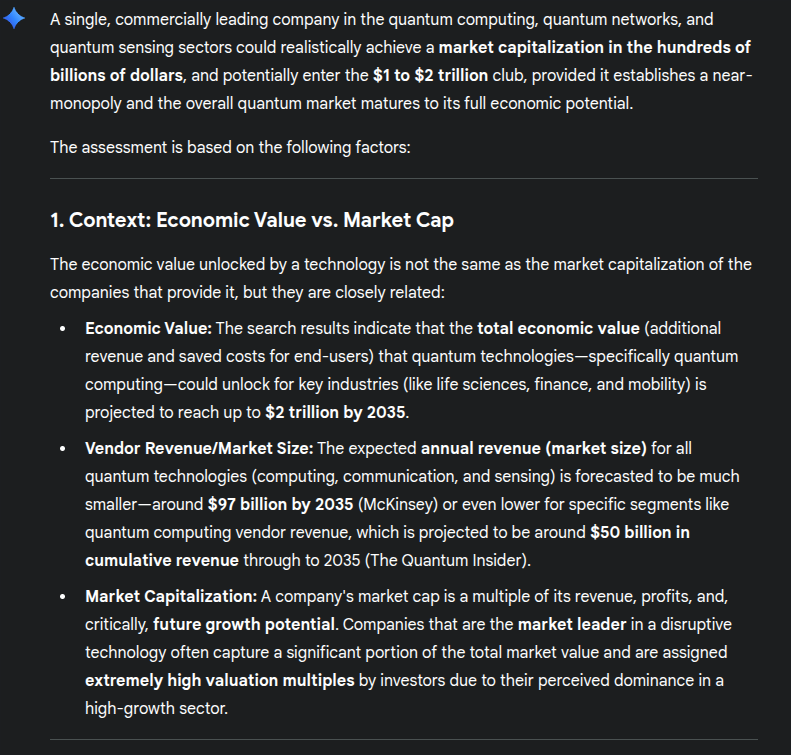
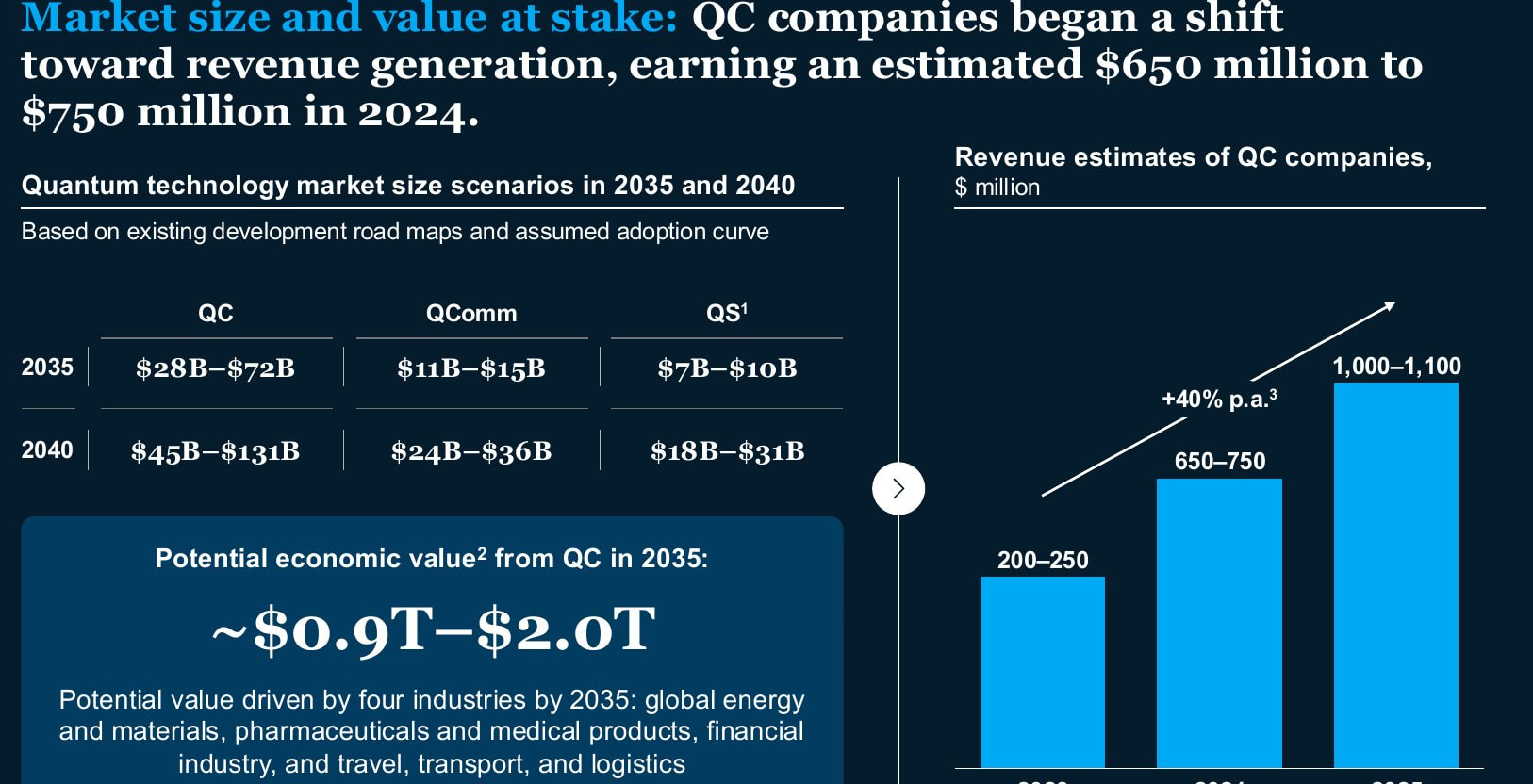
McKinsey estimates that quantum technology will generate 1-2 trillion in ‘economic value’ during the next decade.

Regarding McKinsey’s June 2025 report, I would say the timelines are ‘oldish’ in my opinion; they don’t account for the latest developments in companies’ roadmaps (mainly regarding IONQ). I see this materializing even 5+ years earlier.

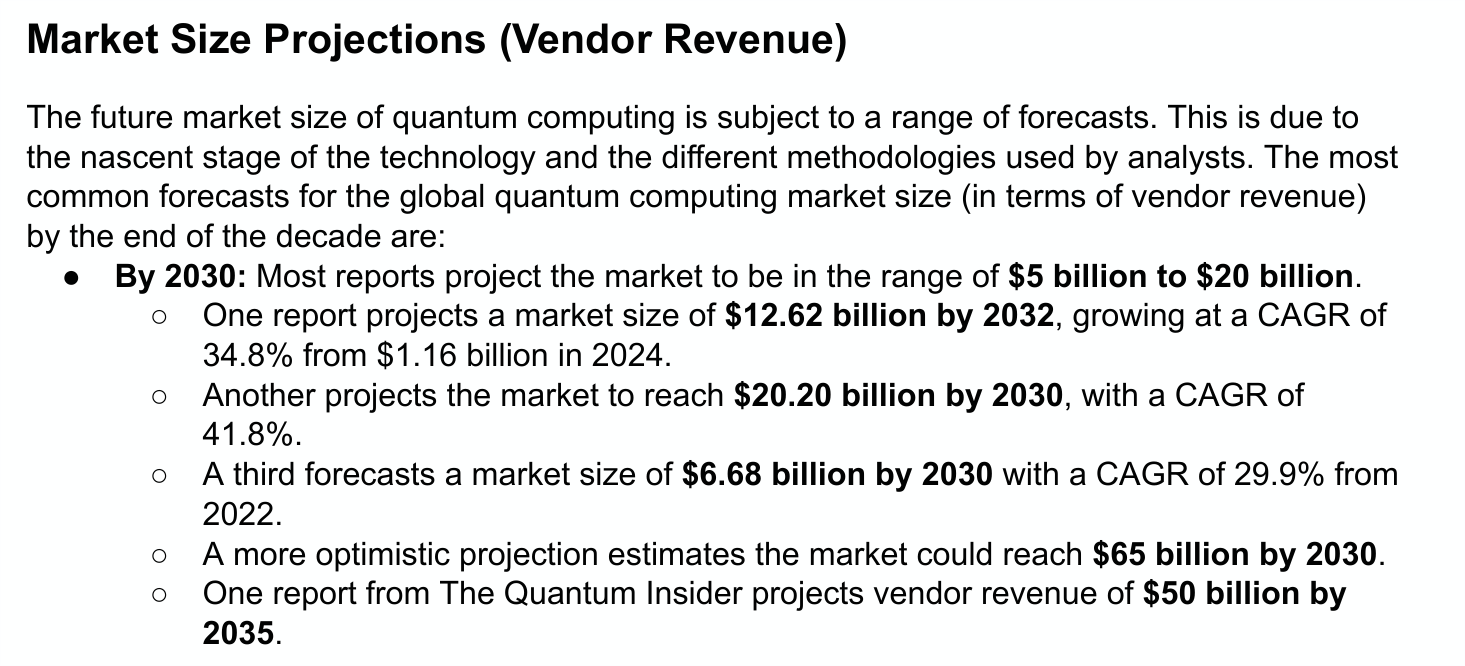
Vendor TAM, which is the essential one for companies in the field:

Depending on the source, figures such as 20–100 billion have been presented for around 2030–2035, with the largest being around 200 billion later.

The truth is that the market will be entirely new, and no one knows the exact answer. Typical for technological disruptions, it’s also possible that a large portion of ‘use cases’ will only be invented later. The market will likely grow for decades.

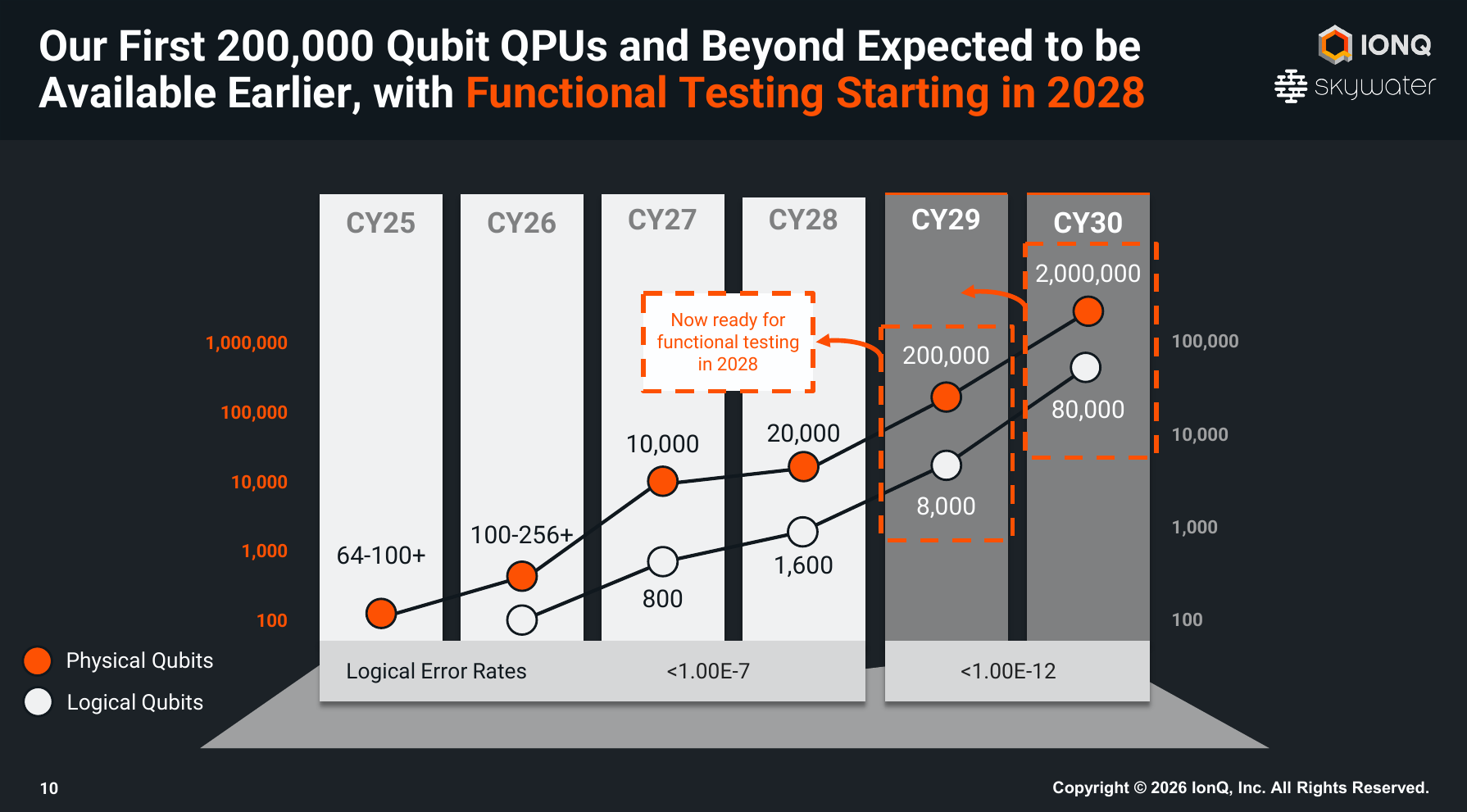
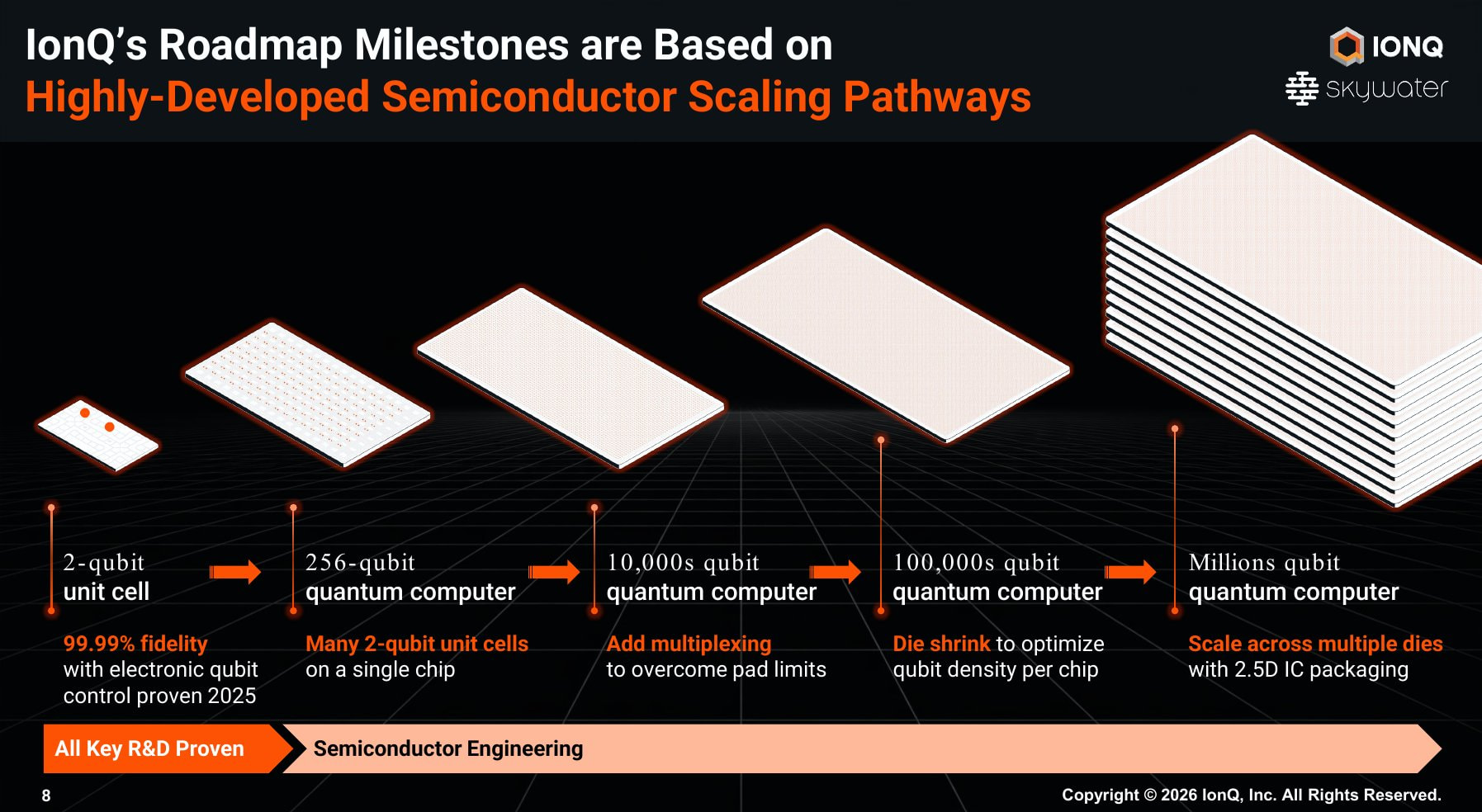
Computers (QC, i.e., quantum computing) are the most interesting part, around which the whole thing is more or less built. The billions will come particularly from there. Below is the IonQ roadmap; these roadmaps are the most important metrics for where we are headed.

After all the activity, IonQ claims to have solved the issues related to quantum physics. Now it’s mainly about scaling qubits using standard circuit boards. For this purpose, Oxford Ionics specifically, and later SkyWater, were/are being acquired.

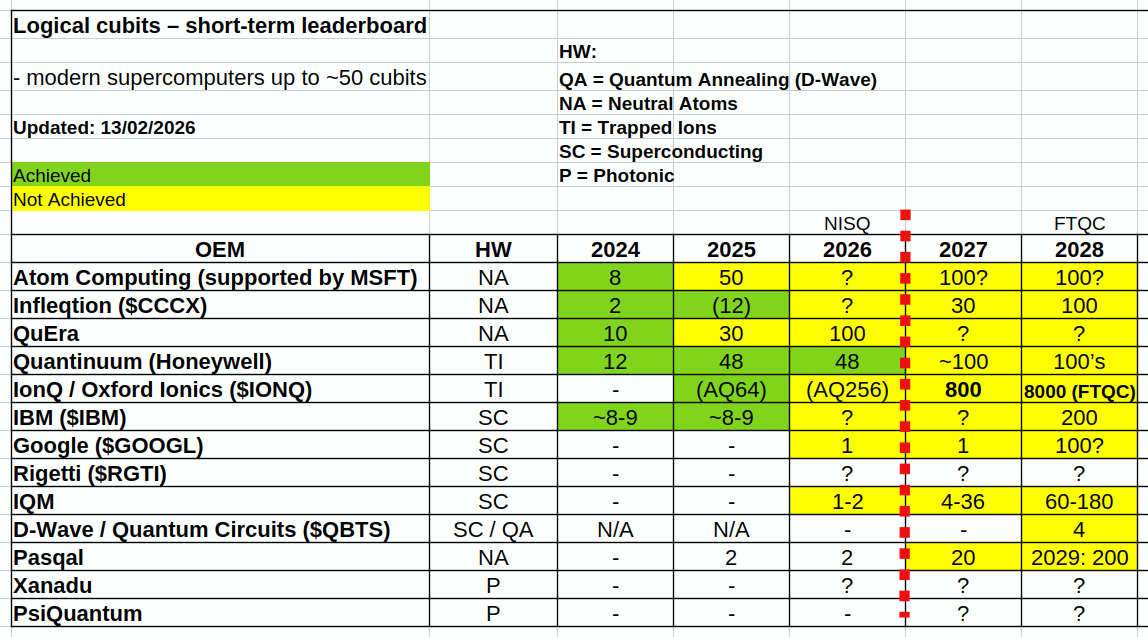
I’ll summarize the QC competition situation in this logical qubits leaderboard table. I won’t elaborate further on the content here. Hopefully, this background work helps you get started if anyone else becomes interested in the topic.

I have had some discussions with Gemini; here are a few highlights. For example, a range for market caps for a player that would get a good grip on the entire market after achieving a breakthrough (an FTQC-level quantum computer).

Conclusion

Given the $1-2 trillion economic value potential often cited for the application of quantum technologies, and the historical precedent of market-leading, disruptive tech companies capturing a large share of that value:

  • Realistic Near-Term Cap (Leader): $100 billion to $500 billion. This is achievable for a clear leader once the market matures into a multi-billion-dollar-per-year revenue stream.
  • $1-2 Trillion Potential Cap (Dominant): A market capitalization in the $1 to $2 trillion range is achievable for this single company, but only if:
    1. It is the undisputed, full-stack leader across all three quantum domains.
    2. The quantum market matures fully, hitting the high end of revenue forecasts.
    3. Investors maintain a high confidence in the company’s long-term growth and its ability to continually capture a significant portion of the trillions of dollars in economic value created by its fundamental technology.

One way to conceptualize this is to start thinking about individual companies. What if company X decides to use a quantum computer that has entered the market? Say, medicine, logistics, materials science, investment banking, defense/government, etc. How do I maintain my competitive position? For this, I asked Gemini for an assessment of Fortune 500 companies:

Background materials to help with the deep dive (some of my link texts are in English)

Summary

Other:
I’m attaching the relevant IonQ presentations (analyst day and skywater) :smiley:

IonQ-2025-Analyst-Day-Presentation-2025-09-12-vFinal.pdf (8.8 MB)

IonQ-to-Acquire-SkyWater-Technology-2026-01-26-vFinal.pdf (3.3 MB)

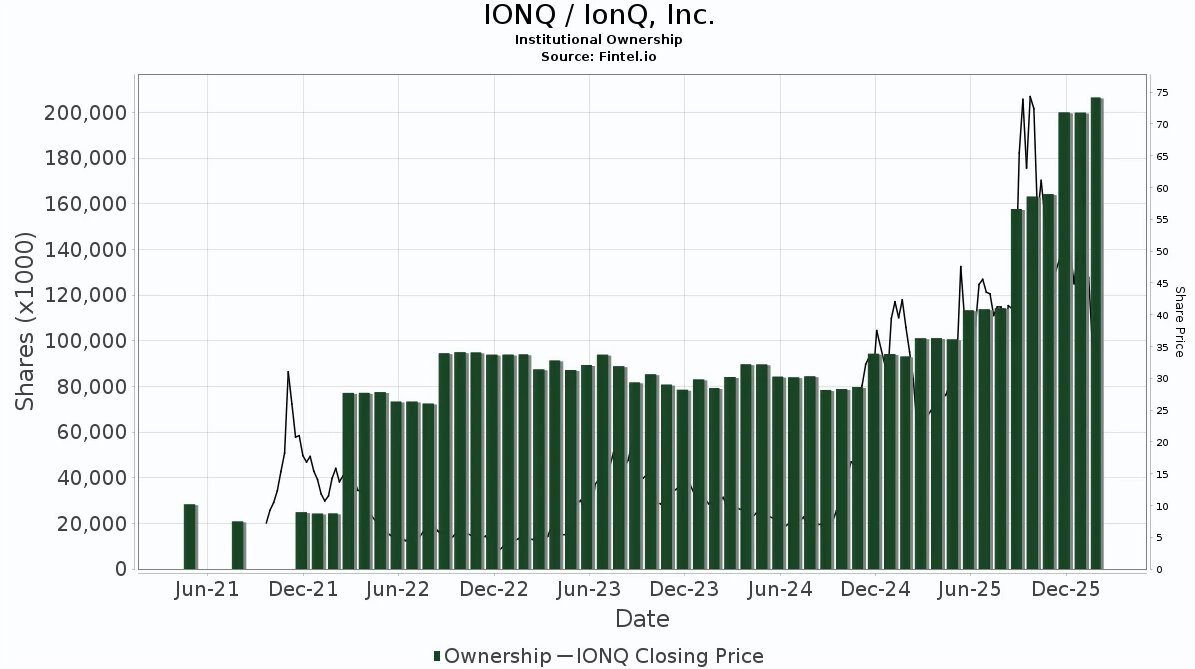
At the beginning of February, institutional ownership was around 60%.

Investment theses, risks, and opportunities (summarized):

  • technological edge seems promising (impossible to confirm without some level of familiarity with different companies)
  • entirely new market, growth opportunities for decades
  • winner-takes-all quite strongly (the entire world is available for the supplier of the first good quantum computer, in a world where the significance of data has grown exponentially)
  • A rare so-called defense prime opportunity available if an American company takes the market leader position. To join the ranks of? (GE Aerospace, RTX, Boeing, Lockheed, Northrop, General Dynamics, L3 Harris, etc.)
  • decades of work across the entire industry would bear fruit over the next couple of years; many key people in the companies have spent up to 30-year careers advancing this. One has the chance to “pick the cherry off the top” with a relatively short wait (if you get it right)
  • a key player has the opportunity to dominate quantum computing / sensing / networks / security ecosystems
  • market cap currently ~$12bn; potential is at minimum 10x. Hype is absent from the stock price because the general public has not studied / does not understand the massive strides being taken in the field. I.e., an opportunity to get in early; quantum stocks have come down and, in my opinion, are not at hype prices.
  • unfortunately, 9/10 quantum companies are “trash.” By that, I mean if you aren’t the first to bring an FTQC machine to market, you’ll have to settle for smaller crumbs or fight for your existence once the winner is clear. The importance of stock picking is emphasized. There is real business in those companies, but there are shady operators as well.
  • Early-stage technology; high risk level. Conviction is not born without your own research and time commitment.

* The firm could lose >99% of its value if it encounters insurmountable challenges. By far the greatest technological risk is failing to deliver on the quantum computing roadmap.

  • Other risks include integrating all acquisitions (technology, people, culture) into a cohesive whole. On the other hand, there has been a very clear “common thread” in the acquisitions, and it is easy to see the rationale behind each purchase.
  • It requires patience from the investor. Furthermore, one must be able to filter out the CEO’s own marketing hype, as well as all the immense noise and chatter (the Googles, IBMs, and Microsofts of the world easily generate major headlines).
  • The company has been constantly poaching talent from all its key competitors. This speaks volumes.

A final tip: When researching companies, always ask “when did they power on?” Most competitors have never actually switched their machines on; some have (e.g., IBM, Infleqtion, IQM, Quantinuum, Atom computing, etc.).

29 Likes