Paragon Ag – Automotive subcontractor that hit the COVID wall

The pace of news is brisk. Now, from Delbrück, the outlook for the next five years until 2027 has been outlined. In bullet points, they are:

  • Revenue over EUR 300 million (currently approx. EUR 175 million)
  • Focus on North American sales (sales office opened)
  • Strong growth in the Power business unit’s sales in the medium term

For 2023, the targets are:

  • EBITDA 12-15%
  • Revenue over EUR 170 million, meaning the Semvox divestment will be compensated for

First, regarding next year’s figures. When the company’s market cap is EUR 25 million, even a rough back-of-the-envelope calculation shows the figures are contradictory. EBITDA at the upper limit would equal the entire market cap. Free cash flow is not yet known, but the figure should become clearer next year. The base assumption is EUR 10-15 million. 2023 and 2024 are still years for paying down debt, but eyes are already turning to the future.

In recent years, there has been tension over whether the mountain of debt would sink the ship. Following the Semvox sale, the CHF bond redemption and potential additional Eurobond redemptions (min. EUR 5 million) will drop the debt level to approximately EUR 75 million, possibly lower. Interest expenses will not decrease in the same proportion because the Eurobond interest rate is higher than before.

Paragon will likely prioritize paying off other loans if covenants allow. Relative to inflation, the interest rate (6.5%) is not even impossible if Paragon can manage to pass increased costs into its contracts! In any case, as the risk level decreases, loans will be refinanced at lower rates.

Looking further ahead, growth in the Power unit seeks a fresh start powered by lithium-based starter batteries. Paragon acquired the technology from the portfolio of its former subsidiary Voltabox. Paragon has produced starter batteries before (starting around 2014-15), so this is not a new expansion. Investors are more interested in profitability and the amount of capital tied up than just revenue.

A CMD (Capital Markets Day) wouldn’t hurt to explain in more detail what achieving this growth requires and what the EBIT level will be in the future. Historically, the base level has been between 8-12%, but there is still a way to go.

In a bull scenario, revenue grows steadily toward the EUR 300 million target and EBITDA hovers between 15-20%. Debt does not consume the cash flow and leverage is brought under control, which should leave enough for shareholders as well. If 5-10% of revenue trickles down to the bottom line, we are talking about a result of EUR 15-30 million, roughly EUR 3-6 per share.

The figure is appetizing, but should be taken with a grain of salt. This is a back-of-the-envelope calculation and susceptible to swings in the automotive industry.

https://ir.paragon.ag/websites/paragon/English/4250/news-detail.html?newsID=2397357

3 Likes

Apparently, 10 MCHF of the Swiss franc bond has already been redeemed in advance a couple of days ago. It was a somewhat unusual move to carry out a partial redemption of half just a few months before the final buyback. The redemption offer was 92.5% of the par value + interest, so the financial benefit of the redemption is in the region of 0.5 MEUR. This unexpected redemption move is a small flexing of muscles toward the financial markets.

The decrease in the debt ratio has not been reflected in the share price development. Automotive suppliers are not the sexiest investment targets, and the rise in interest rates and inflation tightening consumers’ wallets may show up in Paragon’s order book with a delay. Paragon’s products lean toward premium models, and those tend to always find their buyers.

A bigger problem could be the loss of position for the German automotive industry (read: VAG), but Paragon also has its foot in the door of Chinese brands. Still, it would take a hit. Top of the wish list would be at least a few somewhat normal years. There have been spanners in the works at every turn. The last normal year was 2019…

With the clearing of the debt mountain, there is more money available for developing operations. The special situation that has overshadowed the company is fading away, and after this year, the ratio of debt (60-70 MEUR?) to free cash flow (estimate 10-15 MEUR?) should be sufficient for a reasonable refinancing rate and mandatory Eurobond redemptions for the years 2025-27. Much depends on how large the upfront investments required for the planned revenue growth will be.

Preliminary information on the financial year’s figures has been received during the first couple of months. We have to wait for the actual earnings release in traditional style until the end of April (sic!). The analyst following the company could take a proper winter break.

Addition: By the way, the Paragon case has been the most rewarding of my “investing career.” In euro terms, the position is currently somewhat in the red, but the case has taught me a great deal about business crises and thinking through different scenarios!

3 Likes

Preliminary information on the FY2022 numbers arrived as expected.

  • revenue EUR 172.9M (EUR 160.1M without the Semvox unit for sale), +17.7%
  • 2023 revenue target EUR 170M, EBITDA% 12-15%

No estimate was provided for free cash flow yet, so that remains a topic for the earnings release at the end of April. This year’s theme is, unsurprisingly, paying back debt. The sale of Semvox will be finalized during Q2.

The final redemption amount for the Frangibond was CHF 8M, followed by an offer to buy back EUR 5M worth of Eurobonds. Apparently, 5 million is the upper limit for the purchase amount, not the nominal values. The amount used for the purchases likely stems from the decrease in inventory levels and the receivables that were elevated in Q3. Some might originate from the financing agreement related to the sale of Semvox.

In any case - it looks good and the threat of bankruptcy has passed.

https://ir.paragon.ag/websites/paragon/English/4250/news-detail.html?newsID=2439683

1 Like

I added to my Paragon holding today. The bogeyman of default risk has been banished, and it seems the market hasn’t sufficiently updated its view in a positive direction. In my reasoning, Paragon should account for both an improving earnings component and a higher valuation multiple.

Earnings are most improved by the decrease in interest and financing costs, estimated at €3–4.5m/year. At its peak, this is one euro per share (share count 4.4m). Regarding the 2023 result, the impact remains at about half (40–45c/share) as the bond maturity and redemption fall in April and July, but for 2024, the decrease in interest expenses is already above the €1/share level due to additional debt repayments. (The exact amount depends on, among other things, investments and the success of buybacks.)

The business is generating the promised 12–15% EBITDA (€20–25m). Based on current information, the EPS estimate for the current fiscal year is €0.5, adjusted for one-off items. At the current share price (approx. €5.2), the P/E ratio is around 10–11, and for next year, it would be around 5–6.

Edison Group’s analyst updated the figures last week and reached the same conclusions as yours truly. The analyst is a bit more optimistic in their numbers than I am, but better this way.

The €26.6 per share DCF value would be a multiple of 15.6x our notional post disposal FY24 EPS estimates (Exhibit 2). While this might look ambitious today, we feel that such a multiple could increasingly be supported by fundamental metrics, as ongoing debt reduction reduces risk.

(A P/E of 15 is hardly realistic for an automotive supplier, but the figure is of course understandable as a result of the DCF calculation. A realistic P/E ratio is likely somewhere in the 11–14 range, depending on growth.)

Corrected link:

4 Likes

Volkswagen Group’s estimate for this year’s delivery volumes is a boon for Paragon’s business.

  • Group Outlook for 2023: deliveries expected to rise to about 9.5 million vehicles; sales revenues to increase by between 10 and 15 percent primarily driven by the strong order backlog on hand…

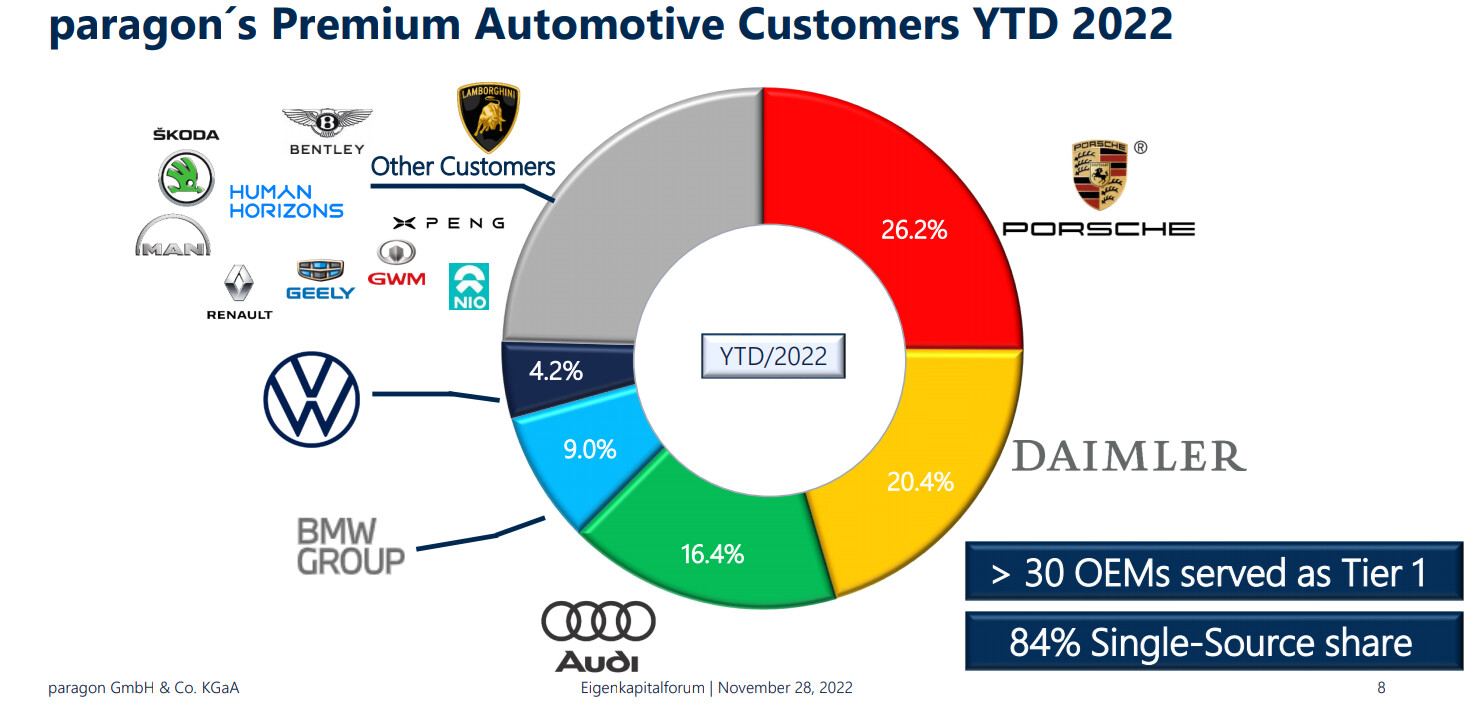
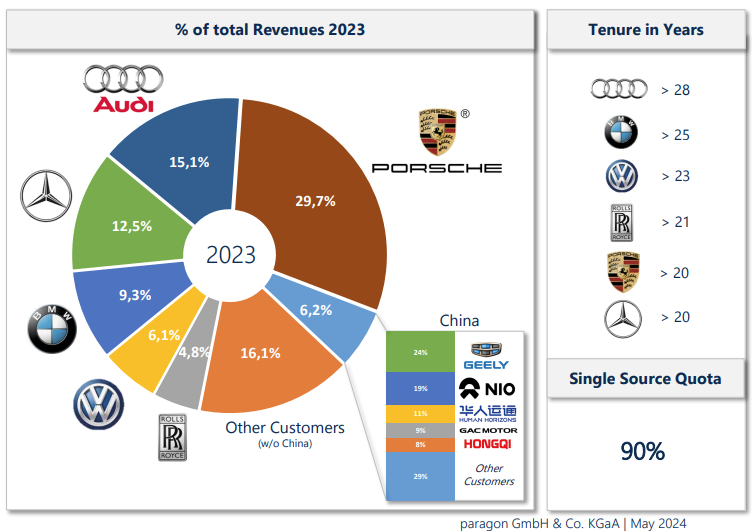
For comparison, the delivery volume for 2022 was 8.2 million cars, so the growth would amount to 15-20%. The chip shortage clearly seems to be behind us. VAG brands represent approx. 50% of Paragon’s revenue (image below), so the success of the Wolfsburg giant is fully reflected in its suppliers’ order books.

In this light, Paragon’s revenue growth estimate for the current year seems slightly conservative.

3 Likes

The Eurobond was held onto more tightly, and only 1.7M EUR (nominal value) worth of notes were tendered for the offer, which was priced well below par.

In my view, however, it is a good sign that the buyback offer did not cause investors to rush for the exit. With the redemptions in the early part of the year, the debt amount decreased by roughly 10M EUR.

The skiing holiday season for the Paragon investor is over, and the start of April will be busy right away.

  • The Semvox deal will likely be completed during the current month, because…
  • The remainder of the Frangibond (12.5M EUR) must be redeemed on April 23.
  • The annual report and the final figures for 2022 will be published on April 26.
    At the same time, preliminary Q1 results will likely be published at some point.

Additionally, the Q1 results will be published on May 12, so there will be plenty to follow over the next 5–6 weeks.

1 Like

Nah. The Semvox deal is still awaiting final confirmation (I don’t doubt it will go through), so the business reviews (FY20002, Q12003) are moving to the end of May (May 22), as is the confirmation of the Semvox deal.

The franc bond, on the other hand, has been redeemed—which was likely handled with a bridge loan and cash flow. I assume this was part of the Semvox deal terms and is guaranteed by the buyer (Volkswagen), so that the selling party doesn’t end up in an unreasonable predicament due to the delays.

Actually, they didn’t; the Q1 figures were released as early as May 12, immediately after the confirmation of the Semvox deal.

Key points:

  • revenue €45 million, +14.3% (comparison period was relatively weak)
  • EBITDA unchanged (€5 million)
  • bond redemptions continued, CHF bond fully repaid, Semvox deal completed
  • full-year revenue guidance €170 million and EBITDA €20-25 million (approx. 11-16%). Improving gradually, as communicated in December. I consider the revenue guidance conservative in light of the Q1 figures.

Positives:

  • sales are strong and debt levels will drop during Q2 (Semvox sale finalized)
  • no mention of chip shortages, apparently “last season”; I also expect freight and energy costs to decrease gradually
  • new Power segment (starter batteries) is growing rapidly (yes, from a starting level of ~0). Orders received (now €40 million), providing an additional revenue pillar. (Note: no information on margins or capital requirements)

Negatives/Questions:

  • The Mechanics segment’s EBITDA% (0.1 vs. 8.5) is fluctuating wildly. It accounts for about 1/3 of the total revenue, so it weighs down the figures significantly. The reason is unclear to me. However, the full-year EBITDA target is 12-15%, so performance should improve as the year progresses.
  • EBIT level is still weak, but Q3 figures will reveal more about business performance once the Semvox deal is behind them and the business operates with a lower debt level than in the first quarter.

Observations:
Reading and evaluating the balance sheet is difficult because the situation is naturally from the end of Q1, and significant events (CHF bond redemption, transfer of Semvox sale proceeds, larger EUR bond redemption) will only appear in the Q2 figures. At the same time, the “bridge loan” used for early bond redemptions and the final redemption of the Swiss franc bond in late April will be cleared from the balance sheet.

Additionally, there are items on the balance sheet related to Semvox (assets/liabilities associated with assets held for sale), and their final impact on the purchase price is unclear to me. I assume that goodwill and capitalized R&D no longer include the transferred portion, but I will save the overall assessment of the balance sheet for the Q2 report, as common sense alone isn’t enough to decipher this.

4 Likes

The purchase price was estimated at 40 MEUR in cash. 3 MEUR in debt will be transferred to the buyer. The closing of accounts will show the final sum once the cash and debt figures are finalized.

The cash will be put to work, and a redemption offer for the Eurobond will be made soon, estimated at 20 MEUR initially. My guess is to offer 85% of the nominal value in the redemption. A small premium compared to the market price, a small saving compared to the nominal price.

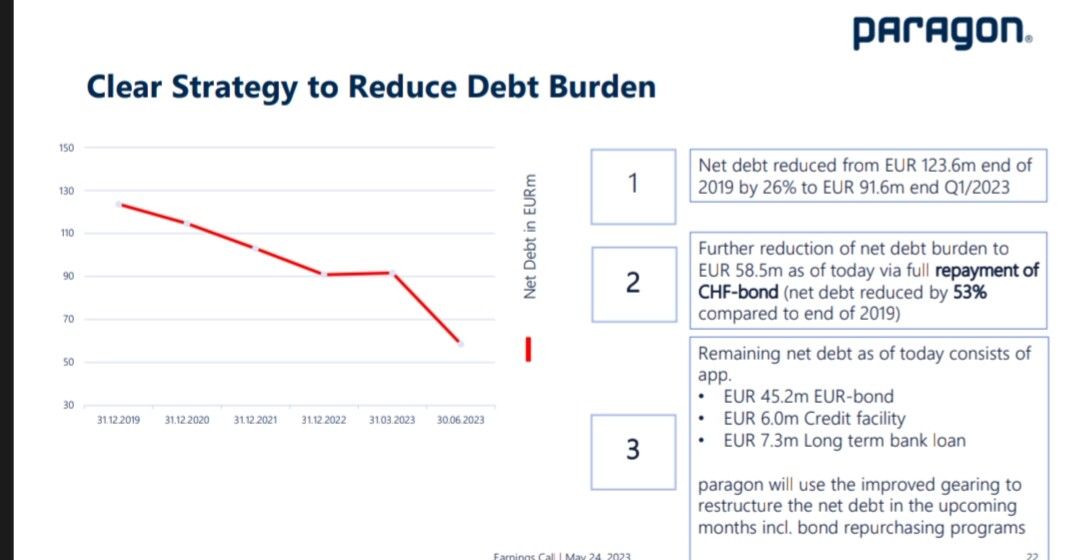
The most anticipated slide of yesterday’s annual report investor call was the description of the debt situation. At the end of Q2, the sum would be approximately 60 MEUR. At this stage, the leverage ratio is already starting to normalize, and the company is becoming investable again for many who shied away from high debt levels.

In the Q2 report, we’ll see how much cash was left in hand after a busy spring and summer of operations. The gearing ratio improves from terrible to even just bad.

Quite expected development and nice that things are progressing in the direction I have expected them to go recently. The beginning was terrible, in an S. Vilén-like “no two ways about it” manner, but let’s enjoy it now that positive drivers are pushing the story forward.

2 Likes

Based on the AGM speech, the redemption of the eurobond will actually only take place during H2, when the remaining part of the purchase price is paid and the total purchase price has been settled. (This interpretation was not known to me before.) The final purchase price was mentioned as 43 MEUR. The purchase price is “significantly” higher than Semvox’s book value and likely means a one-time boost to earnings per share (EPS).

Other scattered observations:

  • H1 revenue estimate 86 MEUR → revenue is weighted towards H2, so the full-year revenue forecast of 170 MEUR will likely be exceeded at least slightly
  • 27 customer accounts in China; as I understand it, almost all significant Chinese players in the (passenger) car industry, either directly or through a system supplier
  • They are not satisfied with the margin level, especially regarding the zero-profit Kinematics segment (e.g., spoilers and their components) (and for good reason!). The transition to a new production environment has not been without problems at Kinematics. The segment management has finally been replaced, hopefully with more competent people…
  • In Paragon’s view, adjustable air deflectors (spoilers) will be standard equipment on almost every electric car in the future due to range optimization
  • Seeking first customers in the USA, likely breaking ground with a spoiler delivery. Seeking customers from the USA was one of the main goals of the new 23-27 strategy period.
  • One selling point for the Power segment’s lithium batteries is a long service life and fire safety thanks to the foam structure; mass production started in June for the first customers
  • Gearing will drop to 2.5 as debts are paid; this is already a good level (the interest rate tied to the eurobond’s gearing level will decrease), but the final target figure is likely somewhere between 1.5-2

Summing up: it’s good to see that the weak margin level of the Kinematics segment was addressed. The segment’s revenue has grown and looks to grow in the coming years, so improvements (or deteriorations) will quickly be reflected in the bottom line.

The compass is still pointing in a good direction, and I’ll continue holding. By the 2027 strategy period, revenue should already be over 300 MEUR, which would be achieved with 15% annual growth. A tough feat if it’s done organically!

Paragon’s Q2 review is out. Key points in brief:

  • revenue guidance of EUR 170 million was reconfirmed, as was the EBITDA level (EUR 20-25 million)
  • the Kinematics segment, previously weak in profitability, jumped to become the group’s largest by revenue, and profitability improved simultaneously with new spoiler deliveries—great!
  • the Semvox deal was finalized, and as a result, the leverage ratio dropped to 2.6; at the same time, the Eurobond interest rate will decrease to 7.25% as of the next interest reset date
  • the Power segment (batteries) is growing rapidly, revenue y-o-y 8x (the starting level was low, of course, now ~EUR 4 million)
  • free cash flow is surprisingly deep in the red, but note a) -EUR 3.5 million in financing costs and b) -EUR 5 million in ElectricBrands partnership initiation costs (?!)

General Overview

With the Semvox deal, the threat of bankruptcy has vanished, and the company is “investment grade” material again. The investment can thus be viewed as a proper investment rather than an exotic turnaround story. At the same time, the analysis should be more precise than before, as future value creation will rely on something other than the removal of a major risk factor.

Examining and comparing the figures is complicated by a couple of things – the Semvox sale and its associated costs, the anomalous interest accrual of the bonds, and the rapid growth of the Power segment all add pluses and minuses to the figures, making it no easy task to see past them.

I sent a few questions to IR regarding the published figures. Hopefully, I’ll get a slightly better idea of the target margin levels for different segments and how much CAPEX is required to achieve growth.

Related-Party Deal

It is strange that even in 2023, related-party deals are as murky as this EUR 5 million “compensation for initiating a business relationship” between Paragon and its new shareholder, ElectricBrands. Even though the sum is said to be repaid over time, there would be better uses for these related-party deal funds. Naturally, this was one of the questions sent to IR.

Link to the Q2 report (pdf):

1 Like

Just as one business deal has been finalized, the next one has been agreed upon. One of the sectors planned to be central to future revenue growth, batteries, is being transferred to a company called Clarios. The deal came as a surprise, at least to me.

Clarios is better known in Europe as the owner of Varta Automotive – the same company whose battery can be found under the hood of quite a few Finnish cars.

According to Paragon, personnel and production lines will be transferred to Clarios, but Paragon will continue to supply Clarios with battery management systems and electronics. Additionally, an agreement has been reached to expand cooperation regarding other technologies.

The purchase price is not being disclosed, but I estimate it to be between 5–15 MEUR. Paragon is no longer under pressure to sell, so I assume the terms of the deal are favorable for them. I also assume that battery management systems have better margins, so in a bull scenario, Clarios scales up battery production faster and Paragon benefits from this development.

I was already skeptical about Paragon’s intention to produce batteries, which is likely a scale business requiring large capital and long production series, not a side hobby for a small technology supplier.

A bigger question mark is Paragon’s revenue growth multiplier in the coming years – correspondingly, the assumed CAPEX requirement will decrease. Without knowing the purchase price, I assume this deal will further accelerate the repayment of the eurobond and provide financial room to maneuver.

2 Likes

A response was received, but there wasn’t much meat on the bones. They cited the equal treatment of shareholders, as margin level targets would fall under inside information.

For an investor, this information would be significant, as the EBITDA margin level for the Kinematics segment in particular has been fluctuating like a scent hound between negative and ten percent for some time now. The annual report provided a few explanations (I edited them out) and a outlook for better performance:

The profitability of the Kinematics operating segment deviates by approximately € 6.5 million from the 2022 expectations … Based on the optimistic results of the measures initiated and the management change at the Landsberg am Lech site, as well as the price increases that will take full effect from 2023, the Management expects the Kinematics operating segment to make a noticeably positive contribution to the comprehensive income of the paragon Group in fiscal year 2023.

The 2022 EBITDA was -€3.9 million, so the EBITDA target at that time was around the 6-7% range. For this year, the target is a “noticeably positive contribution” to the result during the fiscal period.

The Q1/2023 EBITDA margin was only ~0%, but by Q2/2023 it was already 11%. An investor’s natural reaction is to wonder at such volatility, and I messaged IR back saying that many others are likely also uncertain about what variation range is normal and what target level they are satisfied with. After all, uncertainty flows directly into the share price.

The CAPEX question became obsolete after it was sent because Clarios acquired the battery production lines for themselves, as already noted above. The Clarios deal necessitates an update to the company’s 5-year strategy, in which batteries were a key driver of business growth for the coming years.

Various investor presentations have been published quite frequently this autumn, so let’s wait and see how these points raised above are taken into account in the future.

1 Like

The EBITDA impact was approx. 5-6 MEUR, so the deal can be considered very successful for Paragon. Paragon kept a portion of the battery manufacturing and licenses, so the top end of the price range was not reached.

Net debt dropped below 50 MEUR, and the bond interest rate, which is tied to the decrease in debt level (gearing 1.7x), will drop by nearly 2 percentage points from the start of the year. Annual savings in interest payments are estimated at approx. 800,000 euros. (Note: without the impact of buybacks.)

Additionally, the repurchase of the Eurobond from the market (price level now 70-75% of par value) will further reduce interest expenses. Due to thin trading volumes, weekly buybacks have been in the range of 10,000-30,000 euros, so a rapid drop in the debt level is not expected. As the year turns, more bonds are likely to enter the market as the interest rate drops and yield decreases. I also expect a larger buyback offer from Paragon, because buying 10 euros for 7.5 euros is simply smart (plus the interest saved).

Everything okay in Delbrück? Sales for the end of the year and the start of next year look sluggish. Although the share of revenue from Chinese customers specifically is growing quarter by quarter, it hasn’t been enough to compensate for the sluggish sales of German brands. Demand is expected to pick up in Q2/Q3 when the new factory in China begins operations and enables increased production.

The company is also opening sales offices in the USA and India. There will be local manufacturing in the USA (due to tariffs), and for India and South Korea, they are looking for a partner for a joint venture. The benefits from the JV deals are likely to be visible only in the latter half of the decade. Still, the move is correct because the new customer relationships sought alongside German premium brands balance customer risk and bargaining power.

image

Contrary to my expectations, the stock price has dipped significantly during the autumn and is glowing a festive red in my portfolio. My own rough estimate for the 2024 P/E ratio is around 5-6, and for 2025 (if anyone dares to guess that far ahead), it’s even lower.

Bankruptcy risk is no longer present, but the general gloom in the automotive industry and uncertainty related to German car companies seem to have affected Paragon as well, despite the excellent management of the debt problem. German industrial small-cap companies seem to be on sale across the board, so both sentiment and the sector are currently acting as headwinds.

Regarding growth and future outlooks, I expect a strategy update from management during December. I don’t believe the company will be satisfied with its current size, and the investment story needs some growth elements now that the debt problems are behind them.

2 Likes

There are indeed growth elements in the strategy:

Due to the high order backlog, paragon expects to have exceeded the EUR 300 million revenue threshold by the end of the current planning period from 2024 to 2028. In the coming years, paragon hopes to see a significant increase in revenue and profit from further major orders that are in the pipeline, meaning that the management believes this revenue mark could be reached much earlier.

Revenue would double. I assume growth will come from outside the automotive industry, which the strategy aims for, although it’s a matter of opinion how far removed things like motorcycle battery technology are from cars…

After refocusing in recent years, paragon has engaged forward gear to achieve the next
level of its corporate development paragon’s growth strategy consists of three element:
:black_small_square: Usage of paragon’s products in higher-volume premium models and by more OEMs
in Europe and China
:black_small_square: Further regional expansion to USA, India and South Korea
:black_small_square: Development of multi-disciplinary and industrial sector agnostic product

There is local representation in the USA, and joint ventures have been established with Tier 1 players in the Indian and South Korean markets. The “doomsday” of the German automotive industry has been sung for a long time, so it’s no wonder Paragon is visibly playing the Asia card and highlighting its customer base there.

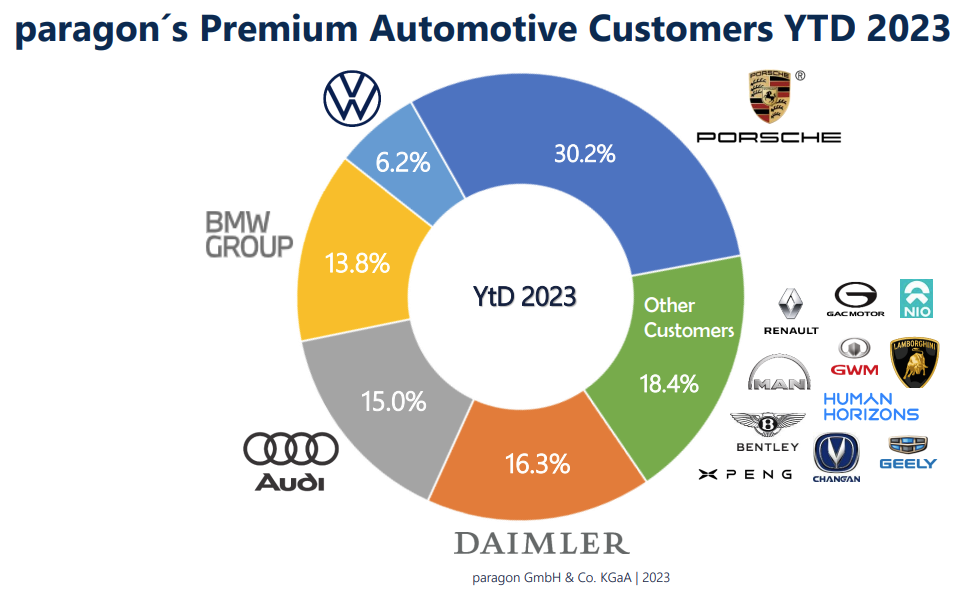
Of the 2023 revenue, Chinese brands accounted for only a 6.2% share, but starting this year, Paragon’s entire portfolio is available for the Chinese market, and the move to larger facilities during Q1 lays the groundwork for operating in the world’s largest automotive market.

image

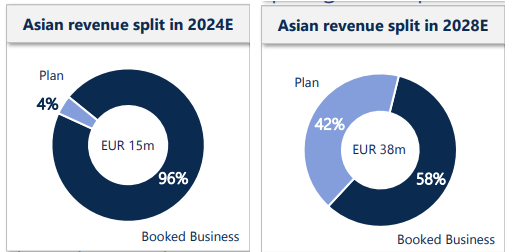
Another Asia-related estimate concerns revenue generated with Asian OEMs — growth by 2028 is expected to double, and in the text section, it is estimated to increase by 50% compared to the present within the coming years (2026?).
image

In the annual report, banks are said to still be reluctant to finance Paragon, and it’s not easy for a German automotive supplier to shake off the messes of past years and convince lenders of the competitiveness of European customers.

A broader buyback of the Eurobond is waiting for a change in bank sentiment, and the loan package is expected to be finalized during the current year. So far, only €500,000 worth of bonds have been repurchased from the market, so the obligation under the bond terms would still require an additional €19.7 million.

In my view, the business is still heading in the right direction. According to forecasts, revenue will be slightly lower than last year (EUR 160-165 million) due to 2023 divestments, but comparable EBITDA remains nearly the same as before (EUR 18-20 million). Especially in light of the Q1 figures, the Mechanics segment’s EBITDA jumped to 8.1%, but let’s wait for at least the Q2 figures before I dare to declare the chronic sluggishness over; Q1 revenue was expectedly soft, and revenue is expected to be back-end weighted. The result was only half a million in the red, which is the expected direction and should improve toward zero and into positive territory by the end of the year.

This has been an interesting case to follow, and even though I’m “underwater” on the position, the lesson has been an educational experience in hindsight. It’s dangerous to say, but I still see potential here, which is being weighed down by sectoral and European problems.

A clear turnaround company, but as is commonly known, there are more those who try than those who succeed. Even if the turnaround succeeds, it could remain a chronic value trap in the portfolio, crippled by the sector.

https://ir.paragon.ag/download/companies/paragon/Presentations/20240514_Paragon_Earning_Call_May_14_Investors.pdf

4 Likes

Paragon Ag announced preliminary Q2 figures and an outlook for the full-year result.

Revenue has only reached 75 MEUR, so the full-year target of 160 MEUR would require a roughly ten percent improvement in the second half. Perhaps we’ll hear more about this in a month.

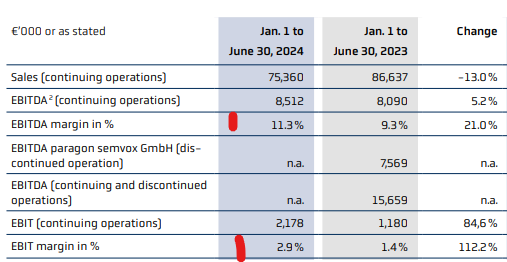
A potential revenue miss doesn’t matter, as either way, the most positive news is the improvement in profitability. EBITDA was 11.3%, and with debt servicing costs at only 3.2 MEUR, the full-year result is estimated to be slightly in the black. For real, and not just due to gains from asset sales. As it should be.

When management’s time isn’t spent putting out fires, efficiency can be squeezed out of the machine even at this revenue level. I would assume there’s still room for further tightening.

The auto industry and Paragon would benefit immensely from falling interest rates right now. Financing the Eurobond redemption would be easier, and an increase in consumer demand would support the automotive sector, which is struggling with a lack of demand.

Regardless, it’s encouraging that Paragon seems to be making the business profitable. They’ve been able to grow revenue before, but there’s been too little left on the bottom line to distribute.

https://ir.paragon.ag/websites/paragon/English/4250/news-detail.html?newsID=5d25dc96-e0cb-4d88-b1ee-2a403f6b0086

5 Likes

The H1 report is out and, in my eyes, it’s pleasant reading. The automotive industry—at least Paragon’s customer base—seems to be on the mend after interest rate shocks and energy crises:

Management anticipates a moderate upturn in the automotive industry in the second half of the year

image

They’re still not running a gold mine, but despite the low revenue in the first half, EBITDA and EBIT improved compared to last year. The pace will accelerate in the second half, with the full-year EBITDA estimate between 18–20 million EUR, and the result is still expected to be slightly positive.

In the investor call, they made sure to highlight the rapid growth of Chinese customers. Chinese customers are already the third-largest customer base after Porsche and Audi. German designers moving to work for the Chinese plays into Paragon’s hands—after all, they prefer to use the same familiar components as they did when designing German premium cars. BYD appeared to be one of the customers.

Other miscellaneous:

  • The RFP (request for proposal) pipeline looked very good, and customers are increasingly funding R&D.
  • The Eurobond redemption is not currently relevant—forecasted revenue growth and factory plans in America tie up working capital, so the bond extending to 2027 provides better leeway than banks. Buybacks continue, and positive free cash flow will likely increase purchases in H2.

If one dares to look ahead to the 2025 financial year and revenue grows by 10% compared to the current year (~€175m), scalable production would produce a better EBIT level of 5%, i.e., approx. €8–9m. If we take half for taxes and interest, earnings per share would be roughly one euro. Quite cheap.

https://ir-api.eqs.com/media/document/c2a946f3-add9-4fef-9b2b-470c90fddbd8/assets/DE0005558696-Q2-2024-EQ-E-00.pdf?disposition=inline

2 Likes