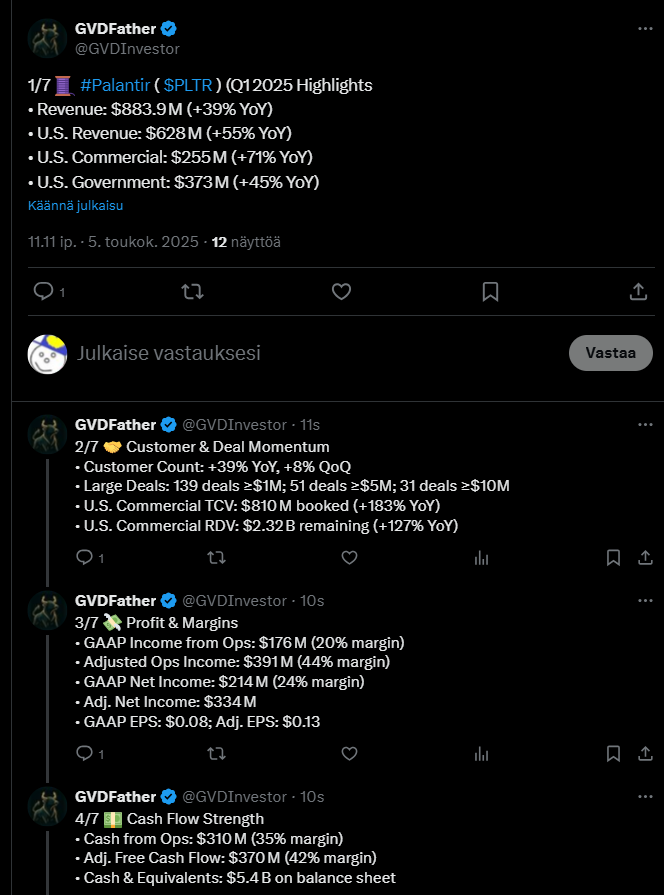
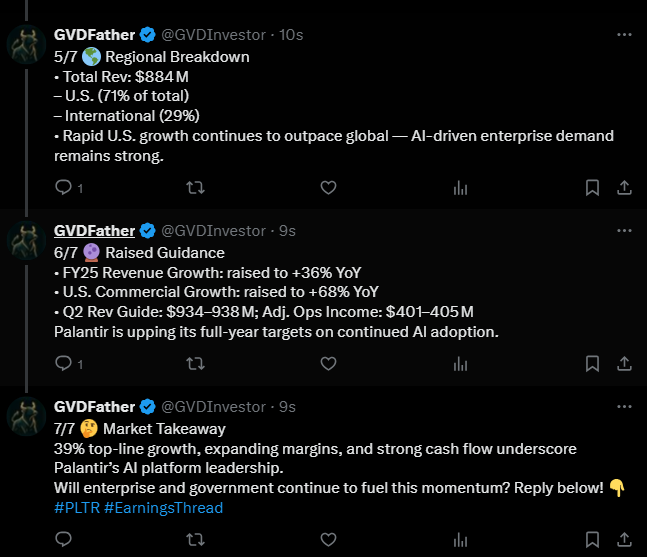
Here’s a short Twitter thread about Palantir; a few of these “slides” are already familiar from this thread. 
https://x.com/InvestingVisual/status/1918642869172064518

Rest of the Twitter thread
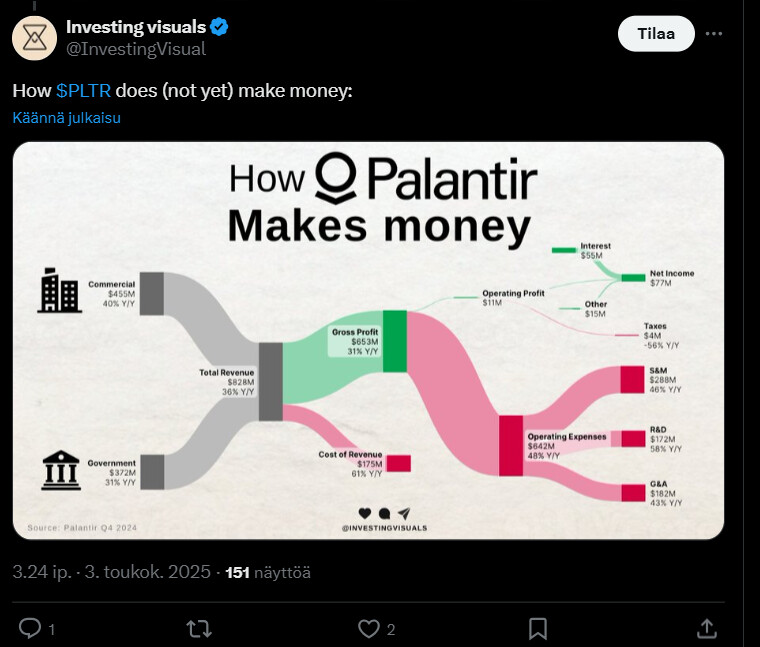
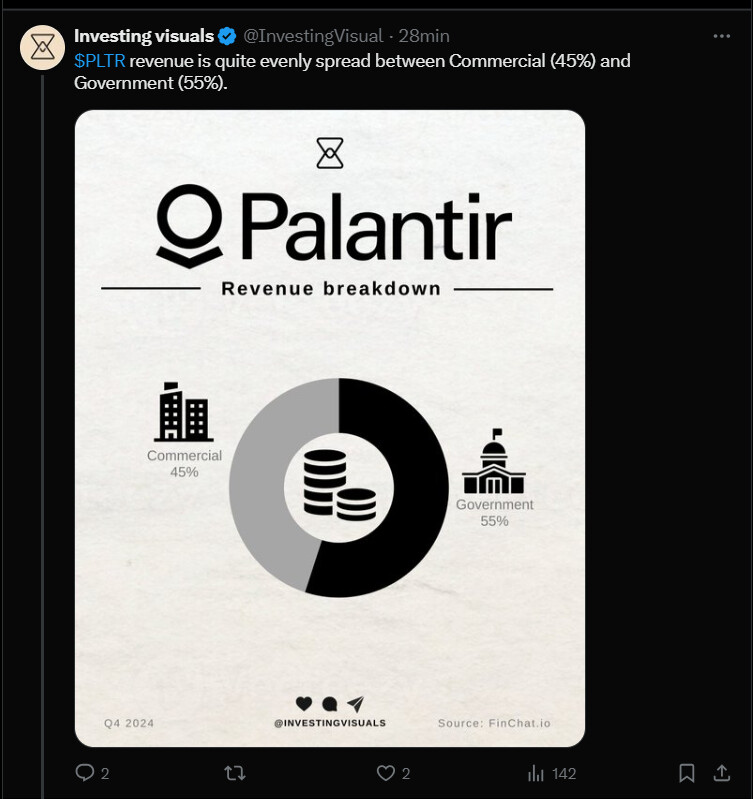
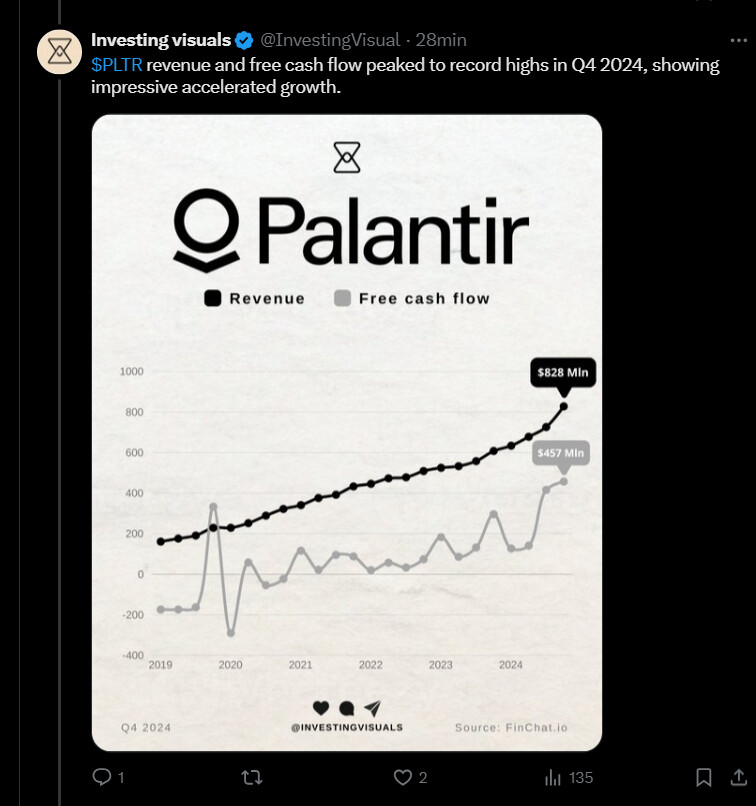
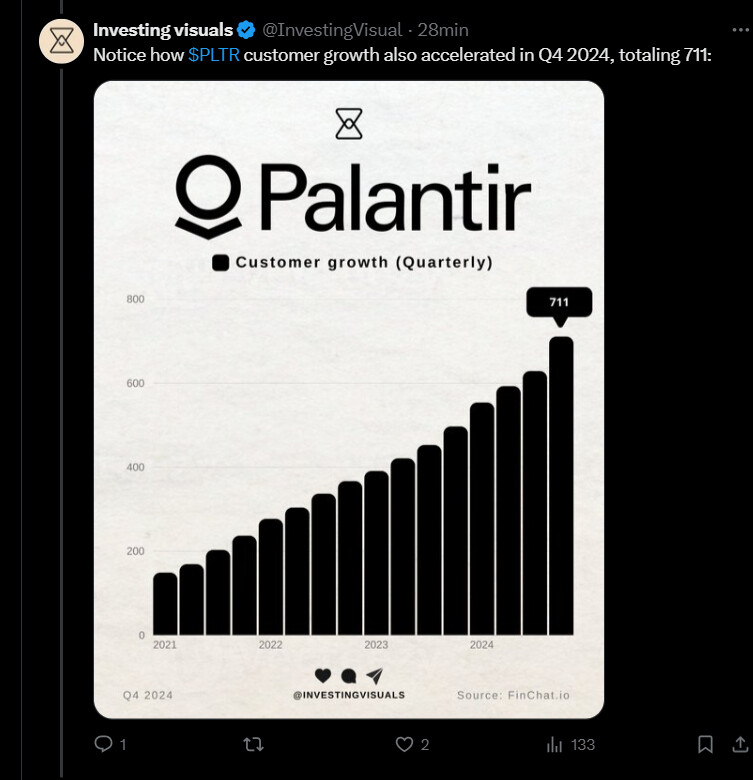
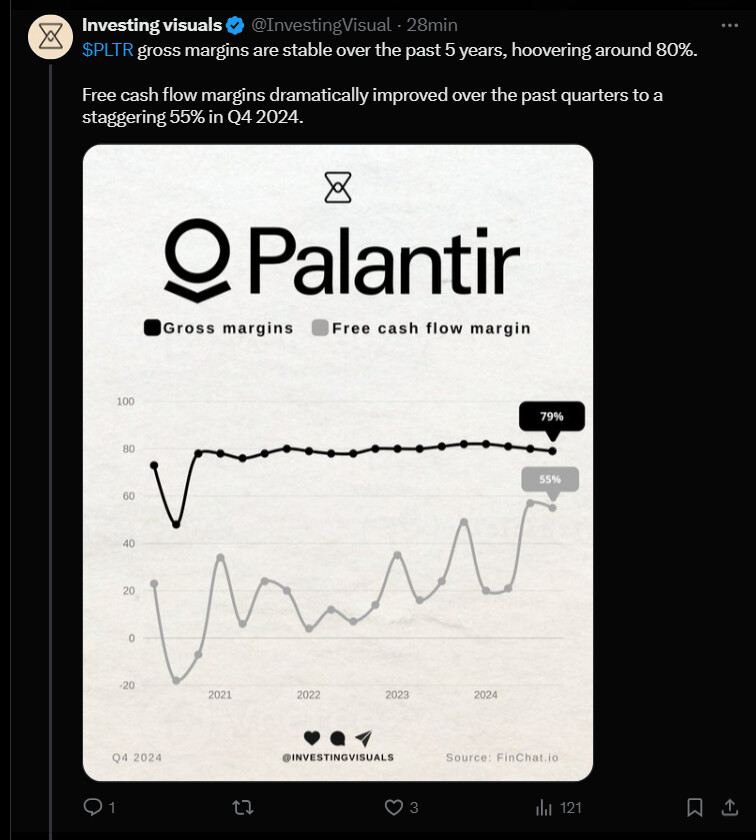
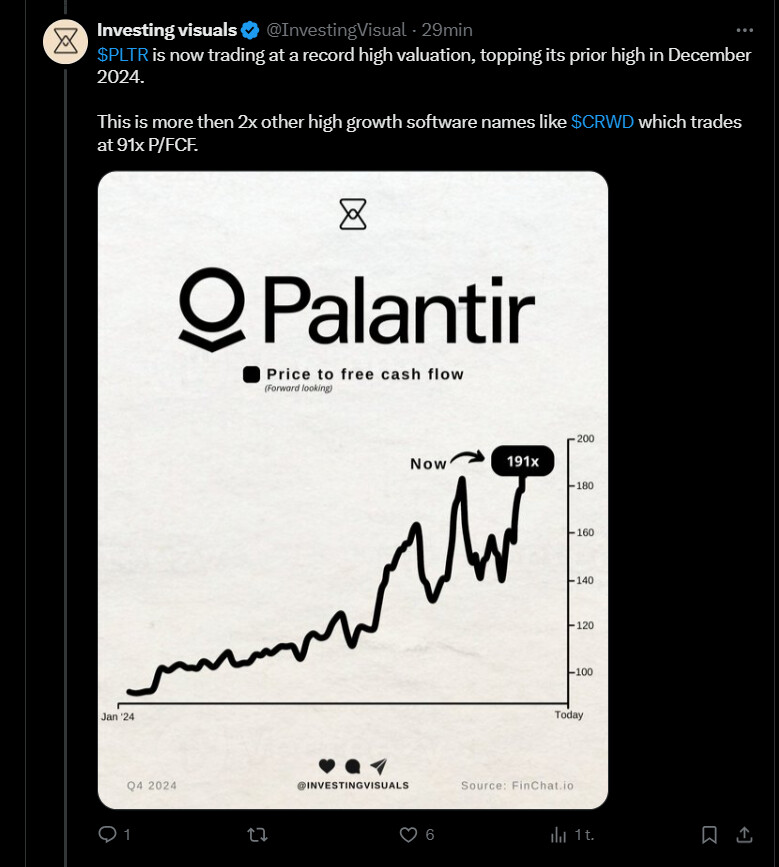

Here’s a short Twitter thread about Palantir; a few of these “slides” are already familiar from this thread.
https://x.com/InvestingVisual/status/1918642869172064518
I personally cashed out the profits from the previous dip on Friday. Even though I’m 99% sure the earnings report will be excellent, I don’t believe the stock price will rocket up next week anymore. It will probably even pull back a bit.
But I’m probably wrong.
Palantir reported strong growth, especially in the United States, where revenue and customer count increased significantly.
The company’s so-called U.S. commercial business grew significantly and surpassed the one-billion-dollar annual revenue level.
According to CEO Alexander C. Karp, the company’s software is a key tool for businesses in the age of artificial intelligence.
Based on these results, Palantir raised its full-year revenue forecast.
https://x.com/StockSavvyShay/status/1919483880526270916
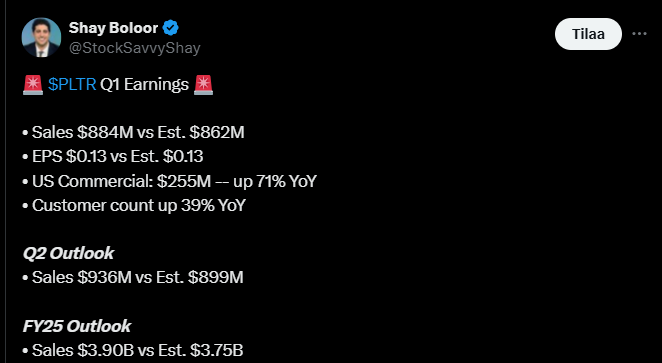
In the tweet thread below, the following points were highlighted:
Palantir’s early year showed strong development in several areas, not just isolated ones. The company secured a significant number of large contracts and clearly improved its operational profitability. Business margins expanded, and cash flow was strong, in addition to cash reserves remaining at a high level, which strengthens its financial position.
The company also benefited from growing demand for artificial intelligence, which was particularly evident in the growth of its order backlog.
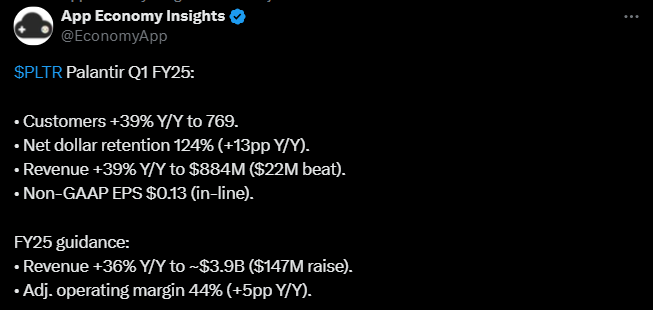
The result was perhaps even more impressive than I thought 
https://x.com/StockMarketNerd/status/1919491892498087995

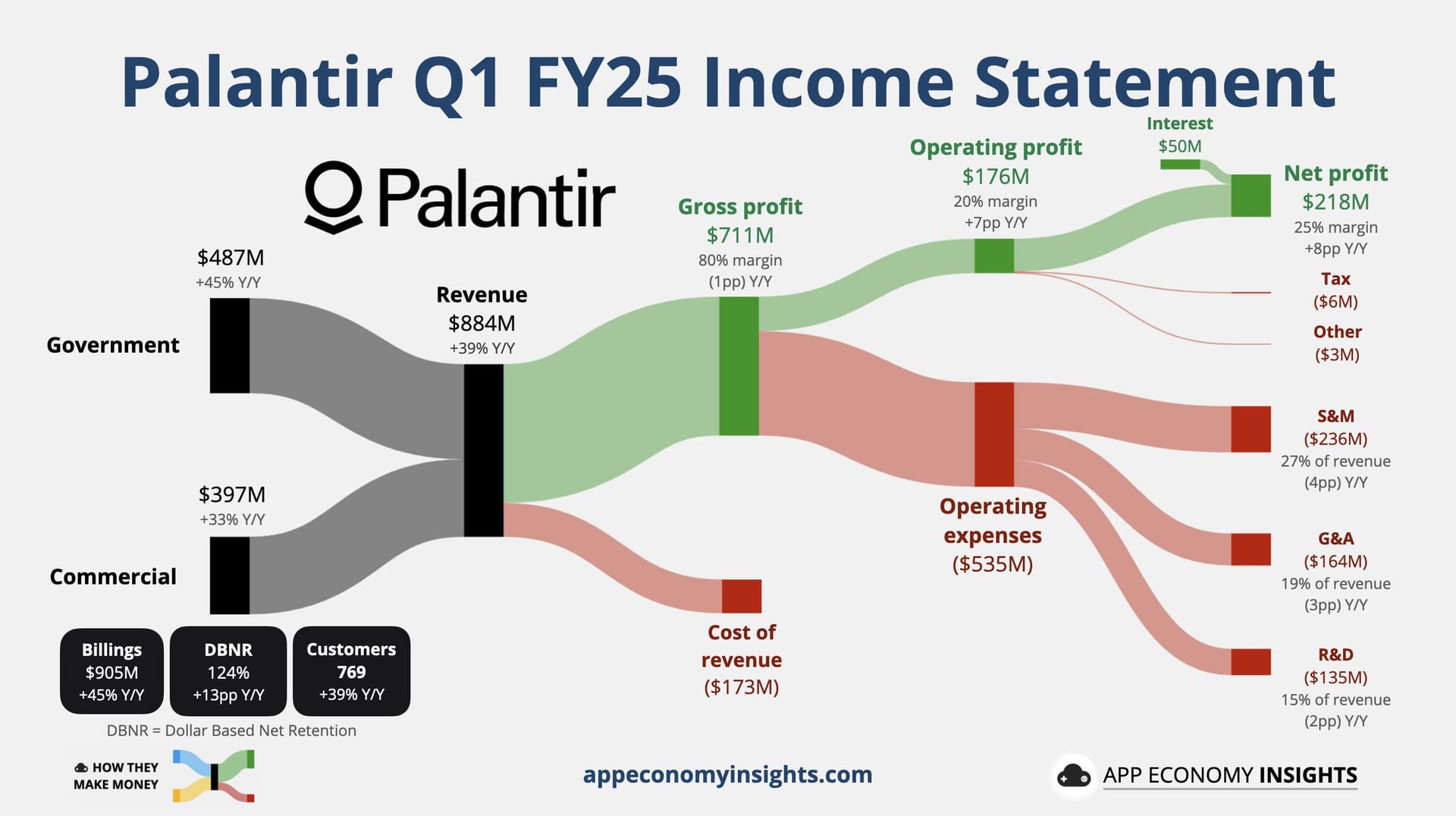
Here are Palantir’s numbers beautifully visualized.
Once again, an analyst has earned their salary by writing these basic phrases.
Did anyone find a weak point in the Q1 results? It feels quite difficult to find any other reason for the sell-off in Palantir’s numbers than valuation. Each stock in my portfolio has a special task. Palantir’s special task is to protect the portfolio in extreme situations, whether caused by natural phenomena or political escalations. If things in the world go into a major crisis, Palantir’s stock is a better safe haven than Bitcoin, which has become a kind of gold substitute. It’s a topic for a broader discussion if I start to elaborate more on my opinion. But in short: Palantir’s bankruptcy risk is small due to its central importance specifically to the government sector. And if interest rates shoot up, for example, with the federal debt ceiling approaching, debt-free Palantir with a large cash reserve will fare well. Palantir’s business is developing strongly, so there is upside potential for the stock, at least in the longer term.
I chose the most important key metric for myself for this thread, which shows that the business is in good shape, and that’s why I bought a few more percent of Palantir after the earnings dip, while trimming my portfolio elsewhere. So, my most important metric is the Net retention rate, which indicates how much the current customer base buys additional services on top of old deals. The figure is now 124%. For example, Cloudflare’s equivalent is 111%, and even there, the figure is quite okay. So, additional purchases from existing customers bring 24% annual growth. Below I’ve included a trend image on the topic I found on X:
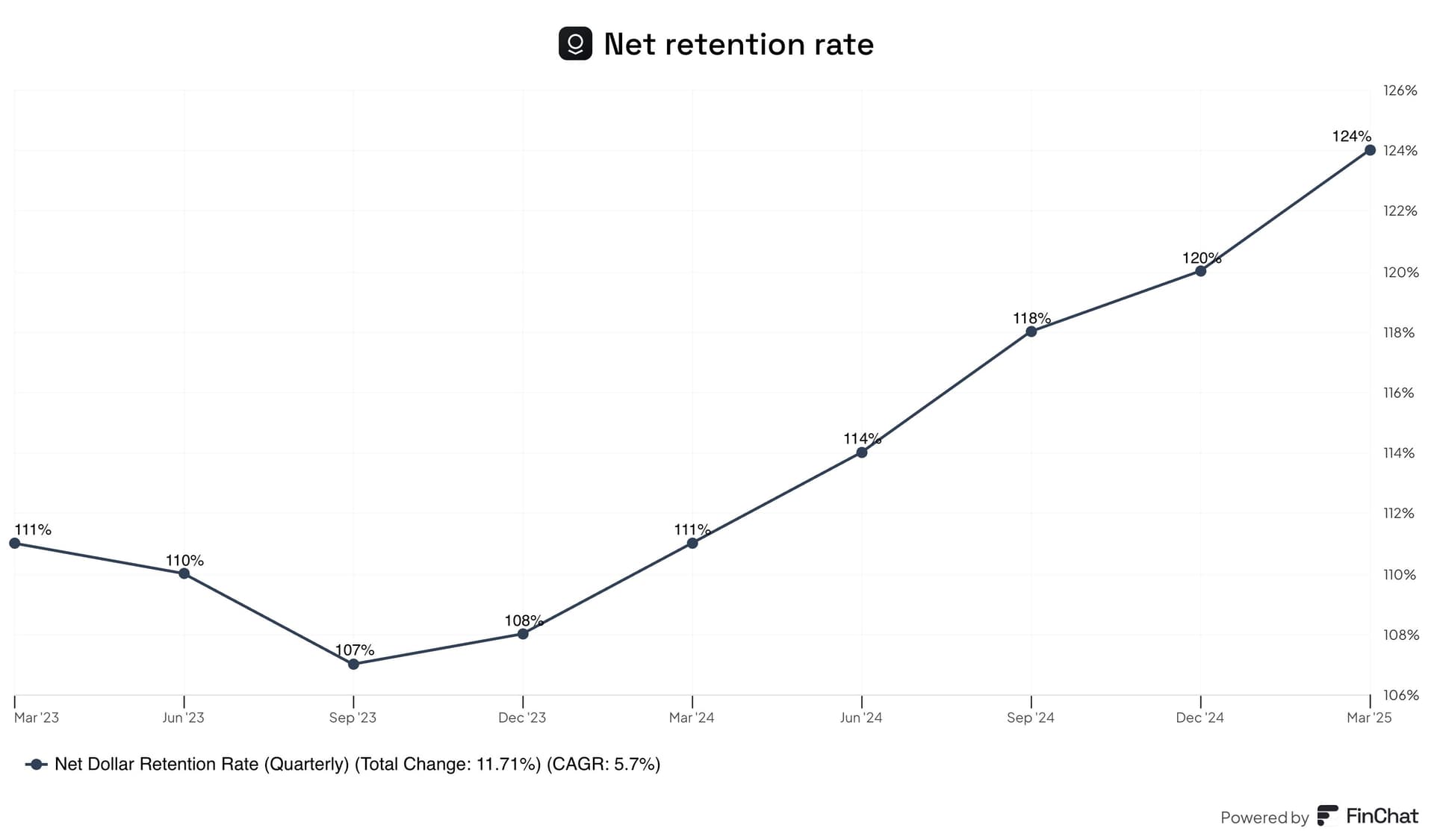
And I picked up the image from here, from a Danish investor’s page:
(3) Henrik Karlsen on X: “Palantir indfrier forventningerne ja hæver guidance for hele året  Som vist herunder er det sjette kvartal i træk, at Palantir øger deres net retention rate
  Aktien falder (nok) på grund af tårnhøj prissætning 8% i eftermarkedet
  Note: Lang $PLTR https://t.co/jGe19InF2y” / X
I just have to post this slightly more humorous video about Palantir.
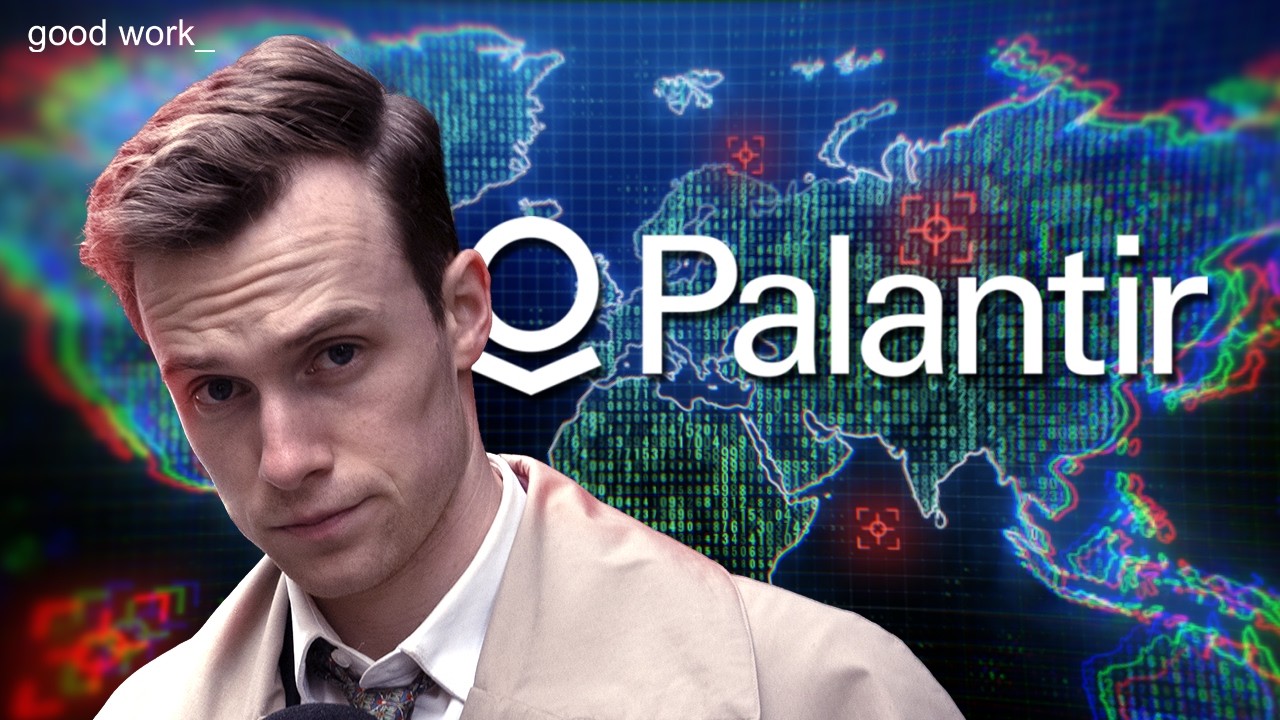
That was a funny highlight, that video @SunnyCarCentrist. And it seems that reality is much stranger than that parody. Palantir can playfully be considered the Hollywood company of the IT world, and the only viable home base for Palantir is the USA. Elsewhere in Western countries, politicians would have already scored their own points from Palantir, and then it would have been regulated into dysfunction.
US Space Force orders software services from Palantir for 218 million. Over 5% of annual revenue, so a pretty good one-time deal. Because of these and other deals, the market believes in the company and its growth.
Space Systems Command Advances Space C2 Dominance Decision Making through Data Platform Program > Space Systems Command > Newsroom
These are indeed cool deals, and if one wants to calculate the impact on the result with an approx. 80% margin, then it’s approx. 175 million. But a lot more of these would be needed for this to have a more material impact on the share price, as the valuation has gotten so badly out of hand.
The good side of these agreements is that their product is really “sticky”, which generates quite certain recurring revenue from this, but what its price is, is the biggest question for this company.
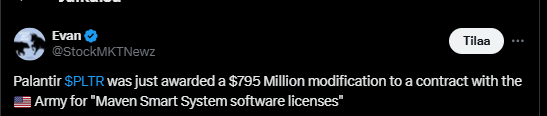
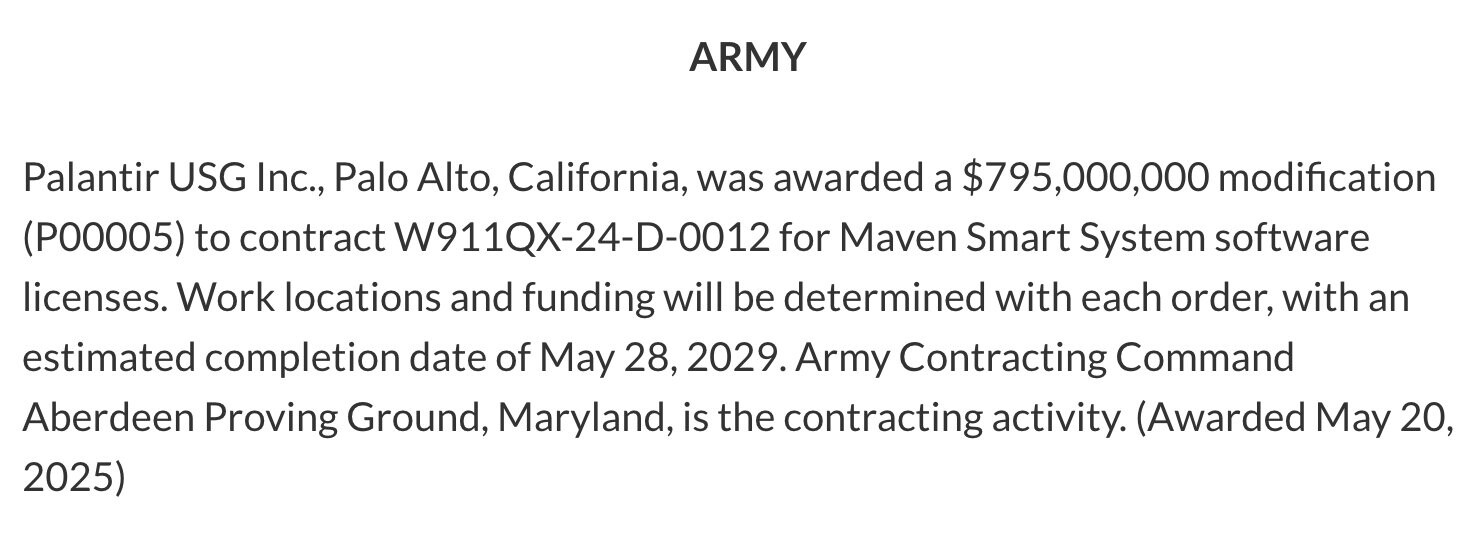
Palantir has received an additional $795 million deal from the U.S. Army for Maven Smart System software licenses. The agreement is valid until 2029.
https://x.com/StockMKTNewz/status/1925300036012847570
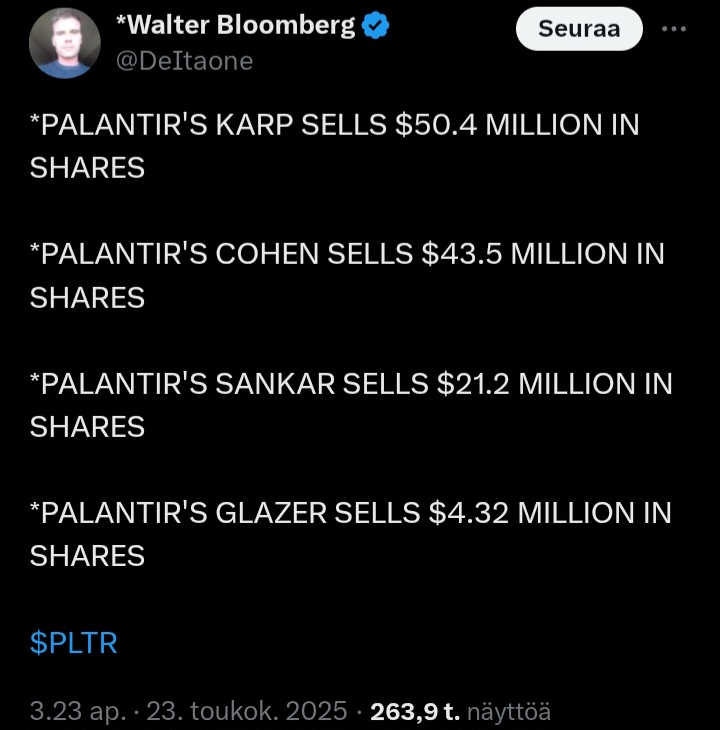
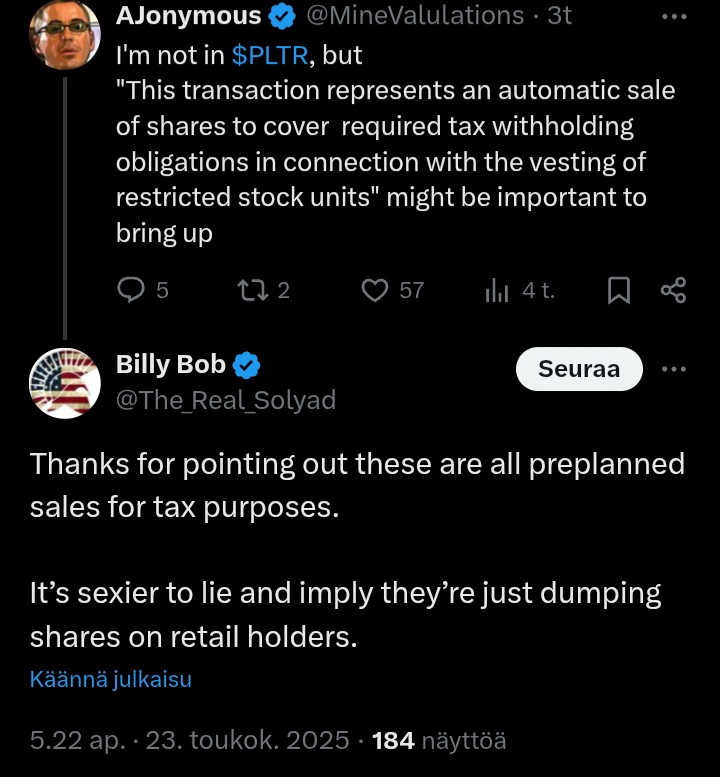
Here is a tweet and replies to the tweet about Palantir insider movements.
Palantir CEO Karp said that the artificial intelligence development race between the United States and China will end with one winning – and also that AI is inherently dangerous.
He emphasized that Western countries must learn from the United States. Karp also denied the New York Times’ claims that Palantir was spying on Americans.
"Key Points
https://www.cnbc.com/2025/06/05/palantir-karp-ai-dangerous-china.html
If one wants to think that way, then Orwell’s 1984 is no longer very far off in the USA. The US immigration - or was it deportation - agency uses Palantir’s software to find undocumented immigrants. Today, Finnish news even showed a clip of the Los Angeles riots, precisely due to deportation issues. But if IT is to be used effectively, data must be used broadly. Finland has several national registers; there’s the personal identity code register, the tax authority has nationwide data, as do Kela’s (Social Insurance Institution of Finland) Kanta services. In Finland, there is no talk of spying.
Regarding Palantir, it’s good to be aware of the responsibility issues. Once a quarter, I consider whether I want to keep my money in the shares of a company whose software is used for deportations, identifying enemies, controlling drones, and, with the TITAN deals, destroying enemies. It’s a tricky question, and everyone considers it through their own conscience.
I will continue as an investor, meaning the aforementioned issues are not a problem for me. But I won’t elaborate further here, perhaps sometime when I have more time.
And when attention is shifted from the above issues to deals made in the private sector, the past spring has been a tremendous success. Many new collaborations and thus new customers. Well, the multiples demand tremendous success. But it has been churned out. Perhaps during the summer holiday, I could summarize Palantir’s deals. You can get some idea of them on X. But my point is that Palantir is still one of the world’s leading AI companies, and business is going extremely well.
In this tweet, it is apparently indirectly implied that Palantir will benefit from various situations like these around the world.
https://x.com/StockSavvyShay/status/1933505435132428526

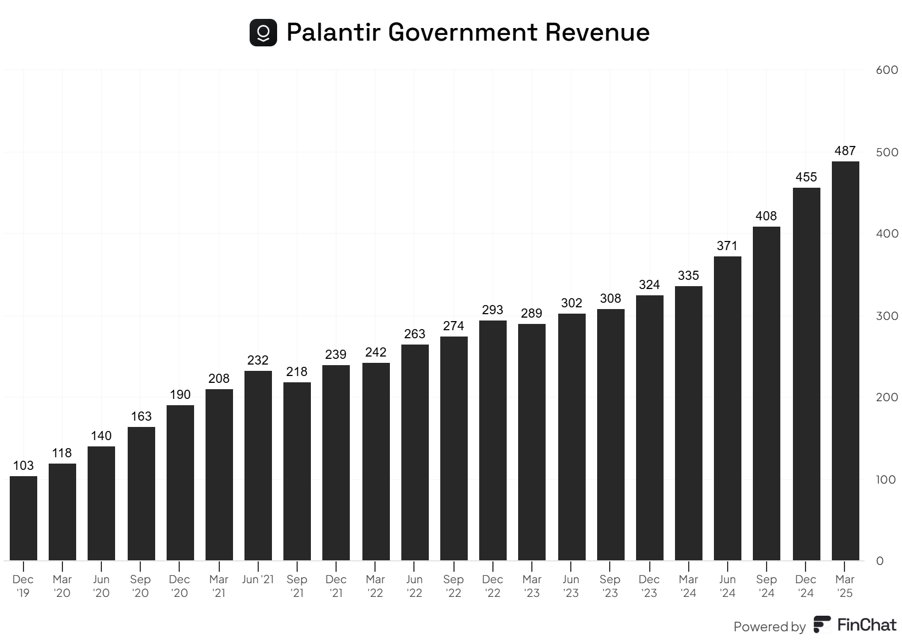
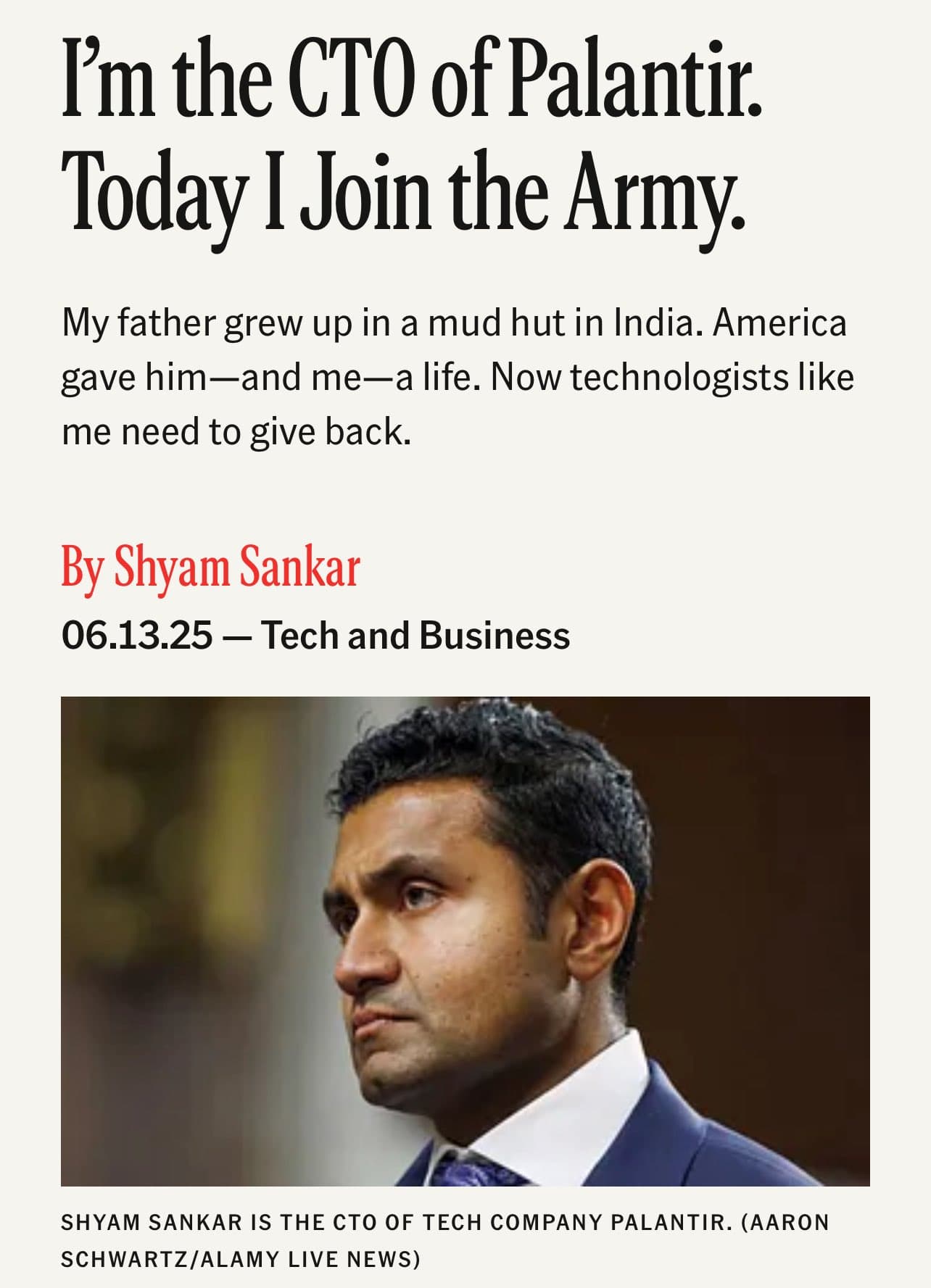
That’s just how it is. As for Palantir, its cooperation with the federal government extends deeper than just the revenue figures from government deals. Today, Palantir’s Chief Technology Officer Shyam Sankar joined the army, specifically the reserve technology forces. And below you can see who will join him in developing the world’s most superior solutions:
“at my side will be some of the most impressive minds from the world of technology: Kevin Weil, the chief product officer of OpenAI; Andrew “Boz” Bosworth, the chief technology officer of Meta; and Bob McGrew, formerly the chief research officer of OpenAI and engineering director of Palantir Technologies, where I work as chief technology officer.”
We are starting to really see alpha growth go in…
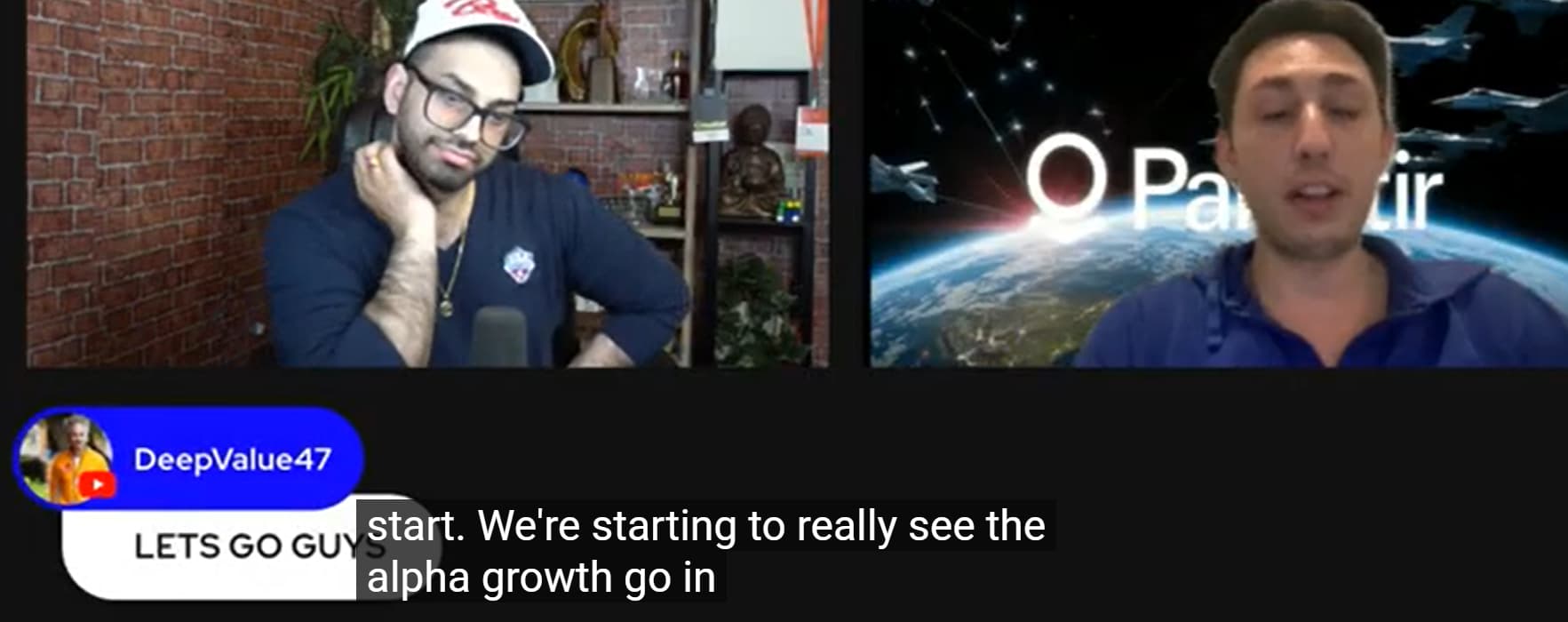
Adam, also known as Gokarp, and Amit Kukreja are discussing. Gokarp has deep insights into Palantir’s government affairs. At 1 hour 6 minutes into the podcast, Gokarp talks about how only when the ordinary worker, the average Joe, starts talking about using Palantir’s Foundry or knows someone who uses it, will Palantir be in a growth phase that will bring significant alpha to those who are currently involved. He also mentions the Titan and Maven projects, stating that they are only pilots.
If you are invested in Palantir, then following Gokarp on X can be useful. I don’t know anyone else who is similarly deeply involved in Palantir’s government business. Gokarp is very fact-based on X, but Adam’s videos are not to everyone’s liking, perhaps with hints of extreme views, perhaps, well, everyone can judge for themselves.
The discussion can be found here:
https://www.youtube.com/watch?v=7LckTZM_x7I
Below is a link to Sequoia’s interview series, now featuring Bob McGrew, former Head of Research at OpenAI.
The Breakthroughs Needed for AGI Have Already Been Made: OpenAI Former Research Head Bob McGrew
Before OpenAI, Bob worked at Palantir. He is also an investor in an unlisted AI company called Distyl. I picked this interview because it is very recent, June 17, 2025, and certainly offers some of the freshest AI interpretations from the heart of American AI development. First, a few observations: Sequoia is a large venture capitalist from the US, so there might be some OpenAI promotion or other agenda behind the video. And Bob worked at Palantir before 2016 and now invests in Distyl, which is perhaps Bob’s interpretation of an improved version of Palantir.
Despite a strong marketing angle, the video might offer some benefit to Palantir investors when considering Palantir’s role in the entire AI value chain.
There is a text-based summary of the video, and from it, I’ve extracted the following paragraph:
Enterprise applications requiring deep domain integration remain safe from frontier lab competition: Companies like Palantir and Distyl succeed by building systems around models rather than training specialized models. Frontier labs see business problems as opportunities to train new models, but individual enterprise needs are too small to warrant dedicated model development. The opportunity lies in creating the infrastructure that extracts context from businesses, feeds it to models and transforms outputs into actionable decisions—turning many small problems into one scalable solution.
The above summarizes from the video that agents found in modern AI architecture will replace many expert roles whose current price, or cost to the buyer, is due to scarcity. Such services include legal services and healthcare expert services. The prices of agents will fall due to competition. In other words, their prices will not at all match current legal services or healthcare consultation fees.
So, according to Bob, where can one find profit in the AI stack, or at what point in the value chain is competition limited? It is stated in the paragraph extracted from the interview: “The opportunity lies in creating the infrastructure that extracts context from businesses, feeds it to models and transforms outputs into actionable decisions—turning many small problems into one scalable solution.” That is, as a machine translation in Finnish: “The opportunity lies in creating the infrastructure that extracts context from businesses, feeds it to models and transforms outputs into actionable decisions—turning many small problems into one scalable solution.” Well, that’s a brief description of Palantir’s overall architecture.
No silver bullet was discovered here, but this reflection helps structure Palantir’s role in the AI value chain. Nvidia provides generic computing capacity as its own production and generic basic AI components, such as AI agents, either itself or in cooperation with AI companies. But what was described above is still a general solution, not connected to the situation of an individual client organization. And Palantir does that, “which extracts context from businesses, feeds it to models, and transforms outputs into actionable decisions.” So Palantir is the actor that enables the current AI solution infrastructure to connect to the client company’s processes. Here, Palantir uses ontology, which I might have referred to earlier in this thread. Now comes a purely amateur interpretation, but I will try to concretize ontology. Ontology aims to describe things as they are. For example, a car has its own weight, consumption, speed, and load weight. It has a purchase price and an insurance price. Ontology is supported by object-oriented programming, which, as its name suggests, aims to describe/handle different properties and relationships of things.
So, what is the conclusion of this story? According to Bob, the AI infrastructure is now ready even for AGI (AGI, or Artificial General Intelligence, means AI that is capable of understanding, learning, and performing any intellectual task that a human can). AGI would also mean that the overall picture of a company/organization can be obtained from Palantir’s software. Without it, the overall picture would be assembled from Excel sheets. And simulations / digital twins are not made with Excel sheets. Nor do Excel sheets provide decision-making support, which is a feature in Palantir’s solutions.
This article of mine keeps growing and growing. It indicates that building an AI system that supports an organization’s operations and decision-making, and even writing about it, is a complex exercise. Palantir has the American corporate landscape to work on, through its AIP platform. I personally don’t identify competitors that would challenge Palantir in the US right now. Therefore, it is possible that high margins – the Rule of 80 – will persist. Europe is still a quiet market for Palantir. However, at least in Finland, American consulting firms and integrators are eagerly used. Perhaps Palantir – NATO cooperation will gradually open doors for corporate collaboration on the old continent as well. Perhaps precisely this yet-to-be-realized opportunity to grow into a global AI platform is the most interesting scenario for Palantir.
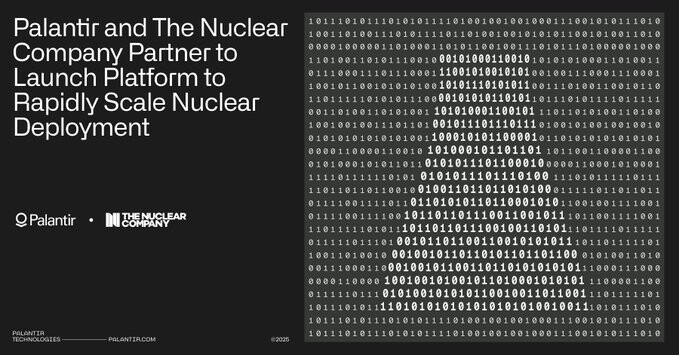
In my previous post, I wrote: “the overall picture of a company/organization is obtained from Palantir’s software. Without it, the overall picture would be compiled from Excel sheets. And simulations / digital twins cannot be made with Excel. Nor do Excel sheets provide decision-making support, which is a feature of Palantir’s solutions.”
And today, according to X, The Nuclear Company and Palantir have agreed on a 100 million 5-year deal, which will do exactly those things I mentioned earlier. Palantir offers an AI operating system for nuclear power construction, meaning Nuclear Operating System (NOS) will achieve on-time, on-budget nuclear construction. The operating system keeps the whole package together. Here, a digital twin is introduced, which describes the target state of construction. Sensors are placed in the physical environment, and the real situation is compared to the digital twin. And LLM models are used for documentation management to ensure compliance with documentation requirements. Predictive analytics is used to identify problems in advance. All available information is used in construction project management, e.g., from material availability to weather forecasts. This is how Palantir’s holistic, comprehensive AI works. And this is how the benefits and applications of AI spread to physical work, where the business case “market” is practically limitless. AI rules!