Outokumpu - A continuous rollercoaster or a serious investment?

Outokumpu is getting a boost today (+5%) from Aperam’s results, in addition to which it seems a colleague from SEB has raised the target price and likely reiterated the previous buy recommendation.

Aperam reported its best Q1 in three years. The company has a somewhat different business structure than Outokumpu, but comments regarding the European market are, of course, always interesting. It is positive that according to Aperam, imports fell to 12% in Europe in Q1’26, i.e., to the level of import quotas. Although underlying demand has not picked up in Europe, the company benefits from the decrease in import supply and says: “In Europe, we are not just waiting for a market recovery - we are benefiting from a structural shift.” So, the Commission’s actions seem to be taking effect, and this also benefits Outokumpu.

The company is also guiding for a better result for Q2, driven by higher capacity utilization and rising prices. All in all, the market situation seems to be developing in a good direction for Outokumpu, but it would be important to get the European economy and, consequently, stainless steel demand growing. That is when prices would really start to rise, and through that, Outokumpu’s earnings.

28 Likes

Here are Petri’s pre-result comments as Outokumpu is set to release its Q1 results on Tuesday :slight_smile:

We forecast that earnings have improved from the comparison period in both stainless steel business areas, but the absolute earnings level remains somewhat subdued, particularly due to low stainless steel deliveries. It is expected that in its short-term guidance, the company will guide for increasing stainless steel deliveries and growing EBITDA for Q2. We will review Outokumpu’s results on Tuesday morning in a live broadcast starting at 8:50 AM on inderesTV.

6 Likes

Acerinox reports 1Q2026.

Briefly, the stainless steel division’s Ebitda rose from the zero level of 4Q25 → 82 million USD. Adjusted to 97 million USD.

Company-level guidance for 2Q26 ebitda is ‘Higher than’ 1Q26.

By division, the Stainless Steel division reported an EBITDA of 82 million euros (compared to 1 million in Q4 2025), driven by a gradual recovery of prices in key markets. Nevertheless, the rising cost of raw materials and energy has slowed the recovery of margins in Europe.

Outlook for Q2

Acerinox faces the rest of the year with caution due to geopolitical uncertainty. However, the company is optimistic thanks to its geographic diversification and the normalization of production in Europe.

“We expect Q2 EBITDA to be higher than in Q1. The improvement in order books in Europe and the United States, added to the decrease in imports, will allow us to improve sales volumes in the coming months”, the Group has stated.

Acerinox reports an adjusted EBITDA for Q1 of 119 million euros - Acerinox Stainless Steel Manufacturer Radware Captcha Page

Quarterly Information - Acerinox Stainless Steel Manufacturer Radware Captcha Page

9 Likes

Tomorrow is Outokumpu’s earnings day, and the livestream is scheduled for 8:50.

Will “Outsa” pull an Acerinox and raise its adjusted EBITDA from zero to a hundred as early as Q1 2026?

It’s certain, however, that they will guide for a growing EBITDA for Q2 2026, one would think…

We’ll find out in the morning.

10 Likes

The first quarter of 2026 in brief

Adjusted EBITDA increased from the previous quarter to EUR 65 million. Growth was supported by improved profitability in the Europe business area, resulting from higher delivery volumes, and in the Americas business area, mainly due to a higher average selling price for stainless steel.
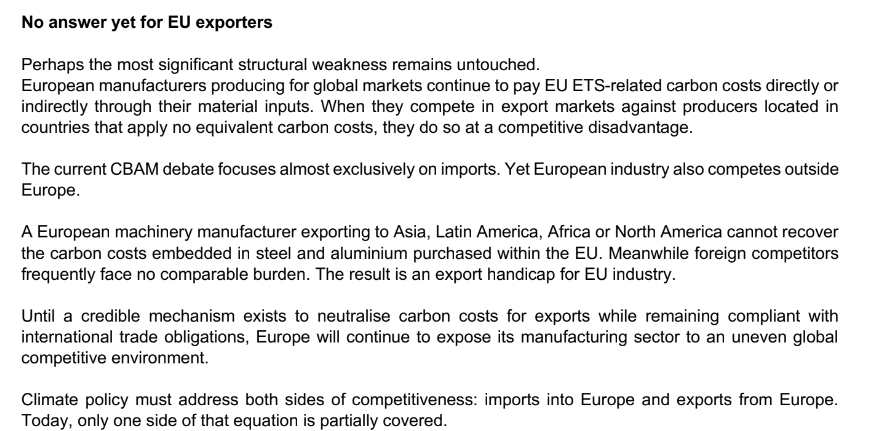
Stainless steel market activity improved due to seasonality and the Carbon Border Adjustment Mechanism (CBAM). Deliveries increased by 27% from the previous quarter to 465,000 tonnes.
The ferrochrome market remained balanced, supporting price increases and favoring Outokumpu’s low-emission European offering. Deliveries rose by 17% from the previous quarter to 110,000 tonnes.
Operating cash flow strengthened to EUR 85 million, mainly due to a stronger result, which was also supported by the release of working capital. Net debt decreased to EUR 241 million.
The restructuring program is progressing as planned, targeting annual cost savings of EUR 100 million by the end of 2027, with approximately half expected to be realized in 2026.
The EVOLVE growth strategy is progressing:
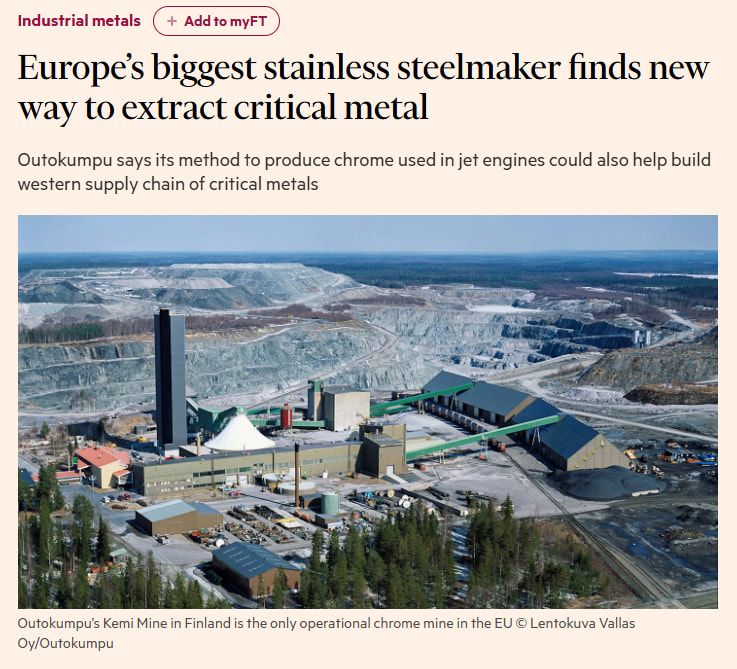
In the United States, construction of the pilot plant is moving forward. The facility will pilot the scaling of developed technology for the production of low-emission enriched ferrochrome and chrome metal. Production is scheduled to start in the first half of 2027.
Development of higher-margin specialty products in the ferrochrome business is progressing.
A large-scale circular economy ecosystem has been launched at the Kemi mine to utilize side streams.
The investment in the Tornio annealing and picking line is still under review.
The study regarding the investment in the Avesta melt shop continues, enabling the company to further expand into high-nickel alloys.

Outokumpu’s January–March 2026 interim report: More favorable market dynamics supported improved adjusted EBITDA | Kauppalehti

Guidance for the second quarter of 2026

Adjusted EBITDA in the second quarter of 2026 is expected to increase compared to the first quarter of 2026.

You guessed correctly.

Still, that wasn’t exactly a mind-blowing interim report.

7 Likes

A bit muted due to Europe, otherwise strong momentum. Last year’s order backlog, or the large share of it, apparently eroded margins in Europe, and additionally, there have still been challenges with the ERP system. Hopefully, these are starting to be left behind; some clarification on this in the press conference would be welcome. Now is the time to get the engine running efficiently as the market and price levels improve in Europe as well.

7 Likes

Outokumpu’s (Outsa) performance fell a bit short again when compared to Acerinox.

However, let’s say it is somewhat comforting regarding the company’s poor financial performance that:

  1. One factor in Europe’s poor performance is their own internal operations—specifically, fumbling with the planning system.
  2. The Carbon Border Adjustment Mechanism (CBAM) has nearly halved imports to Europe (from 28% to 15% of consumption).
  3. Presumably, Europe’s new tariff mechanism will come into effect IN JUST 1.5 MONTHS.
  4. Europe’s demand potential (?) is still yet to materialize.

First quarter of 2026 compared to the fourth quarter of 2025
Sales rose to EUR 955 million (Q4/2025: EUR 675 million) mainly due to
significantly increased stainless steel deliveries. Deliveries
grew by 46% primarily due to seasonality and the Carbon Border Adjustment Mechanism, and additionally,
the challenges in implementing the ERP system’s supply chain planning solution
were less significant than in the previous quarter.
Adjusted EBITDA was EUR -13 million (Q4/2025: EUR -56 million) mainly due to
the growth in deliveries and the decrease in raw material costs secured in the previous quarter.
This positive development was partially offset by the high share of order backlogs
from the previous quarter, reflecting the temporary challenges in implementing
the ERP system’s supply chain planning solution. The margins on these deliveries
were lower than those for orders in the first quarter of 2026. The raw
material-related inventory and metal derivative gains/losses were EUR -11 million (Q4/2025: EUR 1 million).

11 Likes

It looks like they’ve messed up with the long-term contracts; I wonder when they’ll ever learn.

3 Likes

@Petri_Gostowski the \n - ERP system\n - - supply chain planning solution\n - - - implementation\n - - - - challenges\ndeserve to be addressed properly in the interview!\n\nIn the 4Q2025 interim report, the matter was somewhat of a side note etc., but in 1Q2026 there was a clear change in the sense that deliveries rose significantly, and the poorer margins of old orders flowed through to the results, affecting the weakness at the entire group level.\n\nSo: \n -has Outsa’s management now gotten a handle on the situation?\n -are there still backlogged deliveries?\n -have many customers and deals been lost to others because of the inability to deliver?\n\nIn my opinion, Outsa’s management is leaving the matter unnecessarily open because they don’t clearly state that the situation is now OK. Is there an “excuse mode” on?\n\nWhen looking at delivery volumes in Europe, 4Q2025 is indeed in a huge pit, i.e., -60 ttons vs 3Q2025.\nAnd the massive increase in 1Q2026 vs 4Q2025 sort of offsets the pit left by 4Q2025\nBUT, even so, 1Q2026 is not any larger than 1Q2025\nSo it’s as if the pit has merely shifted\nUnless the “pit volume” has permanently disappeared into the hands of competitors…\n\nReview of delivery volumes in Europe:\n1Q2026: 324\n4Q2025: 223\n3Q2025: 284 \n2Q2025: 324\n1Q2025: 318\n4Q2024: 287\n3Q2024: 316\n2Q2024: 316\n\nFrom the 4Q2025 interim report:\n> Fourth quarter 2025 compared to the third quarter 2025\n> Adjusted EBITDA was EUR -56 million (Q3/2025: EUR -12 million).\n**> • Stainless steel deliveries decreased by 22% due to a weaker**\n**> market and temporary challenges in the implementation of the ERP system’s supply chain**\n**> planning solution.\n> • The decrease in average stainless steel selling prices was offset by an\n> improved product mix.\n> • Sales decreased to EUR 675 million (Q3/2025: EUR 859 million).\n> • Profitability was supported by a relatively smaller share of fixed costs, while\n> variable costs rose. Inventory and metal derivative gains related to raw materials\n> were EUR 1 million (Q3/2025: losses of EUR 4 million).\n> • Return on capital employed was -8.5% (Q3/2025: -7.1%), mainly due to weaker\n> profitability.\n\nFrom the 1Q2026 interim report:\nFirst quarter 2026 compared to the fourth quarter 2025\nSales rose to EUR 955 million (Q4/2025: EUR 675 million) mainly\ndue to significantly increased stainless steel deliveries. Deliveries\ngrew by 46% mainly due to seasonality and the Carbon Border Adjustment Mechanism (CBAM), and additionally\nchallenges in the implementation of the ERP system’s supply chain planning solution**\nwere lower than in the previous quarter.\nAdjusted EBITDA was EUR -13 million (Q4/2025: EUR -56 million) mainly due to the growth\nin deliveries and the decrease in raw material costs secured in the previous quarter.\nThis positive development was partially offset by a large share of order backlogs from the\nprevious quarter, reflecting temporary challenges in the implementation of the ERP\nsystem’s supply chain planning solution. The margins on these deliveries\nwere lower than for orders from the first quarter of 2026. Inventory and metal\nderivative results related to raw materials were EUR -11 million (Q4/2025: EUR 1\nmillion).

9 Likes

Here is Kati’s interview, which at one point turned into a political platform for ensuring the competitiveness of Finnish industry. :smiley:

Topics:

00:00 Start of the year

00:30 ERP (Toiminnanohjaus)

01:15 Execution

01:55 Carbon tariffs

03:55 Structural change

07:10 Data centers

07:42 War in Iran

09:55 U.S. demand

11:30 Impact of data centers

13:13 Low-carbon ferrochrome

6 Likes
quote="Verneri_Pulkkinen, post:3971, topic:621"

Here is Kati’s interview, which at one point turned into a political platform for guaranteeing the competitiveness of Finnish industry.

/

A few observations regarding the Outokumpu CEO’s otherwise commendable interview:

- Finland has the cheapest electricity in Europe; instead of just being the cheapest country, Finland successfully competes with Sweden and Norway.

  • Finland has some of the best conditions on the continent to grow and strengthen power production.
  • Outokumpu itself is a massive consumer of electricity. It demands energy investments from others, but what about its own?
  • Outokumpu’s CEO seems to think that there is a long queue of investments from various sectors waiting to enter Finland, and that we could precisely manage and quota them here like the Soviet Union’s Gosplan.
  • Outokumpu gives the impression that it somehow controls Finland’s energy production and that other new investments in a country with Europe’s highest unemployment—Finland—should be restricted. Typical protectionist thinking.
  • There was sense in the Outokumpu CEO’s words, however, regarding the point that those making investments must (increasingly) start thinking about managing their own energy needs; but this should apply to all electricity consumers and not just one production sector (data centers).
5 Likes

Politicians really need to consider future employment impacts and where electricity prices are headed if these data centers keep coming in large numbers in pursuit of cheap power. Outokumpu and heavy industry will certainly suffer, but how will the ordinary person manage with their electricity bills?

9 Likes

I personally don’t understand those fears regarding data centers. These companies are coming here specifically because of the affordable electricity. It is therefore also in their interest that electricity remains affordable in the future. There is a huge amount of permitted solar and wind power plants. Okay, there is a shortage of baseload power, but that will also start to come online if electricity prices rise from here. There are alternative forms of production for this as well, so we don’t have to wait 10 years for nuclear power. Let’s try to get investments into Finland now that it is actually possible for once.

7 Likes

Well, it is quite relevant to be concerned about the price of electricity, whether you are a consumer or especially if you are the CEO of Outokumpu.

Indeed, in the US, new large-scale consumers—at Trump’s insistence—participate in creating energy production/reserves, thereby helping ensure that the matter isn’t left solely to the assumed market mechanisms to handle at some point in the future.

Outokumpu has certainly participated in the controlled expansion of energy capacity throughout its long history in the community known as Finland.

They even tried to invest a few hundred million euros into increasing nuclear power capacity. However, Fennovoima collapsed, along with the money invested by Outokumpu and other shareholders.

Additionally, Outokumpu might be irritated by the fact that the electricity tax rate for industry, including Outokumpu, was raised.
And to attract data centers, after some political debate, it was decided that their electricity tax would remain unchanged instead of being raised similarly.
Furthermore, to finance the lower electricity tax for the aforementioned data centers, it was decided that a mining tax would be created in Finland.
Likewise, the electrification support for industry was scrapped.

Outokumpu has acted quite professionally and responsibly, and Ter Horst spoke well in the interview.

I also think that Data Centers, with their massive construction projects and various maintenance jobs, are a good addition to our declining country.

The challenge is simply trusting that the markets are capable of managing electricity prices within a reasonable average price and standard deviation.
The FUTURE is the risk, because it just doesn’t seem economical to build steady production.

But let’s keep our fingers crossed that the markets handle things quickly, even with those Wärtsilä engines to level out the peak prices.

After all, we all remember when experts enlightened us that Jaska went and hosted a sauna evening for his friends, and demand was just high enough that Pera’s Trailer Generator Ltd’s bid of 73.5 c/kWh went through. Then Pera pulled the starter cord, and the markets gasped at the high daily price, while secretly enjoying it and smirking at their income statements.

15 Likes

Now to the matter at hand.
The verdict is to Reduce as the share price has reached neutrality.

Inderes: 5.5 (Accumulate) → 5.8 EUR & Reduce.

Risk/reward ratio is balanced

Relative to the historical through-the-cycle earnings level, the stock’s current valuation stands at a P/E ratio of approximately 11x and an EV/EBIT ratio of 8-9x. We consider these valuation multiples to be relatively neutral, as the through-the-cycle earnings level is clearly higher than the current earnings performance. The expectations baked into the current share price are also reflected in the fact that the stock’s pricing offers only a low free cash flow yield of approximately 5% relative to the realized average free cash flow of the past ten years. Thus, in our view, the current valuation already reflects expectations of structurally improved earnings power, which we consider justified given the changed market fundamentals. Overall, we find the stock’s valuation justified, the forecast risks balanced, and thus the risk/reward ratio neutral.

10 Likes

In my opinion, it is quite good that Outokumpu does not invest directly in power generation. We are talking about a steel company and a ferrochrome mine, not an energy company.

Instead, Outokumpu has sought to reduce its electricity (and other energy) consumption and has made investments in these areas. There are certainly still investment targets to be found on this front as well, but it is good that there is strict discipline regarding investments, so that they don’t have to resort to various share issues and thereby hit the owner’s wallet.

It might be worth listening to that interview again, as Kati was merely hoping for a clear long-term industrial (and thus energy) policy for this country, where it is clearly stated what kind of activities they want to encourage in this country to improve opportunities for everyone.

10 Likes

A few of my own highlights from the press conference:

  • In the Americas, the rise in price levels was already fully reflected in Q1 due to the market dynamics. The Mexican market is improving, and new regulation has been introduced that steers towards the use of local production > this supports Mexican production and prices, now that exports from there to the USA have been restricted due to tariffs. Order books in the Americas are strong and lead times are quite long.
  • In Europe, the rise in price levels is reflected with more of a delay. During Q2, lower-margin orders represent a clearly smaller share than in Q4/25 and Q1/26 and will phase out during Q2. I’m thinking that from Q3 onwards, we should start to see a clear increase in price as well, considering that CBAM came into effect at the start of the year and new safeguards from July; thus, the incoming order backlog is certainly already at a better price and improving all the time. Contracts will, however, partly cause a delay before this fully feeds through to sales prices.
  • FeCr should already receive some support during the year from higher-margin sales. Total production of over 500kt possible? Demand is robust.
  • Q2 results will improve significantly. Half of the improvement comes from volume and half from timing and hedging. Marc Simon further clarified that these improvements will come from “most of Europe”.

Summa summarum: Q1 could have been better (Europe!!), but the market direction as a whole is good now. Based on the above, I’ll throw out my own Q2 EBITDA forecast: Americas €55m, FeCr €35m, and Europe will also bounce clearly into the black at €20m, so my own Q2 EBITDA forecast/guess is €110m. The positive development should continue in Q3 and Q4, taking seasonality into account of course, but it looks good. Furthermore, if peace could be achieved in Ukraine and Iran in the near future, one could expect a quite significant jump in both European demand and earnings levels, as well as the share price.

13 Likes

Outokumpu Executive Sold Shares for Over 400,000 Euros | Arvopaperi

Outokumpu announces that Johann Steiner, the head of its Americas business area, sold company shares worth over 400,000 euros.

6 Likes

I was left holding almost a million of those weird shares.

1 Like

Today, new protective measures have been approved in the EU.

https://www.consilium.europa.eu/en/press/press-releases/2026/06/08/steel-overcapacity-council-greenlights-new-rules-to-protect-the-eu-steel-market-from-global-overcapacity/

18 Likes