On Wednesday, I made a few small moves in my equity savings account (OST), so I’ll write them down here as a memo with the rationale. ~20% trims to the following positions:
- Fortinet reduction: 10 shares @ $164.34. These were bought on Feb 25, 2026, at $76.4, meaning a ~115% return in 6 months.
- Zeta Global reduction: 51 shares @ $28.27. These were bought on Jul 15, 2025, at $14.36, meaning a return of around ~97% in 13 months.
- Medpace reduction: 2 shares @ $598.38. These were bought on Mar 31, 2025, at $295.77, meaning a return of about 102% in roughly 16 months.
There is no drama involved in the trims; mostly due to a chronic cash shortage, I trimmed stocks that have performed very well this year and whose valuation levels have tightened. All of them remain among the largest positions in the portfolio with a 5%+ weighting, and we will add to them back if the market offers better entry points in the near future.
The money from these went straight into buying a new stock that I have only started to look into more closely in recent weeks. So the new addition to the portfolio is:
- Purchase of Applovin: 15 shares @ $313.43 with a ~5% portfolio weight.
About 3% of cash was left in the portfolio, split between the equity savings account (OST) and standard brokerage account (AOT), so we won’t be going to the moon with that cash. It’s possible I’ll make some more sales or trims later in the year to grow the cash position to between 5–10% for good buying opportunities.
As has been my habit, I’ll write a bit of analysis about the company and my investment thesis on the forum as a sort of investment diary. At the same time, I can get good feedback from the forum members who know the company, and hopefully corrections if I’ve misunderstood anything. There is also a thread about the company on the forum: Applovin - mobiilisovellusten mainosalustayhtiö, but based on the 16 messages in the thread, nobody here is interested in this company even though Alokas valiantly updates the company’s news.
What is Applovin?
Applovin (a terrible name for a company) is a mobile advertising technology platform (ad tech) utilizing machine learning (i.e., artificial intelligence), which handles ~1.5 billion active users daily. Simply explained, the vast majority of the company’s revenue comes from mobile game advertisements: when you play free mobile games on your phone, for example, in addition to microtransactions, game developers use ads shown in-between as a monetization method (usually these ads advertise other mobile games). Before diving into a deeper analysis, it is worth going over the company’s history a bit, as this provides essential background information for understanding the company’s business model.
A Short History of Applovin
Founder and CEO Adam Foroughi founded Applovin in 2012. Foroughi started by building, among other things, dating and fashion apps that flopped, as well as the AppLovin “recommendation app” which failed to take off, but the firm got its name from that app anyway. The idea behind the AppLovin app was thus to be an app that recommends other apps to its users, but for understandable reasons, nothing came of this. The problem with mobile apps is visibility and distribution: how to stand out from a huge crowd of other mobile apps? They set out to solve this problem by specializing in mobile advertising technology.
Popular mobile games thus have the opportunity to show ads to their users, meaning game developers can sell ad space. But who buys these ad spaces, and how do they get a return on the money spent on advertising? Applovin’s idea was to start solving this problem using an ad auction platform, but the problem in the beginning was why game developers / publishers would sell ad space to them or through them, and on the other hand, why advertisers would buy this ad space through them and where to get data to develop ad algorithms? An ad auction initially has a chicken-and-egg problem, because if the platform doesn’t have users at first, it has nothing to offer, so where do you get those users?
Applovin set out to solve the user acquisition problem around 2018 by buying mobile game studios for over a billion dollars to gain ad space and data for developing ad algorithms through them, but the company simultaneously became both a mobile game developer and a mobile advertising platform. In 2018, they also bought the media tool MAX, more on that later.
During Covid, a lot happened around the company. Applovin went public in April 2021. During Covid, gaming and especially mobile gaming flourished (the company’s revenue grew by ~90% in 2021), but in 2022 growth ground to a halt at around 1% and the company’s operating profit dipped into the red. Apple’s privacy changes also hit the industry at the same time, and the stock crashed by ~91% on the stock market. At the same time, however, founder Foroughi worked to revamp the company’s ad tech architecture.
In 2022, Applovin bought the MoPub mediation platform from Twitter and brought its publishers to its MAX platform, significantly increasing its scale. In 2023, Applovin released the AI-based AXON 2.0 advertising platform (more on that later). In 2025, the company sold its own gaming business for $800 million to Triple Dot studio ($400 million in cash and a 20% ownership stake) because the games had fulfilled their purpose in data collection and the company had reached a scale where it no longer needed game studios, shifting its focus entirely to mobile advertising.
Applovin’s Business Model
The business is largely based on combining two different sides (the publisher side and the advertiser side) in mobile game advertising and running an ad auction.Thus, the publisher or game developer does not sell the ad itself, but rather the ad space (e.g., a 30-second non-skippable video). On the publisher side, the MAX media tool acts as a sales platform that organizes a real-time auction, comparing bids from various networks (AppLovin AXON, Google AdMob, Unity, etc.). The highest bidder wins the ad space for the publisher. MAX is known for its fair and transparent auction model compared to competitors (e.g., Google).
The advertiser (e.g., another gaming company or online store) uses the AXON platform for advertising and uses it to define their advertising budget and goals, such as a specific ROAS (Return On Ad Spend). AXON 2.0 uses a machine learning-based algorithm that analyzes billions of data points and calculates, for example, the probabilities of which user will click on the ad and download the app.
AppLovin makes its revenue from the price difference, or spread, between the buyer and the seller. For example, an advertiser is willing to pay $20 for ad space through AXON, and AXON wins the ad space from the publisher on MAX by beating other bids with a $15 bid. AppLovin thus pays the publisher $15, collects $20 from the advertiser, and the remaining $5 difference becomes AppLovin’s net revenue. Because AppLovin has so much data, its AI is able to target ads so precisely that the advertiser’s goals are achieved with fewer ad impressions, and AppLovin can take a high commission/margin in between. According to estimates, AppLovin can take up to a 40% commission on the ad volume. However, for understandable reasons, there is no full transparency on this.
Key Figures of AppLovin’s Business
The company’s revenue grew by 53% in Q2 2026 compared to the comparison period, reaching $1.924 billion. Over the past three years, the company’s revenue has grown at a dizzying pace and profitability has scaled strongly:
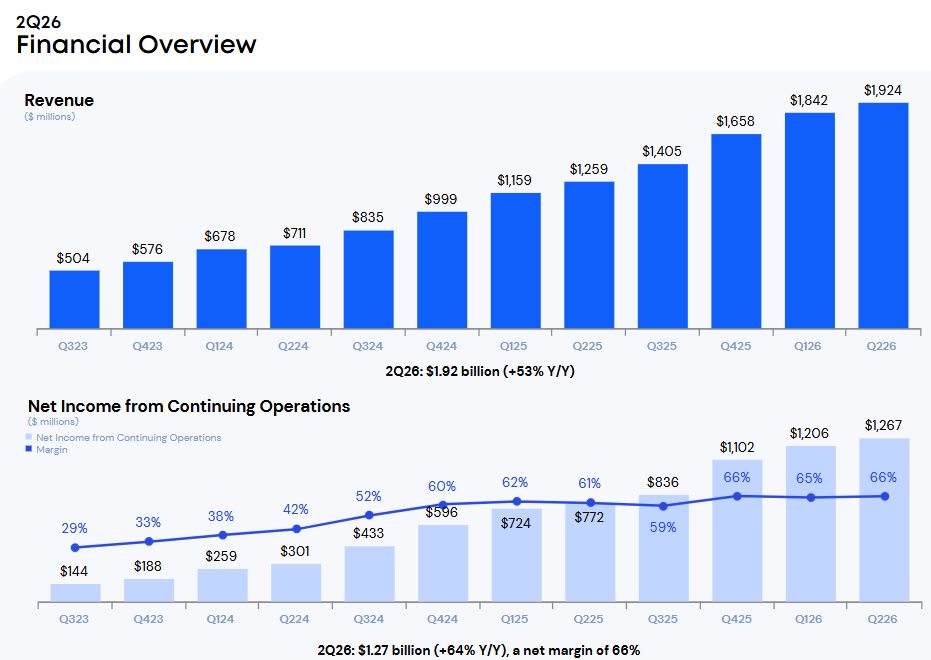
The company’s gross profit margin is ~88% and the operating profit margin is an incredible ~77%. This is partly based on the company’s extremely lean organization; the company has only about 900 employees, which translates to about $7 million in revenue per employee. CEO and founder Foroughi avoids hiring large teams and sales organizations. His idea is that he wants to hire only the best talent and keep the organizational structure lean, which enables these elite teams to operate extremely efficiently when unnecessary bureaucracy and bloated organizations do not slow down the best workers or lower their motivation. Foroughi’s view on the sales organization is that if the product is good enough and delivers directly visible ad returns to the customer, the product sells itself. As a result, stock-based compensation/dilution, which plagues American software companies, is also conspicuously absent, and only ~6% of free cash flow goes to stock dilution:
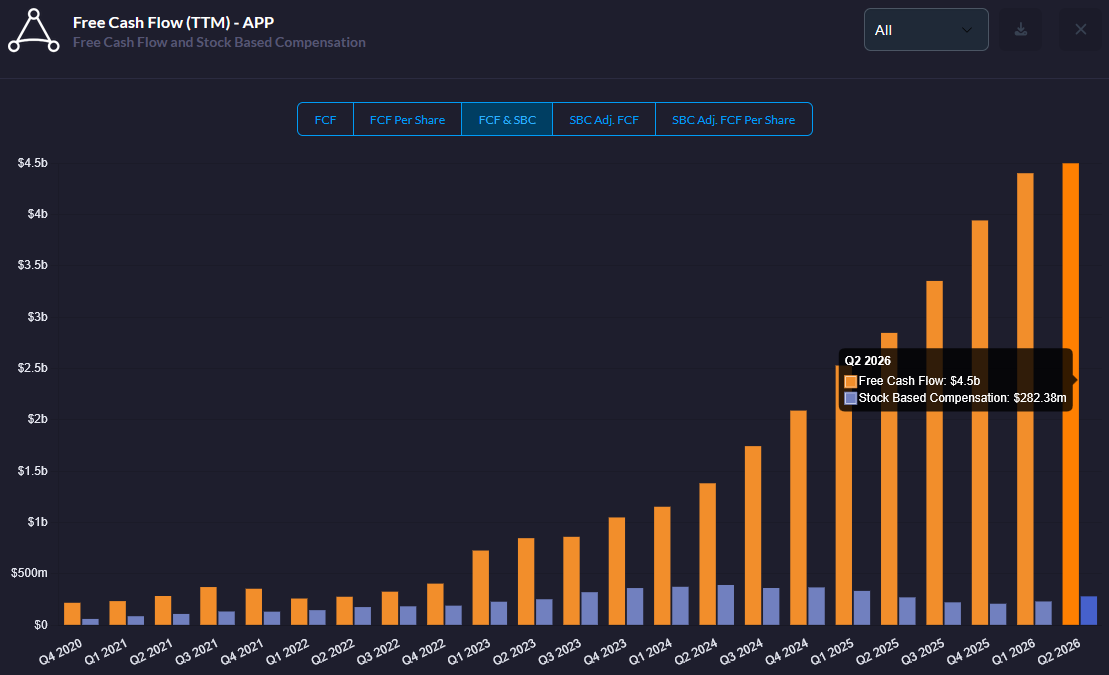
Founder and CEO Foroughi owns ~9% of the company, which is always nice to see and, in my opinion, a good sign. The company’s profit distribution takes place by buying back its own shares and canceling them, and the number of shares has indeed been in a steady slight decline since 2022.
The company has ~3 billion in cash on its balance sheet and ~3.5 billion in debt, with a market capitalization at the current price of around 105 billion, meaning EV (Enterprise Value) does not need to be used in the company’s analysis, and the vast majority of the free cash flow generated by the company can practically be returned directly to owners via share buybacks.
Future Growth Opportunities
In mobile game advertising, the company currently holds a dominant position, but at some point, the limits of that market will certainly be reached. The market is fragmented to the extent that I haven’t found a good estimate of the market size or growth, and AppLovin does not publish that information or its market share. According to the CEO, AppLovin grows the market all the time by making its advertising algorithm more efficient, meaning that when an advertiser gets a better return on their ad budget, they buy more advertising. AppLovin is also trying to expand into e-commerce advertising and the “connected TV” advertising market, but those markets are competitive and difficult. On the other hand, the company’s data and current data collection model do not lend themselves to those as well as they do to mobile gaming. It is easy to advertise other mobile games to a mobile gamer because they probably like them, but otherwise, there isn’t a lot of data on the user for well-targeted advertising. However, Foroughi’s goal is to reach a $1 trillion market cap and grow the company’s revenue at an annual rate of ~25% to $70 billion, meaning the goal is to grow AppLovin into the same class on the advertising side as Google or Meta.
Key Business Risks
The most significant risk to the business, in my view, is the development of competitors in the mobile advertising market and pressure on margins. If competitors (e.g., Unity) improve their ad targeting technology, they will be able to offer higher prices to publishers in auctions, which will force AppLovin to raise its own fees to publishers, thereby reducing the margin/commission AppLovin takes.
Reports have also been made about the company by short sellers, and the SEC (U.S. Securities and Exchange Commission) launched an investigation regarding allegations that AppLovin collects data from its users unlawfully and uses unauthorized identification, i.e., creating device profiles without permission. Based on the Q2 earnings call, the SEC has closed the investigation without penalties or further actions.
The company’s revenue is also still highly dependent on the mobile gaming market and its consumer behavior. In addition to this, expansion into other markets such as e-commerce is challenging.
Company ValuationThe company’s stock price has dropped by \~50% since the beginning of the year and by \~57% from its peak. On Q2 earnings day, the company’s stock plummeted by about \~20% as revenue hit the low end of the guidance, and profitability fell 1 million short of the lower end of the guidance. At the current price, the company’s trailing P/E is about 24, the forward P/E based on forecasts is about 17, and the free cash flow yield is \~4% adjusted for share dilution, which I consider a modest valuation relative to the company’s growth rate. So what is causing the price drop? As I see it, there are 3 explanations:
- The general stock price decline of software companies this year.
- Short reports and the SEC investigation (which, based on the earnings call, has already been concluded without consequences).
- The company’s “beat and raise” streak—meaning beating expectations and raising guidance—was broken with the Q2 2026 interim report. At the start of the Q2 earnings call, CEO Foroughi immediately addressed this, saying it was mainly due to the timing of the company’s algorithm development, meaning that Q2 model development was lighter than normal and a significant step in model development was achieved just as the quarter ended.
Why did I invest?
The company combines strong growth and profitability, and in my view, this year’s stock price decline has already gone into overreaction territory.
However, investing actually required some thought because the business involves significant risks, and this is probably one of the riskiest stocks in my portfolio. To be completely honest, I don’t fully understand the company’s monetization model, and the transparency regarding the monetization model, the company’s economic moats, growth prospects, and overall market dynamics simply isn’t high enough for this stock to comfortably fit into the “too hard to understand” pile. On the other hand, based on its price action, this also seems like a company where you need a strong stomach as an owner, but volatility has never been an issue for me, so I mostly focus on business risks.
However, the company’s track record over the past 3 years is so convincing, and on the other hand, founder and CEO Foroughi owns a significant amount of the company’s shares, so based on everything, I believe he is aligned with shareholders. I also appreciate his leadership philosophy on a rhetorical level, so I decided to take a modest \~5% position in the company. I might increase it slightly if the stock drops to the \~250 dollar level from the current \~310$ level, because the return potential is, in my view, so good. But on the other hand, the risks are also so high that the position size must be kept modest. Nevertheless, the company is financially and operationally exceptionally efficient, and its competitive advantages are, in my view, strong in its narrow segment of mobile advertising. I will be following with interest whether the Q3 guidance is met and how the company’s business develops in the future, and I want to see if the company can grow at over 20% annually for the next 5–10 years, as is Foroughi’s vision.
Over the past couple of weeks, I’ve waded through a lot of interim reports, financial statements, earnings calls, and other content around the company, and this write-up is just a scratch on the surface of my own thoughts, and surely a lot of relevant information was left out again. The main point, however, is that I strive to understand the business well enough to be able to explain it “simply and clearly,” and besides, it’s good to have some rationale recorded for myself looking ahead as to why I invested in the company.
If the company sparks your interest, Drew Cohen has an excellent business review of the company, from which I also got a lot of information for this write-up and where the things I wrote about are explained in much more detail:
You can get to know the company’s CEO and founder Foroughi by, for example, listening to this podcast, where Foroughi opens up the company’s history from his perspective as well as his own leadership philosophy: