China is preparing rules to limit the purchase volumes of foreign AI chips, such as Nvidia’s high-end models.
The goal is, of course, to support domestic manufacturers while simultaneously allowing limited imports. Chinese companies still need Nvidia’s H200 chips, at least for the time being, and can still purchase them, but in the future, these purchases will require justification as well as regulatory approval.
The United States said this week it would allow sales of Nvidia’s advanced H200 AI computing chips to China. Demand for the chips remains strong among Chinese technology groups, including Alibaba (HK:9988) and ByteDance, the report said.
According to the news below, deliveries of Nvidia’s H200 chips to China are stalling because the country’s customs are not allowing new “AI chips” into the country, and component suppliers have therefore put production on hold. Chinese companies have also been warned against buying chips “unnecessarily” without a clear reason being given; furthermore, there is no information regarding the length of the ban or whether it is temporary or permanent.
Nvidia is further deepening its collaboration with CoreWeave by investing two billion dollars in the company.
With this deal, Nvidia almost doubles its stake in the company and becomes CoreWeave’s second-largest owner.
The funding is apparently intended to accelerate the construction of AI-focused data centers to better meet growing demand.
CoreWeave is targeting to build more than 5 gigawatts in AI data center capacity by 2030. The fresh investment from Nvidia will help the AI infrastructure provider speed up procurement of the land and power required to build the facilities.
It’s quiet in the thread. NVIDIA’s forward multiples have decreased as the share price has been moving sideways for some time. Vendor financing and circular revenue questions are still surfacing. NVIDIA invested 2B in Coreweave, whose credit default swaps have seen volatile movements. Mega-tech companies’ free cash flows are shrinking, and Oracle and Meta are apparently already taking on a reasonable amount of debt for investments. Additionally, there’s the memory bottleneck, which will inevitably lead to price increases and perhaps a decline in NVIDIA’s staggering gross margins.. These developments, in addition to a reckless overweight position, have led me to start selling NVIDIA shares for the first time.
On the other hand, ASML just reported an incredible €13.2B in net bookings, while the consensus expectation was €6.85B, which at least doesn’t show any signs of the AI infrastructure cycle cooling down yet.
Also, perhaps the most eagle-eyed analyst, B Kindig, remains bullish and sees that we are still firmly in the “AI infrastructure build phase” and doesn’t see, for example, Apple as attractive. I’m starting to disagree a bit here and am now moving my chips in anticipation of the next wave of AI (“user-centric AI?”).
Apologies, my response is going off-topic for this thread.
Regarding the Mag7, I’m interested in GOOG, which I hold, as well as META. And of course AAPL, which is seen as an AI laggard. I believe AAPL will stay true to its style and only release AI features for its gadgets once the user experience has been polished to excellence. Microsoft’s AI pivot looks clumsier now, in part. Enterprise AI software companies that are “new gen,” cloud/AI native, are more interesting to me. I’m currently involved in Figma and Rubrik, among others. And then, of course, the “platform-like” companies that produce “proprietary” data to feed AI and bake it into the value they provide. Like our favorites PL and HIMS. I still look down on Tesla; maybe I just don’t get it.
But Nvidia will remain at a good weight in my portfolio going forward, unless we witness blatant bubble pricing in the future. A must-own company for me, absolute “best-in-breed.”
Oh right, edge. I’ll have to return to being a Nokia (Noksu) owner if and when operators start signaling a willingness to invest in AI-RAN technologies. Or even earlier, if the share price starts taking a forward lean…
Jensen Huang has confirmed that the company is participating in OpenAI’s major funding round, though this was considered quite a foregone conclusion even before the confirmation.
Huang also dismissed rumors of specific disagreements regarding this “project.” The exact sum has not yet been disclosed, but in any case, it is still one of the largest investments in Nvidia’s history.
According to the article, investors have been concerned about whether these are a bit too much like “insider dealings,” as Nvidia is directly funding its own best customer.
Nvidia’s massive investment commitment to OpenAI, a key buyer of its advanced AI chips, has stoked concerns about the circular nature of AI deals over the past year. Investors are increasingly questioning how these partnerships — in which tech companies are investing in AI businesses that purchase their products — may be artificially propping up demand. In a separate such deal, Nvidia recently announced plans to invest an additional $2 billion in CoreWeave Inc., a cloud computing provider that’s also a key customer.
OpenAI is a “too big to fail” institution. If it were to collapse, the likes of Oracle and others would blow up in its wake. So, it’s necessary to continue funding it for the time being.
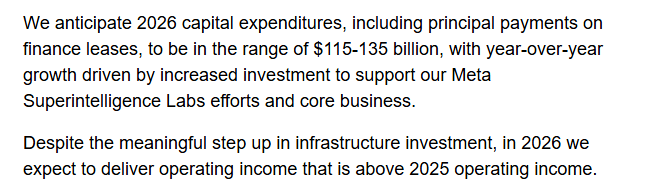
Big Tech capex guidance was quite aggressive. Exactly a year ago, the 2026 Capex spend was estimated at about $350B, which was exceeded more than a year ahead of schedule during the past year, shortly after the end of Q3. Realized 2025 capex was over $410B. That’s about 75% higher than analysts’ estimates at the beginning of the calendar year.
I estimated this year’s capex at potentially $600B levels 3 months ago. Now it looks like the actual level, based on the provided guidance, is over $700B—I was off too, in a good way. Microsoft has not provided guidance, and the figures are calculated based on the latest quarter’s run rate. Now it seems that even $750B is not impossible.
Q1
Q2
Q3
Q4
2025e (at Q3)
2025 actual
2026 guidance
Meta
13.69
17.01
19.37
22.14
72
72.21
135
Microsoft
21.4
24.2
34.9
37.5
115.5
118
150
Amazon
24.3
31.4
34.2
38
125
127.9
200
Google
17.2
22.4
24
29.4
93
93
185
76.59
95.01
112.47
127.04
405.5
411.11
670
The previous 0.6x ratio to Nvidia’s revenue has perhaps decreased slightly—presumably due to, among other things, Amazon’s and Google’s own chip investments. If such $700B+ were to materialize even at, say, a 0.5x ratio, it would mean quite a large margin for upward revision in analysts’ Nvidia revenue expectations for the current fiscal year.
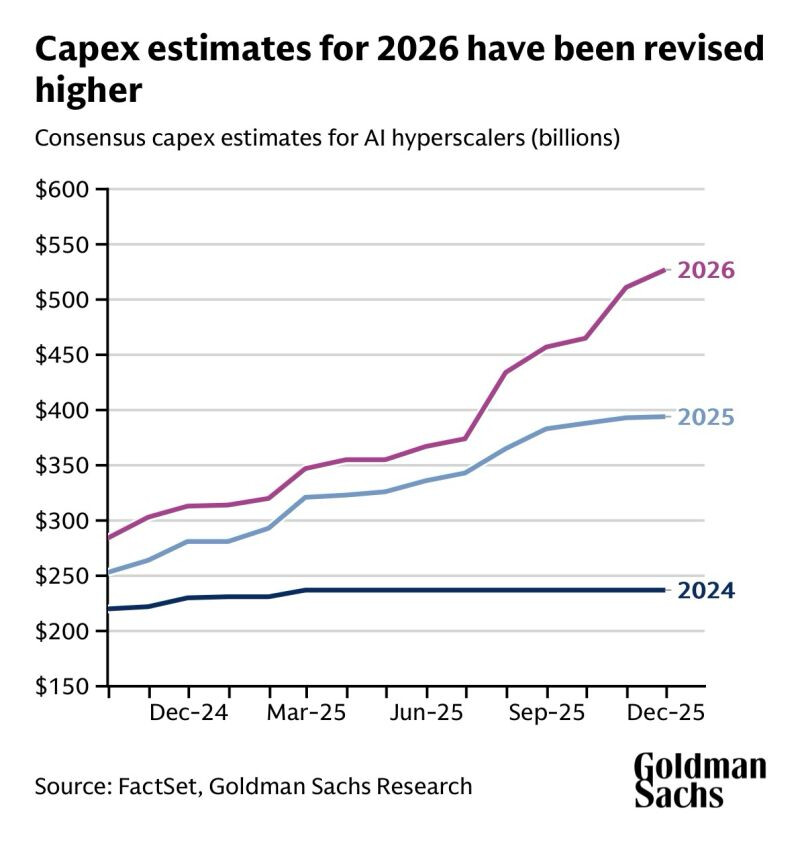
By the way, analysts’ capex estimates were in a completely wrong ballpark again just 4 weeks ago—just like before:
I probably won’t find the source anymore, but I saw an interesting thought on X, which I’ve paraphrased here. Google has Gemini, the cloud, its own TPU chips, and cash cows like Search and YouTube. They have a partnership with Apple and ownership in Anthropic (Claude), as well as apparently some involvement in the current SpaceX/xAI mess. To prevent Google from becoming the sole winner, others must support OpenAI or start doing better themselves. This is, of course, in addition to ensuring that the already cross-linked ownership, debt, and sales relationships don’t blow up
Google has indeed played a masterful hand for itself, from hardware through models to the AI software layer, and looks like an obvious winner, either regarding the whole stack or some part of it. I’ve been eyeing opening a Google position myself for a while now .
But Nvidia’s main incentive to support OpenAI and as many other players as possible is to keep the race for model development as broad and intense as possible. Broad and intense competition means for Nvidia:
More DC hardware sold
More frequently replaced DC hardware
because as a model developer, you can only be a pioneer if you have enough of the latest compute capacity. Nvidia’s worst enemy, however, is the possibility of the industry switching to fit-for-purpose ASIC hardware instead of Nvidia’s (rightfully) premium-priced multipurpose hardware. And that situation is driven fastest by the cooling down of competition.
Technically, OAI is not “too big to fail” in terms of model switching, as every AI software company has had to practice this for almost three years now, at least every 2-3 months. But regarding financial arrangements, we are indeed starting to reach a situation where the fallout could be worse than the financial crisis if OAI no longer had the resources to stay in the game.
PS. I probably haven’t remembered to link this podcast here, but Gavin Baker provides once again a top-tier recap of DC hardware economic dynamics.
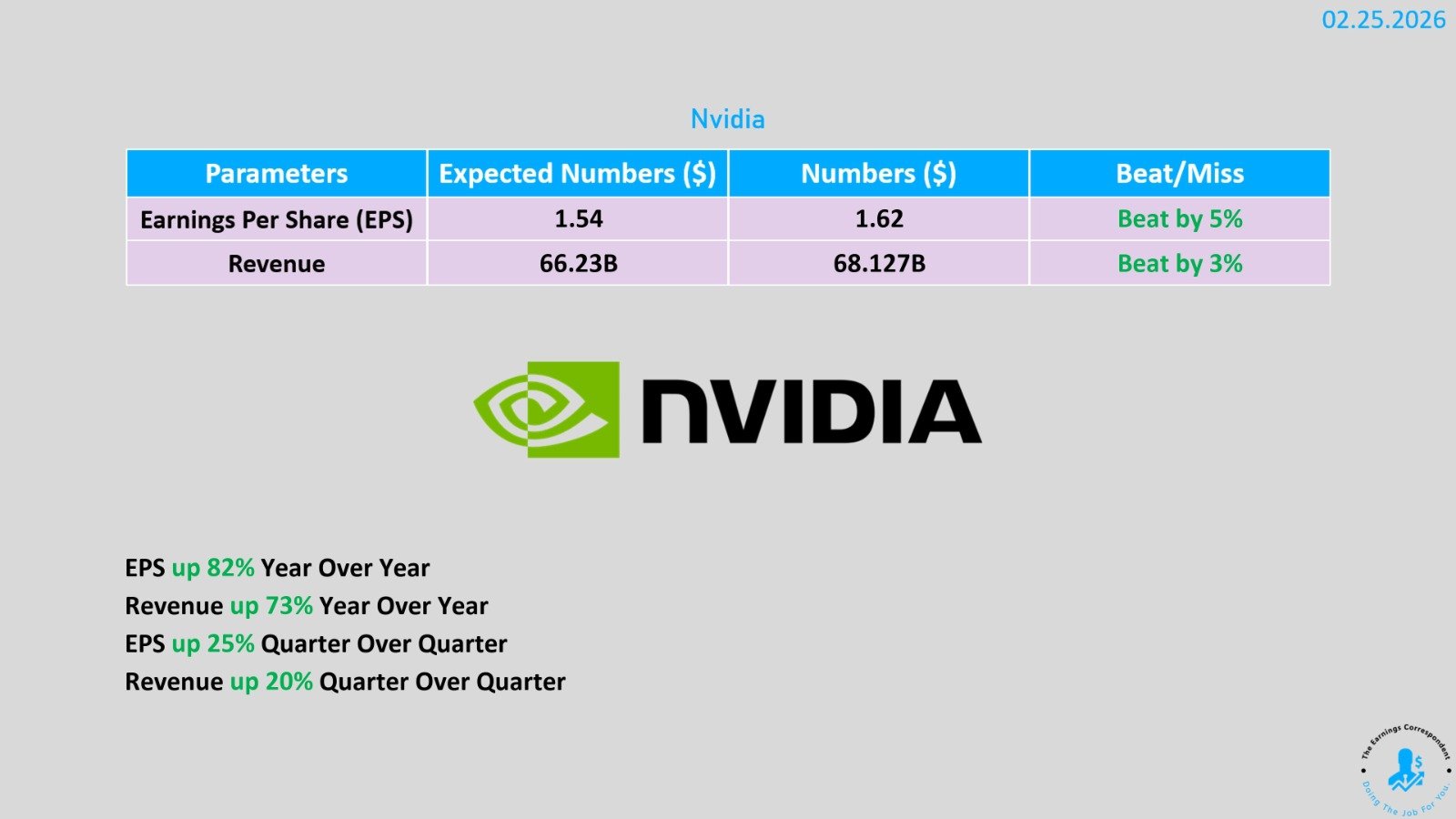
The FY26 results are coming out soon. Things have calmed down both here on the channel and in the market. For example, the implied volatility in the options market is only 5.6%, the lowest since Q1/23 (which, of course, is nearly the market cap of the Helsinki Stock Exchange ).
My expectations:
Beat and raise across the board, especially with the GB300 NVL72, which is by far the best and most cost-effective chip for current AI workloads
A message that capacity still limits sales – the figures would be even stronger if there was more to sell
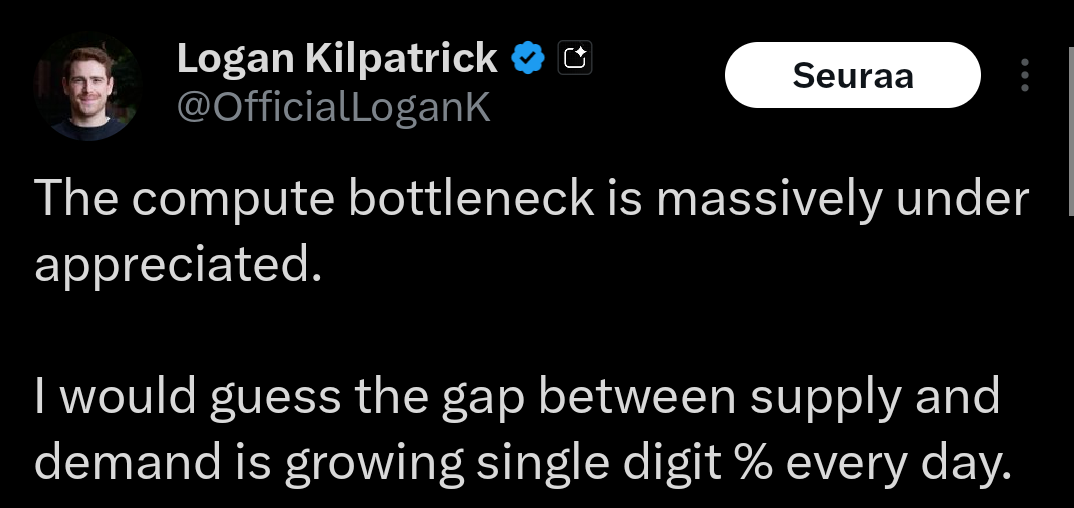
A raise to the previously given CY26 ~$500B bookings following the 20-30% increase in mega-tech capex guidance
Confirmation that Rubin will start generating revenue, preferably as early as Q3.
As a bonus, something positive from China
If these come through, maybe we’ll finally break out of this sideways trend.
Approaching the results with a calm mind. I think it’s telling for this upcoming massive result that there isn’t even a single model trained on Blackwells on the market yet, and the next chip generation is already in the pipeline .
It does feel that way. The market is somehow pricing in that we have now seen the last of the OpenAI funding rounds, and then Nvidia’s strongest growth will start to taper off.
Alright, listened to the earnings call. My main observations on the situation:
The growth that started last quarter is indeed accelerating. Guided +80% growth after this kind of growth and at this company scale is something completely unprecedented.
Nvidia just did an unbelievable $217B in revenue for FY26. But even more unbelievable is that if/when growth and profitability continue like this, the FY27 operating profit will be in the same ballpark as the currently reported revenue. Absolutely insane.
The importance of networking is growing all the time. Networking growth is an incredible 263% y-o-y.
The customer base is broadening, and thus customer concentration is becoming healthier. HPC accounts for 50% of DC revenue, and for example, neo-clouds are apparently lowering this figure significantly with their own super-fast growth (and this is despite the massive CAPEX investments from the mega-caps). Really good!
China is still essentially a lottery ticket providing upside to the numbers. It’s nice, but it would be much nicer if there were a surer outlook on how Nvidia could compete with its products in that market, which is moving forward at a terrifying pace.
So, compared to the pre-set expectations:
Beat and raise on every line –> CHECK
Capacity limiting growth –> NOT REALLY. According to Kress, a balance is now being found, meaning there isn’t really any pent-up demand anymore (excl. Gaming, where memory challenges are limiting supply)
Raise to the previously given $500B guidance –> CHECK (not numerical, but they said they’ll clearly exceed this)
Confirmations for Rubin production –> CHECK
Good news from China as a bonus –> NOT REALLY
Indeed, the stock is still trading flat, which worries me a bit as well. Someone once said that a decline is near when even good news no longer lifts prices. We’ve now had two completely exceptional quarters of accelerating growth behind us and practically only tailwinds for Nvidia, yet it’s trading flat. What about when the first quarter comes where, for example, they “only” deliver growth and profitability in line with guidance and not clearly above it?
Clearly, the markets are indeed pricing in a weakening of the CAPEX cycle in the near future, and in my opinion, by buying/owning Nvidia, you are betting against this idea.
I wonder if the OpenAI situation is one big gray swan that people are afraid of? OpenAI is making, or at least claims to be making, massive investments, but they don’t have the money for it. The cash comes from Microsoft and Nvidia, until it doesn’t anymore. I read somewhere that OpenAI loses $100+ on every subscription per month—or was it even per day? And this is without the new investments. When this setup, which resembles a pyramid scheme, collapses, then look out below.
 So, it’s necessary to continue funding it for the time being.

 .
 .