Nordic Semiconductor - Norwegian MCU workshop

Introduction

The forum was missing a thread on Nordic Semiconductor, or more familiarly, Nordic or NS. No worries, I’ll fix that. In my opinion, Nordic Semiconductor is a very interesting company in many ways. It combines high technology, a significant market position, and a Nordic growth story. I wonder if anyone else here on the forum has looked into the company more closely?

NS is one of the small-large MCU manufacturers. NS is nowhere near the largest manufacturers like NXP, TI, or ST when measured in absolute metrics. At the time of writing, NXP’s market cap is a shy 40 billion, ST’s is 24 billion, and NS’s is just over 2 billion. However, NS has an ace up its sleeve: insanely good radio IP that has been refined into a world-class Bluetooth radio and subsequently productized into the nRF51, nRF52, and nRF53 microcontrollers. This has led to a market situation where a company of NS’s size has a 42% market share of the BLE (Bluetooth Low Energy) MCU market. You don’t have to be a genius to notice that something is happening when a small player in the industry holds the lion’s share of a market that is predicted to skyrocket over the next decade.

NS Products

NS’s product portfolio is divided into 5 parts.

  1. Proprietary ASICs:
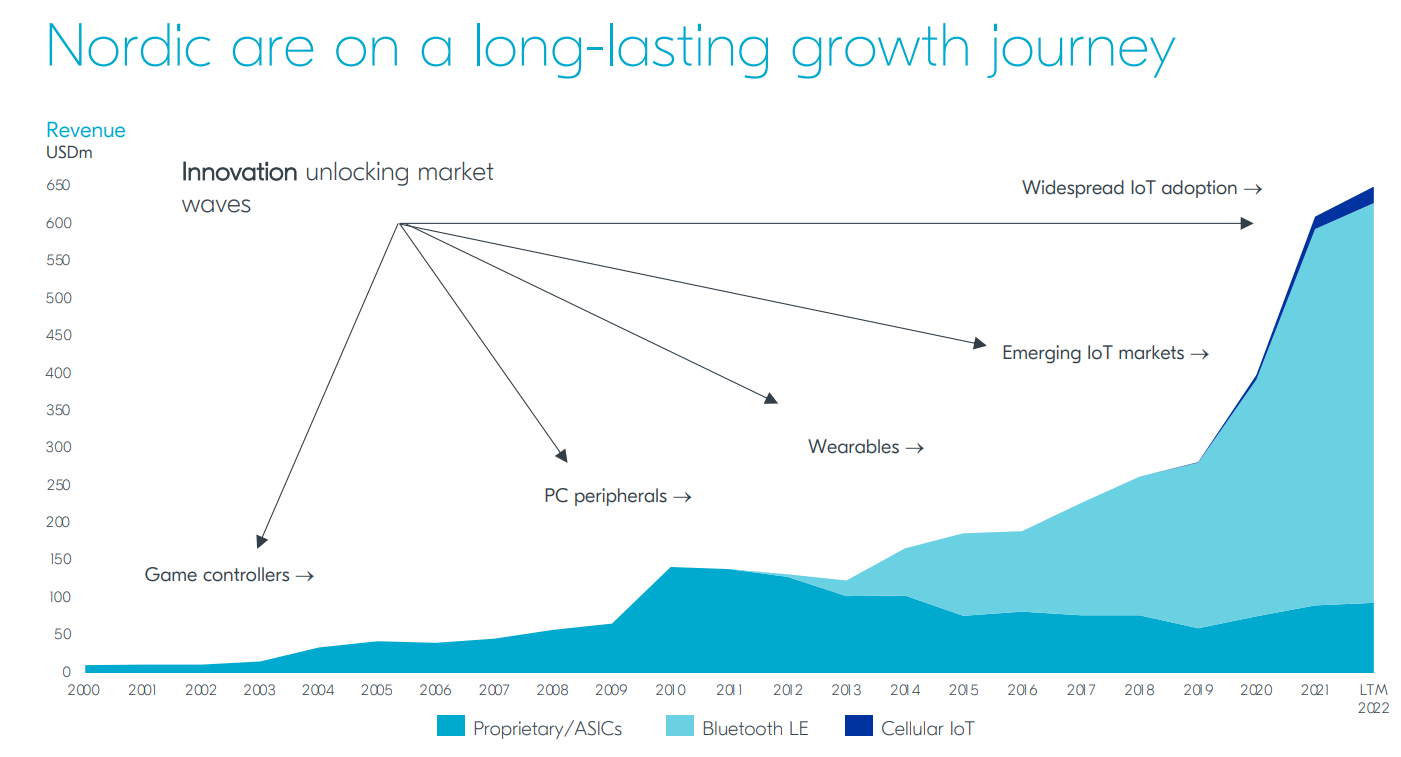
    Historically, custom radio solutions were NS’s mainstay about 10 years ago. Today, products in this category are a relatively small part of the entire company. Often these kinds of solutions are not public references, but as I understand it, the Logitech Unifying Receiver belongs to this category (Nordic is inside, but whether it’s a custom ASIC or a generic radio solution is debatable). This is the device used to connect a Logitech wireless mouse or keyboard to a computer via a small dongle plugged into the computer’s USB port.

  2. BLE:
    BLE is NS’s bread and butter and its most significant source of growth. Nordic’s first BLE product was the nRF51 series. The product brought NS to the attention of developers and began building trust between developers and NS. The product was significant at the time because it combined a capable microcontroller and peripherals, low power consumption, and a BLE radio into one package. The nRF51 was the first released product, and its successor, the nRF52, can be considered a more mature and improved nRF51. The nRF52 is larger, more powerful, and more energy-efficient than its predecessor. Both chips have a single ARM core on which both the radio and the application run. To function, the device requires a “softdevice,” which is a software device included as part of the binary. The SD specifically contains the radio core. Because the radio and application share the processor, it leads to interesting situations from a development perspective—especially regarding how memory and Flash are shared. Also, stepping through code line-by-line with a debugger while BT is on will crash the device sooner or later. The nRF52 is not perfect, but it’s a damn good compromise on many fronts. It is particularly well-suited for the ultra-low-power segment, as a device can operate as a BT beacon for years on a few AA batteries. The Finnish RuuviTag uses the nRF52 chip. It has a bunch of sensors and BLE. The manufacturer promises several years of operating time on a single battery (with an asterisk, of course). The newest member of the nRF series, the nRF53, is significantly different from its predecessors. The nRF53 contains separate processors for the radio and the application. The application core is also slightly more powerful than in the nRF52. The chip is still fairly new to the market, and there is no reliable data on its sales statistics yet.

I have over a year of active professional experience with the nRF52. Nowadays, the nRF52 serves as my primary platform for hobby projects. I’ll post a Git repo somewhere eventually when the project is in a state where it’s worth showing. You can then peek at what code and architecture made for the nRF52 look like.

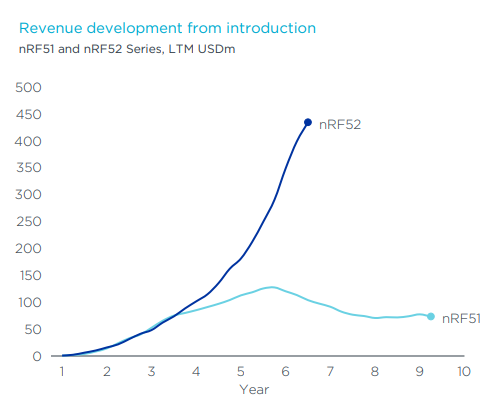
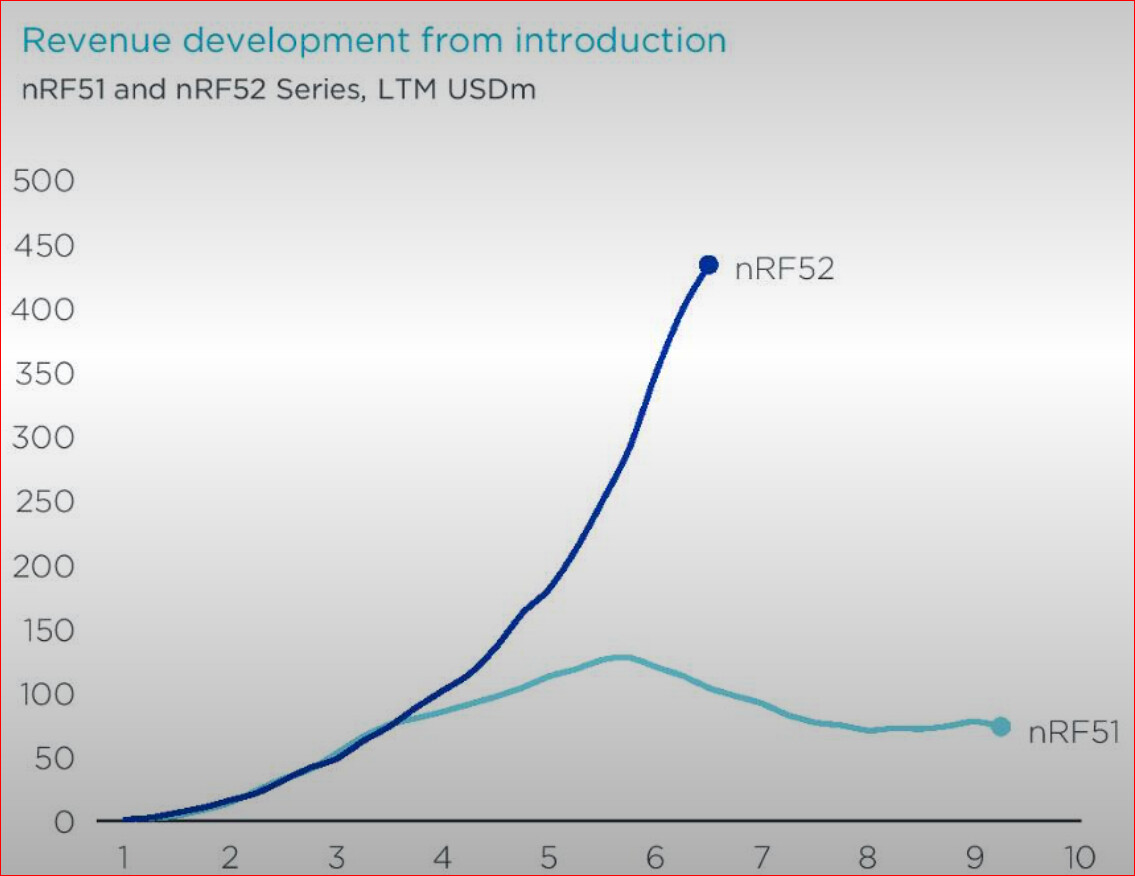
As seen from the graph, sales of the nRF51 and nRF52 have clearly developed, and the maturity brought by the nRF52 has been well received by the market.

  1. Cellular IoT:
    Cellular IoT is a significant growing trend for the future. NS released the nRF91 last year. The product is like the nRF53, but instead of a BLE radio, it has an LTE radio. The device achieves the same low-power characteristics as its BLE counterparts. In the future, a large part of NS’s valuation will come from cellular IoT.

  2. PMIC:
    NS released the nPM1100 PMIC (Power Management IC) last year. This is a very capable DC-DC PMIC designed specifically to work with other NS products. The chip is designed for low currents and also handles potential battery charging and fits well into a smart USB line. NS’s goal in designing the product was to increase the “real estate” of NS components on the circuit board. The product is a so-called companion product for the previous portfolio.

  3. WLAN:
    It’s hard to say much about WLAN as its announcement is expected during H2 this year. So, pretty soon. NS acquired an Indian design house specialized in WLAN design some time ago. This would be the first product to come out of that acquisition. I would assume NS wants to recycle old IP, so I’d estimate it’s an nRF53/nRF91 clone but with a WLAN radio. However, there is also a risk that the Indian company uses more of its own catalog, making the final product somewhat different from NS’s other products. At one point, NS identified business opportunities, and this was the most suitable angle for it.

Market Environment

NS’s market environment is interesting. In my opinion, there is no direct peer to NS. There are a few that are worth examining:

  1. Espressif ESP32:
    The ESP32 is a Chinese MCU family that DOES NOT use an ARM core but instead their own RISC-based processor architecture, or more recently, a RISC-V core in a few new products. From a global perspective, Chinese chips carry some risk regarding security, geopolitics, and reputation. Additionally, these chips are not very power-efficient, meaning they are not suitable for battery-powered applications such as wireless headphones. These chips can be found in all sorts of Chinese consumer electronics. For instance, Roborock robot vacuums use ESP32 chips. Roborock is a subsidiary of Xiaomi. Xiaomi is a company under state guidance. Espressif is roughly the same size as NS. Clearly a junior in the field.

  2. Texas Instruments
    TI has a bunch of different BT radios. I don’t know much about these. I know that some model is used in the Libre 2. Additionally, TI recently released the CC12405R, which is quite close to NS’s catalog. A significant note about TI is that the house and its semiconductor portfolio are massive and broad, ranging from power transistors to processors, instrumentation amplifiers, and MILSPEC components. A true giant. It’s difficult for a large house to cover all verticals. TI is worth watching in the future.

  3. STMicroelectronics:
    ST’s BLE product family is called STM32WB. It is a lineup consisting of a few models that are very similar to the nRF53 because the WB series processors have two cores: one application core and one radio core. It’s worth noting that ST’s BLE radio is not their own but a purchased IP block (if I recall correctly) from Infineon, which in turn bought a good part of this (if I recall correctly) from Murata. This leads to an unfortunate situation where the communication method between the application space and the radio space is very limited, making it a bit buggy, especially during development. ST is a large general-purpose MCU manufacturer, especially for industrial applications. If I were designing a circuit board implementation that didn’t require a BLE radio, I would choose an STM32 series processor 9 times out of 10. About a year ago, there were rumors that ST might acquire NS. That situation hasn’t developed further since then.

  4. NXP:
    I can’t say much about NXP. They have some kind of BLE portfolio. They face the same challenges as ST and TI: being giants, they cannot or are unable to manage every vertical. Someone else could assist with research regarding NXP if they wish.

Other things worth noting:

  • NS is a so-called fabless company that has its chips manufactured at TSMC and uses 55ULP technology, at least in its nRF52 series. Others likely use either the same or perhaps a version a generation or two newer. This means that NS does not have direct control over its own production in special situations. This has been particularly evident during and after COVID.

  • NS’s current valuation is based on a massive growth multiple and is therefore highly exposed to large swings in the share price within a changing macro environment.

  • NS’s primary markets are asset tracking, person tracking, consumer electronics, and the beacon market. The internet is full of various paid analyses on how the market is growing. Behind paywalls of several thousand euros, these are quite an expensive source of information. While working on my Master’s thesis, I tried to talk my way into getting a copy of one report. The lowest price they offered was €500. Here is an example of one: https://www.verifiedmarketresearch.com/product/bluetooth-chips-market/?utm_source=Designerwomen&utm_medium=016. If someone wants to spend money on professional literature for tax purposes, something like this is probably quite good for that :smiley:

29 Likes

Great!

Just a couple of days ago, I was thinking this would be an interesting topic for a thread.

About 15 years ago, in my job at the time, I was heavily involved with these when we were trying to get BT LE (now BT smart) into Nokia phones.
Later, in my previous startup, Nordic chips were used in remote controls. No need to change batteries.

Seems like a reliable company based on this.

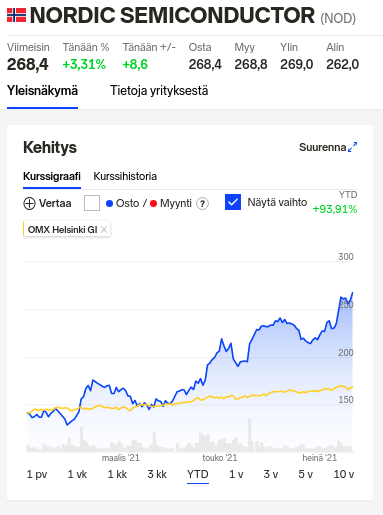
Someone on Shareville, a Norwegian, brought this up in early 2020, and I took a small position for myself. +200% now.

5 Likes

As a customer, I can confirm that the products, support, and development environment are good. The reason for choosing Nordic is specifically the BT radio.

Availability is currently poor, as with all manufacturers. Reseller prices have roughly doubled since the turn of the year, but I’m not sure if Nordic itself has raised its prices or if the intermediaries are cashing in. We use about 50,000 units of a couple of different models per year.

But the stock is definitely too expensive for me. With these valuations, however, I can’t really manage to buy anything; there’s far too much cash in the account.

4 Likes

I started looking into them recently and bought some positions in $NOD. I’m trying to get my heard around how they are postioned and their products it’s a very technical area and I’m a non technical person. There’s good secular momentum with cellular iot and recently rumoured to supply apple. Think with 5G this is a good nice play, also think with $SLAB becoming a more pure IOT player valuation are going to converge to $SLAB levels. What’s your view 2-3 years out on $NOD.

3 Likes

STM is going to buy Nordic?
https://www.nasdaq.com/articles/stmicroelectronics-mulling-offer-for-oslo-listed-nordic-semiconductor-paper-2021-05-20

3 Likes

Now, about a week after the Q2 earnings report (https://www.nordicsemi.com/-/media/Investor-Relations-and-QA/Quartely-Reports/2021/Q2_Quarterly_Report_2021.pdf?la=en&hash=A5706B599D13B19C7F633B8BCC97B307AA05C429), the valuation has once again received a new boost upwards. The stock performance is quite palatable. Profitability and earning power have both been tested, and growth can be achieved despite the general problems in the semiconductor industry.

A potential takeover bid is still a possibility, although I personally see the quick profit from a takeover bid as less attractive than an independent and strongly growing company.

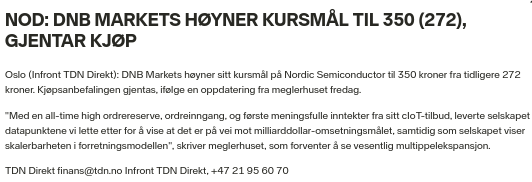
I hadn’t realized before what the Norwegian analysts thought about this. The language barrier is a challenge, but Google is the solution. 350 NOK and buy. That’s what I think. This is dated 16.7.20201.

Let the solo discussion continue. I have been collecting job posting data for Qt since the beginning of the year. Qt and NS’s products are similar in that they are both, in their own way, specialized tools for developers. Therefore, I will also start monitoring “NRF” and “Bluetooth Embedded” job postings. We’ll see if this data is useful.

The dataset is freely available:

2 Likes

The Q3 results are due in a couple of days. Here are some thoughts on what to expect:

  1. NS has already stated that it has passed on increased manufacturing costs directly to the customer. This is hardly surprising given the current global situation. Product margins should therefore be in good shape. This leads to the conjecture that TSMC revised its order book around the beginning of summer. They raised prices and streamlined the order book according to the wishes of major customers. In practice, this pushed some smaller, lower-margin products (i.e., not-so-good customers from TSMC’s perspective) later or completely out of the order book. NS’s announcement of customer price increases would suggest that NS dug deep into its pockets and did not give up its own orders.

  2. Everything that is produced is sold off the shelves. The limiting factor is likely availability from TSMC. Since NS is a rapidly growing company and its valuation includes a significant amount of high double-digit annual growth, it is important that delivered volumes remain high. A dip in shipped chips would create a good buying opportunity.

  3. There have been some product mentions in the news feed directly with NS chips. Not many, but that’s not surprising since it’s often not mentioned at all. What has been a positive surprise, however, is several pre-certified MCU modules released during the summer and autumn, including from Bosch. This seems very delicious.

  4. The npm1100 has started shipping. This should open a new segment in the delivery pie chart. It will be interesting to see how the product has been received by the market and how things develop. In theory, every premium-priced BT/cellular MCU sold automatically also sells a premium-priced PMIC chip. It seems like a win-win situation.

Thursday will tell what happens

2 Likes

What do you think about Nod’s partial results? And what do you think the future looks like?

21.10.2021 at 8:00 AM · Oslo Børs

NOD: Third quarter results 2021 and forward-looking statements

(Oslo, Norway - October 21, 2021) Nordic Semiconductor ASA reported revenue of

USD 148.5 million for the third quarter 2021, an increase of 24% from the same

quarter last year. Revenue growth continued to be capped by limited wafer

availability, and the order backlog increased to USD 1,316 million at the end of

September 2021.

Bluetooth revenue increased by 28% to USD 123.3 million, whereas Proprietary

revenue declined 5% to USD 18.1 million and Cellular IoT revenue more than

tripled to USD 5.3 million. Gross margin was 53.1% compared to 54.1% in the

third quarter 2020, and EBITDA of USD 28.3 million compared to USD 28.6 million

in the same quarter last year. The lower EBITDA margin reflects continued growth

investments in a period where supply chain constraints temporarily limit revenue

growth.

For the first nine months of 2021, revenue increased by 58% to USD 439 million,

with EBITDA increasing to USD 82.4 million from USD 49.9 million.

"We continue to see strong interest in our products and solutions although our

current delivery capabilities are limited by the supply constraints in the

semiconductor industry. We have established a very strong customer base across

both tier-1 customers and the broad market and continue to invest to capture the

large growth opportunities we see in the market", says CEO Svenn-Tore Larsen in

Nordic Semiconductor.

Nordic will adjust prices in the fourth quarter to reflect increasing wafer and

outsourced assembly and test (OSAT) prices and cost inflation through the value

chain. In combination with the indicated allocation of wafers, this allows the

company to guide for a revenue level of USD 150-170 million for the fourth

quarter of the year. Gross margin is expected at 51%-53% in the fourth quarter.

"Going into the final quarter of the year we expect a revenue level that

corresponds with full year revenue of around USD 600 million. We are now

confident that we can grow this to USD 1 billion already by 2023", says Larsen.

Capital Markets Day - forward looking statements

Nordic Semiconductor ASA later today hosts a Capital Markets Day to present the

company strategy. The presentations will contain certain forward-looking

statements which can be summarized as follows:

  • Nordic expects to reach its USD 1 billion revenue target in 2023, one year

earlier than previously communicated. Given the company’s order backlog, revenue

growth is dependent on supply rather than demand in this timeframe. Committed

wafer deliveries secure the 2022-2023 growth plan.

  • Nordic expects continued revenue growth beyond this period and holds an

ambition to more than double revenue from 2023-2026. This growth ambition is

based on continued strong growth for the company’s short-range business,

accelerating traction for its cellular IoT business, early traction for Wi-Fi

products, and gradually increasing revenue contribution from power management

products and other adjacent technologies and products.

  • Nordic has consistently reported gross margins above 50% over the past years

and believes this will continue also going forward.

  • Nordic has previously presented a long-term EBITDA-margin target of 20%. Given

the growth outlook the company believes scale benefits and increasing

operational leverage will enable the company to grow EBITDA-margin towards 25%

by 2026.

  • Nordic remains committed to innovation and will continue to invest in R&D with

the aim to remain in the forefront of a technology development holding

significant growth opportunities over the next decades.

  • Nordic assesses its cash position to be adequate given the expected level of

R&D and capex investments and believes a strong balance sheet required to ensure

flexibility and resilience. Cash generation is however expected to increase over

the coming years and will allow for the evaluation of cash return to

shareholders in 2023.

Practical arrangements

The management team will host a webcast presenting the third quarter results

today at 08:00 CEST. The presentation will be held in English. A live webcast of

the presentation can be found at www.nordicsemi.com/IR, and a recorded version

of the presentation will also be available after the event.

Nordic’s Capital Markets Day at Oslo Konserthus starts at 15:30 CEST. CEO

Svenn-Tore Larsen will be joined on stage by EVP Sales & Marketing Geir

Langeland, CTO Svein-Egil Nielsen, EVP Product Management Kjetil Holstad, EVP

People & Communication Katarina Finneng and CFO Pål Elstad, and the

presentations are expected to be concluded at around 18:00 CEST.

The presentations will be held in English and will be made available at 15:00

CEST. A live webcast of the presentations can be found at www.nordicsemi.com/IR,

and a recorded version of the presentation will also be available after the

event.

For further information, please contact:

Pål Elstad, CFO Nordic Semiconductor ASA

Phone: +47 991 66 293

Ståle Ytterdal, SVP IR Nordic Semiconductor ASA

Phone: +47 930 37 430

About Nordic Semiconductor:

Nordic Semiconductor has been a pioneer in ultra- low power wireless solutions,

from proprietary technologies for PC accessories to today’s Bluetooth low energy

and multiprotocol products and long-range cellular IoT solutions. Nordic

Semiconductor is the clear market leader in the ultra-low power wireless

segment, serving a growing market in consumer electronics, wearables, building

and retail, healthcare and an increasing number of other verticals and

applications. Nordic Semiconductor (NOD) is a public company listed on the Oslo

stock exchange in Norway.

For more information go to www.nordicsemi.com

This information is subject to the disclosure requirements according to §5-12 in

the Norwegian Securities Trading Act.

2 Likes

Both the results and the webinar held in the evening were very interesting and twofold. The market reaction shows that more was expected. In my opinion, it was quite close to what I realistically expected.

Growth is limited by wafer availability and manufacturing slots. This was known in advance. The growth of the backlog was perhaps greater than I imagined. The webinar stated that with current information, the backlog will not be fully cleared during 2022 and will certainly carry over into 2023. On top of this, of course, there are new orders. I’m not sure if this was stated verbally, but there was a mention of diversifying the supply chain in one of the slides. Would NS be buying capacity from, for example, Intel? That’s hard to know.

The webinar mentioned new products and verticals many times and how both the WLAN, cellular, and PMIC portfolios will be expanded in both directions. This is really, really good news. Regarding cellular, it was stated in response to an audience question that the 100m revenue threshold will be broken in 2023-2026, but probably closer to 2023. I expected a slightly faster timeline, but we’ll go with this.

Most of the results and backlog are from BT devices. Especially the picture of nRF51 vs nRF52 volumes per year after launch looked really appetizing:


This is worth remembering.

In addition, the analyses of the growth of the entire IoT industry (3rd party) create a very strong picture.

The webinar also heavily emphasized technology leadership in BT radios. The current market share is good, there is room for growth, and the entire sector is growing.

Audience members asked about acquisitions. The answer was that the matter is constantly being investigated, and between the lines, one could understand that there are irons in the fire regarding this matter.

Before the earnings report, I had already moved to a clear overweight in NS at 250NOK from the previous dip. A few analysts lowered their TP from 350 to 320 but still recommended buying. My entire investment case is purely based on technology. It’s great, and it’s really enjoyable to work with. The fundamentals are in order, and now it’s just a matter of waiting for capacity growth.

Here’s a scattered and rather poorly structured opinion on the earnings report. Mr. market didn’t take to it immediately, but there’s so much good stuff here that I can’t wait to see what the next 5 years hold.

2 Likes

Oh, by the way, I can only recommend watching the webinar if you are interested in NS as an investment case beyond a superficial glance. It can be found here: https://www.nordicsemi.com/Investor-Relations and is a little under 3 hours long.

2 Likes

Actually, I have some Nod (Nodia) myself, so thanks for the tip.
Yesterday, Mr. Market punished Nod (Nodia) -12.41%,
and today it has risen +5.34% so far.

2 Likes

News feed. Nordea and BofA started covering NS. Nordea recommends buy at 375 NOK and BofA at 425 NOK.

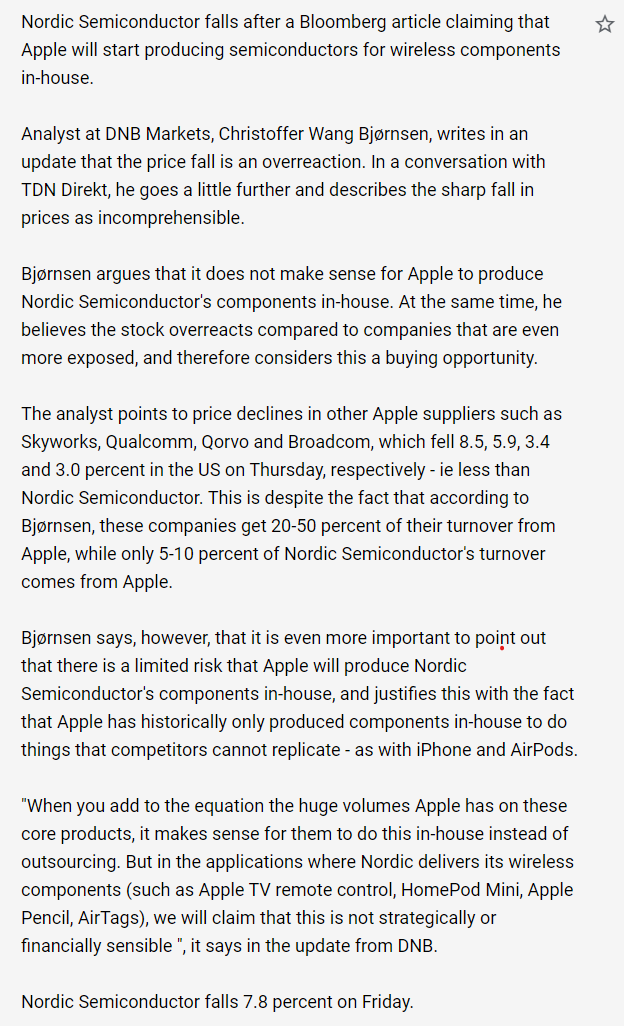
Additionally, Apple, a major buyer for many component suppliers, has decided to start moving some chip design in-house. The market has reacted strongly to the share prices of several suppliers. As the Google Translate screenshot indicates, the reaction, at least for NS, is overly strong. However, a moment ago, the price had been fluctuating between the ATH price and around 300 NOK for some time. NS will publish its Q4 results quite early on February 14th.

It’s been so busy, and I haven’t really had time to go through my thoughts on NS’s (Nordic Semiconductor’s) earnings report. The share price reaction after the earnings report has been strongly negative. The strong results and guidance, as well as some indication that TSMC’s capacity-limiting factors will start to ease during Q1, do not in themselves warrant this. As a small player and a rather speculative target, NS has gone with the flow as multiples for technology companies have been deflated.

In my view, the most important things in the report were the good margin and clear guidance on how increased prices are directly passed on to the customer. Also, a significant 40-50% share of FCC BT applications is still very well aligned with the validation of my investment case. The backlog is massive, and its resolution is entirely dependent on chip producers. Not even a single Tier-1 customer (e.g., Apple) or anyone else can influence this. I truly hope that NS has explored alternatives for using asymmetric suppliers, as was implied in the Q3 report. My gaze is still directed towards Intel. Also, the 1-billion-dollar guidance for 2023 was reiterated once again.

From the report itself, it’s great to see the rapid growth in sales of the 91-series. Also, the release of the WLAN chip(s?), scheduled for the second half of 2022, is on schedule.

In summary, to quote Matti and Teppo: “the pace is accelerating,” even if the markets disagree. I, for one, intend to use prices below 240 NOK as buying opportunities to increase my position size.

4 Likes

I suggest Inderes start following Nordic Semiconductor, which develops microchips for wireless technology (Bluetooth, Cellular, Wifi). This could potentially be a target company for you to market your analysis service to, especially if you are aiming for clients in Norway. Would it be possible to get a dedicated company page for them?

In my opinion, Nordic Semiconductor is an interesting target for analysis, both in terms of technology and financials.

Q1/2022:

  • Revenue: USD 183.1 million (+28%)
  • EBITDA: USD 55 million (+120%)
  • EBITDA margin: 29.9%
  • Order backlog: USD 1537 million

Source of figures: Q1 2022 quarterly report

5 Likes

:norway: I’m also following Nordic Semiconductor closely, as its technologies enabling IoT applications interest me. Today, I bought a bit more.

As I understand it, Nordic Semiconductor’s Bluetooth and LTE technologies are quite competitive. The company has also acquired a Wi-Fi development team from Imagination Technologies, so it will be interesting to see how they progress in that area in the future.

Earlier this week, I coded a small http-client test application for the nRF9160 DK and Nordic Thingy:91 platforms. Based on my preliminary experiments, the nRF9160 seems to be a very competitive cellular-IoT solution. The following three points, in particular, are significant in my opinion concerning LTE technology:

  • Very high integration (modem, app processor, RF front end, PMIC, …)
  • Extremely low power consumption (LTE-M PSM floor current: 2.7 uA)
  • Very small physical size (10x16x1.04 mm LGA)

It would be great to read an analysis of Nordic in the future to gain tools for analyzing the company. I already suggested the company as a target for analysis in another thread [*]

If you want to try out Nordic Semiconductor’s Bluetooth technology, you can find it, for example, in the Finnish Ruuvi Innovations Oy’s Ruuvi Tag sensors, which use Nordic’s nRF52832 Bluetooth chip.

[*] Suggestion for an analysis target

13 Likes

I’ll try to revive this discussion thread. Let’s see if I succeed. :slight_smile:

I am interested in Nordic Semiconductor from both the perspective of wireless IoT technology and as a shareholder. It would be great to find fellow travelers who actively follow the company or work building applications with its technologies. It would also be great to identify perspectives and facts that help in analyzing the company. Could you share your thoughts on topics such as the following?

  • Experiences with Bluetooth and LTE software development environments
  • Future growth prospects and challenges in the IoT segment
  • Competitive landscape in Bluetooth, LTE, and Wi-Fi modules
  • Chip manufacturing capacity outlook and the evolution of the chip shortage over time
  • IoT and future wireless applications
  • Breakthroughs in IoT and wireless technology
  • General development of the wireless market
  • Competitiveness in terms of price, power consumption, integration level, and so on…

I am a nascent entrepreneur and I am considering doing IoT application development on demand for the nRF9160 LTE-M environment. So far, the nRF9160 is one of the best LTE-M modems I have identified on the market, considering price, integration level, physical size, and power consumption. The software development environment (C and Zephyr) also seems excellent based on preliminary experiments. Previously, I have also tested Digi’s Xbee module, which uses u-blox SARA-R410M-02B. Have you identified other competitive LTE-M modules?

For discussion inspiration, you can, for example, read Nordic Semiconductor’s latest Wireless-Quarter technology publication.

Have a pleasant and relaxing weekend! It’s inspiring to be part of this wonderful forum. Thank you to all fellow forum members for the great community. :slight_smile:

P.S. Thanks @Sijoittaja-alokas for moving my previous related posts to this thread.

10 Likes

There aren’t many analysis firms globally that follow NS, but the situation has significantly improved. Especially in the latest conference call, there were questions from large financial institutions that don’t officially follow NS, for example, in the form of price targets (TP) or analyses.

Nordic’s core is still in BT technology, with products like nRF51, now nRF52, and nRF53 in the near future. Additionally, a WLAN chip will be released during H2. Other segments include custom ASIC implementations and additional chips like the PMIC nPM1100. In the Q1 conference call, expansion was promised for both the PMIC and nRF91 series.

Regarding competitiveness, I still believe (referencing the start of the thread) as an embedded developer, that NS’s BT is by far the best for productization and development, both with the legacy SDK (17) and the new Zephyr implementation. Cellular IoT is rising (compare NS’s Q-reports, for example) and is a workhorse for the medium-to-long-term horizon alongside BT. NS had good luck with both strategy and choosing LTE network technology as its foundation. Over the past 10 years, when the IoT boom began, there were many different techniques for how narrow-band cellular IoT should be implemented. Many of these technologies have died out during this time, mostly for good reasons. LTE was not originally a favorite in this race, but technological development has proven that LTE radio can be packaged (put to sleep) beautifully into currents below 10uA.

I just switched companies, but I managed to be the primary nRF52 developer for a couple of years, both on the firmware side and on the so-called companion app side using Flutter technology (primarily for Android targets).

  • I can only speak about the BT side. It’s incredibly good. For nRF52, I always used the legacy SDK. The biggest plus with it is that it’s purely Makefile-based and doesn’t force you to use, for example, the chip manufacturer’s own, often Eclipse-based IDEs, which are always terrible (NXP, ST’s SCP, SES, ST’s AC6, etc.). This allows for easy and fast development with the tools you want to use. I personally favored VSCode, arm-none-eabi-gcc, and Segger’s J-Link.

  • As I briefly mentioned in the opening post, the market (and my own) consensus is that MCUs without BT/other radio will be replaced in many applications by those that do. Not in all or even most verticals, of course, but the most lucrative verticals, i.e., 32-bit high-performance MCUs and their applications - yes.
    I would break down IoT segments into two parts: BT and LTE/other long-range. In both, power consumption is important, and with current technology (e.g., NS’s 55ULP from TSMC), there are hardly any differences. Both can achieve sub-10uA sleep currents. Of course, BTLE 5+ also operates actively with currents of a couple of tens of uA, while LTE radios consume a bit more during communication. 10uA sleep is important because it allows for battery life of tens of months even with a couple of hundred mAh battery. BT will be the go-to technology for consumer devices (and others that are, for example, indoors/in the yard), whereas LTE-side technology is suitable for distributed access/asset/maintenance monitoring tasks. For consumer devices, it is important that the device is standalone and integrates with existing infrastructure. In this case, it’s the user’s mobile phone.

  • The competitive situation varies. NS is one of the few that produce precisely these kinds of products; especially counterparts to the 51/52 series don’t come to mind. ST and NXP both have products that resemble the nRF53 and include a dedicated radio processor in addition to the application processor. However, both of these buy the BT IP block from elsewhere (if I’m not completely mistaken, it’s from Cypress Semiconductor, which Infineon now owns, and they, in turn, buy at least part of this IP from Murata). From China comes the ESP32, sold with WLAN and BT enabled. ESP’s popularity is evident, especially in Chinese consumer devices. The problem is high power consumption (not suitable for the ultra-low power segment) and distrust of China. Many do not want to build their product on a Chinese chip.
    The best comparison, in my opinion, is the module manufacturer u-blox. U-blox sells both its own modules and modules that contain, for example, an nRF52 inside. There are also other module packagers like Bosch and a large number in China. The great feature of modules is that they enable fast and cheap production. One of the most annoying development tasks for BT devices is FCC certifications. If you use a completely custom PCB design, you have to validate the entire design with the FCC. If you use your own PCB design but the processor is a module that is already FCC certified, this process is significantly faster and cheaper. Those seriously following NS should study module manufacturers and their production/sales figures. They should be good at fronting production.
    Modules are suitable for smaller companies’ prototypes and initial production batches. Once the product is validated and selling, it’s fairly easy to switch from a module to your own design later.

  • NS’s Q1 report indicates that they are now on the “better side” of the bottleneck, and volumes are clearly growing. In the Q4 report (and my related message in this thread), I mention how they flirted with the idea of having multiple suppliers. Now, in the Q1 report, this is stated quite directly. Nothing concrete is revealed here, but my own guess is either a wild card like Intel or GF. This would be massive news as it would remove NS’s biggest problem, namely silicon availability. They have now stated in several Q-reports how they have themselves fronted a lot of their own testing and packaging capacity, meaning that when silicon starts flowing strongly again, they will be ready to deliver on their end to the same extent.
    I have theorized that during a chip shortage, it is beneficial for developers and designers to maximize the benefit from silicon. Thus, products with high integration levels (MCU + BT + WLAN, for example) are winning technologies because they yield the most functionality with the smallest footprint. I intuitively believe that in the post-chip shortage era, the MCU business with integrated radio will be stronger than in the pre-chip shortage era. It is worth challenging this view.

  • BTLE 5.x and LE Audio are breakthroughs in IoT technology, and technologically, there is no competition. In my opinion, the technology race has already been won. Gen 1 5G is not very suitable as a BT replacement due to its high complexity and currently missing products. Perhaps Gen 2 5G when maturity is found. In the Cellular IoT sector, it’s different, and I see Gen 2 5G, in particular, being important in the future.

  • As stated earlier, the nRF5x product families are good and among the best in the industry. Especially low power consumption combined with functional, easy, and efficient BT is NS’s current cutting edge.NS’s valuation has melted beautifully from 300NOK prices to almost half. But so has the entire sector. The semiconductor (PJ) sector is seen as somewhat cyclical. However, I personally believe this is not the case. The cyclicality narrative is supported when examining the entire PJ industry, especially historically, including TSMC-Intel-AMD-Nvidia-ASL-NXP-STM-Renesas, etc. In contrast, when examining the MCU sector, many arguments emerge that are entirely against this. Some also apply to the so-called big players and PJ enablers like ASL and TSMC.

  • The world is increasingly electronic and connected. In addition to the natural existing PJ verticals, older technologies are constantly moving under the PJ umbrella, simultaneously increasing the need for different PJ products.

  • Originally, when MCUs were developed, the goal was to increase integration from discrete circuits to a few or even one. Then the bit count began to grow from 8->16->32 so that memory would suffice for more complex operations. Now the same is happening with MCU radios. Development progresses, and so does the market. There is no reason why the pursuit of higher integration would end when there are clearly still known technologies and applications for it.

I will write more about these market cyclicality/non-cyclicality ideas, especially as applied to NS, at some point, but I want to structure it better than, for example, this text. Apologies for this text as it is written at a rather stream-of-thought level.

11 Likes

Thanks @luettelo for the thorough and detailed answer. It was very interesting to read about your experiences with Nordic’s Bluetooth technology and your observations on its excellent competitiveness from a productization and development perspective. Core indeed seems to be in Bluetooth, as according to the Q1/22 interim report, Bluetooth’s share of revenue was approximately 82%.

Cellular IoT’s share of revenue still appears to be quite small (less than 4% in Q1/22). However, the revenue growth for Cellular IoT is quite impressive. In Q1/22, cellular IoT revenue was more than five times higher than in Q1/21 a year ago. It will be interesting to see how this area grows if wafer availability and component shortages ease somewhat by the end of the year.

Regarding Cellular IoT, I also noted that Nordic made an agreement with Nokia, which will hopefully simplify the licensing of SEP (Standard Essential Patent) patents in end products. Perhaps the agreement simplifies the use of LTE-M technology in IoT applications a bit. However, for many low-data applications, LoRaWAN or Sigfox are probably quite sufficient. It will be interesting to see how widely cellular technologies are utilized in IoT applications in the near future. It will also be interesting to see how well Nordic succeeds in competing with u-blox’s Sara series LTE-M/NB-IoT modules.

For Wi-Fi technology, it’s interesting to await what kind of solution will be brought to market and how it will differentiate from competitors. If Nordic stays on schedule, Wi-Fi would be introduced during the second half of the year (according to the Q1/22 interim report). Hopefully, the schedule holds.

If Nordic’s Cellular-IoT and Wi-Fi projects are highly successful, I think it will be interesting to monitor their share of revenue in the coming years, especially if solutions to microchip manufacturing capacity problems are found in the near future. However, there is, of course, a risk that capacity problems will continue.

It remains to be seen how cyclical the Bluetooth and Cellular IoT market is. @luettelo, it was interesting to read your thoughts on the cyclicality and non-cyclicality of the market. It is pleasant to read your expert and experience-based observations and views on technology and the nature of its market.

Have a great week, everyone! It’s wonderful that we have such a great community through which we can learn new perspectives and ideas from each other. :slight_smile:

6 Likes