Here are a few highlights from Nordec’s IPO prospectus that I found interesting, to support decision-making:
The subscription period for the Public Offering commences on 8 June 2022 at 10:00 a.m. and is expected to end on 20 June 2022 at 4:00 p.m.
The subscription period for the Institutional Offering commences on 8 June 2022 at 10:00 a.m. and is expected to end on 21 June 2022 at 12:00 noon.
The subscription period for the Personnel Offering commences on 8 June 2022 at 10:00 a.m. and is expected to end on 20 June 2022 at 4:00 p.m.
The Company aims to raise gross proceeds of approximately EUR 7.0 million from the Share Issue by initially offering up to 960,000 new Shares (“New Shares”) for subscription (the “Share Issue”) (assuming that up to 40,000 New Shares are offered in the Personnel Offering). In addition, the Selling Shareholder preliminarily offers up to 3,330,783 existing Shares of the Company (“Sale Shares”) for purchase (the “Share Sale”, and together with the Share Issue, the “Offering”).
…
The net proceeds received by the Company from the Share Issue are estimated to be approximately EUR 4.8 million (assuming that all New Shares preliminarily offered are subscribed for)*
…
The Selling Shareholder expects to receive gross proceeds of approximately EUR 29.3 million from the Share Sale.
…
The Company expects to use the net proceeds received from the Share Issue to advance the execution of Nordec’s strategic growth objectives, as described in “Business—Nordec’s Strategy”, and to strengthen the efficiency of Nordec’s operations and production. According to Nordec’s estimate, the prioritized long-term production investments set out in “Business—Nordec’s Strategy” require investments of approximately EUR 10.5 million from the Company.
Nordec’s business is largely project-based, and its projects may face disruptions, delays, changes in scope, or even cancellations that may be outside Nordec’s control, which could result in significant costs.
Project-related risks are greater in large-scale projects, such as the ongoing DLS Bålsta project and DS2 project, which have been delayed, for example, due to SARS-CoV-2 (“COVID-19”) infections among the workforce at the construction site. Project-related risks are also greater with new customers with whom Nordec has no prior project experience.
Any of the project-related uncertainties described above, if realized, could increase Nordec’s project costs and lead to damages and contractual penalties resulting from delays.
Nordec manufactured the majority of its steel frame structure solutions in-house during the financial year ended 31 December 2021. In-house production is the cornerstone of Nordec’s operations, enabling control over quality as well as health and environmental aspects in its manufacturing and projects. Nordec’s steel structure production facilities are located in Ylivieska and Peräseinäjoki, Finland, Gargždai, Lithuania, and Oborniki, Poland. In addition, Nordec has a production facility for aluminum-glass facade structures in Alavus, Finland. Nordec’s production facilities are tailored for the production of specific types and sizes of building structures. Within these constraints, the choice of production facility for a product is determined dynamically based on Nordec’s total order backlog and workload situation, as well as space availability and the size and type of the structure to be manufactured.
…
Nordec’s production facility in Oborniki, Poland, is located on premises and land leased from third parties.
Difficulties in maintaining, upgrading, integrating, or outsourcing IT and data processing systems, as well as issues with the quality of services and data or cybersecurity, could also have an adverse effect on Nordec’s business and administration, cause additional costs, and have a material adverse effect on its operations. Furthermore, IT system disruptions may lead to project delays. Nordec is currently implementing a customer relationship management (“CRM”) system, and the roll-out process is expected to be completed during the summer of 2022. There can be no assurance that the new CRM system will function properly at all times and that the implementation will not cause disruptions affecting Nordec’s operations.
…
Since Normek and Ruukki Building Systems merged relatively recently, the IT architecture has not yet been fully harmonized, and there are some differences at the subsidiary and country levels.
However, the ongoing war in Ukraine that began in February 2022 has caused new disruptions in the steel market due to reduced steel flows from Russia, Belarus, and Ukraine into Western Europe. The drop in steel supply has driven increased steel prices in early 2022. A portion of Nordec’s project contracts are based on fixed pricing without index clauses, and continued poor availability or further price increases could cause significant additional costs, as Nordec may not be able to pass on raw material price increases to its customers.
Delivery delays could also have a material adverse effect on Nordec’s business and reputation. In addition, the ongoing war in Ukraine may affect market development and the timing of investments related to Nordec’s targeted growth segments, as well as lead to instability in the supply chains relevant to project execution.
The Company and the Selling Shareholder are expected to commit, subject to certain exceptions, to a lock-up period ending 180 days after the First North listing. In addition, the members of the Company’s Board of Directors and Nordec’s Management Team are expected to enter into a lock-up agreement corresponding to that of the Company and the Selling Shareholder, ending 360 days after the First North listing. Furthermore, personnel participating in the Personnel Offering must commit to a lock-up restriction corresponding to the lock-up agreement of the Company and the Selling Shareholder, ending 360 days after the First North listing.
Arbitration proceedings concerning the Umeå bridge accident
In May 2021, Nordec Construction AB (“Nordec Construction”) received a claim for compensation from GRK related to an accident that occurred during the construction of a bridge over the Ume River in Umeå, Sweden. The accident caused substantial damage to the bridge and its supporting structures, as well as disruptions to the construction project. In January 2022, Nordec Construction received a request for arbitration concerning the accident in Sweden. The request for arbitration includes claims against Nordec totaling nearly EUR 13 million.
The Andromeda litigation
Nordec has assumed responsibility for the litigation, although the formal defendant in the lawsuit is Rautaruukki.
…
The litigation includes claims against Rautaruukki totaling EUR 1.14 million. The main hearing in the lawsuit will be held in June 2022 at the District Court of Helsinki.
Nordec currently finances its operations and investments through operating cash flow and debt financing. Nordec’s interest-bearing financial liabilities amounted to EUR 4.8 million as of 31 March 2022. In addition, Nordec has negotiated a EUR 10 million Loan Agreement (as defined below), which is conditional upon the completion of the First North listing.
The Company’s Board of Directors has adopted a dividend policy under which the Company aims to distribute a dividend of at least 50 percent of its profit for the financial year, also taking into account the Company’s financial position, cash flow, and growth opportunities.
Nordec has one operating segment comprising five business units: Multi-storey, Single-storey, Heavy Industry & Bridges, Envelope, and CEE. Each business unit is structured to possess the most capable resources to meet customer needs and execute specific types of construction projects. Installation personnel are a shared resource utilized across all business units. Cross-functional projects involving multiple business units within the same project are common for the business units. In addition, the production capacity of Nordec’s production facilities serves the entire business. Project management personnel and other staff are also reassigned between Nordec’s business units based on operational needs.
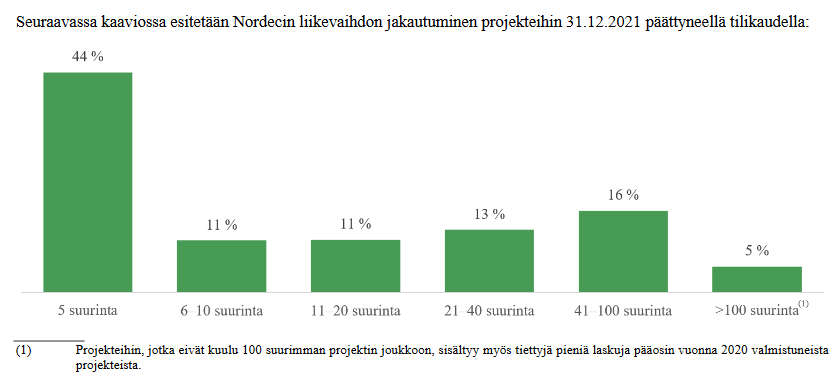
Nordec’s customer base primarily consists of construction, industrial, and real estate investment companies, with construction companies accounting for 61 percent, industrial companies for 24 percent, and real estate investment companies for 14 percent of Nordec’s net sales for the financial year ended 31 December 2021. Geographically, Nordec’s most significant market is currently Sweden, which accounted for approximately 70 percent of Nordec’s net sales for the financial year ended 31 December 2021. However, the geographic distribution of Nordec’s net sales varies from year to year depending on the total volume of projects in the countries where Nordec operates.
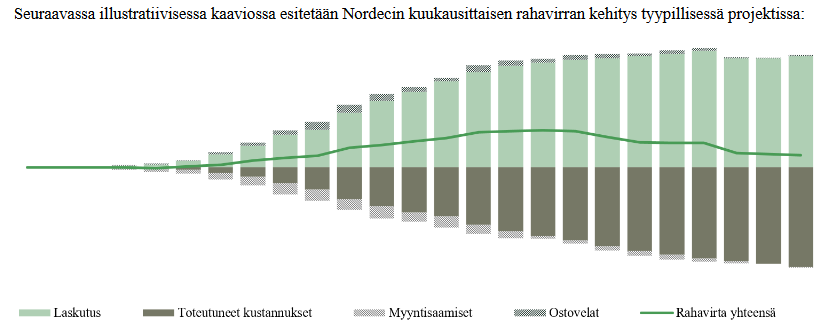
In recent years, Nordec has focused on developing its project management processes, which has significantly improved forecasting and the profitability of construction projects. For completed projects initiated between 2019 and 2021 with net sales exceeding EUR 0.1 million, 92 percent had a positive project margin, which Nordec believes is a strong figure. Project margin is calculated from project revenue less the direct costs allocated to the project. Project procurements are booked directly to the projects, and factory manufacturing costs as well as work performed for the projects by project managers and designers are allocated to the projects based on hours worked and hourly rates.
Nordec’s cash conversion has historically been high. Nordec’s cash conversion was 104.1 percent for the financial year ended 31 December 2021 and 102.7 percent for the financial year ended 31 December 2020.
Personnel safety plays a key role in Nordec’s operations, and Nordec has launched a safety program to reduce the accident frequency rate to zero. The program includes implementing specific processes and practices to improve overall safety management and systems, as well as ongoing efforts to engage the entire organization, especially operational personnel, in improvement initiatives to achieve the target level of zero for the accident frequency rate (Lost Time Injuries, “LTI”). Nordec’s accident frequency rate was 14.2 for the financial year ended 31 December 2021 and 16.4 for the financial year ended 31 December 2020.
 https://www.inderes.fi/fi/yhtiot/nordec-group



 It was already exceptional a good couple of weeks ago, so the real reasons are probably elsewhere.