Same here. I try to follow the teachings of Buffett and other financial gurus and look at the business itself. Q1 was good, and Q2 is now even better. We’ve hit the bottom, but the recovery is strong. In other words, “they sold more and raised prices.” Pretty amazing performance!
22 Likes
No, not at all! I bought more shares from the 90s IPO during 2024/2025. I don’t know how many people here participated in the NRE IPO, but it has been an extremely profitable journey. Let’s hope for profitable days ahead as well!
I also hope for patience with cash management, so that we pay down debt first and then distribute dividends on a sustainable basis.
25 Likes
Here is a new company report on Nokian Tyres from Rauli 
Nokian Tyres’ Q2 result was strong, and our forecasts rose to the upper end of the guided profitability range. We believe the company will continue its good earnings performance over the coming years, but in our view, the stock’s valuation (e.g., 2026 P/E 25x) already prices this in. We reiterate our sell recommendation but raise our target price to 11.5 euros (previously 10.5 euros) due to higher forecasts.
9 Likes
OP maintains SELL and raises the target price from €9.00 to €11.00.
OP believes there might still be a positive profit warning (posari) coming later this year.
Our earnings forecasts are rising for the coming years, and we are also raising our long-term margin assumption to 13% (previously 12%) due to strong profitability development.
23 Likes
Have you, @Rauli_Juva, tried to outline a scenario where we could reach a positive recommendation, or at least reach the level of the required rate of return in a cash flow model at the current share price of around €15? It’s easy to do in Excel, but what would it mean in terms of the company’s performance? Would hitting the company’s own targets even be enough for this?
Before the invasion of Russia, the share price was hovering around the €30 level, but at that time a portion of the profit came from Russia and the company was net debt-free. The depreciation level has probably also risen significantly due to investments, which shows up on the bottom line but not so much in the cash flows.
16 Likes
I don’t understand why OP (original poster/the bank) gives this kind of guidance; to me, it’s quite contradictory. The recommendation is SELL, and yet they are positive about the near future and potentially expecting a positive profit warning.
Investors usually don’t want to invest for just a year, but rather for the long term, 3–5 years. Why is the guidance only provided for a year ahead? If the target price were for 3 years out, investors would get a better idea of the potential future price.
Inderes should also really think about how they guide their clients. Wouldn’t it be better to hold onto stocks instead of telling us to sell them? You probably agree that in about 3 years’ time, it would have been better to hold rather than sell, and that this would be more profitable for us as clients, right? Should the wheel be reinvented, or at least updated?
I don’t care whether the analyst was originally right or wrong; the most important thing is that the current recommendation is sound and correctly considers the future.
11 Likes
There is nothing contradictory about that. If, in the analyst’s estimation, the share price has risen too much, the recommendation is logical. If the valuation of Nokian Renkaat (Nokian Tyres) shares indicated a negative profit warning instead, and OP suspected the possibility of a positive one, the recommendation would naturally be different.
Whether or not OP is correct in their assessments is another matter entirely. But their recommendation is based on a specific scenario and a specific valuation model.
If target prices are set for a one-year horizon, they are set for a one-year horizon. The problem isn’t the target prices, but the fact that people focus on them too much. You should look into the analyses and their scenarios. If you agree with the probability of that path, the one-year target price is likely quite well-justified. If, on the other hand, you feel the analyst is clearly being too pessimistic, you should also disregard that target price.
Also, a final note: just because a stock is good three years from now doesn’t necessarily mean you should rush to buy it today.
25 Likes
You are also right. And the problem is precisely that people stare at them too much. And whose responsibility is that? It is the responsibility of the analyst firm. They should build their systems in such a way that people understand them, not so that people stare at the wrong numbers (the target price a year from now). That is why things should be reformed! Perhaps introduce a “hold” recommendation between reduce and add. Another thing could be a longer-term target price. This would certainly make things easier for Inderes’ clients for long-term investing. I believe it is Inderes’ desire to promote their clients’ investing, and this would naturally lead in a positive direction for Inderes as well. Happy customers, you know 
I don’t have the energy to argue about this any further, I just wanted to share my opinion and feedback.
ps. I draw my own conclusions based on the company’s data, and I don’t blindly follow target prices. But since many others do, it affects the share price quite a lot.
Over & Out
3 Likes
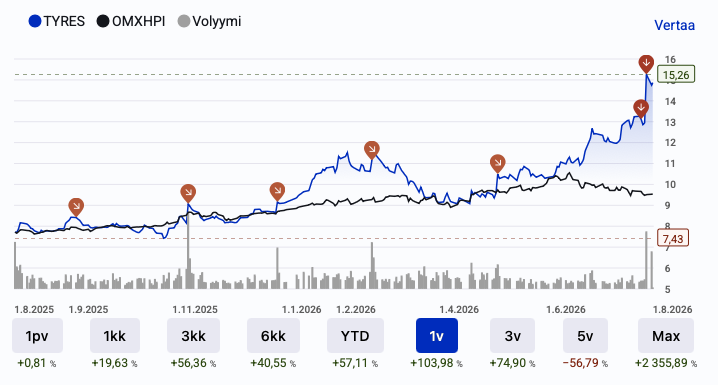
All due respect to @Rauli_Juva, I really like his style. Sometimes an analyst is too gloomy, or simply cannot be otherwise based on the available information. Below is the recommendation history, and for my part, I’ll say that thankfully I didn’t use it as support for my own buying and selling. It’s a pleasant surprise when it works out this way, as opposed to when the price curve points in the other direction despite a continuous “buy” recommendation.
7 Likes
Why do analysts set price targets at all? Could they focus more on evaluating a company’s performance relative to its competitors, as well as the growth prospects of the industry compared to other sectors in both the short and long term?
Predicting a stock price with price targets is, after all, more driven by emotion and wishful thinking.
11 Likes
In principle, Juva doesn’t believe in more than a maximum of 12% operating profit in the long run either, which is quite a pessimistic scenario, given that it has previously been over 20%, as is the case with Harvia right now, for instance. For Harvia, it is believed that they will maintain this and that revenue will also grow quite aggressively. Which one has more room for a positive surprise OP’s analysis is better in that the target price range is 8-14 euros (avg. 11e), depending on various scenarios. It makes the analysis at least less prone to error..
Shareholders certainly don’t like reading such gloomy analyses, should they take more cues from Kinnunen’s and Gostowski’s analyses .
4 Likes
Has the operating environment and market for “Rinkulat” [a colloquial term for Nokian Tyres] changed since those 20%+ operating profit margins? Yes, and that is a major reason why those are no longer very relevant points of comparison.
Comparing Harvia and “Rinkulat” is a bit like comparing apples and oranges. Harvia is a global market leader whose operating profit margin has been around 20 for as long as Inderes’ history goes back (2019). Nokian Tyres is a small player globally, perhaps the 30th-40th largest tire manufacturer, which reached a 20% operating profit margin only thanks to the Russian factory. Now the situation is completely different.
It is good to challenge analysis and disagree with the analyst. But it would be good to bring up the points as to why the analyst is wrong. “Yes it is, no it isn’t” arguing adds no value.
In my opinion, an analyst should take a definitive stance instead of hedging their bets on every possible outcome.
12 Likes
Nokian Tyres’ strength lies in its winter tires. And in my opinion, its brand (image) is stronger in the premium category than Harvia’s, which likely sells a lot of, for example, cheap heaters manufactured in China. Competitors from abroad will certainly emerge in large numbers if saunas start selling better there.
In Russia, a lot of profit was perhaps shown also because the corporate tax rate was lower there. They could decide whether to show the profits at Vianor in Finland or in Russia.
One complaint is also the low P/E requirement for the company (as is the case with Anora as well). Last November, Juva predicted a P/E ratio based on his own figures of only 8.5 for three years out, and yet a “reduce” recommendation was given. Since then, the share price has risen by almost 100%! Well, perhaps a little ahead of time…
6 Likes