Now, the rubber mass is being cooled down at the factory. According to Järvinen, the staff is breaking up the mass so that it doesn’t get oxygen and reignite. At the same time, rescue service employees are cooling the mass with water.
No smoke was generated outside the factory from the fire.
Nokian Tyres’ share has risen sharply after the Q2 results. We still see potential for significant earnings improvement in the company in the coming years, but with the recent share price increase, the stock already reasonably prices in the improvements of the coming years, which is why we currently see the risk-reward ratio as weak. We revise our target price to 8 euros (previously 7.7), but lower our recommendation to reduce (previously add).
I don’t actually disagree with the analysis, but I’ll comment anyway.
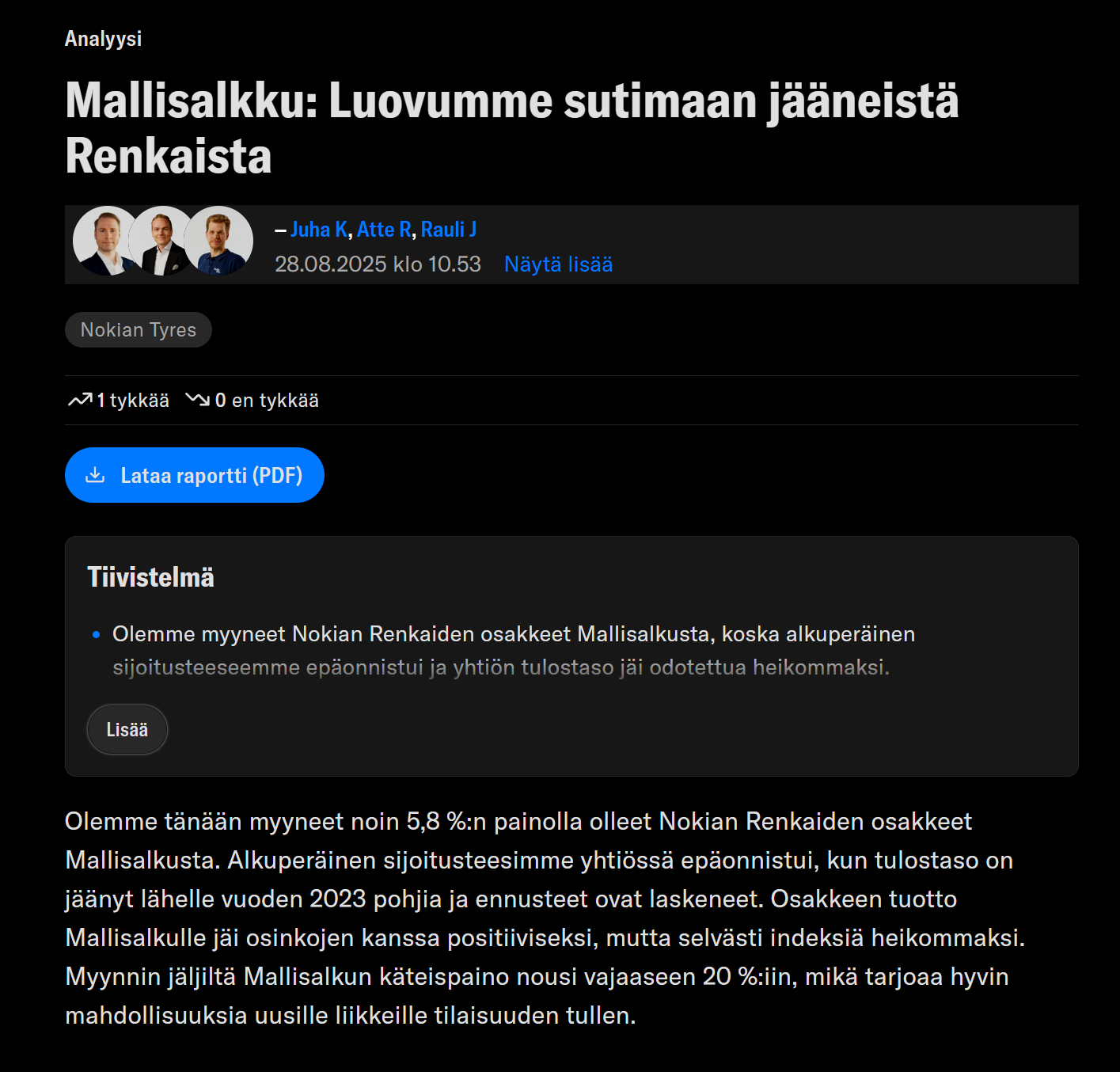
Rauli himself was on the model portfolio team, picking Nokian Tyres for the model portfolio at a higher price than the current one, and the model portfolio’s goal is to achieve over 15% annual return
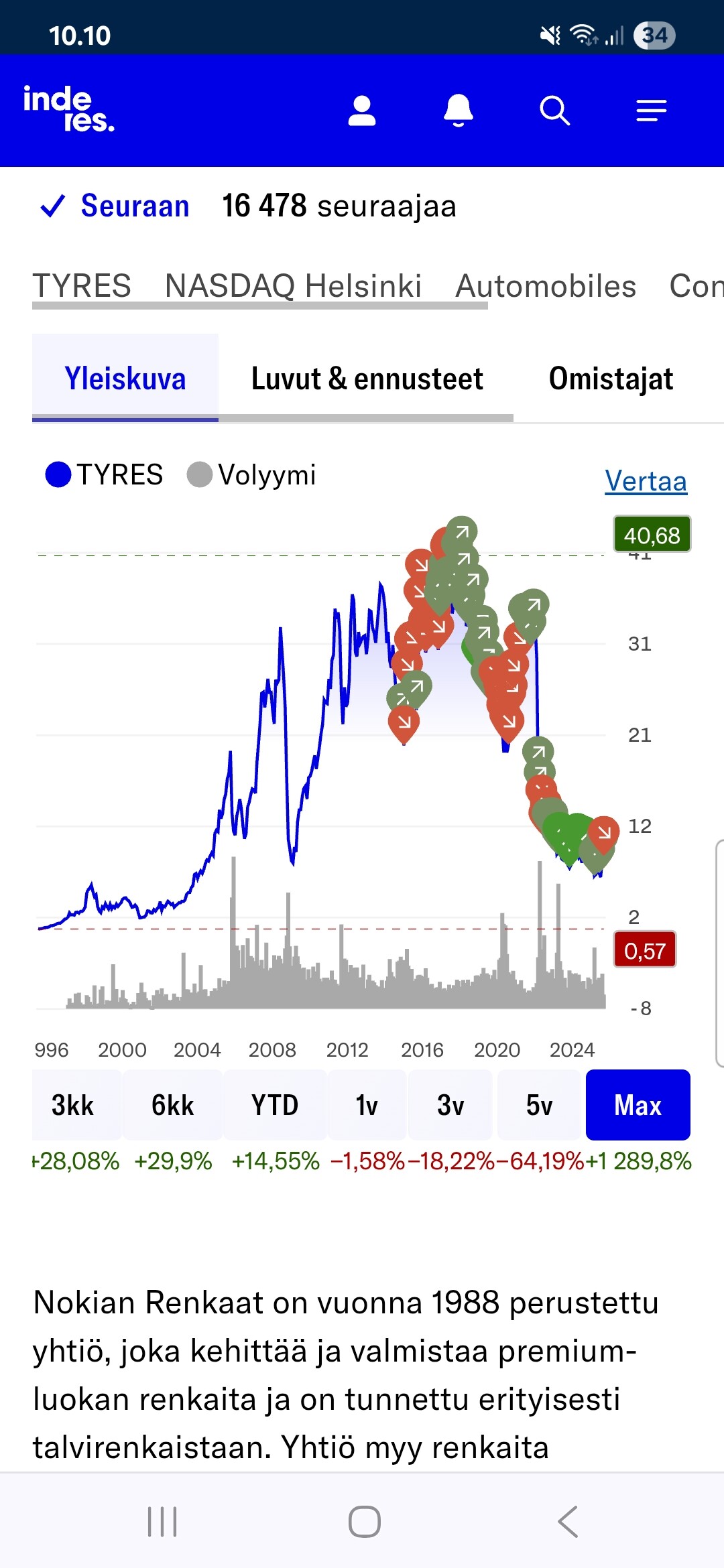
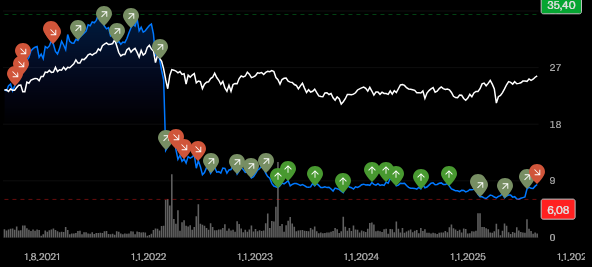
Of course, I don’t expect Nokian Tyres to return to the same performance level as before Russia’s invasion of Ukraine, but it reminds me of Inderes’ semi-legendary “the price increase has unwound the undervaluation”:
This certainly requires patience, but we haven’t risen particularly high yet.
No one is taking over Nokian Tyres due to its ownership structure. But we can reflect on the brand and the value of production facilities (USA has reasonable production, a completely new factory in Central Europe, Finland has a somewhat outdated facility); these are currently valued on the stock market at P/B<1. If Nokian Tyres were not anchored by its ownership and competition authorities allowed it, there might be interested buyers among larger players.
Also, if we believe the forecasts (and why wouldn’t we?! Forecasts always come true/are exceeded ), then with Inderes’ own forecasts at a normalized earnings level, Nokian Tyres will generate a normalized earnings yield of over 13% at the current price!
If one examines that stock price chart and recommendations anyway, they haven’t gone hand in hand. I, at least, don’t intend to react even if the recommendation changes!
Edit
Indeed, the company’s Q4’24 report largely dampened our previous expectations regarding forecasts for the coming years and thus also returns, even though the potential is still seen within a few years’ horizon. I believe this has also been stated quite clearly, and we’ve acknowledged that our previous ideas went awry.
The problem is that even though the 2028 earnings forecast is roughly the same as a couple of years ago (EDIT: it has also decreased somewhat), significantly less cash flow will be generated in the interim than previously expected, leading to more debt. Naturally, the risk of that forecast materializing has also increased, as there has been little to no improvement in the past couple of years, and previous expectations have been significantly missed.
As stated in the report, positive development is still expected in the coming years, but currently, the risk-reward ratio appears quite balanced.
The problem with Inderes’ recommendations is that a “hold” recommendation cannot be given, which should, however, be the most common recommendation, as too much trading should be avoided, as investment guides already state. It’s hard to understand when other analysis firms manage to give “hold” recommendations. Surely, a P/B below 1 is a sign of a discount. Even Trump’s tariffs should at the very least save the viability of the US factory.
The explanation for this has always been that in every situation, one must be able to take a view, and “hold” is practically “we failed to take a view.”
In real life, however, this leads to “add” / “reduce” recommendations sometimes being such that they can be interpreted as “add but actually hold” or “reduce but actually hold”
If clear answers to these questions are not found in the analyses and previous comments, let’s reiterate them here:
Yes, start-up costs have been higher than anticipated, especially in the USA due to one-off costs continuing longer than expected. The costs for the ramp-up in Romania are not yet known, but looking at the US figures, they will also be significant.
Historically, the company’s price premium in current markets has only been in the Nordics, and I don’t believe the price position has significantly changed. Of course, sluggish consumer demand drives towards cheaper tires, and seeking growth in the USA and Europe puts pressure on the average price rather than supporting it.
The sluggishness in sales is clearly more permanent than thought a couple of years ago, as the company has not been able to grow at the same pace as its capacity has recovered. Of course, it is not considered entirely permanent, as clear growth is expected in the coming years, but revenue forecasts are significantly lower now than a couple of years ago.
The products are certainly good, but in my opinion, they are not significantly different from the main competitors in any way. This is even more pronounced when moving from Nordic winter tires to Central European or US winter or all-season tires, not to mention summer tires where the competition is even tougher. So, the price position in the Nordics is mainly dependent on brand and distribution strength, in my opinion.
The price premium is probably based on market share, product quality, etc. That relative quality advantage is concerning, features are copyable.
About 10+ years ago, Kim Gran said that Nokian Tyres hardly patents its solutions. Because competitors see what’s coming, and patents are easy enough to circumvent.
Costs are never constant. When building something new, there are almost always surprises that increase costs. In the second round, mistakes are usually learned from, so the same surprises no longer occur. In the USA, the company itself has stated that it has deliberately invested in quality, training, and workforce. A large part of the additional costs also came from logistics disruptions caused by the pandemic, which stretched schedules.
Regarding Romania, the claim “costs are not known” is not entirely accurate. Before the ramp-up phase, personnel have already been hired, warehouses filled, and supply chains built. Costs will naturally increase in the initial phase, but it is more crucial to monitor the development of efficiency: larger raw material orders reduce unit prices, employee routine reduces errors, and the supply chain becomes more efficient when the right partners are found.
I don’t believe the price premium has permanently disappeared – especially not for winter tires. There are price pressures, but they are more due to the cyclical economic situation: consumers are temporarily looking for cheaper alternatives. The electrification of the car fleet makes tires an even more critical safety factor, as cars are heavier and more powerful. Once someone has “saved” -30% by buying cheap Chinese tires and notices them having melted by the end of summer, the probability of returning to premium increases. Falling interest rates and rising wages also support the recovery of consumption.
It is true that capacity has recovered faster than sales have grown. Recently, however, there have been signs that Nokian Tyres is growing faster than the market. The markets have been weak and competition fierce, but as demand picks up and distribution expands, the pace can accelerate quickly. The increasing prevalence of electric cars alone boosts tire demand.
In summer and all-season tires, competition is tough and differences are smaller, but in winter tires, Nokian Tyres still has a strong reputation and testing success. The brand and distribution network are big advantages. “Copyability” sounds easy, but building quality, testing, and brand takes time and money. And factories like Dayton and Romania cannot be set up in an instant.
Here are Rauli’s comments on European new car sales in July.
New car sales indirectly reflect on Nokian Tyres’ operations, as new winter tires are typically purchased with a new car, especially in regions with clear seasonal differences. Additionally, new car sales affect the car fleet, which is essential for the entire aftermarket.
In this case, however, there was a huge difference in that during the construction and ramp-up of the Russian factory, the company did not book any one-off costs, and profitability was consistently top-notch. In the USA, on the other hand, tens and tens of millions of “one-off items” have been recorded. The company has partly explained this by saying that after losing Russia, the product portfolio of the US factory changed significantly, and a kind of second ramp-up had to be done. So, the USA is not entirely comparable to Romania, if that was the impression left by my previous message.
I simply meant that the final amount of costs is not known, as the ramp-up has only just begun. Estimates can certainly be made, and the company has also given some guidance.
This cannot be monitored in any way solely for the Romanian factory, and only to a limited extent at the company level, as pricing and product mix, for example, affect gross margin in addition to efficiency.
It’s also noteworthy that the electric car fleet is growing. They are known to wear out tires quickly because they are heavier and have more power. However, if winter tires are made from a harder and more wear-resistant rubber compound, they will slide like a sled along ditch bottoms and snowbanks in winter.
Isn’t this a “classic Buffett case” - buy a well-managed company at a reasonable price and let time do the work. It’s not such a big company that getting two factories
@Rauli_Juva
Perhaps not the most relevant point, but I’ll address it anyway.
From Inderes’ report: “The Romanian factory will be fully utilized. The production from the Romanian factory will replace lower-margin contract manufacturing.”
What the company itself states about its tires: The Romanian factory focuses on passenger car and SUV tires, which are classified as more expensive premium products.
The first passenger car tire range to be manufactured at the Romanian factory is the company’s recently launched Nokian Tyres Seasonproof 2.
Has the situation changed, or will the aforementioned products replace lower-margin contract manufacturing?
I don’t disagree with the report per se, but on the other hand, if Inderes’ own people are to be believed, the markets look ahead, and if, in your view, 2028 is the year when the situation significantly improves, then won’t it start to be priced in already next year? For me, a target price of €8 for the end of 2027 is a bit too cheap.


 ), then with Inderes’ own forecasts at a normalized earnings level, Nokian Tyres will generate a normalized earnings yield of over 13% at the current price!