Here is some sort of answer to your question, and some thoughts on the future of tires 
This EU decision on anti-dumping duties for Chinese tires seems to have received relatively little attention in the thread, even though it may have a positive impact on Nokian Tyres, at least on paper.
I tried to find out more specifically what anti-dumping duties mean, how their rates are determined, and what kind of impact they could have on Chinese tires sold in the EU.
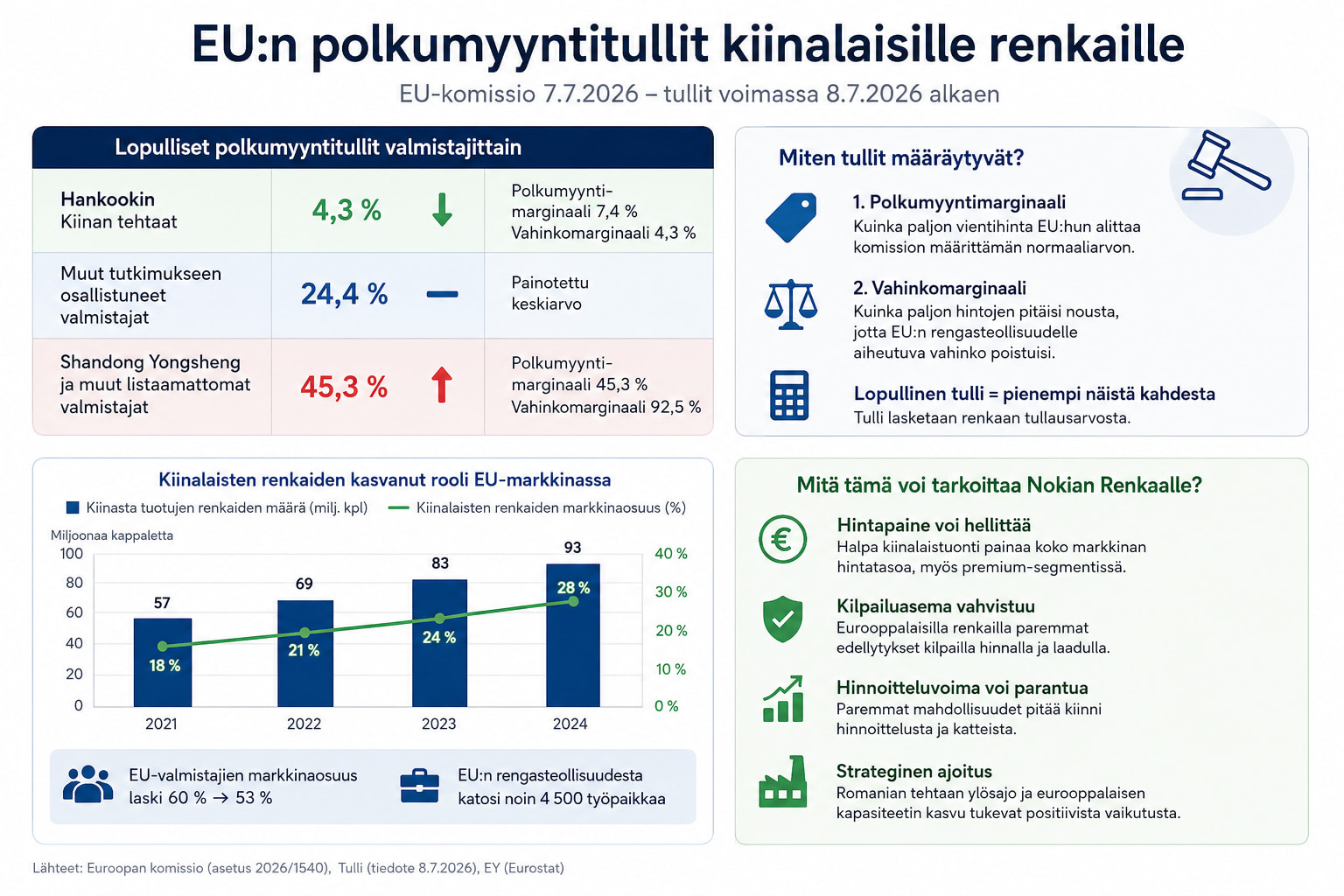
On July 7, 2026, the European Commission imposed definitive anti-dumping duties on new passenger car and light commercial vehicle tires manufactured in China. The duties came into effect on July 8, 2026, and their rates depend on the manufacturer:
Hankook’s Chinese factories: 4.3%
Other cooperating manufacturers: 24.4%
Shandong Yongsheng and other manufacturers not specifically listed: 45.3%
There are huge differences in the percentages. The Commission calculated both the anti-dumping margin and the injury margin for the investigated manufacturers and chose the smaller of the two as the final duty.
The anti-dumping margin indicates how much the export price of tires sold in the EU is below the normal value determined by the Commission. The injury margin, on the other hand, indicates how much prices would need to rise to eliminate the injury caused to the EU tire industry.
Hankook’s anti-dumping margin was 7.4% and the injury margin was 4.3%, so the final duty was set at 4.3%. Tires manufactured by Hankook in China are, on average, closer to the upper-mid-price range and the premium segment, so their prices did not undercut the benchmark used by the Commission as much.
Shandong Yongsheng’s anti-dumping margin was 45.3% and the injury margin was as high as 92.5%. The duty was set at the lower figure, i.e., 45.3%. The company operates more in the budget tire segment, where the price undercutting was the most severe in the investigation.
For other participating manufacturers, a 24.4% duty was formed from the weighted average of the more closely investigated manufacturers. Other manufacturers not specifically listed were subject to the highest investigated anti-dumping margin of 45.3%.
The duty is calculated from the customs value of the tire, so, for example, a 24.4% duty does not necessarily translate directly into the consumer price. The manufacturer, importer, or retailer may absorb part of the cost into their own margins. In any case, the cost advantage of tires manufactured in China in Europe will decrease.
The country of manufacture is the deciding factor, so the Hankook duty applies only to its Chinese factory production, not to Hankook tires manufactured in Hungary or South Korea, for example.
The number of tires imported from China to the EU grew from approximately 57 million in 2021 to nearly 93 million in 2024. During the same period, the market share of Chinese tires rose from 18% to 28%, while the share of EU manufacturers fell from 60% to 53%. At the same time, about 4,500 jobs were lost in the EU tire industry.
Nokian Tyres does not compete directly with the cheapest Chinese tires because the company positions itself as a premium manufacturer. According to the Commission, however, there is a chain effect between price segments: budget tires push down the prices of mid-range tires, and mid-range tires, in turn, push down the prices of premium tires.
Extremely cheap imports from China can therefore also weaken the pricing power and margins of premium manufacturers, even if the cheapest Chinese tire is not a direct competitor to, say, the Hakkapeliitta.
The duties could benefit Nokian Tyres at least in that the general price pressure in the European tire market will ease, the competitive position of European tires will improve, and Nokian Tyres’ ability to maintain its pricing will be strengthened.
The timing is interesting for the company because the Romanian factory is currently being ramped up. Increasing European production capacity in a situation where the cost advantage of competitors coming from China is being reduced seems like a strategically favorable combination, at least.
It is not worth exaggerating the impact of the decision. Hankook’s duty remained at only 4.3%. Chinese manufacturers can also settle for smaller margins, shift production outside of China, or look for other ways to circumvent the impact of the duties. Furthermore, higher tire prices may lead consumers to postpone replacing their tires.
A separate investigation regarding Chinese state subsidies is also ongoing for the same tires, which is expected to be completed in December 2026. As a result, countervailing duties may be added alongside the current anti-dumping duties.
Does anyone know how to better interpret the potential significance of these duties for Nokian Tyres? Or is this just splitting hairs?
Here is the source: