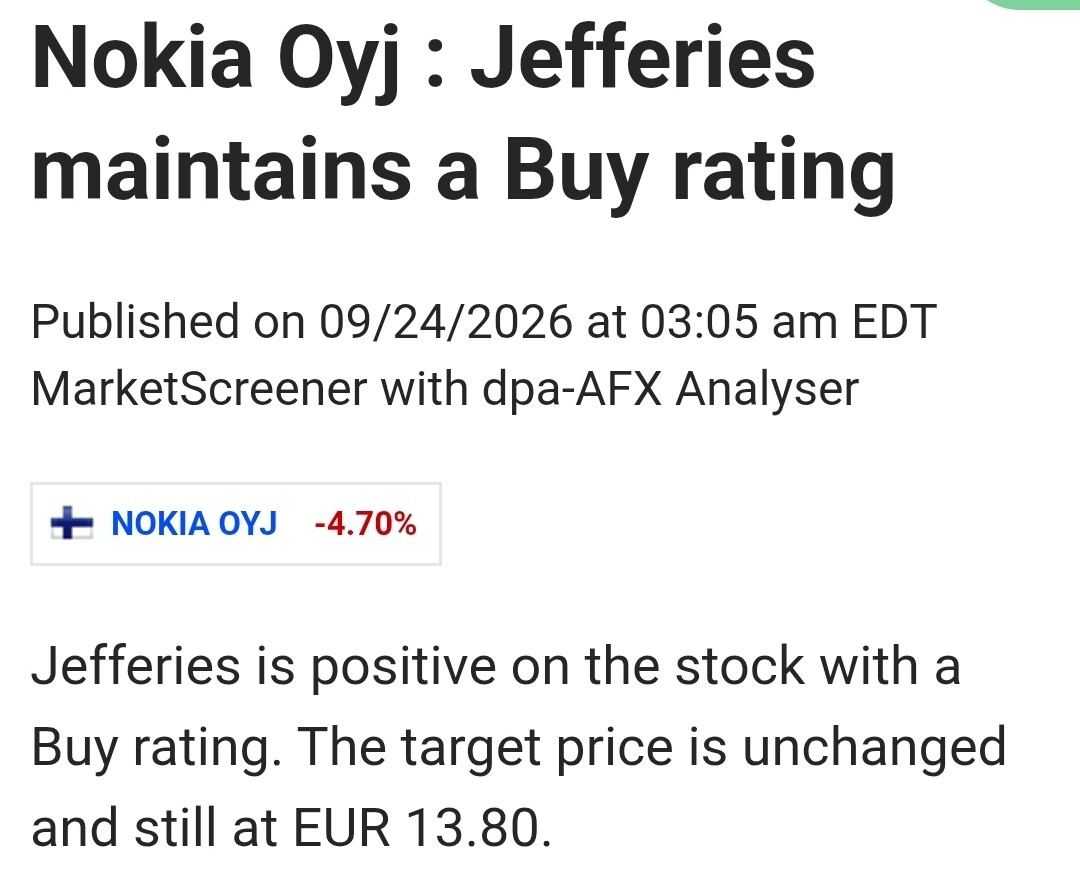
I was wondering about the odd market sentiment this morning, and above all, Ericsson’s clear slump. The mystery was solved, and Nokia is partly following the same path out of empathy. On the other hand, according to Morgan Stanley, the RAN market is still not attractive, as they believe Ericsson will face margin pressures for 2027–2028. This same driver basically applies to Nokia as well, even though Nokia is now living and breathing a completely different story. Time will tell how AI-RAN catches on. Until then, Nokia’s earnings will consist solely of the network infrastructure side, spiced up with patent revenues.
Morgan Stanley downgraded Ericsson to Underweight from Equalweight and lowered its price target to $9.00 from $11.00.
Morgan Stanley prefers Nokia within the telecom equipment space for its direct artificial intelligence exposure from hyperscalers, while Ericsson remains exposed predominantly to telecom capital expenditure plans.
I checked the upcoming Events on Nokia’s website, and at the end of the month, there’s the US version of ECOC. If there are any product launches, wouldn’t the US of A be a better place to announce them? Those are somewhat bigger festivals… although the keynote speeches didn’t look all that interesting to my eye, but…
This is also a good idea. Ugh, this uncertainty is a bit annoying since this theme has such a reasonably significant impact on Nokia’s earnings for the next few years.
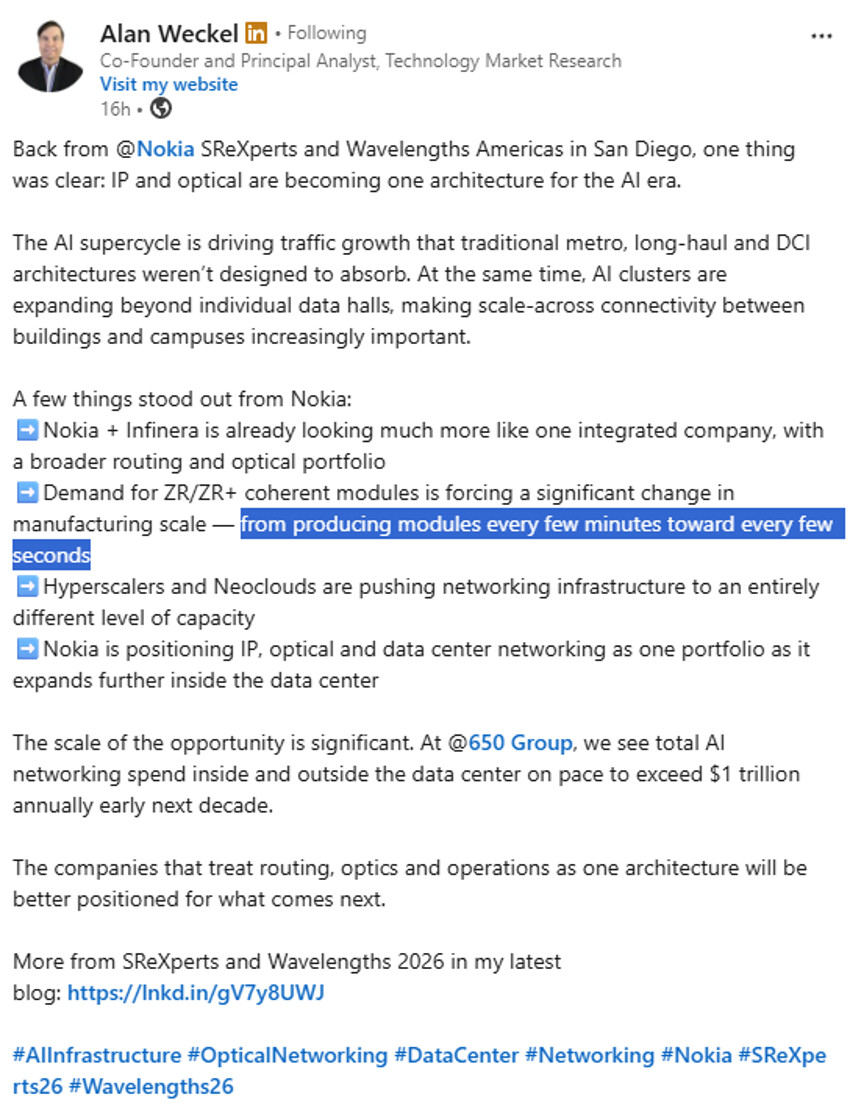
However, this post by Alan Weckelin also gave some confidence in the matter. Modules aren’t going to be made in about 60x (?? probably a slightly inaccurate interpretation of the comment, but in any case, a multiple) compared to before just because of pluggables demand. In my opinion, such a large increase only means that Nokia would also be getting inside data centers.
Competition is very fierce, though. And then competitors, like Marvell, seem to announce things right away when a deal is being made. Even Ciena seems to be trying to boost its own CPO expertise. And what does Nokia do? It’s very quiet about things.
I am still quite confident that Nokia will get its share of this development (scale-up) as well. It would be extremely good for Nokia’s margins, and in that sense very important. Perhaps it depends on Nokia’s customers that these things aren’t announced – perhaps not at all.
Could it be that in reality, there is nothing to publish at this stage? Why conceal information favorable to the company?
We have seen this before with many companies, where hype that was pumped up big sort of deflates when nothing materializes to be announced. This possibility must be taken into account, especially since Cramer is also on the buying side.
Nokia has itself commented at times—if I remember correctly, it was Hotard—that customers don’t necessarily want plans to be made public, but the most essential thing is execution. Something along those lines.
It would be quite unusual to scale up capacity at a 1000% pace without knowing whether there is a real need for it. And on the other hand, considering the time period, you would think that the plans regarding NPO technology should already be ready. But this is just my own thinking on the matter.
Below is a brief summary of Serge Melle’s article:
Background of development: Moore’s Law and more advanced digital signal processors (DSPs) have reduced the size and power consumption of coherent optical components, enabling a transition from large line cards to small pluggable modules (pluggables).
Terrestrial evolution: The technology has evolved from 100G/200G CFP models through 400G solutions to the latest 800G ZR/ZR+ pluggable optics, which are widely used in data center interconnects (DCI) and long-haul transmission.
Expansion to subsea: Although traditionally optics have evolved from water to land, coherent pluggable optics are now making the reverse journey from land to subsea. They can be utilized in both unrepeatered and repeatered submarine cables (as Nokia and Telxius have demonstrated in tests).
Benefits and the future: Submarine cable operators gain the same benefits for subsea transmission as in terrestrial networks: lower power consumption, higher density, operational simplicity, and lower cost per bit—while simultaneously alleviating space constraints and efficiency issues at cable landing stations. Performance-optimized embedded optics will still remain an option for the most demanding and longest routes.
I’ve been thinking the same thing about that capacity increase. With some calculation, one could even talk about a 10,000% growth rate if we just look at the InP side and assume that the number of cleanrooms is directly proportional to potential production capacity.
I still assume that a growing transition from being an equipment vendor to a component vendor is ahead, at least on the data center side. Nokia could be a pretty decent competitor to Lumentum and Coherent, at least when it comes to Amazon.
It’s hard to see these kinds of investments being made without certainty of demand. The extra 2.5 billion R&D investment announced at the end of the year is still burning in my mind, and the expansion of production facilities was announced right along with it. I would think that the acquisition of Chandler and the expansion and streamlining of San Jose are connected to something fairly big related to that R&D investment.
The deal with Nvidia was to look into how Nokia could be integrated into the data center infrastructure while Nvidia threw a billion in development money at Mobile. About 3 months after that, the announcement of these large investments came, and less than a year after that, Nokia announced the acquisition of Chandler. Hopefully, these things are connected. Nvidia hardly has its name on any decisive paper, and their subsequent investments in Lumentum and Coherent were definitely unpleasant developments. Nokia is, as I understand it, pushing hard into their turf with these investments. Vertical integration can be a considerable competitive advantage, and sales for those companies will decrease when Nokia has its own production and potentially improved competitiveness for end products compared to, say, Ciena—meaning Ciena might no longer have the same need for components. This would, of course, also require aggressive pricing, which owning InP production (among other things) provides the keys to.
It’s a shame that others are also building more production, but naturally not surprising. The fact that “everything” happens under the same roof is absolute manna from heaven for product development. It will be exciting to see whether there will even be demand for all this production in the end, or if the next 5 years have already been agreed upon in back rooms.
US-based research firm B. Riley Securities initiated coverage of Nokia with a “buy” rating and a price target of $15, viewing the company as an undervalued beneficiary of AI infrastructure; its expanding gross margins and strong cash flow make it an attractive investment.
Nokia and Microsoft expanded their collaboration on the development of AI-driven telecommunications networks by integrating Nokia’s Data Suite solution with the Microsoft Fabric platform, aiming to accelerate the utilization of network data for operators.
Orange is preparing to test Nokia’s AI-RAN platform in its live network, putting claimed radio-efficiency gains to the commercial test while exploring the bigger proposition of shared compute for AI workloads.
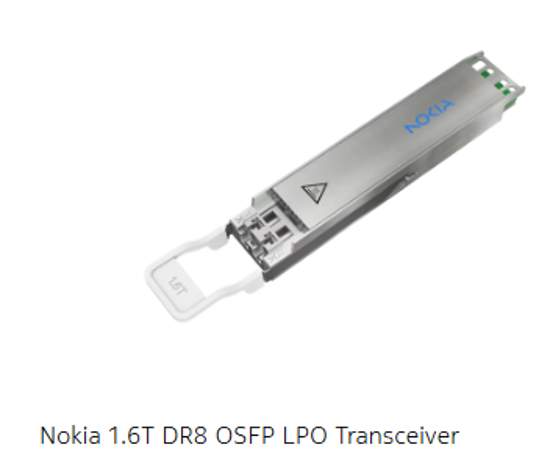
I happened to come across a sort of new product announcement from Nokia that apparently hasn’t really been announced or advertised anywhere—well, the name is mentioned on Nokia’s ECOC 2026 website, anyway. However, the timestamp on the page below reveals the product addition 13 hours earlier.
This is designed to be easily integrated as part of internal data center construction—plug and play.
Nokia’s ICE-D 1600G LPO is a 1.6 Terabit (1600G) optical module designed for internal data center traffic (intra-datacenter). It combines photonics based on Nokia’s proprietary ICE-D Photonic Integrated Circuit (PIC) with LPO (Linear-drive Pluggable Optics) architecture, which significantly reduces power consumption.
The module is designed for next-generation AI data centers for 1.6T connections between switches and servers (switch-to-server) as well as between switches (switch-to-switch).
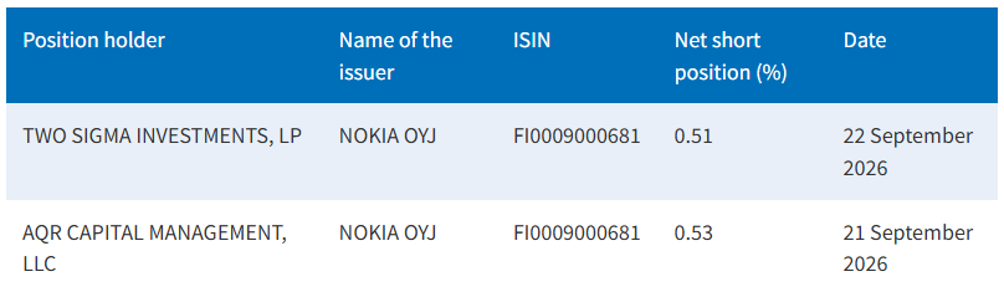
Well, exactly - two public short positions have appeared. I think they are making a misstep now. At the same time, it means that attempts to manipulate the share price are certainly not decreasing.
Asset management company AQR Capital Management has taken a public short position in Nokia, with the position size amounting to 0.53 percent of the company’s capital. Meanwhile, Morgan Stanley announced that it favors Nokia among telecommunications equipment suppliers while downgrading Ericsson’s rating to underweight.
I ran the market for LPO modules through AI a bit more, specifically from the perspective of who might be chosen as a supplier for data centers, given that competition certainly exists. At my request, the AI scored the competitive landscape as follows. Of course, this would still require a genuine industry expert to confirm or shoot down the stance.
In my opinion, Nokia is now aiming for volume with this, most likely with Microsoft and Google.
Competitors’ product portfolios:
Coherent (formerly II-VI):
Introduced its own 1.6T LPO OSFP transceivers (incl. DR8 versions). Coherent is one of the world’s largest manufacturers of optical components and InP/EML lasers.
InnoLight Technology:
The world’s largest manufacturer of optical transceivers (measured by volume). InnoLight has a wide range of 1.6T LPO / LPO-HALO modules based on 100G/lane and 200G/lane for AI clusters.
Broadcom:
Although Broadcom is known for its switch chips (Tomahawk 5 / Jericho 3-X), the company is heavily involved in the LPO ecosystem by offering edge-level electrical and optical components (Bayo-DSP-free solutions) and advocating for CPO/LPO integration.
Lumentum & Cisco (Acacia):
Lumentum supplies high-performance photonic components and LPO modules. Cisco-owned Acacia develops its own high-speed modules based on silicon photonics.
Selection Criterion
Weight
Criterion Description and Significance
Nokia (ICE-D LPO)
Coherent
InnoLight
Broadcom
Cisco / Acacia
Energy Efficiency (Power Consumption)
25 %
The ability of the LPO architecture to eliminate DSP and cut power consumption by ~75%. The most critical factor in MW-scale AI clusters.
5
5
4
5
4
Signal Quality & Integration (SiGe/PIC)
20 %
Without DSP correction, the interplay between the optical chip (PIC) and the driver must be flawless to minimize losses.
5
4
3
4
4
Vertical Integration (Own InP)
20 %
Own Indium Phosphide (InP) fab and in-house manufacturing of the photonic chip. Guarantees delivery reliability and margins.
5
5
2
3
2
Production Volume & Scalability
20 %
The ability to deliver hundreds of thousands of modules in a rapid cycle (at production level “seconds per unit”).
4
5
5
4
4
Cost Structure & Price (TCO)
15 %
Unit price and lifecycle cost of the module in relation to performance and power savings.
4
4
5
3
3
TOTAL SCORE
100 %
Weighted average
4.65
4.60
3.70
4.00
3.50
Summary of the impact of selection criteria:
InnoLight (Volume King, but Dependent): InnoLight wins in unit price and production volume alone (5/5), but its weakness is the lack of its own InP fab (2/5). It is forced to purchase critical lasers externally, which leaves it vulnerable to supply chain disruptions and margin pressures.
Nokia & Coherent (Vertically Integrated Winners): Thanks to their own InP fabs and in-house PIC design, Nokia and Coherent achieve the best scores. Nokia edges narrowly to the lead thanks to the edge-level ICE-D PIC + SiGe-driver co-design, which guarantees the market’s best signal quality in an LPO environment without a heat-generating DSP chip.
Edit: This once again highlights yet another reason why I personally have also invested in Coherent alongside Nokia. And from the outside, also in Fabrinet, which in turn assembles these products for everyone. But everyone should research the situations and companies for themselves.
No help today. A corrective wave A → C is in progress, and the ADR is clearly targeting at least the USD 10.40 gap fill. The previous peak fell short, adding more short-term uncertainty about the direction. Shorts have clearly been hunted due to the poor short-term sentiment. However, the moves are fast.
From a fundamental standpoint, I hope Nokia will finally share some good news regarding the optical side. Apparently, Coherent is having yield issues when it comes to 6-inch wafers. However, responsibility for this has apparently been shifted toward Sumitomo. I don’t know whether Nokia is struggling with the same issue or not. An update is hoped for, and it would also be nice to hear that the new factory is up and running at 100% capacity… and that yields are already at a good level and constantly improving…

 , if NOK don’t surprise the market positively