Nokia as an investment (Part 4)

The financial side of AI-RAN can be divided into three different areas:

1) Improving the network’s own performance, where the value comes primarily from savings rather than new revenue.

a) Spectrum efficiency: If AI algorithms can, as Nokia estimates, even double data capacity per existing band, operators could achieve significant savings. The same amount of traffic can be handled more efficiently without a corresponding need to acquire more spectrum or build new base stations. This is particularly relevant in crowded urban environments. This is not really a question of whether computing is cheaper in a base station than in a large data center. RAN signal processing is done close to the network edge anyway due to real-time and latency requirements. More importantly, will the additional investment in GPU hardware yield sufficient benefits through better spectrum efficiency and network capacity?

b) Network programmability and flexibility: GPU-based architecture makes it easier to update and optimize network functions via software without the constant need to renew physical equipment.

2) Nokia’s own cost structure: savings in chip design

By transitioning from its own baseband chip development (ABIP was the last product) to Nvidia’s GPU platform, Nokia can reduce its reliance on in-house chip design and instead lean heavily on the scalable Nvidia ecosystem. This allows Nokia to reduce R&D costs related to in-house chip design, which likely constituted a significant portion of Radio Networks’ R&D expenses (totaling €2,076 million in 2025). This could be a structurally significant saving, which is particularly relevant given Radio Networks’ weakened operating profit margin (5.5% in 2024 and 2.8% in 2025). Of course, these savings will only materialize if a sufficient number of operators adopt Nokia’s solution.

On the flip side, moving to Nvidia’s platform also means dependence on Nvidia for pricing and availability. Nokia loses some of the bargaining power that its own chip provided, and part of the savings may erode over time in component acquisition costs if demand remains tight. But in Nokia’s situation, economic realities have likely forced it to make a virtue of necessity. On the other hand, dependence on Nvidia could decrease in the long run if GPU-based platforms become the industry standard and multiple compatible suppliers emerge on the market. In that case, Nokia wouldn’t be tied to a single supplier in the same way, even though it would have abandoned its own chip development.

3) Utilizing the base station as a platform for AI computing and applications

a) Leasing capacity: In my view, this is clearly the more uncertain part of the AI-RAN business case. In principle, idle GPU capacity during quiet mobile network hours could be leased to hyperscalers or other heavy computation-dependent companies, e.g., for LLM inference, billed based on the number of processed tokens, but in principle also for other computing workloads. In practice, there are plenty of challenges: base stations rarely have extra space or power for heavy computing units. Furthermore, a distributed base station network, where connections and resources vary by location, is a much worse alternative for many general AI computing tasks than a hyperscaler’s own centralized data center.

b) Low-latency edge computing: Autonomous vehicles on the ground and in the air can benefit from computing close to the user. However, these are unlikely to generate massive volumes in the next few years.

c) A platform for third-party developers (dApps): Nokia is opening up the lower layer of the RAN via the new E3 interface to partners like Cohere, who could build new applications directly on top of the base station. The monetization mechanism is not yet public, and this resembles Core Software’s (formerly CNS) Network as Code initiative, about which monetization hasn’t been hyped up much. One would assume that the anticipated revenues would be shared between application developers, operators, and Nokia.

CONCLUSIONS

The strongest AI-RAN investment thesis may not be that Nokia turns millions of base stations into small data centers. Network efficiency improvements and Nokia’s opportunity to reduce its own R&D spending on chip design do not require a separate external market for computing services; rather, their economic justification can arise simply from the spread of AI-RAN in Nokia’s core RAN business. Selling computing capacity and applications to outsiders, on the other hand, is an additional future option, as it depends on whether there will ultimately be enough paying customers for them.

There are also risks to keep in mind: if AI-RAN were to truly double spectrum efficiency, it could cannibalize Nokia’s traditional capacity expansion business, which could equal several years of traffic growth at a 20–30 percent annual rate. One possible mitigation measure would be a transition to usage-based or recurring pricing, tied to actual capacity produced rather than one-off software sales. On the other hand, regarding competition, if GPU-based platforms eventually become the industry standard, Nokia’s early-achieved strong customer position could help mitigate the impact of software standardization.

5 Likes

The massive commercial contracts are explicitly structured to be conditional on empirical performance data from the 2026 pilots.

The momentum has drastically widened, with 10 major global operators committing to formal AI-RAN co-development contracts and deployment pipelines with Nokia.

Influencing the 6G Blueprint: Operators are using these early pilot contracts to write their own specific requirements directly into Nokia’s software code before global 6G architecture standards permanently lock in 2027–2028.

If Nokia can empirically prove its promised 50% to 100%+ spectral capacity gains and show that renting out tower GPUs offsets the energy costs, it will trigger an avalanche of multi-billion dollar commercial rollouts starting in 2027.

https://www.nokia.com/newsroom/nokia-accelerates-ai-ran-momentum-with-new-partnerships-driving-path-to-ai-native-6g-mwc26/#:~:text=Nokia%20announces%20significant,and%20successful%20functional%20tests

2 Likes

I would also include tokenization here (well, it was already there) when there’s free bandwidth for it, e.g., at night or similar times.

It’s worth brainstorming with AI; I used a domestic amount of 10,000 base stations as an example, and the results now / based on current knowledge are interesting vs. a real datacenter and how technology/GPUs are evolving..

And a larger operator has 10 times that amount.

I’ll just paste this from ChatGPT:

So, Elisa’s entire network of 10,000 base stations in this conservative model could be around:

1 M token/s

vs.

2.8 M token/s / MW

in a modern GB300 datacenter.

No idea if the estimate is even in the “ballpark,” but it’s interesting :wink:

4 Likes

I think there’s a lot of options out there for the monetization AI-RAN. I’m sure we’ll be hearing more in early September. dApps seem one extremely viable looking option…

There’s definitely plenty more to it than is currently widely recognised (as you explained). A native AI-RAN perspective views the tower as a highly efficient, distributed neural network where processing power is integrated directly into the connectivity itself. For example AI-RAN nodes equipped with DSX software can instantly ingest local environmental traffic, filter out the noise, and only pass critical metadata to the main cloud.

The link below provides a pretty decent explanation of what dApps are and how they are a decent fit for open AI native RAN architecture.

4 Likes

Interesting new post from this guy on X. It’s worth reading the 2 Grok summaries underneath his post also.

https://x.com/trailauditor/status/2094050736015294626

Elon just said ~15 GW of AI compute produced in 2027 cannot be turned on in 2027.

Not a $NVDA / $AMD chip problem.

Transformers, wiring, liquid cooling, chillers, and complex networking.

That last word is the $NOK line.

The market spent two years pricing $NVDA $AVGO $MRVL.

It is only now being forced to price the fabric that turns those GPUs into a cluster.

That fabric is $CIEN $COHR $LITE $AAOI and $NOK already leads or co-leads the campus / metro / long-haul layers of it, with ICE6 and ICE7 shipping.

Remember $NOK is still priced like $ERIC.

When I rebuilt the optics market from electricity up for exactly this reason.

I used 10 GW as base and 16 as bull because I only count capacity that actually turns on.

Elon is now saying ~15 GW of 2027 compute gets built and then sits dark. It makes the bull case more interesting.

8 Likes

Nokia mentioned. More of these to Europe, please.

https://www.reuters.com/world/europe/europe-expands-ai-computing-network-with-390-million-order-frances-bull-2026-08-31/

Nokia will be responsible for the data network of the new LUMI-AI supercomputer procured by the European EuroHPC Joint Undertaking, which will connect the computing and storage resources to each other.

The LUMI-AI supercomputer, to be located in Kajaani, will operate as part of the broader European AI factory initiative (AI Factories), and it is scheduled to start up in the second half of 2027.

30 Likes

What might be a realistic estimate nowadays for the share of networking in data center construction? According to AI, it’s 10-15%, but you’d think that would be on the rise. I don’t know how often DCI is included in data center budgets. Hopefully rarely.

Great that Europe is keeping the competitive spirit alive and not buying everything from Nvidia and its data center cartel. :slight_smile: And that Nokia is getting to play with others too, provenly, with a view to the inevitably coming breakdown of Nvidia’s monopoly, in my opinion. I somehow have a relaxed feeling knowing that Nokia keeps everything open to everyone, having learned from mobile to avoid all signs of vendor lock-in.

It must be easy to buy products from Noksu when the sales guys enthusiastically explain that you can just replace these devices of ours with better ones in the future if you find any, nothing prevents you from doing that, but if you buy the whole package from us anyway, you might at least get it cheaper. And a hearty laugh on top of that, of course. :slight_smile:

1 Like

Although it must be said that on the MN (Mobile Networks) side, they are now completely on a single card, meaning dependent on Nvidia. I don’t know if you meant that or if you were thinking about history when they were dependent on Intel.

I am under the same impression that 10-15 percent of expenses go to IP and optical networks. And indeed, one would imagine that will grow as the amount of optics increases inside data centers.

6 Likes

There are plenty of these. I use AI ~2h a day, most of which is at work, so more than social media. At least in my free time. :slight_smile: AI is currently Google 2.0 and will be much more in the future.

Currently, the existing radio infrastructure and distributed energy consumption also offer an interesting opportunity for hyperscalers whose data centers and data center projects are stuck due to high loads and infrastructure waiting for itself. Computing power placed at the edge can also help anticipate and blunt the growth demands of AI traffic until operators have time to build more fiber. Later, applications requiring edge computing will start pushing through, as the edge computing infrastructure exists, so developing applications and thus the true commercialization of edge computing can be profitable.

I think these are pretty good milestones for the product’s appeal (5G/6G), even if I’m cutting it a bit short.

5 Likes

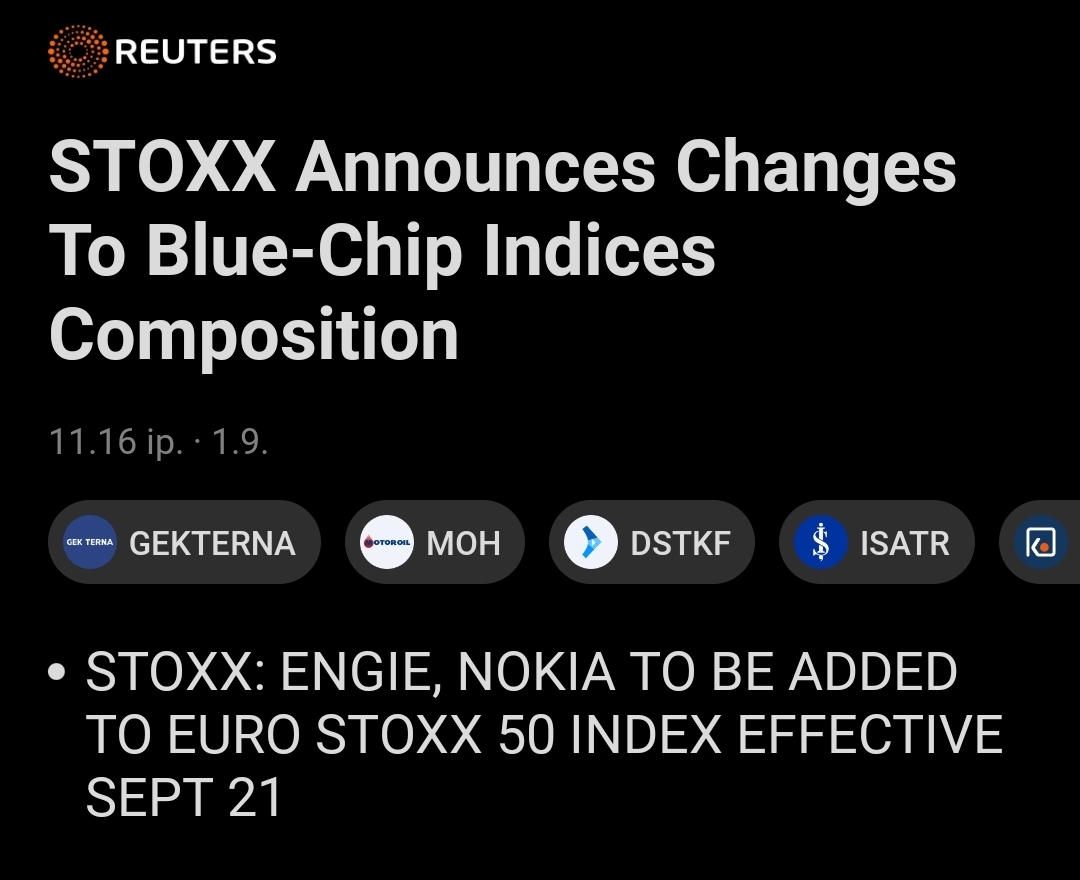
Well, Nokia’s come-back attempt into EuroStoxx50 will soon be decided.

In theory, index trackers like ETFs will create buying pressure, unless they have already anticipated it if they were sure about the matter.

Today it will be decided whether Nokia gets back into the Euro Stoxx 50 index.

Some seem to have a strong interest that it DOES NOT get back in… stock -4%

https://x.com/JuhaVaris/status/2094444476039098395

15 Likes

I mainly mean Nokia’s open system, in which Nokia definitely works best (the future), but you can swap any component, or even all of them, for a competitor’s product without compatibility issues. Operators didn’t want to commit to a single vendor, and I see the same thing ahead with data centers, which is why I also expect Nvidia’s monopoly to break.

If Mobile Networks doesn’t start generating earnings with Nvidia, it will likely be sold. Possibly to Nvidia. The US doesn’t have its own domestic mobile company on paper yet, and 5G/6G will, I believe, be a very large part of future warfare along with edge computing.

I would still hope that Nokia hasn’t abandoned purpose-built radios, but would keep ReefShark as part of the portfolio at least with 6G in mind, given that development was already so far along a year ago. The 7G world will already look completely different, and the interface will probably be open to AMD as well by then.

If Nokia truly abandoned its own development, then perhaps this is a once-in-a-lifetime opportunity seen from the past to sell a moribund business at a good price. :slight_smile: In my opinion, however, 5G/6G will experience a disruption, and I wouldn’t compare the current situation to the mobile phone business. Hotard/the board also refused to sell more than 3% to Nvidia. Perhaps that was a signal that they want to maintain a unique end-to-end setup. A bad signal, of course, if the future of the entire company supposedly depends on whether Nvidia even cares about chump change.

3 Likes

As I noted in the long AI-RAN financial analysis above, AI-RAN has three distinct financial dimensions: the improvement of operator network efficiency, potential cost savings from Nokia’s own silicon development, and using the base station as a platform for AI computing and applications.

Through Nvidia, Nokia gives up the control and bargaining power gained via its own silicon development, but in return, it gains access to a massive GPU ecosystem and can reduce its significant R&D burden related to silicon development to strengthen the mobile business’s very low operating profit margin (2.8% in 2025). If GPU-based platforms eventually become the industry standard, the Nvidia dependency may also become less problematic if additional alternative suppliers emerge. Considering the weak mobile profitability, I believe Nokia turned a necessity into a virtue regarding AI-RAN.

On the other hand, AI-RAN’s higher spectrum efficiency could cannibalize Nokia’s current capacity expansion business by reducing the need for hardware upgrades. A solution could be for the business model to shift from one-off capacity upgrades to, say, annual software licenses, allowing Nokia to secure recurring revenue from the added value generated by AI-RAN. Ultimately, the decisive factor will be how much of the economic value generated by AI-RAN ends up with the operator, Nvidia, and Nokia. Many questions remain unanswered.

6 Likes

Maybe I misunderstood, but neither Nokia nor anyone else has such a thing as “you can replace any piece, or even all of them, with a competitor’s product.”

For example, Nokia has about 15,000 Nokia proprietary 4G/5G features. Marketing may talk about openness, but full or even sufficient functionality is often only achieved with Nokia equipment.

5 Likes

Entering the Eurostoxx, at least in recent years, has by no means been a surefire catalyst for a rise. At times, the stocks have gone quite substantially downward.

11 Likes

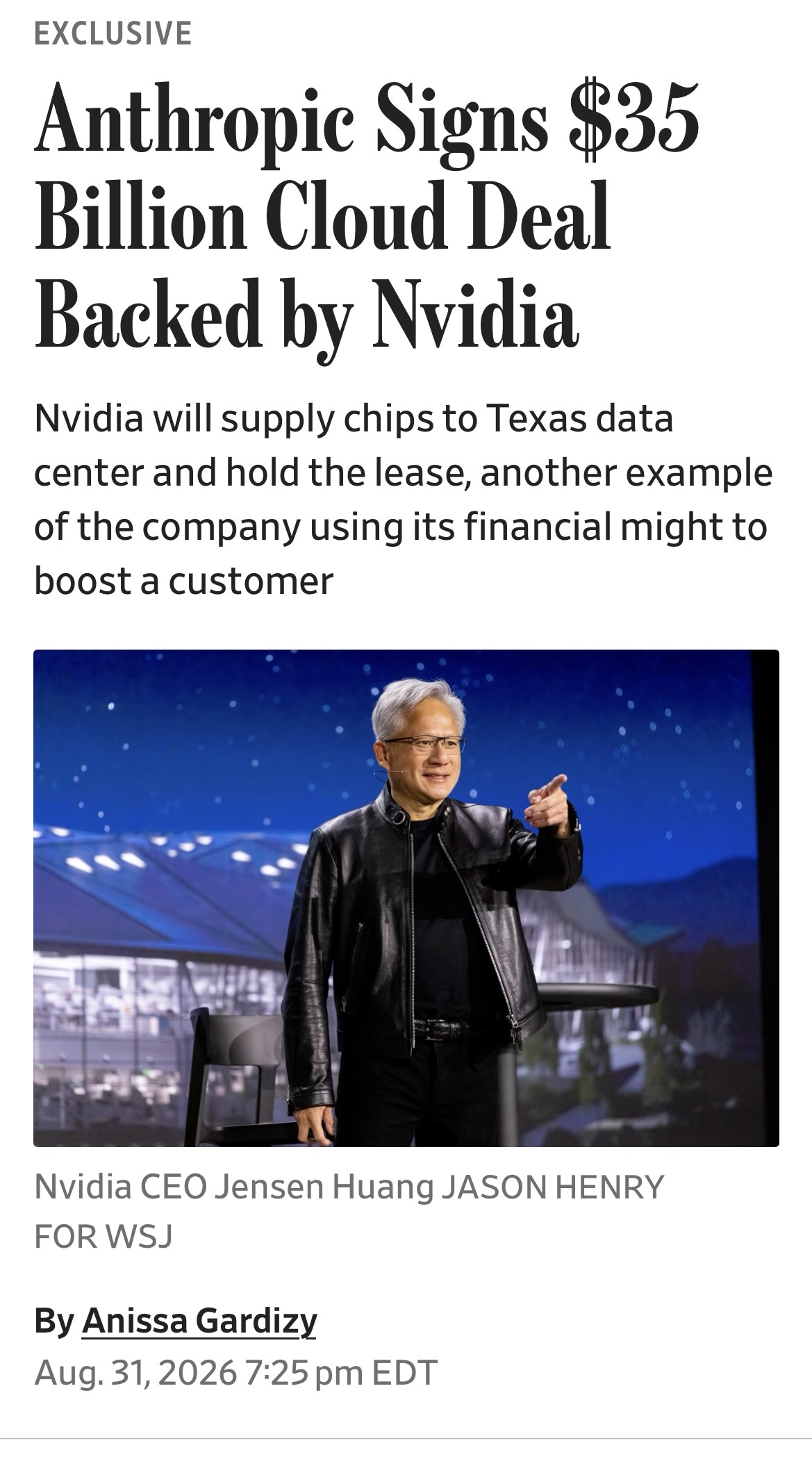
Big deal, good for $NOK?

https://www.wsj.com/tech/ai/anthropic-signs-35-billion-cloud-deal-backed-by-nvidia-f12622f1?st=are7XW&reflink=article_copyURL_share

4 Likes

The reasoning is clear.

AI-RAN transforms mobile networks into an AI computing platform

  • What it’s about: AI-RAN (Radio Access Network + AI computing) combines network traffic and AI execution on the same hardware. It enables the utilization of base stations’ and network infrastructure’s free computing capacity (fallow capacity) for distributed AI inference when network traffic is lower.

  • Disruption of the business model: For operators, this offers a way out of the continuously money-swallowing network investment cycle (cost center). Base stations form a geographically distributed AI platform that generates new revenue (revenue generator) directly for the needs of industry, robotics, and logistics.

  • Major strategic divide:

    • Nokia & NVIDIA: Focus on deep integration. Nvidia’s $1B investment in Nokia drives a model where Nokia’s RAN software runs on Nvidia’s architecture, and base stations act as AI computing nodes.

    • Ericsson: Emphasizes hardware independence and flexibility (Cloud RAN on COTS hardware or its own silicon architecture).

  • Why right now: The focus of AI is shifting from gigantic centralized data centers toward edge computing (edge/physical AI), where power consumption, latency, and data locality drive computing close to users and devices.

AI-RAN gives operators a second chance to capture value in the AI economy instead of playing just a “dumb pipe” role.

https://www.fierce-network.com/wireless/opinion-ai-ran-could-give-telecom-second-chance-own-ai-economy

This is the essential point. Will it go this way?

SoftBank’s mobile revenue, he said, is declining while infrastructure investment remains unavoidable. “So we keep investing in the infrastructure, but the revenue is declining.” AI-RAN, he said, could shift infrastructure “from a cost center to the revenue generator.

17 Likes

Bringing this up because at first glance it brought to mind the previous deal made with Nscale. At least I confused it with that based on the screenshot.

So the starting point is that Anthropic has apparently run into a capacity crunch, having made yet another major deal with a neocloud provider. Here are these 2 deals:

  1. Lambda deal (~$35 billion): Located in Texas (Nueces County). The cook in the kitchen is Hut 8, which transitioned from crypto mining to data center developer, with Nvidia acting as the lessor (holding the actual data center lease agreement), neocloud Lambda as the operator, and Anthropic as the end user.
  2. Nscale deal (~$45 billion): Located in West Virginia. Here, too, Anthropic is leasing Nvidia’s capacity through Nscale.

And here as well, this seems to be a fairly creative financing and leasing arrangement in which Nokia has no role. Nokia does have an agreement with Nscale where it presumably acts as the IP and optical side supplier – meaning in this case as well. There doesn’t appear to be a deal with Lambda, but as the market grows, Nokia may potentially get its slice of that too.

Previously, for Nokia, this has been DCI / scale-across business, meaning Nokia has been interconnecting data center campuses. Moving forward, the big hope, at least for myself, is that Nokia also breaks into the new scale-up market, i.e., the internal network of data centers. I’m eagerly awaiting information regarding this already during September. Hopefully, ECOC 2026 will deliver on that.

21 Likes

The message was a bit confusing. I mainly mean fixed networks, such as a whole switch or router, or even an end-to-end connection. O-RAN is not quite as open as one might imagine, but I am currently more interested in the rest of the hardware in between, as I consider Mobile a dead cow that can only produce positive surprises / turn into a living unicorn. I am referring mainly to the development trajectory of SR Linux and end-to-end connections.

1 Like

Lest we forget: starting today, Emma Falck leads MI. Link
And here is the appointment release.

9 Likes

It seems that information has reached the market that Nokia has made it back into the Euro Stoxx 50 index. I’ll need to check on that.

Yep, that’s the case.

It’ll be interesting to see how the share price moves now, remembering past times… maybe this was already bought up between March and May. :rofl::man_tipping_hand: So I wouldn’t be surprised if the stock drops tomorrow in all its illogic.
21 Likes