Yes, and it needs to be raised. I’m actually a bit annoyed that this hasn’t been done. I think it’s pretty much obvious that that target is no longer up to date. Why hasn’t it been raised? I suspect that things are moving so fast that they haven’t yet figured out by how much it should be changed. And on the other hand, the new business happening inside data centers is perhaps still an unknown. Then again, for example, Marvell updates those figures considerably faster and more often—I would hope for the same from Nokia as well.
11 Likes
To celebrate Friday, I’ve been thinking a bit about the post-2030 outlook.
Nokia is not only developing light-based quantum computing, but also light-based standard computing. According to AI, light-based computing could be significantly more energy-efficient and perhaps better suited for certain types of computing tasks anyway. Now, if an asphalt worker is better at shoveling than a bus driver, but more often drunk, then of course it’s better to leave the shoveling to the asphalt worker and the driving to the bus driver. However, if someone has to do the shoveling and no asphalt worker is in sight, it’s better to use the bus driver than leave the work undone. So, in my opinion, technology is not yet at the point where an asphalt worker is in sight, and that’s why both computing and everything else is still very sub-optimal. Just think of a cell phone in the early nineties, or a computer in the early eighties. Some development has happened.
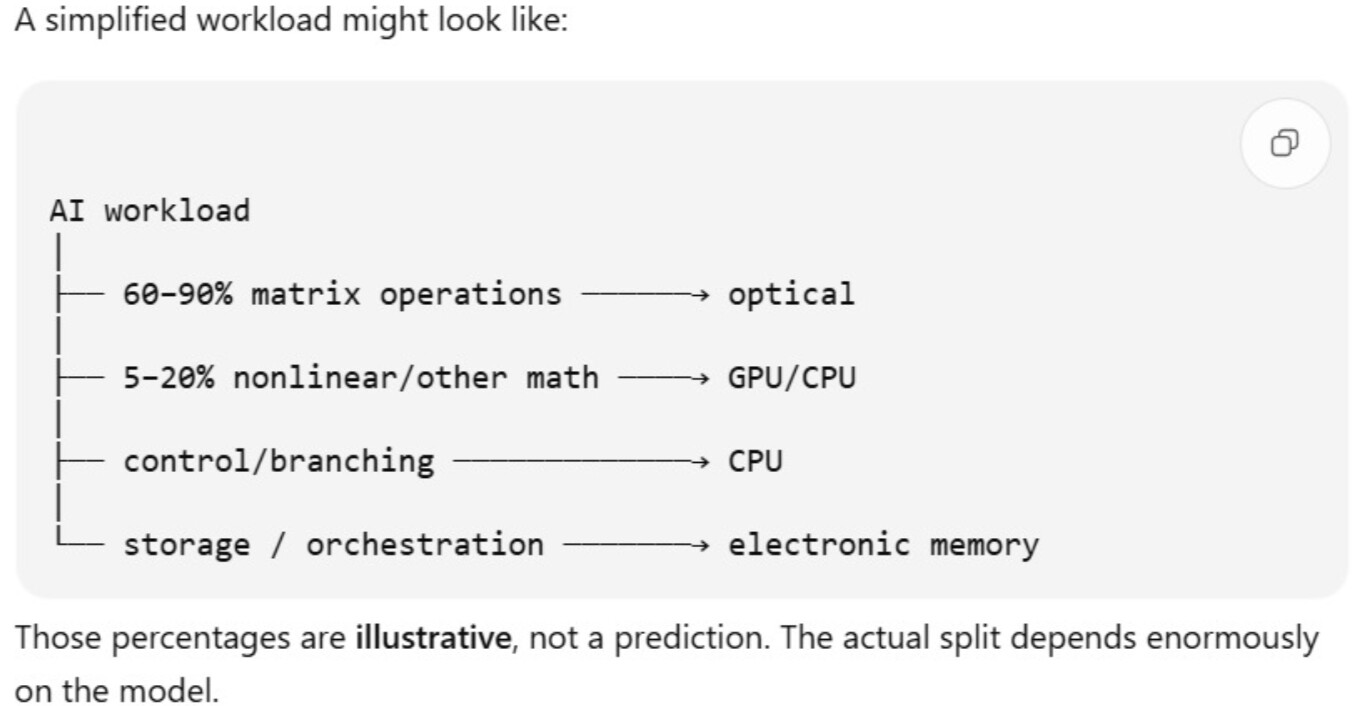
Nvidia is decentralizing computing to different points in the network / “distributed AI”, but that won’t be the endgame if more energy-efficient solutions are found. In the future, the network could even decide where the various computing tasks of a request are sent to achieve the best result—meaning GPU, CPU, or future LPU (lumen processing unit, or whatever one wants to call it)—and finally piece the answers together and give the response to the querier.
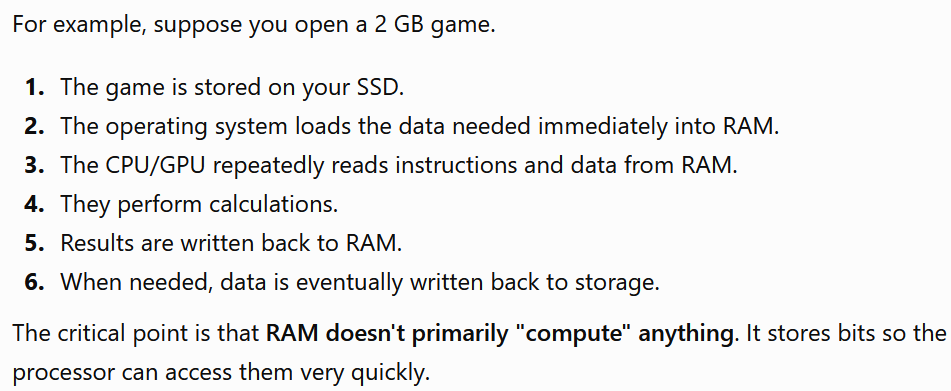
Optical memory is also theoretically possible, because as hardware develops, light could be given a considerable number of states at different frequencies, intensities, etc., etc., and by combining channels, even more states could be achieved. Currently, we are at the level of ~4 bits / 16 different states per light, but say 256 states is entirely possible. Here is an explanation of what RAM actually is:
Thus, optical computing and memory could act as an important and, especially in the future, easily integrable part of both distributed computing, that networking, and AI.
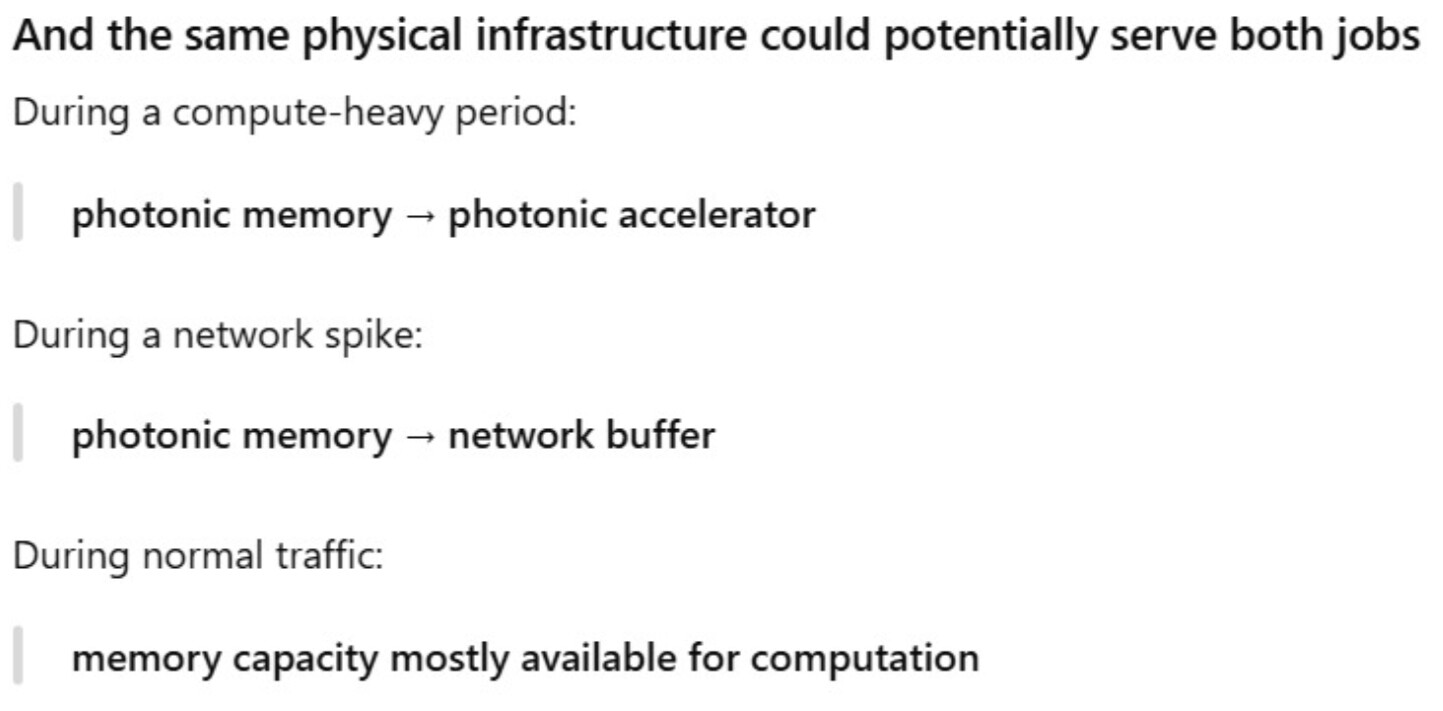
Nvidia is kind of clearing the way for Nokia to succeed. If distributed computing and AI become a real hit, then light → Nvidia → light is just an extra interface in a large part of computing, if the equation could be light → light → light.
Nokia has an excellent opportunity here to even be the next Nvidia as the network becomes intelligent and optical computing, and maybe even memory, starts to be everyday technology. The only Western end-to-end network provider, repeating myself though. Maybe I’m no longer thinking about selling such a large position at the 6G peak price I was waiting for.
I’ve been stressing about the slowdown in data center construction, declining population, and saturation of needs, but despite that, smart glasses are starting to push into the market even though they are still in a very beta phase, and in 10 years Nokia’s networks will be part of data centers on the computing side as well. I use AI daily to write these Friday visions here on the forum sometimes. I believe, based on some degree of information, that optical computing will become something revolutionary, and I think the horizon for its broader adoption could even be under 10 years.
The US should just buy out Nokia, merge it with Nvidia, and build a good infrastructure focusing on modularity/customizability (this is pretty easy, since both Nvidia and Nokia keep the code development pipeline open) and on getting new computing and memory options to the market asappp to be integrated as part of the ecosystem. The AI network meant by Nokia can mean this “own” network developing with code and “pluggables”, where next-gen hardware is occasionally updated.
13 Likes
This was the best post I’ve read in a long time  .
.
However, I’m guessing that after 2030 there might be more drunk bus drivers than asphalt workers. The former might be replaced by self-driving vehicles, but asphalt workers will probably be needed for eternity.
Hopefully, the government will realize even before then that the road maintenance debt cannot continue to grow year after year.
Marcus Weldon, former head of Bell Labs and CTO of Nokia, strongly criticizes Nokia’s current management for cutting Bell Labs’ research staff. According to him, since his departure in 2021, the research staff has shrunk from over 1,200 to possibly around 600. Weldon considers the development “shocking and unprecedented” and even accuses management of erasing the history of Bell Labs.
Nokia, on the other hand, says that Bell Labs remains a very important part of the company and states that under new leadership by Guru Parulkar, research activities are moving into a new phase where the focus is on breakthrough research and technology for the AI era.
The article notes that Nokia’s total R&D spending has not decreased: it grew from approximately €4.3 billion in 2023 to nearly €4.9 billion in 2025, and H1/2026 spending grew by another 6%.
COMMENT: The history of Bell Labs is undoubtedly exceptional, but Nokia is not a technology museum; it is a company accountable to its shareholders. If research does not generate sufficient commercial value for Nokia, scaling it down or reorganizing it is entirely justified. More important than preserving Bell Labs for nostalgic reasons is whether Nokia is targeting its R&D investments into technologies that strengthen its competitiveness where it matters most financially. Of course, maintaining symbolism that costs nothing but can help in recruiting researchers is worth considering.
7 Likes
Could these overly long AI ramblings be put in a hidden format, found under the menu +:
Summary
This text is hidden
14 Likes
Yes sure! Sorry you see them in that light…
I’ll try and sort it out! Obviously the use of AI in these kind of formats is heavily backed up by my own vision and knowledge of the situation in hand and how I see it unfolding.
I admit, I could try articulate my thoughts without AI too, but that would be far more time consuming. I see AI as a decent tool for knitting my thoughts together!
May I ask if you are currently invested in Nokia?
Yes, but I don’t base my investment decision on a chain of reasoning that mixes real news, actual technologies from Nokia and NVIDIA, and plausible-sounding technical details into an AI-generated chain of reasoning that goes much further in several places than publicly verifiable information. Fabulation is a pitfall of using AI. The problem, therefore, is not that everything is wrong. On the contrary: it is precisely the amount of real facts that makes the text deceptively convincing.
In my opinion, your post is a good example of how AI can produce a very convincing-looking investment story where perhaps 60–70% of the building blocks are real, but the causal chain built between them is largely speculative. True analytical value only emerges when those two are separated from each other.
8 Likes
Fair enough and point taken! To be honest, I haven’t worked out the summary feature yet…
The direction and technologies discussed in the post I believe to be 100% accurate and coming to market at a crucial time. It’s up to the reader to research these matters for themselves!
I think if you take a look at what’s happening in Japan, this should give you a good idea of where the technology is! They will be rolling out extensively the technologies described in my post.
In the age of AI and NVIDIA things advance quickly… and I believe the $500B fund will benefit Nokia immensely!
Do you doubt the AWS angle - That the technical parameters, architectural dependencies, and multi-agency mandates dictate that Nokia is actively capturing a massive share of this deployment’s layout?
1 Like
The relationship between Nokia and Amazon (AWS) on this specific software architecture is not an assumption or a market rumor. In June 2026, Nokia and AWS formally announced an expanded global commercial contract specifically to run Nokia’s Autonomous Network Fabric natively on AWS cloud infrastructure.
By integrating SR Linux into NVIDIA’s framework and running its Autonomous Network Fabric natively on AWS, Nokia is selling high-margin, recurring software licenses.
So sovereign or not, Nokia have a vital role… the only possible oversight was the DSX integration angle (AWS may not be utilising this platform). Although as the world’s largest of decentralized AI factories, it is highly probable they will due to the specific architectural power saving advantages.
Otherwise, as it stands it’s quite irrelevant to Nokia where AWS is concerned anyway… I’m sure though Nokia will capture this NVIDIA integrated value on other deals.
But otherwise, I will admit that overly relying on AI isn’t a healthy standpoint. I will honestly endeavour to eradicate my over reliance. I really appreciate honest feedback and I enjoy a little healthy debate (within the rules obviously). Thankyou to the group for making this fact aware to me… I’d hate to think I was just regurgitating AI slop
3 Likes
The day you learn to ask neutral, non-leading questions to the AI, the answers will have a chance to be something other than an echo of your own thoughts.
21 Likes
So, may I ask what was wrong in the question? They have afterall developed this AI-RAN platform with a joint vision. NVIDIA too are now transitioning to physical AI…
Also there is a joint event approaching named…“AI-RAN: Rewiring the Radio Network for the AI Era”
The Fierce Network virtual summit featuring Nokia, NVIDIA, and SoftBank is scheduled for September 9, 2026.
The Core Session: “Monetizing AI-RAN: Turning Next-Generation Networks into AI-Powered Revenue,” which focuses precisely on how these three giants are transitioning GPU-accelerated networks from a conceptual blueprint into a revenue-generating commercial reality.
The Speaker Lineup: You will hear directly from the leaders executing this joint vision:
Pallavi Mahajan (Chief Technology and AI Officer, Nokia)
Soma Velayutham (VP, AI and Telecoms, NVIDIA)
Ryuji Wakikawa (Senior VP and CTO, SoftBank Corp.)
Broader Industry Presence: The summit will also include insights from other major global operators piloting the technology, including leaders from T-Mobile, AT&T, and the Orange Group.
1 Like
So here’s a few reminders of where the technology is:
NVIDIA/Nokia: “Collaboration enables new AI services and improved consumer experiences to support explosive growth in mobile AI traffic.”
“Nokia integrates its RAN Digital Twin with AODT to combine advanced RAN algorithms with accelerated ray tracing for site placement optimization and beamforming validation.”
Let’s hope that AI-RAN pushes through with the joint vision of Nokia and Nvidia. The group of testing operators has grown slightly, and field tests will begin this year. T-Mo, as Nokia’s largest RAN customer, is now really crucial – if it’s acceptable to them for large-scale deployment, meaning a 50 percent share of the radio access network, then it should be acceptable to everyone. And indeed, although we will hear hype related to this – naturally the matter will be advertised – we must at the same time remember that there probably aren’t any actual contracts for this yet. So let’s hope that those who are testing get excited about this. In principle, I don’t think Nokia has anything to lose here, only to gain. Naturally, in the best-case scenario, this will become a big deal.
5 Likes
“Speculate to accumulate” is something we’re all doing atm as Nokia investors. Yes I realise the timelines involved, but I’ve been speculating about whether the AI-RAN scope of the rollout will be larger and faster moving than currently projected.
will be brought forward…I doubt it.
I appreciate that a lot of people don’t like to think that they are speculating too much, but the truth is that Nokia have a massive year of execution ahead - both in NI and MI, so this is a highly speculative position!
Time will tell if all my thoughts are just me fantasising in my own echo chamber or not.
1 Like