Nokia as an investment (Part 4)

I personally suspect that pressure from the US has caused the sell-offs. I don’t know if it’s coming more broadly through indices, or if it’s options or margin pressures.

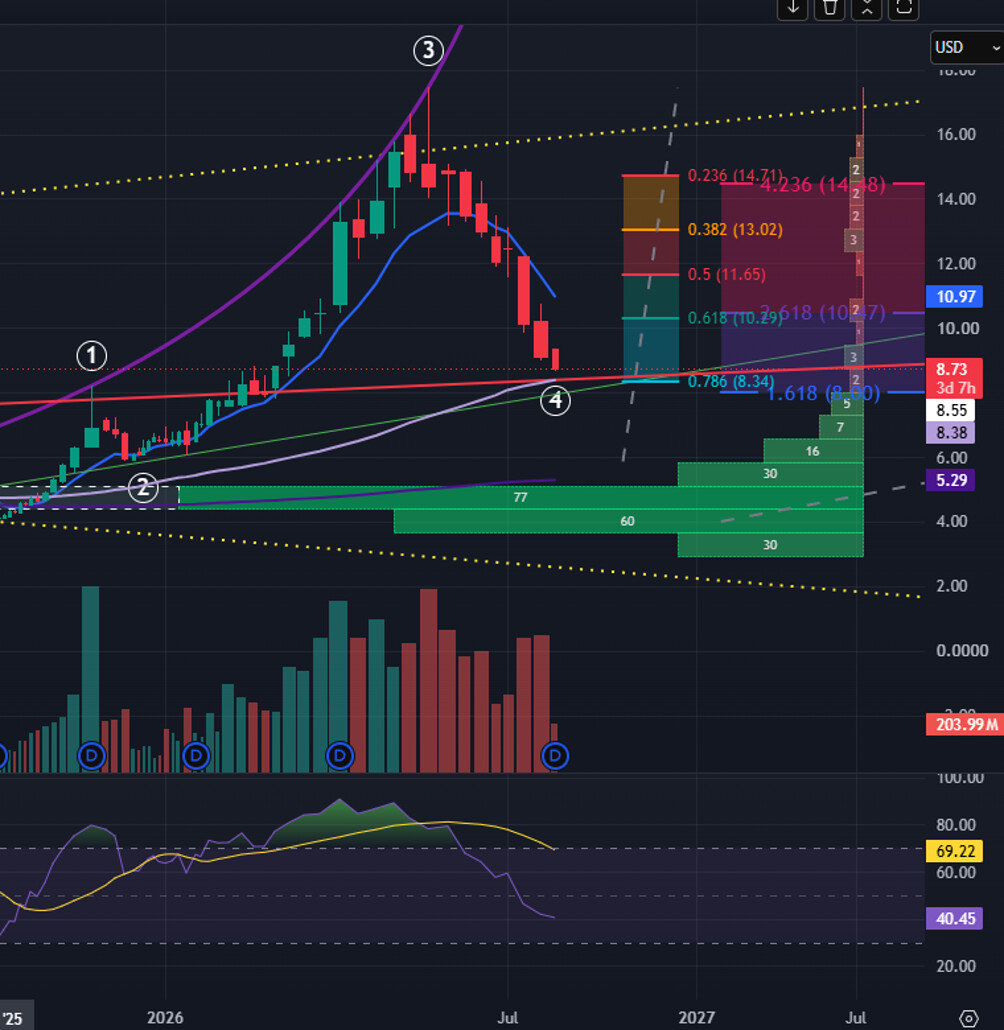
@leohkv This is a good and difficult question. In my opinion, it started to outperform (at least momentarily) other stocks in the sector, such as Ciena or Lumentum. However, there is “sector weight” behind this – so the question, in my view, is when that will ease. The stock has already fallen so much (49.1% from the highs) that some kind of correction would be due. Technically, I would like to see that the high from the Nvidia trading day, i.e., 8.19 USD, is not breached.

10 Likes

Any thoughts on what might cause U.S. pressure to turn around?

Let it just keep falling, preferably for a long time. The risk, of course, is that the whole AI thing was just a big scam to gobble up retail investors’ money, but it’s hard to believe that. The boom might not necessarily mean 20% annual growth for Nokia in the future, but perhaps at worst, only 10%.

I completely skipped buying Nokia once it broke below €10. Now, by my own metrics, it’s undervalued, and that’s fine. €15 wasn’t sustainable, and neither are prices below €8.

I’m partially in on the AI rise, but fully in on the AI decline. It’s no wonder Buffett invests in McDonald’s and Coke, considering modern times crazy. Unfortunately, we can no longer talk about a price-manipulated stock now that the bottoms and tops are following its peers.

P.S. If I were Nokia’s CEO, I would buy raw materials FOR STOCK (sorry for the modern profanity). It’s stupid to build factories if you believe in their capacity to sell, but aren’t sure about the availability of raw materials.

4 Likes

A couple of small deals/JV agreements

https://thesun.my/business/ogx-formalises-deal-to-distribute-nokia-solutions-in-malaysia/

6 Likes

This leans into TA (technical analysis), but out of curiosity, why exactly this level? Surely the strongest buying pressure isn’t at the day’s high…?

Nokia seems to be moving along with the AI infra trade. E.g., memory companies are still at astronomical prices. I am expecting 8.00 USD prices to start my purchases.

1 Like

Nokia technical analysis 07-27-26 https://stockinvest.us/stock/NOK

It’s a bit difficult to interpret whether that would be the first wave of a rising trend according to Elliott Wave theory. If so, then the corrective wave 4 should not overlap with the peak of wave 1.

Edit: For TA (Technical Analysis), the reason behind a rise or fall doesn’t matter. It is possible, however, that the wave theory observations are not correct, so it is worth examining that case more broadly. Because of this, since there was interest, I posted an update in the TA thread.

14 Likes

I’m not familiar with technical analysis, but doesn’t the overall massive decline in the sector since the June peak mean that sector sentiment is currently the primary driver of Nokia’s share price behavior? Does the predictive power of TA (technical analysis) diminish in a situation like this?

6 Likes

The decline in Nokia’s share price probably isn’t due to the company itself, but rather the market in general.

One significant reason might be found in Japan, where the so-called YEN Carry Trade is playing a role:

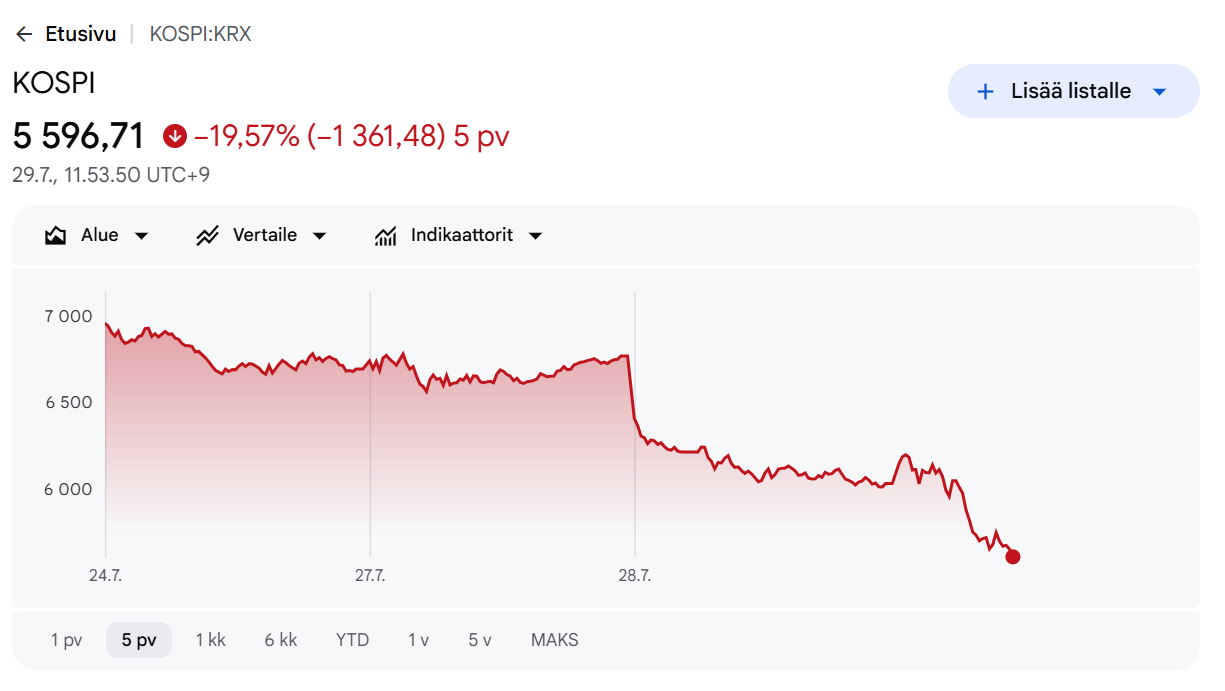
For example, South Korea’s KOSPI has fallen -20% in a week, where the two largest companies in the index account for over 50% of its weighting (Samsung Electronics and SK Hynix, which are AI companies).

11 Likes

Ihre Datenschutzeinstellungen The Kospi (Korea) and Nokia are now quite similar in their 1-month declines of approximately -32-33% Ihre Datenschutzeinstellungen

Well, since you asked, they were indeed further up [in the thread].

2 Likes

SK Hynix, a key company in the AI theme—the so-called “memory company”—released its earnings, and the stock took a significant hit on the Korean stock exchange. Expectations had been extremely high.

  1. Revenue: 79.3 trillion KRW – growth of 51% quarter-on-quarter (QoQ) and 257% year-on-year (YoY).
  2. Operating Income: 60.5 trillion KRW (+61% QoQ, +557% YoY).
  3. Operating Margin: Improved to 76% (a record high).
  4. Net Income: 93.9 trillion KRW (Net profit margin of 118%, influenced by factors such as currency gains and the sale/valuation of investment assets).
  5. EBITDA: 64.6 trillion KRW (EBITDA margin of 81%).
  6. Balance Sheet and Cash: Cash and cash equivalents were 88 trillion KRW. Net cash strengthened to 69.4 trillion KRW, and the solvency ratio/debt-to-equity ratio improved further (debt-to-equity ratio only 7%).

However, for a Nokia investor, the essential point is below. That is, there are no signs here either, at least not yet, that AI giants are slowing down their investments.

Key Insights from the Q&A Session (Analyst Questions)

AI Infrastructure Demand & Lower-Barrier AI Models

  • Question (JPMorgan): Are energy structure bottlenecks and more efficient AI models slowing down data center investments?

  • Answer: SK Hynix does not see more efficient AI models cutting into memory demand. On the contrary, more efficient models lower operating costs, which is causing an explosive expansion in the user base and the usage of AI services. Server DRAM demand is being driven by autonomous “agentic AI,” and eSSD demand by the continuous accumulation of data.

Fear of Overcapacity and LTA Agreements

  • Question (Hana Securities & Meritz Securities): Will major factory expansions lead to an oversupply?

  • Answer: Investments are being made in phases and are based directly on LTA (Long-Term Agreement) contracts reached with customers. The risk of oversupply is not considered acute, as the complexity of advanced packaging technology and HBM manufacturing limits physical supply.

DRAM Prices and HBM Pricing for 2027

  • Question (Daiwa & UBS): Why did the Q2 DRAM ASP fall slightly short of expectations, and how are the 2027 HBM pricing negotiations going?

  • Answer: Q2 blended ASP was affected by the shifting of deliveries for certain high-value-added products to H2. In H2, thanks to the HBM4 ramp-up and 1c nm products, ASP and volumes will rise significantly. The 2027 HBM negotiations are progressing smoothly. HBM pricing takes into account not only the price of traditional DRAM but also the wafer and TSV resources required for HBM, as well as its technical complexity.

14 Likes

On the neighboring forum, I explained what I think we know about next year’s situation and what it is not worth starting to guess about.

rkurppa said:

“I expect revenue to improve significantly in 2027 and beyond, with margins also having considerable room to improve as volumes increase, restructuring costs fall and the cost base is reset.”

There is nothing wrong with your Q2 analysis, but with that same sentence above, one could end up with an €8 or €15 target price depending on how one interprets the words “significantly” and “considerable room”.
I would like to see more concrete group-level numbers in these analyses for the coming years: operating profit / revenue, etc. Reaching €15-20 requires stretching the valuation multiples, and stretching requires growth. 15%? 20%? 25% per year?

My reply:

There are so many things that affect Nokia’s earnings that I won’t start guessing, for example, regarding operating profit. That is why in my Q2 analysis, I stuck to facts that are already known. We know that the addressable market for AI and cloud services relevant to Nokia is growing by 27% per year, but it is impossible to know how much optical sales will grow next year with the new San José factory. After the middle of next year, Nokia will also have a new DSP product family, which might have time to impact sales. The growth of IP networks is also a mystery in terms of scale, even though we know that order dynamics have improved significantly since Q2. Regarding orders, we also know that over the last four quarters, Nokia has received approximately €5.4 billion in AI and cloud orders. Hotard has also previously stated that it takes about 12-18 months from order to delivery in optical, and slightly less in IP networks. Regarding the €2.8 billion in Q2 orders, we also know that half of them will be delivered within the next 12 months. In other words, the gradually growing orders will start to show in sales—perhaps partially already in Q4, for which a strong performance has been promised—but mainly starting from next year.

The negative profit impact of the current cost-cutting programs is €800 million this year and perhaps €100–200 million next year (leftovers from the China and Infinera programs). Therefore, unless new programs are introduced, the reported earnings in 2027 will be subject to an estimated €600–700 million fewer cost charges compared to 2026.

I also calculated earlier what the cost impact of the savings will be heading into next year: Regarding the Infinera program, it was initially stated that the savings would be €200 million per year, with €100 million by the end of 2026. Regarding the China program, a saving of €200 million is also being targeted. Assuming, without certain knowledge, that €200 million in savings is still to come from the 2023–2026 program, €67 million (one-third) from the Infinera program, and €150 million (three-quarters) from the China program, cost efficiency could increase by approx. €400 million next year compared to this year’s level. These are, of course, gross savings, so the net effect may be smaller if Nokia decides to increase spending in areas it sees as important, such as R&D.

In summary, sales are likely to grow next year, there will be fewer cost cuts unless new programs are announced, and the programs will also increase Nokia’s efficiency. With this, 2027 should be clearly stronger in terms of sales and margins, while at the same time, the gap between comparable and reported profit should shrink significantly.
6 Likes