Nokia as an investment (Part 4)

From the perspective of management and staff bonuses, a “cautious” target always yields the best end result.

Perhaps the guidance will be updated in the Q2 report.

If a company’s future prospects change significantly from previously issued guidance, the company must issue a profit warning without undue delay…

8 Likes

Yes, this is what I’m waiting for, and at the same time, I’m wondering a bit why it hasn’t been changed yet. Is the visibility regarding the slope of the curve so uncertain that they haven’t been able to provide it yet?

This will be a true test and an opportunity for the market. How will the guidance be set… will the expectations of hyper-growth align with the guidance, or will it align with the low expectations of analysts, and would that then be enough for the market? Exciting times.

5 Likes

Vontuchman, also known as Pekka, touches on the same topic in his excellent thread regarding the market situation.

And when I’ve mentioned whether there could be a small “time-out” in the hyper-construction of data centers, it relates to this. If investors start voting with their feet by selling stocks (if current AI returns are deemed too small relative to investments), it could force companies to rethink the volume of their investments. The intention is not to say that this will definitely happen, but to keep the options open and try to understand the market reactions.

15 Likes

Nokia does not, at least for now, seem willing to update the 2028 figures at the same pace as the short-term outlook. The 2026 figures were raised because they represent the current year’s “outlook,” i.e., guidance, whereas for 2028, they are “targets.” This is not a minor detail, as for example, Inderes bases its six-euro target price and sell recommendation partly on these very non-updated targets.

However, after the Capital Markets Day, in connection with the Q1 report, guidance and market expectations were raised significantly:

  • NI growth: 6–8% → 12–14%
  • Optical Networks + IP: 10–12% → 18–20%
  • Hyperscaler investments (2026): 540bn → 700bn
  • AI & Cloud market annual growth rate (CAGR 2025–2028): 16% → 27%

In light of this and, for example, signals received from Ciena, is it reasonable to assume that the 2028 targets are still the base case scenario? For instance, Nordea estimates the 2028 operating profit margin at 3.54 billion. Given the drastically raised growth forecasts, the CMD targets seem too conservative if left unupdated, unless Hotard sees a greater-than-expected investment need that continues into 2028 to capitalize on the AI supercycle. For example, the capital expenditure guidance for this year was raised drastically from last year: 900–1000 million this year, compared to a guidance of 650 million for last year. Presumably, this year’s high figure is primarily related to the ramp-up of the San José chip factory.

Hotard also commented on the update frequency of the 2028 targets at the JPMorgan event on May 19:

Sandeep Deshpande
JPMorgan Chase & Co, Research Division

I’d just like to touch briefly on margins here in AI cloud/IP networks and Optical networks. The optical network business margin as a standalone unit has been indicated by Nokia to be double-digit after synergies by 2028, in principle. The scale of revenue growth is much faster than what was expected when you gave that guidance.

Does this, first of all, change the guidance? But secondly, where are you in terms of those synergies, because that is also critical for you to achieve that double-digit margin?

Justin Hotard
President, CEO & Interim President of Mobile Infrastructure

Yes. Yes. I think, first of all, regarding the guidance or assumptions we outlined, we set a series of those assumptions for the CMD (Capital Markets Day) through '28. Fundamentally they hold, they were at the NI level (Network Infrastructure level), and we provided some visibility into the growth of the IP and Optical side below that. So they still apply, and as we’ve discussed, we’re obviously not going to update them every quarter, but we’ll give you visibility into what we see for next year and provide an update from that perspective. And of course, we gave you an update on what we see this year relative to expectations.

11 Likes

Couldn’t this also be interpreted as hyperscalers securing the data center construction they deem essential without jeopardizing their finances? In my opinion, it’s quite sensible if calculations regarding profit potential have been made as a basis for the investments. However, since expenses come first and revenues only follow with a lag, avoiding excessive debt can be quite logical from a shareholder’s perspective as well, especially when the stock price is at a high level.

4 Likes

For 2026, we will fulfill what deliveries we can, and this will be reflected in the revenue and results. I believe the update for coming years is being postponed for purely rational reasons; they want to monitor the development and distribution of the order backlog, which will put them on a much firmer footing.

10 Likes

Nordea’s latest figures from their NOKIA analysis →


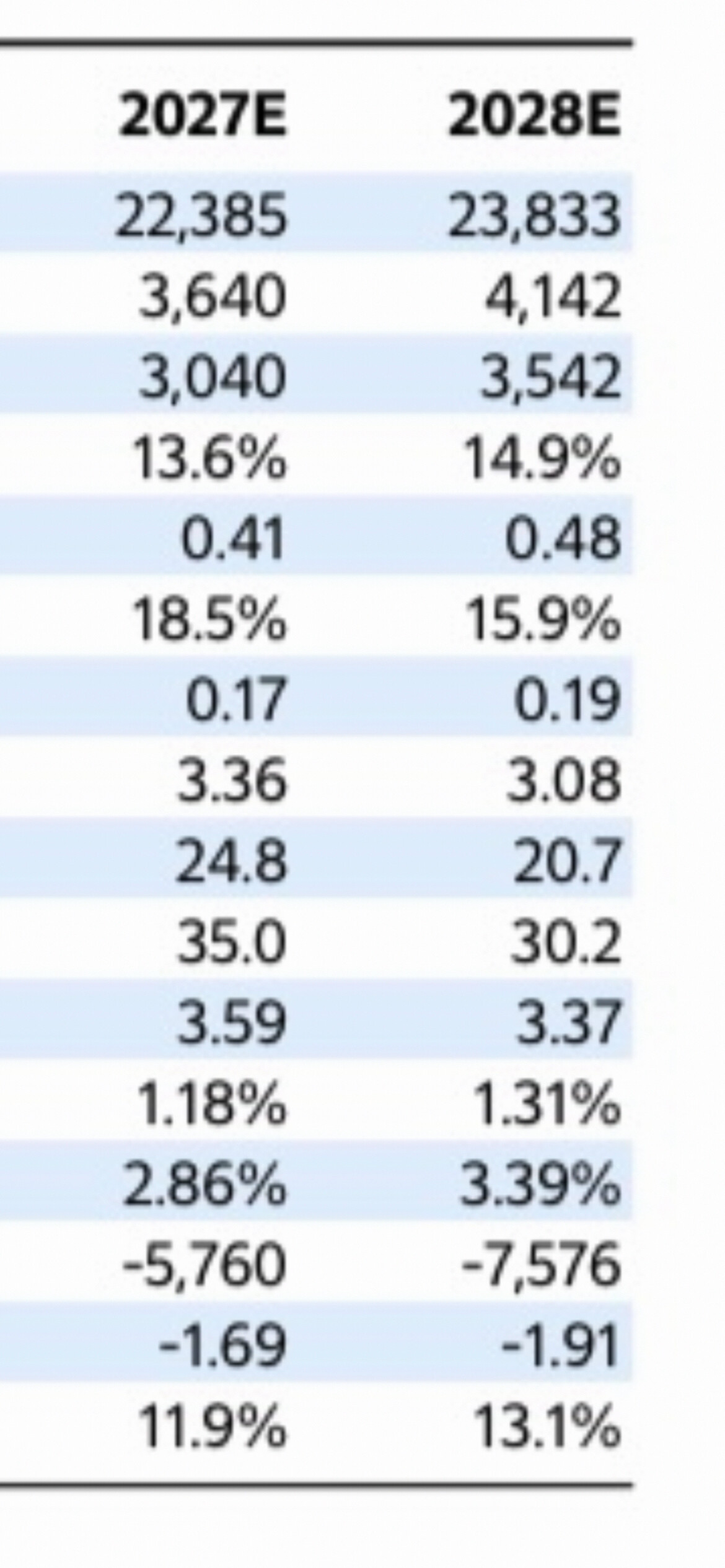
This is how Nordea forecasts/estimates Nokia’s earnings development potential for 2028:

  • [quote=“Mustathmir, post:1024, topic:73687”]
    In light of this exceptionally strong growth environment, Nokia’s goal of achieving a comparable operating profit of 2.7–3.2 billion euros in 2028 looks increasingly cautious," the bank writes. Nordea’s own estimate for 2028 is a comparable operating profit of 3.54 billion euros, which corresponds to an average annual earnings growth of approximately 20 percent from the 2025 level.
    [/quote]
8 Likes

Mötley Fool’s tinfoil hat theory: SpaceX will use IPO funds to buy out Nokia

They don’t have enough money unless they get a discount :person_facepalming:

But amidst the noise, it’s an interesting highlight of how significant a role Nokia plays :oncoming_fist:

While most Wall Street analysts covering the SpaceX IPO are modeling a space exploration business, I think the more savvy interpretation is that the company wants to build the connective tissue stitching the AI economy together. To me, Nokia is a critical piece that helps complete this network.

17 Likes

Alphabet just raised an amount equivalent to Nokia’s entire valuation through private placements, so could they?

In the big picture, the world has very rapidly shifted into an overt geopolitical arena. From that perspective, a U.S. desire to bring Nokia under their control would not be surprising at all.
The race with China has become extremely intense, and they are prepared to do whatever it takes to maintain control and their leadership position.

2 Likes

I’m pretty sure that money is earmarked for AI investments; it would likely be cheaper to execute a potential acquisition through a share swap.

But for the share price, these kinds of “news” items aren’t a bad thing.

5 Likes

That $80 billion private placement targeted at data centers is puzzling, considering the company reported over $60 billion in net income for Q1. Relative to Alphabet’s earnings, the increase in cash reserves from that offering feels small, even if it is a large sum in absolute terms.

1 Like

If there is a “bidding war” for the company, the price should reflect that. A small premium is not going to cut it now. And it would be a huge mistake for Finland and Europe to let go of Nokia right now.

2 Likes

I wonder how competition authorities would react to a buyout of Nokia, depending on the potential buyers?

1 Like

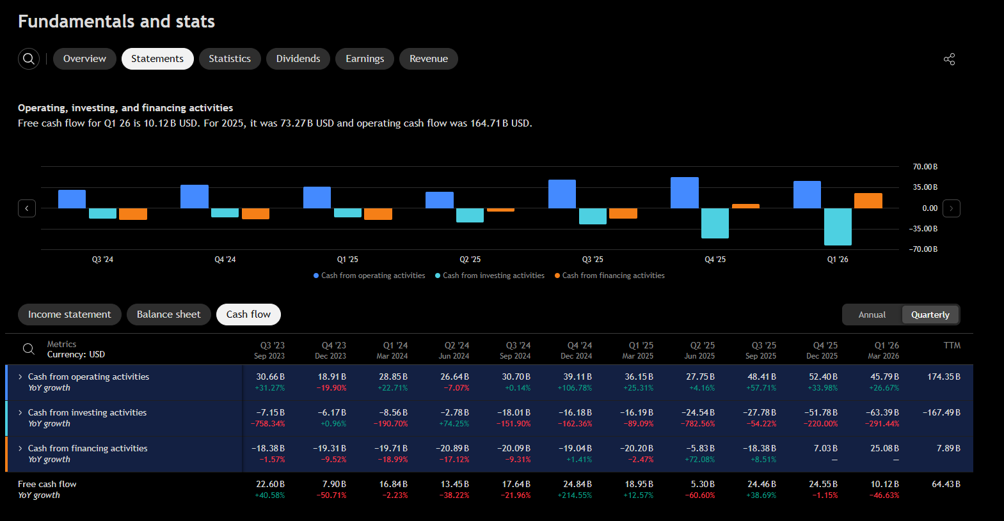
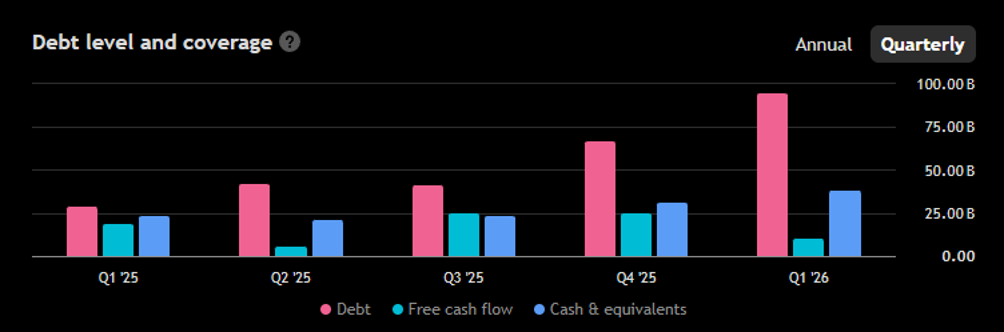
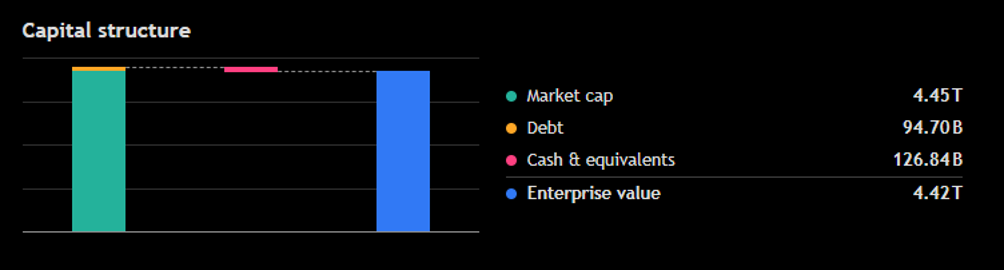
Building data centers consumes an absolutely massive amount of capital, and this is only now starting to become increasingly visible. In other words, net profit is quite a different thing from cash flow. The fact is that Google does not have sufficient cash reserves; instead, it needs more money. The Market Cap is astronomical, but they have $95 billion USD in debt and $127 billion in cash. The amount of debt has actually risen at a staggering pace, as the graph below reveals—from $28.5 billion to $94.7 billion in a single year – ouch…


For example, the company’s Free Cash Flow fell by 47% compared to a year ago, and I wouldn’t be surprised if this pace accelerates. That is why they are seeking capitalization. This is surely a giant surprise to many, given the public perception that money is overflowing from every corner.

14 Likes

Nvidia CEO: Now is a Buying Opportunity for Tech Stocks

AI will become a global infrastructure, the development of which is only just beginning, says Nvidia’s CEO.

Jensen Huang, CEO of semiconductor giant Nvidia, views the sell-off in tech stocks that began last week as a buying opportunity. According to him, building a future based on artificial intelligence is only just beginning.

South Korea’s Kospi index fell nearly six percent on Monday as investors took profits from AI stocks that had previously driven the global market rally. Concerns about market overheating and potential US interest rate hikes have cooled investor enthusiasm.

However, according to Huang, the industry is only in the early stages of creating the infrastructure that serves as the foundation for the AI revolution.

“We are only at the beginning. No matter what happens in the stock market, now is a chance to buy at a discount. Everyone should be very excited,” Huang said after meeting the chairman of the conglomerate SK Group in Seoul.

Nvidia, the leading company in the stock market rally of AI stocks in recent years led by Huang, and the Korean company SK Hynix in the same field, announced on Monday that they have signed a multi-year agreement to develop future generations of AI memory chips. The news helped SK Hynix’s stock recover from the day’s biggest losses after South Korean President Lee Jae Myung also stated that the domestic market is undervalued.

Huang believes that AI will revolutionize the global economy, ways of working, and life in the same way the internet once did. This development will create massive demand for data centers and chips in the future.

“It is a given that AI will become a global infrastructure, just as the internet did,” he stated.

Sourced from Kauppalehti.

4 Likes

Warren would say that this discount is nothing yet. And at the same time, Jensen is trying to boost the SpaceX IPO and all AI stocks when they are down about 10%. I would say that at this rate, his credibility will suffer very badly. How much “color” does he use when talking about his own company’s outlook?

He probably understands (better than anyone) that if the markets are not ready to provide financing, a cooling-off period will follow, and that would be a massive problem for him. But in my opinion, these comments are in a very grey area. No executive should strive to influence stock prices, and their value should not be commented on. The conflict of interest is too great.

23 Likes

The cold hard fact is that this AI market is now such a massive and great opportunity that it can be compared to the Nokia mobile phone era, no matter what anyone says.

1 Like

I bet these markets are being manipulated by the big players anyway :slight_smile:

3 Likes

I am wondering why Alphabet would take on the burden of Nokia’s lower-margin operations? I suspect regulators would intervene in this.

SpaceX: Could Nokia’s AI-RAN enable real-time optimization of Starlink’s data streams and integration into mobile networks? This could be a “dream match” for linking Telecom and Starlink satellite expertise E2E (End-to-End)?

In reality, an NVIDIA-style strategic partnership might be the most realistic scenario in terms of cooperation?

1 Like

True, but how many companies from the early days of the internet survived as winners?

5 Likes